Updated October 2026.
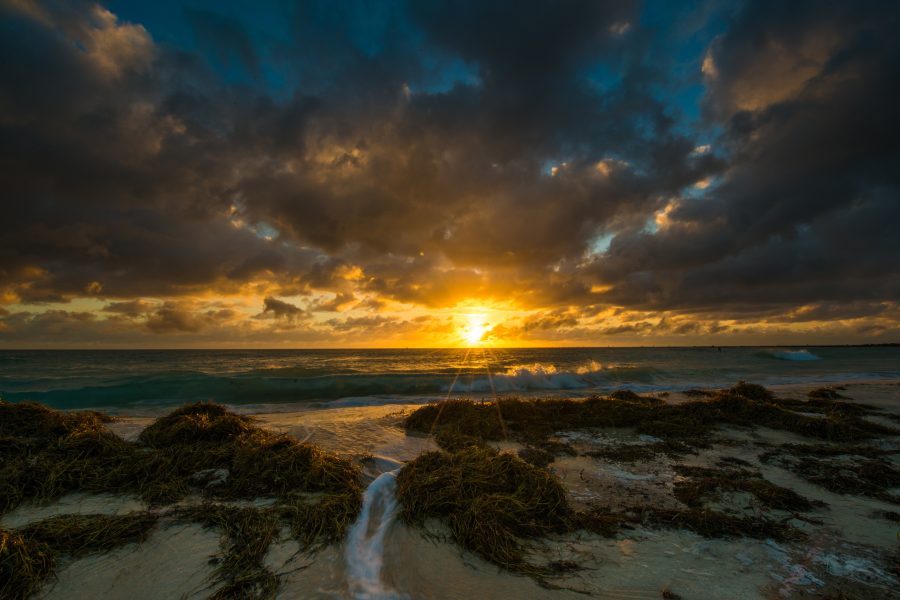
Years ago I spent about a month and a half going back to Virginia Key to shoot a timelapse of the Miami Marine Stadium. I got moved along by police on some of those visits, and I will say it plainly: the stadium is fenced off, and it is not a place to go looking for a way in. I’m leaving the timelapse itself out of this post. What I want to do here is put the whole picture in one place – where this building came from, why it looks the way it does, where it stands today, and how to photograph it without climbing anything.
I have kept the history to what the city, the preservation group and the news reports say, and I name the source each time. Where something is my own opinion about photography, I say so.
What the Miami Marine Stadium is
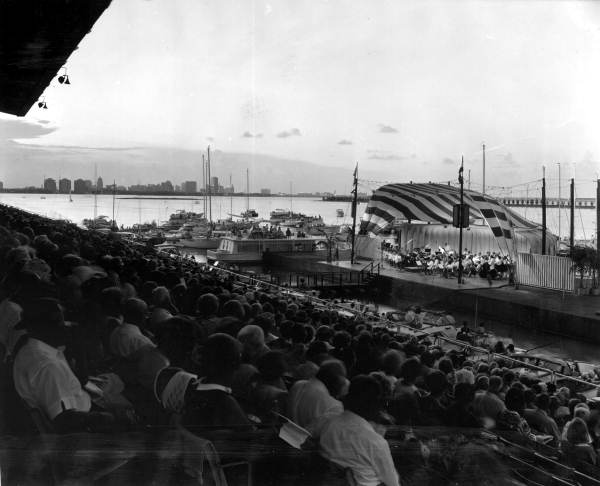
The Miami Marine Stadium sits on Virginia Key, facing a long basin of water with the Miami skyline across the bay. According to the NBC 6 / Associated Press report, it opened in 1963 as the nation’s only venue built for powerboat racing, and it seated roughly 6,500 people. Wikipedia’s article on the stadium puts the opening at December 27, 1963, and describes it as the first stadium in the United States purpose-built for powerboat racing.
The stage was not on land. It sat on the water, and the audience watched from the concrete grandstand across the basin. That is why the old photographs show a stage with boats moored behind it. Concerts were part of the program from early on. The preservation group Friends of Miami Marine Stadium lists The Who, Queen and Jimmy Buffett among the acts that played there, and Wikipedia notes that the 1967 Elvis Presley film Clambake filmed scenes at the stadium.
 Save
The design: concrete that looks like it is folding
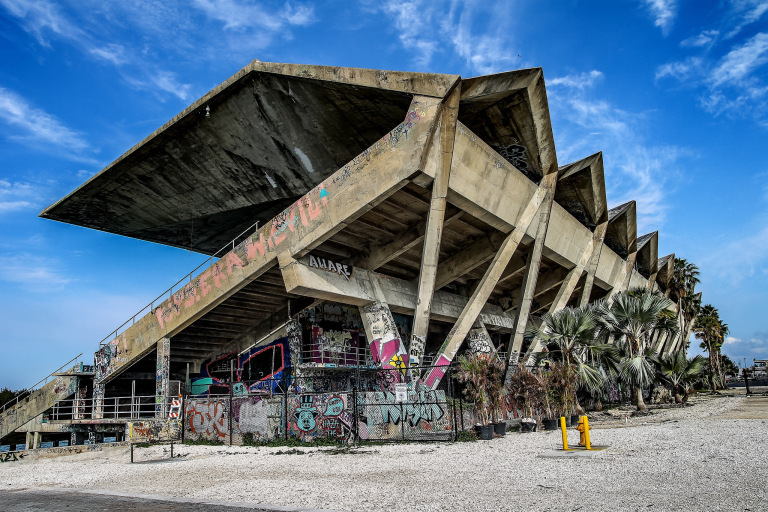
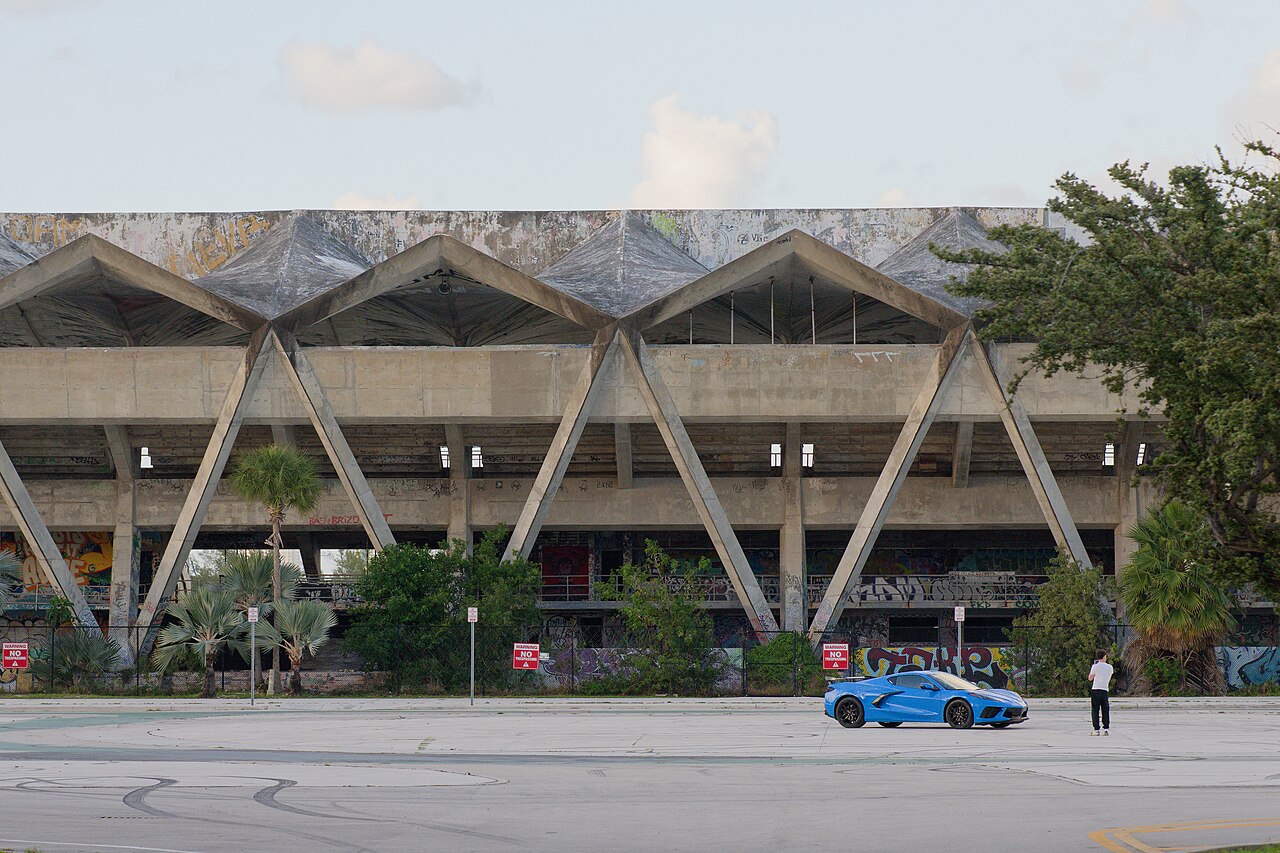
The reason photographers keep returning to this building is the roof. The Friends of Miami Marine Stadium credit the design to Hilario Candela, who was 28 at the time, working with structural engineer Jack Meyer. Wikipedia describes the roof as a cantilevered folded plate of poured concrete, carried on eight slanted columns. In plain terms, the roof reaches out over the seats with no columns in the way, so everyone in the grandstand has a clear view of the water.
Photographically, that structure gives you strong, repeating diagonals. The slanted columns and the sharp creases of the roof make leading lines almost on their own. Add the graffiti that has covered much of the concrete since the stadium closed, and you have a subject with clean geometry on one side and loud color on the other. That tension is the reason the place photographs so well, and I think it is also why people care about it.
 Save
Why it closed
The stadium’s working life was shorter than its reputation. The City of Miami’s project page says it was declared unsafe and abandoned after Hurricane Andrew in 1992, and Wikipedia gives September 18, 1992 as the closing date. The Friends of Miami Marine Stadium say a 1992 engineering report found no hurricane damage to the structure. That is the preservation group’s position, so treat it as their claim rather than a settled fact.
What is not in dispute is what happened next. The building was closed, fenced and left to the weather. Wikipedia says it became a haven for graffiti artists. The AP report says the stadium stayed fenced off and covered in graffiti, and that multiple studies have found it remains structurally safe. Nothing tells you more about how a place feels than a long gap with nobody in it, and that gap is a big part of what draws people to photograph it.
Where things stand now
As of the sources I read for this update, the stadium is still closed to the public, and the news has been good for restoration supporters. According to the NBC 6 / AP report from August 19, 2026, voters approved a restoration referendum. The Friends of Miami Marine Stadium say 69 percent of voters approved Oak View Group as operator, that the company would manage the Flex Park in front of the stadium for five years, and that it would prepare a management, construction and financing package for the city commission. The city keeps ownership, and the plan still needs final city commission approval.
On the repair side, the City of Miami says Phase I work, which covered nine piles and two pile caps, was completed in January 2024. The city’s page also describes plans for a three-acre plaza and says it is conducting a business analysis for operating the site. The stadium and its basin were listed on the National Register of Historic Places in 2018, according to the preservation group and the AP report.
Details like this change quickly. Before you plan a trip, check the city’s project page and the preservation group’s updates for what is open, what is under construction and what is closed.
 Save
How to photograph it legally
This is where I want to be direct. The fence is there for a reason, and the city has been paying for structural repairs. Going over it is trespassing, and it is also a good way to ruin a day or a camera bag. You do not need to be inside to make a strong picture of this building. Here is how I would approach it from outside the fence, based on what the sources describe about the site.
- Shoot from public ground. The stadium faces open space on Virginia Key. Stay on the public side of the fence, obey the posted signs, and respect any closures around the repair work.
- Use the roof lines. From a low angle, the slanted columns and folded roof turn into diagonal lines. A wide lens makes them more dramatic, and a moderate telephoto isolates a single bay of the roof.
- Deal with the fence in the frame. A chain-link fence can wreck a sharp photo. Putting the lens close to the wire at a wide aperture can blur it away, though that works better on some fences than others. Or include it on purpose, as the photo above does, because the fence is part of the story of this place.
- Pick your light. Early and late light rake across the concrete and bring out the texture of the roof and the graffiti. The basin faces the skyline, so the water side is worth a look at sunset.
- Mind the heat and the bugs. This is South Florida. A hat, water and insect repellent are worth packing.
- Do not fly a drone without checking the rules. Local and federal rules apply. I have not verified what is allowed over this site, so check before you launch.
If you want a deeper grounding in planning a location like this, from scouting to light, our landscape photography guide covers it, and the aperture photography guide covers the exposure basics that make this kind of architectural work easier.
If you would like a structured way to learn this, the Shut Your Aperture Academy has a Landscape Photography course: 10 modules, 40+ lessons and 10 assignments, including modules called “Planning & Scouting Like a Pro” and “Shooting Real Locations.” You need to create an account or sign in to access the courses.
Making a timelapse of a place like this
The reason I kept going back was the timelapse. A building like this is a good timelapse subject because the sky does the moving while the concrete stays still. The cloud and light change across the roof, and the water in the basin changes color through the day.
A few things matter for a timelapse, none of which are specific to this site:
- A stable tripod. Any shift between frames shows up in the final clip. A heavier tripod is less likely to move in wind off the water, and hanging a bag from the center column helps.
- An intervalometer. This is a timer that fires the shutter at a set interval, so you are not pressing a button over and over. Many cameras have one built in; some need an external one.
- Fixed exposure. Setting exposure and focus manually before you start keeps the frames consistent. Flicker is a common timelapse problem when exposure changes between shots.
- Enough battery and card space. A timelapse is hundreds of frames. Plan the shot count before you start.
- A legal vantage point. Set up on public ground and leave your gear where you can watch it.
The gear box below lists a tripod and a timer remote that I looked up on B&H for this kind of shooting. I have not tested these two, so read the details and decide for yourself.
 Save
Why this building matters beyond the graffiti
It is easy to treat a place like this as a backdrop, and many photographers do. I think it is worth knowing what you are looking at. My own read, and it is an opinion, is that it is a bold piece of mid-century engineering that was finished in 1963. National Register listing in 2018, and the National Trust attention that Wikipedia mentions (the stadium was on its list of America’s 11 Most Endangered Historic Places in 2009), tell you that people beyond Miami consider it important.
A photograph that shows the building as a piece of engineering, with the roof, the columns and the water, adds something different from the many pictures that are only about the graffiti. If you can, shoot both: the structure and the paint. They are the same story.
It also helps to remember that things change. Restoration plans mean the stadium you can photograph from the fence today may look different in a few years, with a plaza in front and work crews around it. Photographs made now will be a record. That is a good reason to take your time and make the best frames you can from a safe, legal position.
 Save
What to bring
- A wide-angle lens for the full grandstand and a mid-telephoto for details of the roof.
- A sturdy tripod, if you plan to shoot at dusk or make a timelapse.
- A lens hood and a cloth. Salt air and humidity are hard on front elements.
- Sun protection, water and insect repellent.
- A printout or screenshot of the latest city update on what is open, in case your signal is poor.
Prices and availability on gear change, and I only list items I looked up on the day I wrote this update.
Can you go inside the Miami Marine Stadium?
As of the sources I read, the stadium is fenced off and closed to the public. The AP report describes it as fenced off and covered in graffiti, and the city’s repair work is ongoing. Photograph it from public ground outside the fence. Check the City of Miami’s project page for current access.
Who designed the Miami Marine Stadium?
The Friends of Miami Marine Stadium credit Hilario Candela, who was 28 at the time, with engineer Jack Meyer. The stadium opened in 1963. Its roof is a cantilevered folded plate of poured concrete on eight slanted columns, according to Wikipedia.
Why did the Miami Marine Stadium close?
The City of Miami says it was declared unsafe and abandoned after Hurricane Andrew in 1992. The Friends of Miami Marine Stadium say a 1992 engineering report found no hurricane damage, which is their claim. The AP report says multiple studies have found the structure remains safe.
Is the Miami Marine Stadium being restored?
Steps are underway but the project is not finished. The City of Miami says Phase I pile and cap repairs were completed in January 2024. According to the NBC 6 / AP report, voters approved a restoration referendum in August 2026. The preservation group says the operator, Oak View Group, is to prepare a construction and financing package for final city commission approval.
Where is the Miami Marine Stadium?
It is on Virginia Key in Miami, Florida, facing a basin of water with the Miami skyline across the bay.
What is the best way to photograph the Miami Marine Stadium?
From public ground, outside the fence. The roof and slanted columns make strong diagonals with a wide lens, and a longer lens isolates details. Early and late light brings out the texture of the concrete. For a timelapse, use a stable tripod and an intervalometer with fixed exposure.