

Over the years, mastering landscape photography requires a blend of creativity, technical skills, and an understanding of nature’s beauty. In this guide, you will uncover expert tips and insider secrets that will elevate your skills and help you capture breathtaking landscapes that resonate with viewers. From choosing the perfect location to utilizing the golden hour for optimal lighting, this post will equip you with the tools needed to turn your visions into stunning photographic art. Get ready to transform your landscape photography game!
Understanding Landscape Photography
While the art of landscape photography may seem straightforward, it encompasses a rich blend of creativity and technical skill that can elevate your images from ordinary to extraordinary. By delving into the nuances of composition, lighting, and perspective, you can capture the essence of nature in all its glory. The beauty of landscape photography not only lies in the scenery but also in your ability to convey emotions and stories through your images.
Key Factors in Landscape Photography
Clearly, understanding the fundamental components of landscape photography can significantly enhance your photographs. Consider the following key factors:
- Composition techniques like the rule of thirds
- Golden and blue hour lighting
- Depth of field and focus
- Foreground interest and leading lines
This knowledge forms the foundation of your ability to tell compelling stories with your images.
Essential Equipment for Stunning Landscapes
Photography plays a vital role in achieving stunning landscapes, and having the right equipment ensures you capture the best possible images. Basic gear often includes a sturdy tripod, wide-angle lenses, and a high-quality camera that can handle various lighting conditions efficiently.
Another important aspect is investing in filters such as polarizers or neutral density filters to enhance colors and balance exposure. A reliable backpack and a weatherproof cover also help protect your gear during unpredictable weather. Additionally, bringing spare batteries and memory cards allows you to focus on what truly matters: capturing breathtaking landscapes without interruption.

How to Capture the Perfect Landscape
Some of the most breathtaking landscapes require a blend of technique, timing, and passion. To truly capture the essence of a scene, it’s necessary to harmonize your skills with nature’s elements. With the right approach, you can transform an ordinary view into a stunning image that resonates with viewers.
Choosing the Right Location
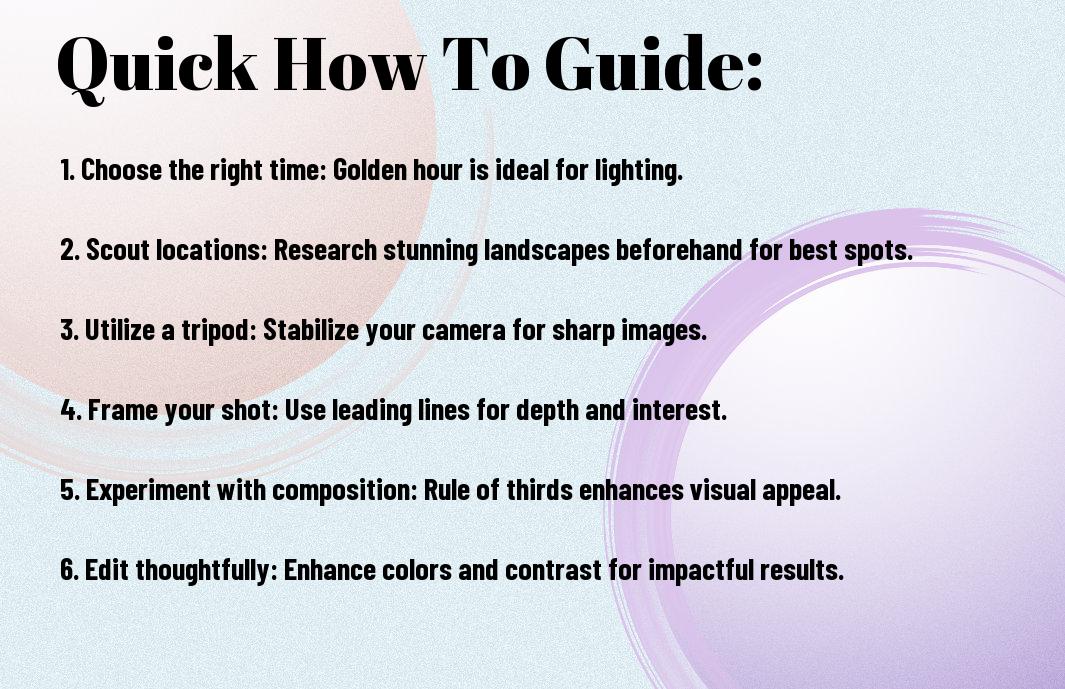
You can elevate your landscape photography by selecting locations that inspire and captivate. Scout for areas with unique features like mountains, lakes, or forests, and consider their accessibility and safety. Research the best spots during various times of day to find the ideal vantage point for dramatic compositions.
Timing and Lighting Techniques
With the right timing and careful attention to lighting, your landscape photography can shine. Early mornings and late afternoons provide soft, warm light that enhances colors and adds depth to your images. Utilize the golden hour, just after sunrise and before sunset, to create magical, ethereal landscapes that are rich in detail.
Perfect lighting can turn a regular scene into something extraordinary. Pay attention to the weather and atmospheric conditions, as clouds and fog can create added drama and intrigue. Experiment with different exposures and shadows, and be patient. Wait for the perfect moment when the light hits the landscape just right, transforming your photograph into a piece of art that evokes emotion and wonder.

Tips for Composition
After mastering your camera settings, focus on composition to elevate your landscape photography. Consider these tips to create stunning images:
- Utilize the Rule of Thirds
- Incorporate leading lines
- Explore different angles
- Pay attention to the horizon
- Make use of negative space
After implementing these strategies, your photographs will convey depth and emotion.
Rule of Thirds and Leading Lines
Lines can guide your viewer’s eye through the frame when you effectively use the Rule of Thirds and leading lines. Positioning key elements along these intersecting lines helps create balance and focus. Incorporate natural pathways, rivers, or fences as leading lines to draw attention to your main subject. This approach enhances the storytelling aspect of your landscape photography.
Utilizing Foreground Interest
For captivating images, incorporating foreground interest can significantly enhance the depth of your landscape photographs. Elements like rocks, flowers, or trees placed in the foreground can create layers and invite the viewer into the scene.
This technique not only adds context but also guides the viewer’s eye from the foreground to the background, creating a sense of scale and balance. Aim for elements that complement your main subject but don’t overpower it, allowing your image to remain cohesive. With thoughtful selection, foreground interest can transform a flat landscape into a compelling visual narrative.
Post-Processing Techniques
Not every stunning landscape photo emerges perfectly from the camera. Post-processing is your opportunity to elevate your images and capture their true essence. Whether it’s adjusting exposure, enhancing colors, or cropping for better composition, mastering a few key techniques can significantly impact your final result.
Basic Editing Tips
Now, start with some necessary editing techniques to refine your landscape shots:
- Adjust brightness and contrast for depth.
- Fine-tune saturation and vibrance to make colors pop.
- Crop strategically to improve composition.
This creates a solid foundation for your images.
Advanced Techniques for Enhancement
Editing goes beyond basics. You can further enhance your landscapes with advanced techniques:
- Utilize masking tools for precise adjustments.
- Apply tonal adjustments for highlights and shadows.
- Experiment with filters to create dramatic effects.
Advanced Techniques for Enhancement
| Technique | Description |
|---|---|
| Masking | Allows you to selectively edit parts of your image, enhancing details without affecting the whole picture. |
| Tonal Adjustments | Helps you to fine-tune brightness in specific areas, adding depth and dimension to your landscapes. |
| Filters | Can create mood or enhance particular elements, giving your landscapes a unique flair. |
Enhancement techniques can dramatically transform your images. Consider these advanced approaches:
- Use the graduated filter to balance exposures in landscapes with bright skies.
- Apply clarity adjustments for sharper details in your foreground.
- Leverage gradient maps for unique color grading.
Advanced Techniques for Enhancement
| Technique | Description |
|---|---|
| Graduated Filter | Helps in managing exposure differences, especially in bright skies. |
| Clarity Adjustments | Increases mid-tone contrast, helping foreground elements stand out. |
| Gradient Maps | Employs color gradients to enhance mood via tonal corrections. |
Common Mistakes to Avoid
Many photographers overlook key aspects that can significantly impact the quality of their landscape photos. Familiarizing yourself with these common mistakes can elevate your skills and ensure your shots resonate with depth and perspective. From exposure issues to neglecting the elements of nature, avoiding these pitfalls will help you capture breathtaking scenes that truly reflect your vision.
Overexposure and Underexposure
On your photography journey, achieving the right exposure is necessary for vibrant landscapes. Overexposure washes out colors and details, while underexposure can leave your images excessively dark. Take the time to adjust your camera settings or utilize exposure compensation to achieve the perfect balance, ensuring your final images capture the true essence of the landscape.
Ignoring the Weather Conditions
There’s a tendency to shoot regardless of the weather, but doing so can lead to missed opportunities. Pay close attention to changing conditions, as dramatic skies or soft light during golden hour can transform an ordinary scene into something exceptional.
Underexposure can often be the result of disregarding the effects of the weather on your images. For instance, shooting in low-light situations like dawn or dusk can create stunning landscapes, while harsh midday light can lead to blown highlights. Understanding how to work with the elements will enable you to capture the mood and texture that different weather conditions bring to your landscape photography.

Creative Approaches to Landscape Photography
Keep pushing the boundaries of your creativity in landscape photography by embracing new techniques and perspectives. When you allow yourself to think outside the box, you’ll produce stunning imagery that captures the true essence of a location. Don’t be afraid to experiment; innovation often leads to your most impactful shots.
Using Filters for Unique Effects
Effects like color saturation and contrast can dramatically enhance your landscape images. By incorporating filters, such as ND (Neutral Density) or polarizers, you can control light exposure and eliminate glare, resulting in more vibrant and balanced photographs. Experimenting with various filters enables you to add depth and creativity to your work, helping your landscapes stand out.
Experimenting with Different Perspectives
An exciting way to breathe new life into your landscape photography is by trying out various perspectives. Instead of defaulting to eye-level shots, consider crouching, climbing, or using a drone to capture angles that showcase depth and interest. Unconventional viewpoints can reveal hidden beauty in familiar landscapes, opening new avenues for your artistic expression.
With a slight adjustment in perspective, you can transform ordinary scenes into extraordinary compositions. Look for elevated spots that provide sweeping views, or explore low angles that highlight foreground elements, creating a sense of depth. Incorporate leading lines or unexpected objects to draw the viewer’s eye into the frame. By experimenting with your viewpoint, you’ll discover captivating ways to tell your story through your landscape photography.
Conclusion
Hence, by incorporating these epic how-to secrets into your landscape photography, you can elevate your skills and create stunning images that captivate your audience. Focus on understanding your equipment, mastering composition, and utilizing natural light to your advantage. Don’t shy away from experimenting with different techniques and perspectives, as these will help you develop your unique style. With dedication and practice, you will see significant improvement in your landscape photography journey.




