Aperture in Photography: Free Aperture Chart + How to Use It
Updated
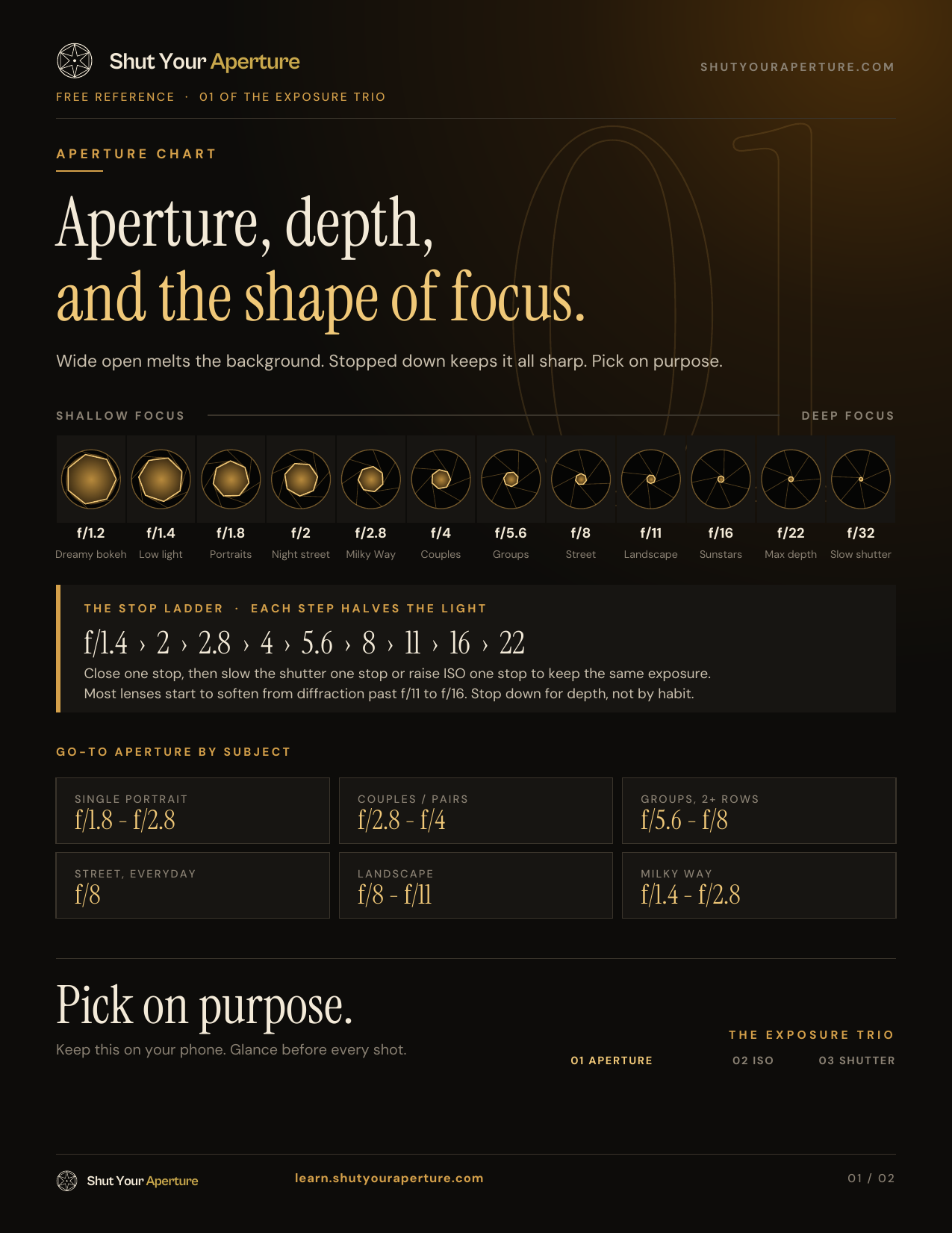
Aperture is the size of the opening inside your lens. A wide aperture (small f-number like f/1.8) lets in more light and gives a blurry background. A narrow aperture (big f-number like f/11) lets in less light and keeps more of the scene sharp. Pick it for how much of the picture you want in focus, then set shutter speed and ISO to get the brightness right. Grab the free chart below and keep it on your phone.
Get the free Aperture Chart (PDF)
Enter your email and it downloads right away. We'll also email you a copy.
You'll join the Shut Your Aperture email list for photo tips. Unsubscribe anytime.
What the f-number means
The f-number is a ratio: focal length divided by the width of the opening. That’s why the numbers look backwards. f/2 on a 50mm lens is a 25mm wide opening. f/8 on the same lens is about 6mm. Smaller number, bigger hole, more light.
The full stops are f/1.4, 2, 2.8, 4, 5.6, 8, 11, 16 and 22. Each step lets in half the light of the one before it. Most cameras also show thirds between them (f/3.2, f/3.5, f/4.5 and so on), which is why your dial clicks three times per stop.
Depth of field: the part people care about
Depth of field is how deep the sharp zone is, front to back. Three things control it, and aperture is only one:
- Aperture. Wider = thinner sharp zone.
- Distance to subject. Closer = thinner. At one meter, f/1.8 can leave the eyes sharp and the ears soft. Step back to five meters and the same f/1.8 holds a whole person.
- Focal length at the same framing. An 85mm headshot at f/1.8 has a softer background than a 35mm shot framed the same way at f/1.8, because the long lens magnifies the background and shows less of it.
So if your background won’t blur, you have three fixes: open up, get closer, or put more distance between your subject and what’s behind them. The last one is free and people forget it.
Go-to apertures by subject
| Subject | Start here | Why |
|---|---|---|
| Single portrait | f/1.8 – f/2.8 | Soft background, eyes sharp. Focus on the near eye. |
| Couples / two people | f/2.8 – f/4 | Two faces are rarely the same distance away. f/4 covers the gap. |
| Groups, 2+ rows | f/5.6 – f/8 | Back row sharp too. Focus on the middle row. |
| Street, everyday | f/8 | Enough depth to miss focus a little and still get the shot. |
| Landscape | f/8 – f/11 | Sharp front to back, before diffraction softens the image. |
| Milky Way | f/1.4 – f/2.8 | You need every bit of light. Stars are at infinity anyway. |
Worked examples with real settings
Outdoor headshot in open shade
85mm, f/2, 1/500s, ISO 200. Put the person in the shade of a building with the bright street well behind them. f/2 turns that street into soft color. Focus on the eye closest to the camera. If you’re getting only one eye sharp, the face is turned; go to f/2.8.
Family of six, two rows, late afternoon
35mm, f/5.6, 1/250s, ISO 400. Focus on a face in the front row about a third of the way into the group. If the back row is soft on review, go to f/8 and raise ISO one stop to keep the shutter at 1/250s.
Landscape at sunset
24mm on a tripod, f/11, 1/15s, ISO 100. Focus about a third of the way into the scene, not on the horizon. Zoom in on the back screen and check both a near rock and the far skyline.
Sunstar on a street light
f/16, and put the light source at the edge of something so only a sliver shows. The number of points depends on your lens blades: an even number of blades gives that many points, an odd number gives double.
Trading aperture for shutter and ISO
Every stop you close the aperture cuts the light in half. To keep the same brightness, pay it back with one stop of shutter (1/500 to 1/250) or one stop of ISO (200 to 400). Example: f/2.8, 1/1000s, ISO 100 is the same exposure as f/5.6, 1/250s, ISO 100. Same brightness, deeper focus, slower shutter. Our shutter speed chart and ISO chart finish the set.
Mistakes I see all the time
- Shooting everything wide open. f/1.4 on a group shot means one sharp face. Wide open is a choice, not a default.
- Going to f/22 for “max sharp.” Past about f/11 to f/16, diffraction softens the whole image. For most lenses f/8 to f/11 is the sweet spot.
- Blaming the lens for soft portraits. At f/1.4 and close range, a small sway puts the focus behind the eye. Use eye AF and burst a few frames.
Practice drill (10 minutes)
Put a cup on a table with a busy shelf a few meters behind it. Set your camera to aperture priority (A or Av). Shoot the same frame at f/1.8 (or your widest), f/4, f/8 and f/16 without moving. Put the four side by side. Then repeat standing twice as far away. You’ll see all three depth controls at once.
Want this on your phone at the shoot?
Get the free Aperture Chart (PDF)
Enter your email and it downloads right away. We'll also email you a copy.
You'll join the Shut Your Aperture email list for photo tips. Unsubscribe anytime.
FAQ
What aperture should I use for portraits?
Start at f/1.8 to f/2.8 for one person and focus on the near eye. For two people use f/2.8 to f/4 so both faces are sharp.
What is the sharpest aperture on a lens?
For most lenses it’s about two to three stops down from wide open, usually f/5.6 to f/8. Past f/11 to f/16, diffraction starts to soften the whole image.
Why is a smaller f-number a bigger opening?
The f-number is focal length divided by the opening’s width. On a 50mm lens, f/2 is a 25mm opening and f/8 is about 6mm.
Is the aperture chart free?
Yes. Download the PDF from this page. No email or sign-up needed.