Shutter Speed in Photography: Free Shutter Speed Chart + How to Use It
Updated
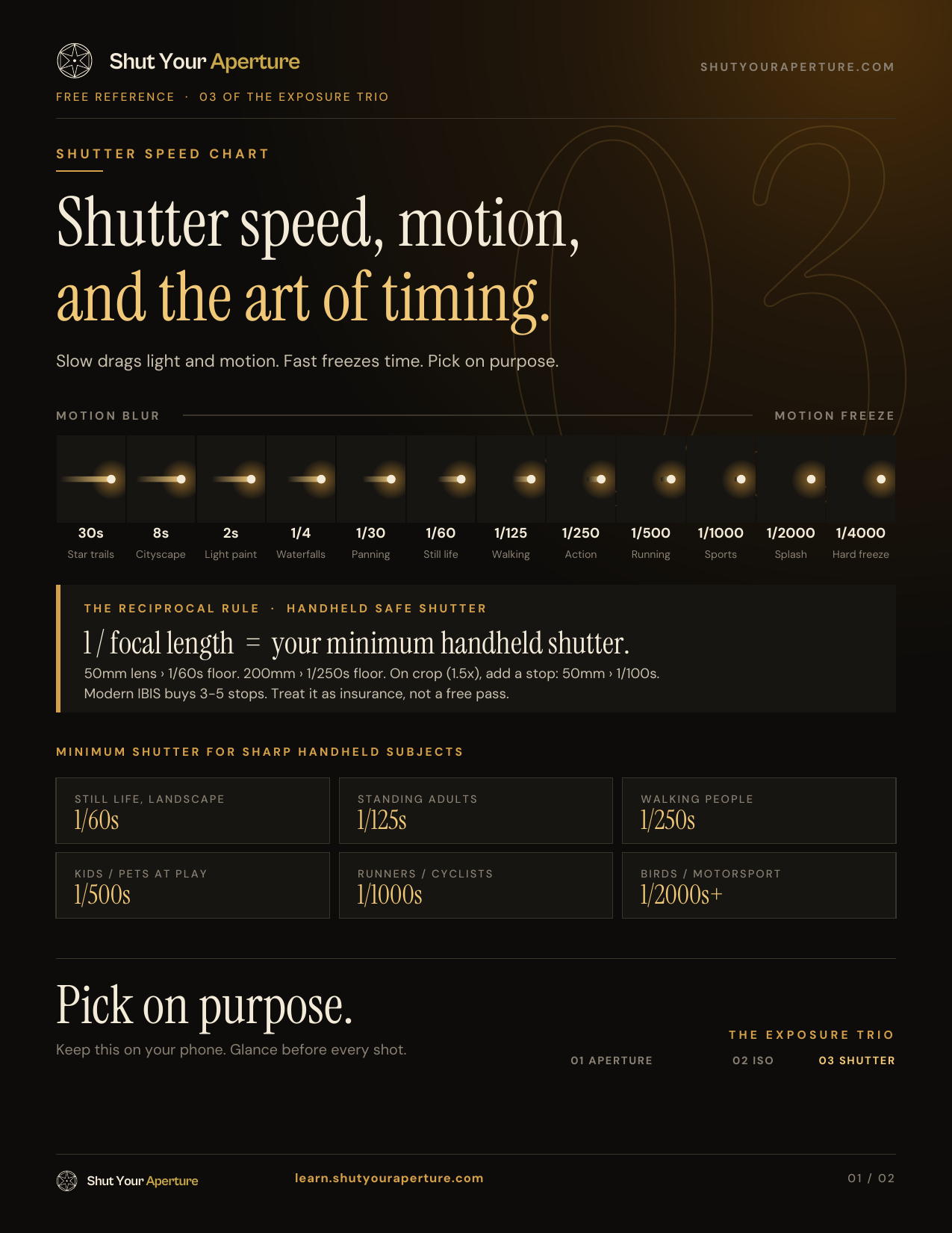
Shutter speed is how long the sensor collects light. A fast shutter (1/1000s) freezes motion. A slow shutter (1/4s and longer) blurs it, turning water into silk and car lights into streaks. Pick it for how you want motion to look, then set aperture and ISO to balance the exposure. The free chart below has safe shutter speeds for every subject.
Get the free Shutter Speed Chart (PDF)
Enter your email and it downloads right away. We'll also email you a copy.
You'll join the Shut Your Aperture email list for photo tips. Unsubscribe anytime.
How shutter speed works
Shutter speeds are written in seconds or fractions of a second: 1/500 means one five-hundredth of a second. Each full step halves or doubles the time: 1/1000, 1/500, 1/250, 1/125, 1/60, 1/30. Halving the time halves the light, which is one stop, the same as one aperture stop or one ISO doubling.
Shutter speed controls two kinds of blur. Subject blur happens when the thing you’re photographing moves. Camera shake happens when your hands move. They have different fixes, so it helps to know which one you’ve got. If everything in the frame is smeared the same way, it’s shake. If the background is sharp and the person is soft, it’s subject motion.
Minimum shutter for sharp handheld subjects
| Subject | At least |
|---|---|
| Still life, landscape | 1/60s |
| Standing adults | 1/125s |
| Walking people | 1/250s |
| Kids and pets playing | 1/500s |
| Runners, cyclists | 1/1000s |
| Birds in flight, motorsport | 1/2000s and faster |
The reciprocal rule for camera shake
Handheld, your shutter should be at least 1 divided by your focal length. 50mm needs 1/60s or faster. 200mm needs 1/250s or faster. On a crop sensor, multiply the focal length first: 50mm on a 1.5x body behaves like 75mm, so use about 1/100s.
In-body and lens stabilization help with camera shake, often by several stops, so you can handhold slower than the rule says. They do nothing for subject motion. A person walking at 1/15s will still blur, stabilized or not.
Worked examples with real settings
Silky waterfall
Tripod, f/11, 1/2s, ISO 100. Between 1/4s and 1/2s the water turns smooth but keeps some texture. Past about 2 seconds it goes to cotton. On a bright day you’ll need an ND filter to get that slow: a 6-stop ND takes you from 1/60s to 1s.
Panning a moving car or cyclist
1/30s, f/8, ISO 100, continuous AF. Plant your feet, track the subject before it reaches you, press the shutter as it passes and keep turning after the click. The subject stays sharp, the background streaks. Expect to keep one in ten while you learn.
Kids running at the park
1/500s to 1/1000s, f/2.8 to f/4, Auto ISO, continuous AF, burst mode. Take bursts of 5 to 10 frames and keep the sharpest.
Night city with light trails
Tripod, f/8, 8 to 15 seconds, ISO 100, 2-second timer. Start at blue hour, about 20 to 30 minutes after sunset, when there’s still color in the sky.
Trading shutter for aperture and ISO
If you need a faster shutter and the photo gets too dark, pay it back with a wider aperture or a higher ISO. Going from 1/125s to 1/500s is two stops, so go from f/5.6 to f/2.8, or from ISO 400 to 1600, or one stop of each. The aperture chart and ISO chart cover the other two sides.
Mistakes I see all the time
- Letting the camera pick 1/30s indoors. Program and aperture priority often drop the shutter too low. Use Auto ISO with a minimum shutter, or shoot shutter priority.
- Using a tripod with stabilization on. Some lenses hunt on a tripod. Check your manual and turn it off if yours does.
- Pressing the button hard on long exposures. Use a 2-second timer or a remote.
Practice drill (10 minutes)
Find a fountain, a faucet or a busy sidewalk. Shutter priority (S or Tv), Auto ISO. Shoot the same scene at 1/1000s, 1/250s, 1/60s, 1/15s and 1/4s (brace yourself or use a table). Look at how motion changes at each step. That’s the whole tip in five frames.
Want this on your phone at the shoot?
Get the free Shutter Speed Chart (PDF)
Enter your email and it downloads right away. We'll also email you a copy.
You'll join the Shut Your Aperture email list for photo tips. Unsubscribe anytime.
FAQ
What shutter speed freezes motion?
1/250s for walking people, 1/500s for kids and pets, 1/1000s for sports, and 1/2000s or faster for birds in flight.
What is the slowest shutter speed I can handhold?
About 1 divided by your focal length: 1/60s at 50mm, 1/250s at 200mm. Stabilization lets you go slower, but only for camera shake, not subject motion.
What shutter speed makes water look silky?
1/4s to 1/2s on a tripod keeps some texture. Past about 2 seconds, water looks like mist. In daylight you’ll need an ND filter.
Is the shutter speed chart free?
Yes. Download the PDF from this page. No email or sign-up needed.