Street Photography — The Complete Guide (The Decisive Moment)
Henri Cartier-Bresson called it the decisive moment — that fraction of a second when everything aligns: the light, the geometry, the expression, the story. Street photography is the purest test of a photographer’s instincts, and it asks nothing of you except a camera, a willingness to walk, and the courage to press the shutter. You don’t need a studio, a permit, or a model. You need only to show up. This guide covers everything you need to get started with street photography — from your first nervous outing to shooting with the confidence of a seasoned practitioner. We’ll cover gear, settings, technique, composition, the masters, ethics, legality, and the psychological barriers that stop most people before they’ve even begun.
What Is Street Photography?
Street photography is the art of capturing unposed, candid moments of human life in public spaces. The “street” is a loose metaphor — it encompasses markets, subway platforms, parks, protests, café terraces, and anywhere people move through shared space without the expectation of a private setting.
Unlike documentary photography, street photography is not primarily about journalism or reportage. Unlike portrait photography, it rarely involves consent or arrangement. It occupies a unique space between fine art, documentary, and social observation — making it one of the most intellectually rich and emotionally immediate forms of photography.
At its core, street photography is about three things:
- Observation — training your eye to see the extraordinary within the ordinary
- Timing — reacting in the moment before the moment disappears
- Empathy — seeing people not as subjects to exploit, but as stories worth telling
The genre as we know it was largely defined in the mid-twentieth century, anchored by the work of Henri Cartier-Bresson, Garry Winogrand, Robert Frank, and Vivian Maier. Today it encompasses film and digital, black & white and vivid colour, cameras ranging from Leica rangefinders to iPhone 15s. The democratisation of the camera has made everyone a potential street photographer — but the discipline of doing it well remains as demanding as ever.
Street Photography vs. Urban Photography
The terms overlap but are distinct. Urban photography is broader — it includes architecture, cityscapes, and environmental photographs that may contain no people at all. Street photography is specifically about human presence, human interaction, human story. A photograph of an empty alley is urban photography. A photograph of a woman laughing under a fire escape is street photography.
Candid vs. Street Portrait Photography
Candid street photography captures subjects unaware of the camera — the purest form, and the most technically and psychologically demanding. Street portrait photography involves approaching a stranger and asking for their portrait. Both are legitimate traditions. The candid approach captures authenticity; the portrait approach builds human connection. Many photographers practise both depending on the situation.
The Masters Who Shaped Street Photography
To understand street photography is to know its lineage. These are the photographers whose work defined the form, and whose techniques you can study and borrow directly.
Henri Cartier-Bresson (1908–2004)
The founding voice. Cartier-Bresson coined the term “the decisive moment” and shot almost exclusively with a 50mm Leica, often taped over with black tape to be less conspicuous. His photographs — Behind the Gare Saint-Lazare, Hyères, France — are exercises in geometric precision and perfect timing. His lesson: patience beats speed. Wait for the scene to compose itself, then fire.
Garry Winogrand (1928–1984)
Where Cartier-Bresson was composed, Winogrand was kinetic. He shot New York’s streets with an almost reckless energy, famously leaving thousands of rolls undeveloped at his death. His slightly tilted horizon — often called the “Winogrand tilt” — gives his images a restless dynamism. His lesson: volume plus instinct. Shoot relentlessly, edit ruthlessly.
Vivian Maier (1926–2009)
Maier’s story is one of photography’s great mysteries — a Chicago nanny who made over 150,000 images in near-total secrecy, discovered only after her death when her storage locker was auctioned. Her work, shot with a Rolleiflex on medium format, combines compositional rigour with extraordinary empathy for marginalised subjects. Her lesson: make photographs for yourself, not for an audience.
Daido Moriyama (b. 1938)
The Japanese master of grain, blur, and darkness. Moriyama’s Tokyo street work — especially from the Provoke magazine era — deliberately broke every rule of conventional photography: extreme grain, harsh contrast, blurred motion, tilted frames. His aesthetic influenced generations of street photographers who wanted to convey raw psychological urgency over technical polish. His lesson: authenticity over perfection.
Joel Meyerowitz (b. 1938)
Meyerowitz was one of the first street photographers to champion colour, at a time when serious photography was almost exclusively black and white. His lush, warm palettes — particularly his Cape Cod work — showed that colour could be as emotionally resonant as monochrome. For street photography, he brought a painterly attention to light quality. His lesson: colour is not a compromise; it is a language.
Alex Webb (b. 1952)
Webb’s photographs are visually dense in a way that defies easy analysis — multiple layers, overlapping figures, complex light within a single frame. He works primarily in hot-light environments: Mexico, the Caribbean, Istanbul. His lesson: don’t simplify. The most rewarding photographs often live at the edge of visual chaos.
Saul Leiter (1923–2013)
Leiter’s street photographs from 1950s New York look like paintings — blurred, abstract, saturated with colour. He shot through rain-streaked windows, from behind layers of reflected glass, using shallow depth of field to create images that obscured as much as they revealed. His lesson: mystery is a compositional choice. What you leave out of focus is as important as what you put sharp.
Elliott Erwitt (1928–2023)
Erwitt was the genre’s great humorist — his photographs find absurdity, irony, and warmth in everyday life with a wit that feels effortless. His dog photographs, his image of Marilyn Monroe’s legs, his juxtapositions of big and small — all show that street photography need not be gritty or heavy. His lesson: look for the joke the world is setting up. It is almost always there.
Martin Parr (b. 1952)
British Magnum photographer and provocateur. Parr uses a ring-flash and close-focus lens to shoot British leisure culture with a garish, colour-saturated eye — sunbathers, tourists, buffet queues, seaside resorts. His work is simultaneously loving and satirical, a social document disguised as entertainment. His lesson: your own culture is always the richest subject.
Gear for Street Photography: What You Actually Need
Street photography is one of the most gear-agnostic forms of photography. A smartphone can make extraordinary street images. But the right dedicated camera removes friction, helps you be discreet, and puts you in a better shooting position. Here is what the street photography community reaches for.
The Best Cameras for Street Photography
The ideal street camera is small, quiet, quick to focus, and unintimidating. A large telephoto setup draws attention and creates psychological distance from subjects.
Fujifilm X100VI
The current consensus favourite. The X100VI is a fixed-lens compact (23mm f/2, equivalent to 35mm full-frame) with a built-in ND filter, excellent auto-focus, and a hybrid optical/electronic viewfinder. Its retro styling means it looks like a film camera, which makes people on the street less wary. Paired with Fuji’s film simulations, it produces images that feel finished straight from the card.
Ricoh GR IIIx
The Ricoh GR is the cult compact of the street photography world — pocketable enough to carry everywhere, with a 40mm-equivalent f/2.8 lens and a sensor that punches well above its price point. The GR has no viewfinder, which forces a different shooting style (from the hip, or using the LCD at arm’s length) and produces a distinctive aesthetic loved by its passionate community.
Leica M-Series
The aspirational choice. Cartier-Bresson taped his Leica M3 so subjects wouldn’t hear the shutter. The modern Leica M11 is the quietest, most discreet rangefinder camera available — and at £7,000+ the most expensive. The rangefinder system encourages zone focusing and deliberate framing. The Leica’s cult status is inseparable from street photography’s history — but you absolutely do not need one to make great work.
Mirrorless Options (Sony, Fujifilm X-series, Nikon Z, OM System)
A Sony A7C with a 35mm f/1.8, a Fujifilm X-T5 with a 23mm, or an OM System OM-5 with a 17mm f/1.8 all make excellent street setups. Mirrorless cameras offer fast, silent shutters and exceptional ISO performance for nighttime work. Add a small prime lens and you have a capable, relatively inconspicuous kit.
Film Cameras
Film street photography is experiencing a genuine revival. The discipline of 36 frames per roll forces a selectivity that improves decision-making. The Nikon FM2, Canon AE-1, Olympus OM-1, and Contax T2 (if you can find one at a reasonable price) are all beloved choices. For 35mm film street photography, Kodak Portra 400 and Kodak Tri-X 400 are the canonical film stocks.
The Best Lenses for Street Photography
Prime lenses are strongly preferred over zooms — their smaller size, wider maximum aperture, and fixed focal length encourage the discipline of moving your feet to compose, rather than zooming.
35mm — The Street Photographer’s Standard
The 35mm focal length (or 23mm on APS-C sensors) is the closest to natural human vision with slight environmental context. It lets you get close while including enough surroundings to tell a story. Cartier-Bresson used 50mm; most contemporary street photographers favour 35mm. The Fujifilm 23mm f/2, Sony 35mm f/1.8, and Nikon Z 35mm f/1.8 are all excellent.
50mm — More Intimate, More Demanding
The 50mm forces you closer to your subjects, creating more intimate portraits with shallower depth of field. It demands more nerve. The 35mm vs. 50mm debate is one of street photography’s perennial arguments — try both on your camera body and see which feels natural to your eye.
28mm — Wide and Environmental
Going wide (28mm or 24mm) pulls in even more context and allows shooting without raising the camera to your eye. Daido Moriyama’s close-focus, wide-angle aesthetic is built on 28mm shooting.
For a full comparison of cameras and lenses with current pricing, see our street photography camera comparisons guide.
Street Photography Camera Settings: The Complete Setup
Settings anxiety is one of the biggest blockers for beginners. By the time you’ve fiddled with your aperture dial, the moment has gone. The solution is to pre-programme your camera before you walk out the door — so when you see the shot, the only thing you need to do is raise the camera and press the shutter.
The Classic Daytime Setup: “f/8 and Be There”
This old photojournalist maxim is still the best starting point:
- Aperture: f/8
- Shutter speed: 1/250s (freezes typical pedestrian motion)
- ISO: Auto (let the camera handle sensitivity; set a ceiling of ISO 3200)
At f/8 with a 35mm lens focused at roughly 2.5 metres, nearly everything from 1.5 metres to infinity will be acceptably sharp. This is zone focusing territory — you rarely need to think about focus at all.
Best Aperture for Street Photography
f/8 is canonical for its deep depth of field, but in lower light you’ll need to open up:
- Bright daylight: f/8–f/11
- Overcast/shade: f/5.6
- Golden hour: f/4–f/5.6 for beautiful background separation
- Night / artificial light: f/2–f/2.8 to collect as much light as possible
Understanding aperture fully is worth investing in — see our aperture photography guide for the complete breakdown.
Shutter Speed for Street Photography
You need at least 1/125s to freeze normal walking motion. In very bright conditions, use 1/500s or 1/1000s. At night, you may need to drop to 1/60s and accept some motion blur — which can itself become an aesthetic choice.
For the full breakdown of how shutter speed affects motion, see our shutter speed guide.
ISO for Street Photography
Auto ISO is your friend on the street. Set your minimum shutter speed and maximum ISO in-camera (typically 1/125s minimum; ISO 6400 max), and let the camera balance exposure automatically. This frees you to focus entirely on seeing. Modern sensors from Fujifilm, Sony, and Nikon handle ISO 3200–6400 beautifully. Don’t fear grain — at high ISO, it adds character to street images. See our ISO photography guide for a full explanation of Auto ISO strategies.
Aperture Priority vs. Manual Mode for Street Photography
Most experienced street photographers shoot in one of two modes:
- Aperture Priority (Av/A): Set your aperture, let the camera choose shutter speed. Use with Auto ISO for fully automatic exposure in complex lighting.
- Full Manual with Auto ISO: Lock aperture and shutter speed, let the camera adjust only ISO. This gives you complete motion control while adapting to changing light.
Avoid Shutter Priority (Tv/S) for street photography — it will choose inappropriate apertures in low-contrast scenes, ruining your depth of field.
Night Street Photography Settings
Shooting after dark changes everything:
- Aperture: f/2–f/2.8
- Shutter speed: 1/60s–1/100s (accept some motion blur)
- ISO: 3200–12800 depending on camera
- Look for pools of artificial light — neon signs, shop windows, street lamps — and position subjects within them
- Night street photography at night also intersects beautifully with flash technique (see below)
Zone Focusing and Hyperfocal Distance
Zone focusing is the technique that separates confident street photographers from those who miss shots fumbling with autofocus. It is the technical secret behind the speed and precision of photographers like Cartier-Bresson, Winogrand, and the Leica rangefinder school.
How Zone Focusing Works
Instead of using autofocus for each shot, you pre-focus the lens to a fixed distance — typically 1.5–3 metres — and use a small enough aperture that everything within your expected shooting range falls within the depth-of-field. When you see the shot, you raise the camera and shoot immediately, without waiting for the camera to focus.
Step-by-step zone focusing setup:
- Set your aperture to f/8 (or f/11 for even more depth of field)
- Pre-focus to approximately 2 metres using your lens’s distance scale
- At f/8, 35mm (full-frame), focused at 2m: depth of field is roughly 1.2m–4.5m — everything in that range is sharp
- Confirm the range using a depth-of-field app (PhotoPills or DOF Master) for your specific lens
- Switch to manual focus to lock the focus point
- Walk through the scene, shooting whenever the subject falls within your pre-set range
Hyperfocal Distance for Street Photography
The hyperfocal distance is the focus distance at which your depth of field extends from half that distance all the way to infinity. Focus at the hyperfocal distance and everything from half that distance to infinity is in acceptably sharp focus.
For a 35mm lens at f/8: the hyperfocal distance is approximately 4.8 metres. Focused at 4.8m, everything from 2.4m to infinity is sharp. This is the “zone” in “f/8 and be there” — pure reactive shooting without any focus hesitation.
Practical tip for APS-C shooters: Fujifilm’s 23mm f/2 (35mm equivalent) at f/8 has a hyperfocal distance of about 3 metres, giving you a zone from 1.5m to infinity. At this setting, almost every street scene you encounter will be in focus.
Zone Focusing on Modern Autofocus Cameras
Even without physical distance scales, you can zone focus on modern mirrorless cameras:
- Pre-focus on a subject at your target distance, then switch to manual
- Use the digital MF assist (magnification) to confirm focus
- Use your camera’s depth-of-field preview to verify sharpness range
- The Ricoh GR’s snap-focus feature pre-programmes a focus distance at the push of a button — ideal for zone focusing
For a dedicated deep-dive, see our street photography techniques guide which covers zone focusing, shoot-from-the-hip, and advanced pre-visualisation.
Street Photography Composition: Seeing the Shot Before You Take It
Technical mastery sets you free; composition is what you do with that freedom. Great street photographs are not accidents — they reflect a trained eye that has internalised a set of visual principles and can apply them instantly.
The Decisive Moment
Cartier-Bresson’s defining concept: the precise instant when form and content achieve perfect alignment. It is not just the peak of action — it is the moment when the light, the geometry, the expression, and the narrative all converge simultaneously. Waiting for the decisive moment means being patient enough to study a scene before pressing the shutter, rather than shooting first and hoping.
In practice: find a compelling background — an interesting wall, a pool of light, a geometric pattern — and wait for the right person to walk into it. Let the scene construct itself, then fire.
Juxtaposition
Juxtaposition places two contrasting elements within the same frame to create tension, humour, or commentary. A suited businessman walking past a graffiti mural. An elderly woman sitting beneath a billboard advertising youth cream. A child running past a pensioner — the energy of one contrasting the stillness of the other. Juxtaposition is the engine of much of the genre’s wit and social commentary.
Framing Within a Frame
Use architectural elements — doorways, windows, arches, mirrors, car windows — to frame your subject within a secondary border. This adds depth, draws the eye to the subject, and contextualises them within their environment. Saul Leiter built an entire aesthetic around shooting through glass, reflections, and doorways.
Reflections in Street Photography
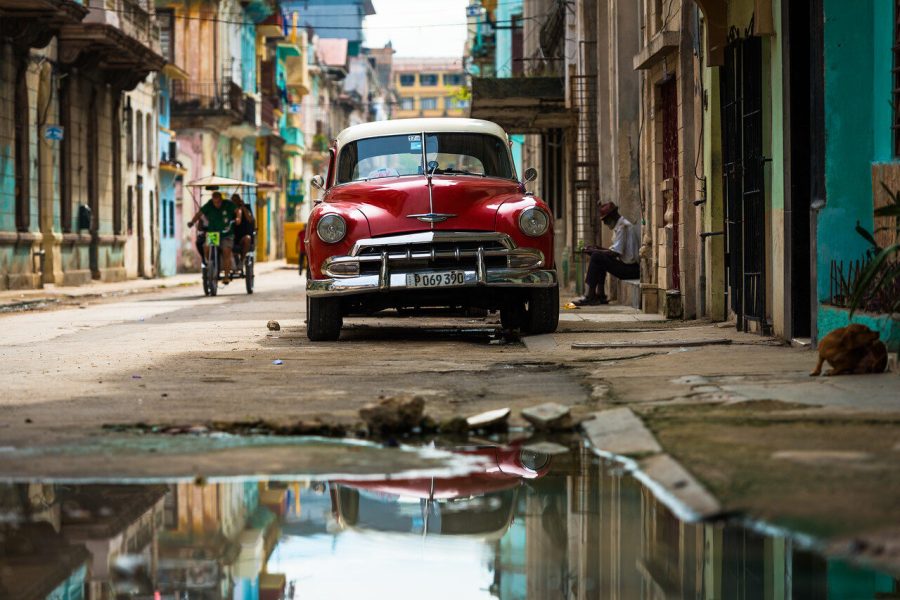
Puddles, shopfronts, car panels, and glass buildings all offer reflection opportunities. The upside-down world in a rain puddle has a dreamlike quality that transforms the mundane. Reflections also allow you to include yourself in the image — making explicit the photographer’s presence, which is always implicit in street work.
Light and Shadow — Chiaroscuro
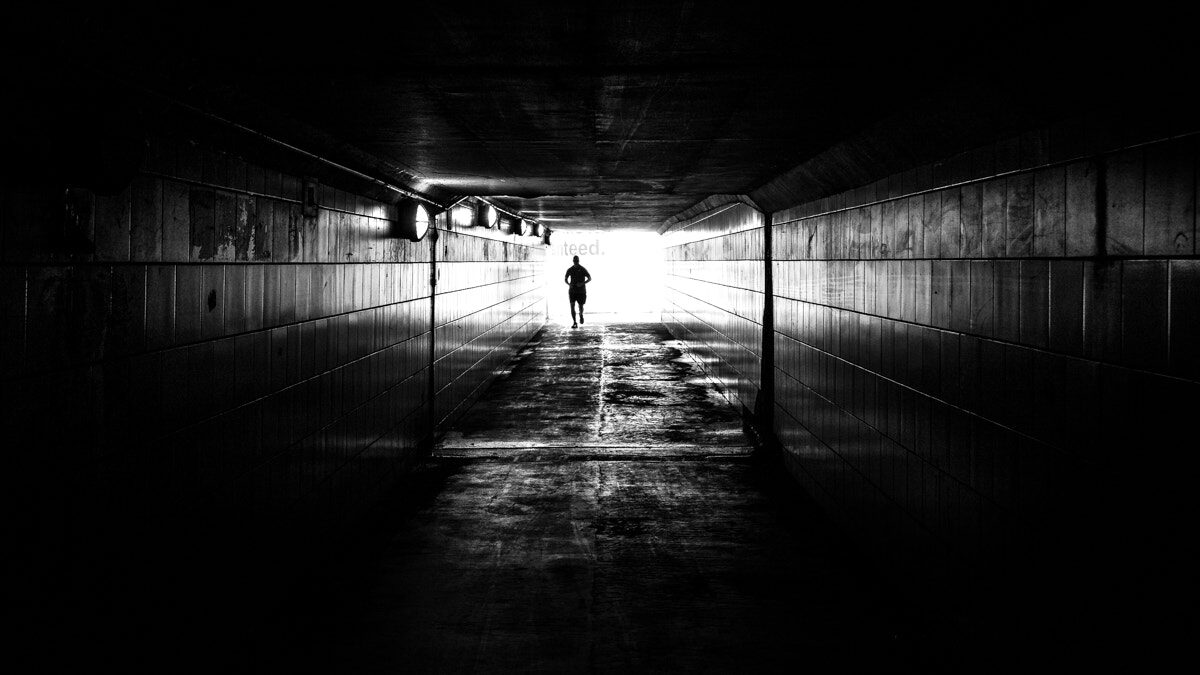
The drama of high-contrast light — deep shadows and bright highlights — is a street photography staple. Strong directional light from a low sun or a narrow alley creates graphic shapes. Silhouettes, particularly at sunset or against backlit windows, strip subjects to their essential outlines. Shadows that precede or follow subjects become compositional elements in their own right.
Street photography chiaroscuro is the application of the classical painting technique — the play of light and dark — to documentary photography. Fan Ho’s Hong Kong photographs from the 1950s are the canonical example.
Silhouettes
Silhouette photography reduces subjects to pure form — the shape of a person against a bright background. To achieve a clean silhouette, expose for the background (the bright sky or lit window), not the subject. The subject will render as a dark outline. This technique works especially well at golden hour or in front of any strongly backlit surface.
Layers and Depth
Alex Webb’s photographs pile multiple subjects and planes into a single frame, creating a compositional complexity that rewards close attention. Look for scenes with foreground, midground, and background elements that relate to each other — figures at different distances, overlapping but not colliding. This is the hardest compositional skill to develop and the most rewarding.
Leading Lines
Roads, railways, fences, zebra crossings, and architectural edges all create lines that lead the eye through the frame. Position your subject where leading lines converge, or use them to add dynamism and direction to an otherwise static composition.
Negative Space
Leaving large areas of empty space around a subject can be as powerful as filling the frame. A lone figure against an expanse of grey pavement, a small child in a vast city plaza — negative space emphasises isolation, scale, and mood.
Black & White vs. Colour Street Photography
The choice between black & white and colour is not merely aesthetic — it is philosophical, and it shapes the kind of photographs you make.
The Black & White Tradition
Black & white street photography is the genre’s founding visual language. Cartier-Bresson, Winogrand, Maier, Moriyama, Robert Frank, Helen Levitt, Dorothea Lange — the canon is almost entirely monochrome. B&W removes the distraction of colour, drawing the eye to form, texture, light, and human expression. It imposes a graphic clarity that colour can muddy.
B&W also creates temporal distance — images that could have been made in any decade, stripped of the era-specific signifiers of colour palettes. This timelessness is part of why B&W street photography has such enduring power.
Editing B&W street photography in Lightroom: In the Develop module, convert to B&W and use the HSL sliders to control how different colours translate to grey tones. Boost the red/orange channel to lighten skin tones and boost contrast in faces. Drop the blue channel to darken skies dramatically. Apply a slight grain in the Detail panel to evoke film texture.
The Colour School
Joel Meyerowitz was one of the first to argue seriously for colour in street photography in the 1970s. Alex Webb brought painterly colour complexity to the form. William Eggleston democratised the ordinary with his dye-transfer colour prints of American roadside life. Today, colour street photography is associated with rich, saturated palettes — golden hour warmth, neon-lit nights, the saturated primaries of Tokyo’s Shibuya Crossing.
Fujifilm’s film simulations — particularly Velvia (oversaturated), Classic Chrome (faded, muted), and Eterna Cinema (low-contrast, filmic) — have made colour processing a distinctive aesthetic choice for street photographers shooting digital.
Film Street Photography
Shooting on film forces discipline. Thirty-six frames per roll means you think before you shoot. The grain structure, the rendering of colour, and the slight softness of analogue lenses all create an aesthetic that is genuinely different from digital — not just a filter applied after the fact.
For street photography, the most popular film stocks are:
- Kodak Tri-X 400: The canonical B&W street film — pushed to 1600 or 3200 for night shooting, it becomes grainy and dramatic in the Moriyama tradition
- Ilford HP5 400: More forgiving than Tri-X, with a slightly finer grain structure
- Kodak Portra 400: The gold standard for colour film — warm, rich skin tones, beautiful with natural light
- Kodak Ultramax 400: More affordable than Portra; slightly more saturated, with a distinct analogue colour palette
For editing your digital street photography, see our complete Lightroom tutorial covering B&W conversion, colour grading, and grain.
Fear, Shyness, and Confidence on the Street
Here is the honest truth: fear is the number-one reason most people never fully embrace street photography. Not the lack of technical skill, not the equipment, not the legal questions. Fear. Fear of confrontation, fear of upsetting people, fear of seeming intrusive, fear of being noticed. And almost all of it is overblown.
The Fear Is Almost Never Realised
Studies of street photographers’ experiences consistently find the same thing: the vast majority of strangers photographed in public spaces never notice, and those who do notice rarely object. Of those who object, almost all confrontations end after a simple, honest explanation: “I’m a photographer. I find people beautiful.” Most people, when addressed with warmth and directness, are disarmed immediately.
How to Overcome Fear of Street Photography
- Start in low-stakes environments. Markets, festivals, parades, tourist areas — places where cameras are expected and people are in a social, open mindset. Nobody objects to being photographed at a food market.
- Set your camera up before you leave home. The fumbling of adjusting settings while trying to shoot is a confidence destroyer. Arrive ready to shoot.
- Use a 35mm or wider lens. A telephoto lens feels intrusive; a wide-angle forces proximity, but the compact camera body is far less threatening.
- Make eye contact and smile. If someone notices you taking their photograph, a direct, warm smile resolves almost every potential confrontation. Hiding your camera and avoiding eye contact creates suspicion; openness disarms it.
- Accept that some people will say no. And that is fine. Move on. Their no does not define your practice.
- Volume cures fear. The more you shoot, the more you realise that the world does not end when you press the shutter. Shoot every day for a week, however briefly, and the fear diminishes sharply.
Photographing Strangers: The Mindset Shift
The psychological shift that unlocks street photography is this: you are not taking something from people when you photograph them. You are responding to something they are giving — a gesture, an expression, a presence in the world. The photograph is not a theft; it is a witness. Approaching your subjects with that mindset — respect, curiosity, empathy — changes everything about how you shoot and how people respond to you.
Shoot From the Hip
One practical technique for overcoming self-consciousness: hold the camera at waist level or below, aim by intuition, and shoot without raising it to your eye. This is Moriyama’s approach — raw, instinctive, less composed but more immediate. The trade-off is lower technical precision for higher psychological comfort. With practice, your hit rate from the hip improves dramatically.
Street Photography Ethics and Legal Rights
The legal and ethical questions around street photography are less complicated than most beginners fear — but they are worth understanding clearly.
Is Street Photography Legal?
In most countries, yes — photographing people in public spaces is legal without their permission.
United States: The First Amendment broadly protects the right to photograph in public spaces. You can photograph anyone in a public place — streets, parks, government buildings (from outside), transit stations. Private property (shopping malls, private events) have their own rules. Publication for commercial purposes requires a model release; artistic and editorial use is broadly protected.
United Kingdom: There is no legal right to privacy in public spaces in the UK. Photographers have broad rights to photograph in public. The Terrorism Act 2000 Section 58A has been misused to harass photographers, but it does not prohibit photography of people in public for artistic purposes. The Metropolitan Police’s own guidance confirms photographers’ rights in public.
European Union: EU countries generally allow photography of people in public for artistic and journalistic purposes. Germany is a notable exception — the Recht am eigenen Bild (right to one’s own image) is more broadly protected, requiring consent for publication in most circumstances. France has similarly strict privacy laws around publication, though shooting itself is not prohibited.
The key distinction everywhere is between shooting (generally permitted in public) and publishing commercially (requires a model release in most jurisdictions).
Street Photography Ethics
The legal question is simpler than the ethical one. What you are allowed to do and what you should do are different conversations.
Most experienced street photographers operate by a personal code that includes:
- Respect for dignity: Avoid images that exploit, humiliate, or dehumanise subjects — even if the law permits them
- Sensitivity to context: Photographing grief, trauma, or vulnerability requires extra thought about purpose and publication
- Honest representation: Street photography is documentary — manipulation that misrepresents reality undermines its integrity
- Awareness of power: Photography has historically been used to extract images from marginalised communities for the benefit of dominant ones. Be aware of that dynamic
Permission vs. Candid Street Photography
The great philosophical debate of the genre. Asking permission changes the photograph — the subject becomes aware, and the candid spontaneity that defines the form is altered. Many photographers feel that asking for permission negates the work’s documentary authenticity. Others feel that any photograph made without consent is a violation, however legal.
There is no single right answer. Street portrait photography with consent is a distinct and equally valid form. The candid tradition, when practised with respect and empathy, has produced the genre’s greatest work. Know your own values, practise with intention, and make images you can stand behind.
Common Street Photography Mistakes (and How to Fix Them)
Mistake 1: Shooting From Too Far Away
The most common beginner mistake. Fear of proximity leads to telephoto shooting from a safe distance, producing images where subjects are small, context is absent, and the energy of close-up human presence is lost. Robert Capa’s rule applies: “If your photographs aren’t good enough, you’re not close enough.” Practice getting to within 2–3 metres of your subjects.
Mistake 2: Using a Zoom Lens
Zoom lenses encourage lazy composition — you zoom instead of moving. Prime lenses force you to use your feet, which connects you more physically to the scene. Start with a single prime (35mm or 50mm) and shoot exclusively with it for at least three months.
Mistake 3: Hesitating After You’ve Seen the Shot
The decisive moment is decisive precisely because it passes. The moment you think “should I shoot this?” the moment is usually gone. Trust your instincts. Shoot first, review later. You can always delete a frame; you cannot recreate a missed moment.
Mistake 4: Not Having Camera Settings Ready
Walking out of the house with your camera in auto and needing to adjust ISO, aperture, and focus when the shot appears is a guaranteed way to miss everything. Set your camera at home, in the conditions you expect. Arrive ready.
Mistake 5: Editing Every Shot Instead of Curating
Developing an editing eye — the ability to identify your best 1% of frames — is as important as developing a shooting eye. Edit ruthlessly: if a photograph needs an explanation to work, it doesn’t work. Only show your strongest images.
Mistake 6: Shooting Exclusively in Good Light
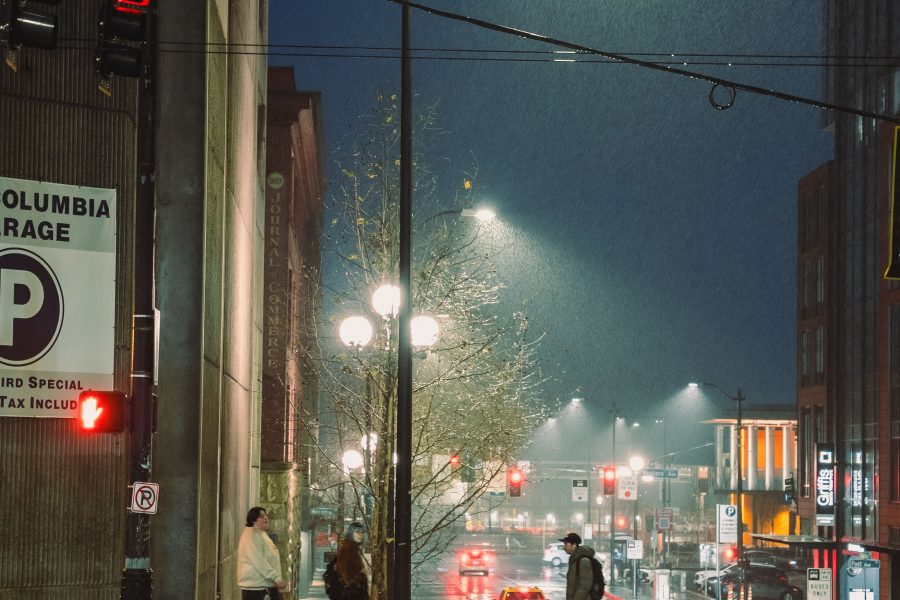
Rain, fog, harsh midday light, neon-lit nights — some of the most compelling street photographs are made in conditions most photographers avoid. Bad weather creates atmosphere, empty streets, reflections in puddles, and subjects huddled under umbrellas. The photographic possibilities of a rainy day are equal to a golden hour.
Mistake 7: Ignoring the Background
Busy, cluttered backgrounds destroy otherwise good photographs. Before you raise the camera, ask: what is behind my subject? Is it adding to or competing with the image? Move slightly left or right, or wait for the person to step into a cleaner area of the scene.
Projects, Photo Essays, Zines, and Building Your Street Practice
Street photography becomes most powerful when it accumulates into a body of work — a series with a coherent subject, theme, or approach.
Starting a Street Photography Project
A project is simply a constraint: shoot one neighbourhood for six months. Photograph only at night. Document one market over a year. The constraint gives your shooting purpose, focuses your editing, and creates work that is coherent enough to exhibit, publish, or share meaningfully. Without a project, most photographers accumulate thousands of images with no through-line.
The Photo Essay
A photo essay is a sequence of images that tells a story — typically 10–20 photographs arranged so that the meaning emerges from their relationship to each other, not just from individual strong shots. The sequence has a beginning, a middle, and an end. It has establishing shots, detail shots, and emotional peaks. Learning to think in sequences, not single images, is the leap from photographer to storyteller.
Making a Street Photography Zine
The zine is street photography’s most authentic publishing format — cheap, independent, democratic, and beautifully tactile. A basic A5 saddle-stitched zine of 16–24 pages costs almost nothing to produce at a print-on-demand service. Our guide to how to make a photography zine covers everything from sequencing your edit to choosing paper stock and distribution.
Building a Street Photography Portfolio
Curate your portfolio with the same rigour you apply to editing individual rolls. Ten extraordinary photographs are worth more than fifty competent ones. Sequence your portfolio images so they work together as a body: open with a strong, clear image; build tension and variety; end with something memorable. Edit it every three months and remove anything that no longer meets your standard.
Street Photography on Instagram
Instagram remains the most active platform for street photography communities. The key strategy: consistency of aesthetic over consistency of posting frequency. Ten photographs with a coherent visual voice (consistent processing, tonal range, subject matter) will grow an audience faster than fifty random, well-shot images. Follow and engage with street photography accounts — @magnumphotos, @street_photography_magazine, @vivianmaier (official archive), @daido_moriyama_official — and use relevant hashtags: #streetphotography, #candid, #decisivemoment.
Frequently Asked Questions About Street Photography
- Is street photography legal?
- In most countries, photographing people in public spaces is legal without their permission. In the US, UK, and most of the EU, you have the right to photograph anyone in a public place. Private property and some jurisdictions with stricter privacy laws (like Germany) have different rules. You generally cannot publish images commercially without a model release, but editorial and artistic use is broadly protected.
- What camera settings should I use for street photography?
- The classic starting point is “f/8 and be there” — set your aperture to f/8, shutter speed to 1/250s, and use Auto ISO. This keeps most of the scene in focus and freezes typical pedestrian motion. In low light, drop to f/5.6, bump ISO to 3200–6400, and keep shutter speed at 1/125s minimum.
- What is zone focusing in street photography?
- Zone focusing means pre-focusing your lens to a set distance (usually 2–3 metres) and using a small enough aperture (f/8 or f/11) to keep everything within that range sharp — without using autofocus at all. This technique eliminates autofocus lag, letting you react instantly to fleeting moments.
- What is the decisive moment in photography?
- The decisive moment is a concept coined by Henri Cartier-Bresson. It describes the instant when all visual and emotional elements align perfectly — the peak of action, expression, light, and geometry converging in a single frame. Cartier-Bresson called it “the simultaneous recognition, in a fraction of a second, of the significance of an event as well as of a precise organisation of forms which give that event its proper expression.”
- What is the best camera for street photography?
- The Fujifilm X100VI is the current favourite for its compact size, excellent image quality, and discreet look. The Ricoh GR IIIx is equally beloved for its pocketability. For film shooters, the Leica M6 or a Nikon FM2 with a 35mm lens is a classic choice. The best camera is the one small enough that you always have it with you.
- Do I need permission to photograph strangers?
- In most public spaces, no. You have the right to photograph anyone in a public place in the US, UK, and most EU countries. Whether you choose to ask permission is an ethical decision that changes the nature of the photograph — candid images capture authentic moments; portraits with consent create a different but equally valid kind of connection.
- How do I overcome fear of street photography?
- Start with low-pressure environments: markets, festivals, busy tourist areas where cameras are expected. Use a wider angle lens that lets you stay further from subjects. Set your camera up in advance so there is no fumbling. Most importantly — accept that most people won’t even notice you, and those who do rarely object. The fear is almost always bigger in your head than in reality.
Ready to Master Street Photography? Try Framehaus Free for 7 Days
Street photography is learned by doing — but doing it smarter accelerates everything. The Framehaus course The Decisive Moment takes you from your first nervous outing to building a cohesive body of work, with guided exercises, critique sessions, and a community of photographers at every level. You’ll get hands-on modules covering zone focusing, composition, the fear barrier, editing your best work, and publishing your first zine or photo essay.
Try Framehaus free for 7 days. Cancel any time. No risk.
30-day money-back guarantee. No questions asked.