If aperture still feels fuzzy, start with our deep-dive aperture photography guide — it covers everything from f-stop math to bokeh control.
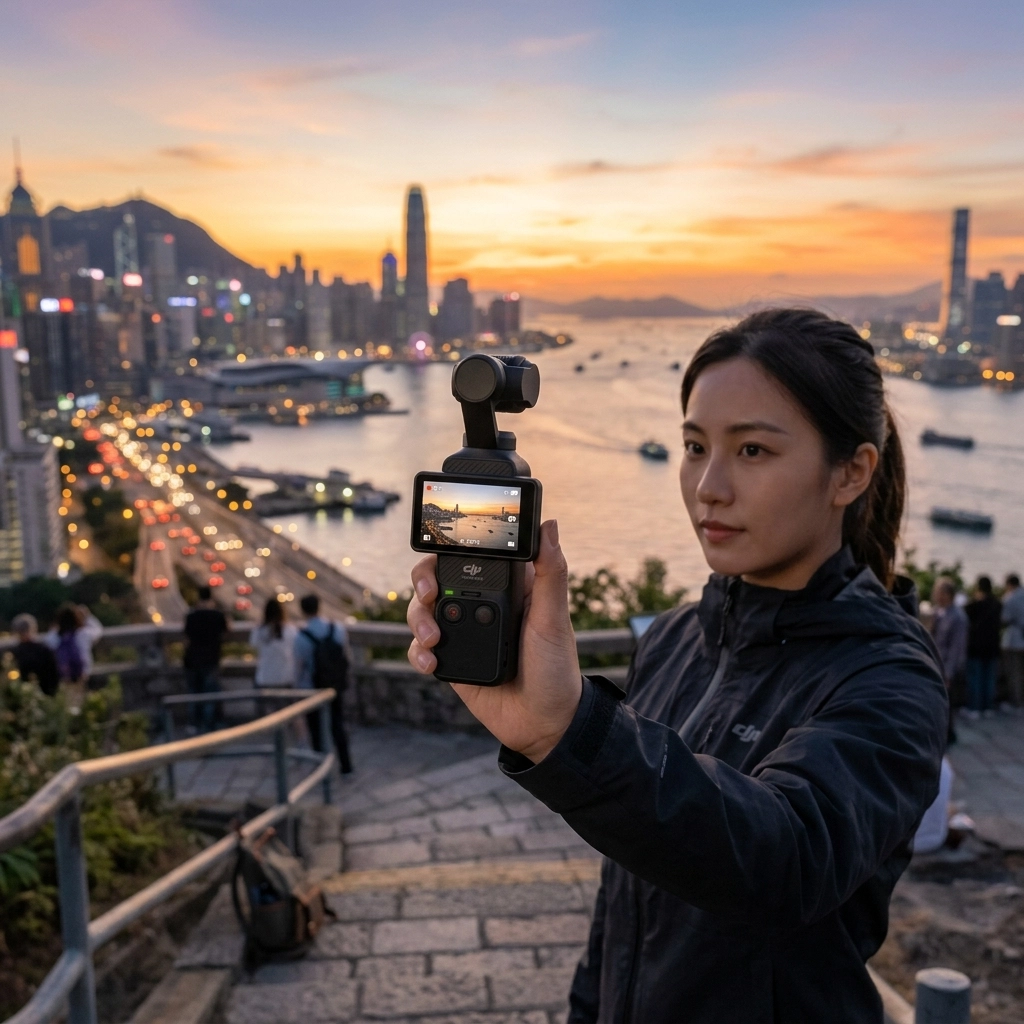
It’s April 2026, and camera launches are hitting like a burst mode you forgot to turn off. If you’ve been following photography news, you already know this month has been chaos in the most expensive way possible. GoPro is chasing cinema vibes, Panasonic is making lenses so tiny they look made up, and now DJI has shown up with the Osmo Pocket 4 like it fully intends to empty the rest of our wallets.
And that’s really the question here. Not just "is it good?" but "is it good enough to make a bunch of people rethink hauling around a full mirrorless vlogging setup?"
Because let’s be honest, a lot of "compact" mirrorless rigs stop being compact the second you add a lens, a mic, a grip, a cage, and whatever other little accessory you swore you totally needed. We’ve had plenty to say about the best mirrorless cameras of 2026, but the best camera is still usually the one that actually leaves the house with you. That’s exactly why the Pocket 4 feels so interesting.
The 1-Inch Sensor: Tiny Camera, Serious Image Quality
Let’s start with the part that actually matters most: the sensor. In a lot of recent camera gear reviews, brands have been playing it safe and calling it innovation. DJI clearly decided not to do that. The Osmo Pocket 4 gets an upgraded 1-inch CMOS sensor, which still sounds slightly absurd when you remember this thing can disappear into a jacket pocket.
And this isn’t one of those specs that only looks good in a press release. In the real world, 14 stops of dynamic range means your footage has a lot more room to breathe. Shoot into a harsh sunset, a neon street scene, or a dim little café with one sad lamp in the corner, and the file still holds together better than you’d expect from a camera this small.

In the April 2026 gear world, where AI upscaling is popping up in everything, starting with a clean file matters a lot more than people think. When you open these shots in something like Luminar, you’ve got enough real information in the file to push the colors, shape the contrast, and not have the image completely fall apart five minutes into editing.
4K at 240fps: Ridiculous on Paper, Great in Real Life
One of the wildest upgrades here is 4K at 240fps. Even now, that sounds like one of those specs you read twice just to make sure nobody got carried away in the marketing department. Not too long ago, 1080p at 120fps was enough to make creators feel fancy. Now this tiny camera is giving you ultra-smooth slow motion that looks way pricier than it should.
If you shoot a lot of B-roll, this matters. Coffee pours, skateboard clips, running shots, city transitions, water splashes, product shots, those dramatic "walking into frame" moments we all pretend we don’t overuse, the Pocket 4 handles that stuff really well. The processing feels fast, the footage stays clean, and it seems to deal with heat better than the Pocket 3, which was one of the more annoying weak spots on the older model.
ActiveTrack 7.0: The Cameraman That Never Asks for Lunch
The gimbal has always been the magic trick with the Pocket line. That part isn’t new. What feels better this time is how much the software helps the hardware out. ActiveTrack 7.0 is where the Pocket 4 starts to feel less like a clever little gadget and more like a genuinely useful filmmaking tool.
Older versions could track you, but the framing sometimes felt a bit stiff and obvious. Very "human detected, placing subject directly in center now." With 7.0, DJI added Dynamic Framing, and it makes the footage feel less robotic. The camera can keep you off-center, leave some space in the frame, and follow movement in a way that looks more intentional and less like surveillance footage.
If you’re still learning how to compose shots without second-guessing every frame, this is also a good place to plug the Shut Your Aperture Learning Portal. We’ve got useful breakdowns on composition and camera basics that make a lot of this stuff way less intimidating.
Internal Storage and the End of the "Card Error" Mood Swing
DJI finally did the thing creators have been begging for. The Pocket 4 comes with 107GB of high-speed internal storage, and honestly, that alone is enough to lower my blood pressure.
If you’ve ever shown up ready to shoot and discovered your card is full, too slow, missing, or still sitting in your computer at home, you already understand the value here. Built-in storage means one less failure point, and for a camera meant to be quick and easy, that matters a lot. The microSD slot is still there if you want more space, but now it feels optional instead of mandatory.
Transfer speeds are faster too, with USB 3.1 hitting around 800MB/s. In normal human terms, that means offloading clips to your phone or tablet is way less painful.
The Feel of It: Small Tweaks, Big Difference
Ergonomics don’t always get enough love in camera gear reviews, but they matter a ton once you’re actually outside trying to use the thing. The Pocket 4 replaces the slightly fussy slider with a proper 5D analog joystick, and that change alone makes it feel easier to control.
You get more precise movement out of the gimbal, which is great if you like smooth little pans and subtle camera moves that don’t scream "I am learning." The body feels a bit more solid too. Slightly heavier, yes, but in a good way. More reassuring, less flimsy. The brighter screen is another small upgrade that ends up being a very real quality-of-life improvement when the sun decides to attack your visibility.
How It Fits Into the April 2026 Camera Mess
Competition is pretty intense right now, and what people consider "pro" gear keeps changing. If you look at something like the Sony ZV-E10 II settings for sports photography, you’re looking at a camera that can do a lot, but also one that starts growing tentacles the second you build it out properly.
That’s what makes the Pocket 4 interesting. It’s not trying to replace a sports camera, a wedding setup, or some giant cinema rig with enough accessories to need its own backpack. It’s trying to be the camera you actually grab when you want good-looking footage without turning the process into a project. In that sense, it really is competing for the everyday carry crown, even against setups built around lenses like the LUMIX S 40mm f/2.
Audio: Better Than It Has Any Right to Be
The internal three-mic array has been reworked, and thankfully it does a better job with wind noise this time around. DJI is also leaning on AI-based noise reduction to make voices stand out more clearly, which sounds like marketing talk until you actually hear the difference in a noisy environment.
No, it’s not going to replace a proper shotgun mic for a serious documentary or polished client job. That would be asking too much from a camera that fits in your pocket. But for vlogging, travel shooting, quick interviews, and casual walk-and-talk clips, it’s genuinely usable.
And if you want cleaner audio, it still pairs nicely with the DJI Mic 2 or Mic 3 systems. The Bluetooth connection is easy, and thankfully you don’t end up turning the camera into a weird little cable experiment.
Editing the Footage: D-Log M Is Still the Move
If you want the Pocket 4 footage to look its best, shoot in D-Log M. Straight out of camera it’s going to look flat, a little gray, and not especially exciting. Don’t panic. That’s the point. You’re keeping more of that 10-bit information so you can shape the look later instead of baking everything in too early.
Once the footage is on your computer, a tool like Luminar can be handy for still frame grabs, while your usual grading software can take care of the video edit. If you want a few extra tips on handling high-dynamic-range files without making a mess of your colors, Shut Your Aperture has some useful reading.
And if you’re trying to get more comfortable with settings in general, the basics still matter here. The same ideas behind OM System OM-1 Mark II settings for street photography, shutter speed, ISO balance, composition, all of that still applies. If you want more beginner-friendly practical help, the Shut Your Aperture Learning Portal is a solid place to keep learning without feeling like you need a film degree first.
Is It Actually the "King"?
So, is the DJI Osmo Pocket 4 the new king of pocket cinematography?
Honestly, for sheer convenience and image quality in something this small, yeah, it has a very strong case. There isn’t much else you can pull out of a pocket and start using almost instantly while still getting stabilized 10-bit 4K footage that looks this polished.
The GoPro MISSION 1 is doing its own rugged-cinema thing, and the Sony ZV line still makes a lot of sense if interchangeable lenses are a must. But the Pocket 4 really owns that middle space. It’s for people who want their footage to look good without needing every casual shoot to feel like pre-production.
Final Thoughts
If you already own a Pocket 3, the jump to the 4 makes the most sense if you care about the upgraded slow motion and the improved dynamic range. If you’re coming from a Pocket 2, or you’ve been trying to squeeze cinematic life out of a smartphone, this is going to feel like a pretty major step up.
Photography keeps shifting, and honestly, that’s part of what makes it fun right now. The gap between "amateur" and "pro" has less to do with camera size than ever before. It’s more about whether you can spot a moment, frame it well, and capture it before it disappears. The Pocket 4 feels built for that kind of shooting. Fast, simple, and way less annoying than dragging around a whole rig.
For more practical tips, gear breakdowns, and tutorials that don’t read like instruction manuals written by robots, head over to the Shut Your Aperture Learning Portal. It’s a good place to sharpen your skills without overcomplicating things.
And if you want more photography news, our comparison on the Canon EOS R5 vs Sony A7R V is still worth a read if you’re curious how the big, serious bodies stack up in a world where tiny cameras are getting absurdly capable.
If your shoulder is tired, your camera bag is starting to feel personal, and you’re not in the mood to build a tiny rig every time inspiration hits, the Pocket 4 makes a pretty convincing argument for keeping things simple. For more inspiration, check out the fine art work being done with compact systems over at Edin Fine Art or read more personal gear journeys at blog.edinchavez.com.