If you’ve picked up a camera or scrolled through social media lately, you’ve probably seen the debate. One side says AI is the death of "real" photography. The other side says it’s the greatest thing since the digital sensor. It’s now 2026, and the dust has finally settled. We aren’t arguing about whether AI should exist anymore; we’re talking about how to use it without losing our souls.
At Shut Your Aperture, we’ve seen a lot of trends come and go. But AI photo editing isn’t a trend. It’s a shift in the fundamental toolkit of every creator. Whether you’re shooting landscapes in the Tetons or doing corporate headshots, AI is likely already touching your workflow.
Here is why everyone is obsessed with it right now and why you should probably stop fighting it and start playing with it.
The Death of the "Plastic" Look
A few years ago, AI editing meant one thing: smooth skin that looked like a Barbie doll and skies that looked like a Windows XP wallpaper on steroids. It was obvious, it was aggressive, and frankly, it was a bit tacky.
But things have changed. The biggest trend in 2026 is authenticity. According to recent industry shifts, the "luxury look" of today isn't about perfection; it’s about real texture, real emotion, and real connection. AI has evolved from a tool that replaces reality to one that enhances it.
Modern AI tools are now used to bring back the details that digital sensors sometimes crush. We're talking about invisible retouching. If you look at a photo and can’t tell it was edited, that’s the peak of AI technology. It’s about maintaining the natural pores in a portrait or the subtle haze in a mountain range while removing the distracting trash can in the background.

Workflow Efficiency: Taking Your Life Back
Let’s be honest: nobody actually likes spending eight hours culling thousands of photos from a wedding or a long weekend of shooting. This is where AI is winning the hearts of professionals.
In the past, you’d have to manually mask a sky, carefully brush around every leaf on a tree, and hope the edge didn't look like a glowing halo. Now, software like Luminar allows you to do complex masks in a single click. It recognizes the depth of the field, knows where the subject ends and the background begins, and lets you adjust lighting in 3D space.
The "boring stuff" is being automated. Culling tools can now scan your 2,000 photos and instantly flag the ones where someone’s eyes are closed or the focus is slightly off. This isn't "cheating", it’s efficiency. It allows you to spend more time behind the lens and less time behind a monitor. For more on the latest tools making waves, check out our breakdown on photography news and software updates.
AI as a Creative Partner, Not a Replacement
There is a new genre emerging called "hyperreal dreamscapes." It’s a mix of traditional photography and AI-driven intuition. Think of it as a collaboration. You provide the vision, the composition, and the "soul" of the shot, and AI helps you push the boundaries of what’s physically possible with light and color.
Some photographers are using AI to generate elements that weren't there, like a specific type of bird in a landscape or a puff of smoke in a product shot. This is where the line between "photography" and "digital art" gets blurry, but as Edin Chavez often shows in his fine art work, the goal is always the final impact on the viewer.
If you can create a feeling that moves someone, does it matter if the fog in the background was enhanced by an algorithm? In 2026, the answer for most people is a resounding "no."

Solving the Biggest Mistakes
We often talk about the technical side of photography, like the 7 mistakes you’re making with landscape photography. One of those big mistakes is poor light management. Sometimes the sun just doesn’t cooperate.
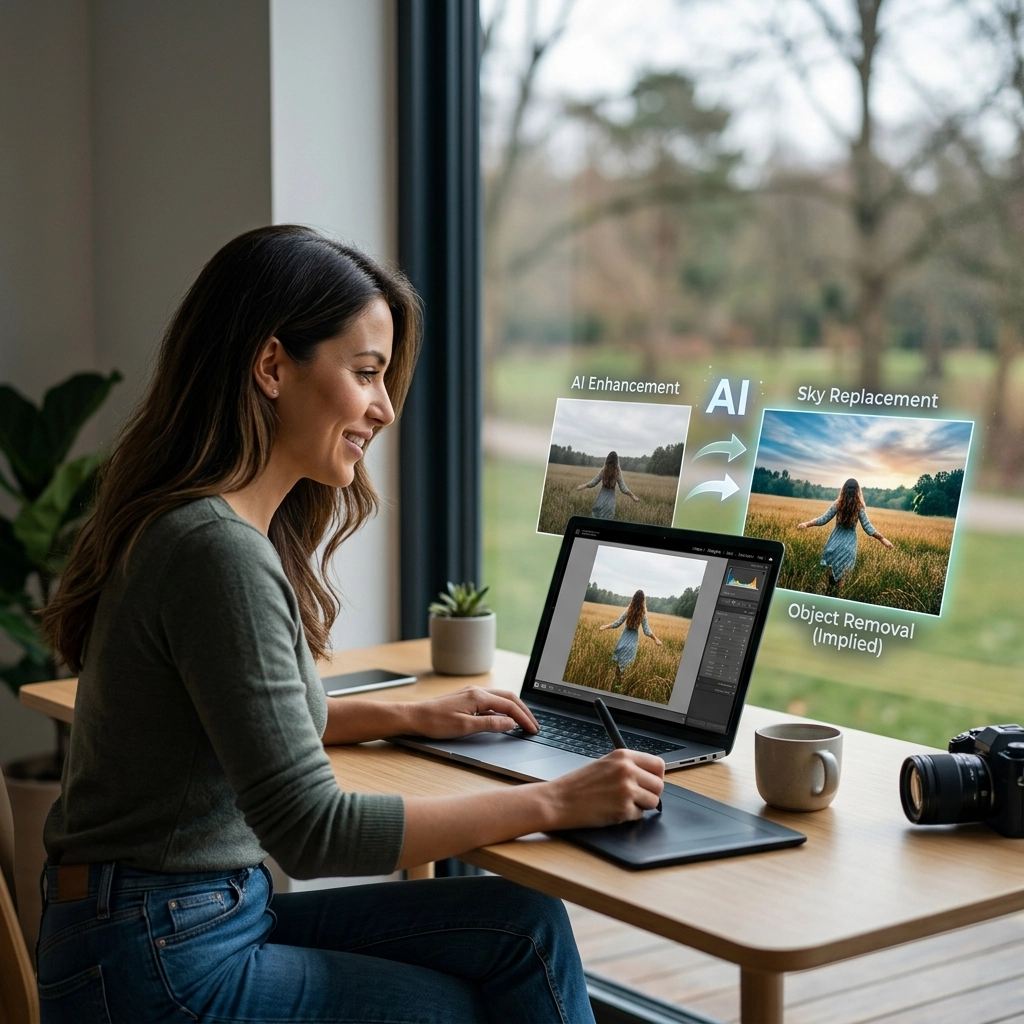
In the old days, a flat, gray sky meant a wasted trip. Today, AI can relight an entire scene based on a new sky. But it doesn’t just "paste" a sky in. It calculates how that new light would reflect off the water, how it would cast shadows on the ground, and how it would change the color temperature of your subject. It’s incredibly sophisticated.
It’s also a lifesaver for business. Commercial creators are using AI to maintain character consistency. If you’re shooting a brand campaign and need the same model to appear in ten different locations you couldn't actually travel to, AI can help bridge that gap while keeping the lighting and "vibe" identical. This level of consistency was nearly impossible for solo creators five years ago.
The Practical Reality: Commercial Safety and Ethics
One reason everyone is talking about AI right now is the legal side of things. In 2026, we’ve moved past the "wild west" of AI. Companies are now focusing on commercially safe AI. This means the models are trained on licensed images, so you don’t have to worry about copyright strikes when you use these tools for client work.
Transparency is also becoming a standard. Many platforms now automatically embed metadata that indicates if a photo was AI-enhanced. This helps maintain trust between the photographer and the audience. We always recommend checking out resources like PhotoGuides.org to stay updated on the ethics of these new technologies.

Why You Should Jump In
If you’re sitting on the sidelines because you think AI is "fake," you’re missing out on a massive creative expansion. Think of AI like the darkroom. Purists once said that developing film with chemicals was "cheating" and that the image should stay exactly as it was on the negative. Then they said Photoshop was cheating. Now, they say AI is cheating.
The truth? The camera is just a box that catches light. What you do with that light is your art.
Using AI allows you to:
- Experiment Faster: You can try ten different "looks" on a photo in thirty seconds.
- Save Your Best Shots: We’ve all had that one perfect shot that was ruined by a stray power line or a blurry face. AI can fix those "unfixable" images.
- Compete with the Big Dogs: Tools like Luminar give hobbyists the power that used to require a full retouching team.
How to Get Started Without Overdoing It
If you’re nervous about your photos looking "too AI," start small. Don’t go straight for the "Generate an entire mountain range" button.
- Step 1: Use AI for Masking. Let the software find the subject for you. It’s faster and more accurate than your mouse.
- Step 2: Use AI for Noise Reduction. AI-powered denoise is lightyears ahead of standard sliders. It can make an ISO 6400 shot look like it was shot at ISO 100.
- Step 3: Subtle Relighting. Use AI to add a bit of "glow" where the sun is, or to slightly brighten a face without affecting the background.
By the time you get comfortable with these, you’ll realize that AI isn't taking over your job: it's just giving you better tools to do it.

The Human Element is Still Number One
Despite all the talk about algorithms and generative fill, the most important part of a photo is the person behind the camera. AI can’t choose the moment. It can’t feel the tension in a room during a wedding. It doesn’t know why a specific sunset makes you feel nostalgic.
The people who are finding the most success in 2026 are those who use AI to handle the technical hurdles so they can focus entirely on the story. Whether you're reading up on the latest tips at blog.edinchavez.com or out in the field getting your boots dirty, remember that the AI is working for you, not the other way around.
Photography has always been about technology: from glass plates to film to digital sensors. AI is just the next chapter. It’s a weird, exciting, and occasionally confusing chapter, but it’s one that is making photography more accessible and more powerful than ever before.
So, the next time you see a headline about AI "destroying" photography, take a deep breath. Then, open up your favorite editor, grab a RAW file, and see what you can create. You might just find that the "magic" of photography hasn't gone anywhere( it just got a lot more interesting.)