
Street photography is the ultimate test of a photographer's reflexes, eye for detail, and patience. We’ve all seen the classic shots: a person walking past a mural, a rainy alleyway, or a black-and-white portrait of a grizzled local. There’s nothing wrong with those: they’re classics for a reason. But if you want to truly stand out in a sea of Instagram feeds and digital portfolios, you need to push past the obvious.
Creating a unique body of work requires stepping outside your comfort zone. It means looking where others aren’t looking and trying techniques that might feel "wrong" at first. Whether you’re shooting with a high-end setup like the Canon EOS R5 vs Sony A7R V or a compact street machine, the goal is the same: to capture a moment that feels fresh.
Here are 25 creative street photography ideas you’ve probably never thought of to help you level up your game.
1. Shoot Through the Mess
Most photographers spend their time trying to find a "clean" shot. They want no distractions between the lens and the subject. Forget that. Start shooting through things. Use metal grates, dirty cafe windows, or low-hanging tree branches to frame your subject. This adds a layer of depth and a voyeuristic quality to the image. It makes the viewer feel like they are peeking into a private moment. If the foreground is blurry enough, it creates a beautiful frame that leads the eye directly to the action.
2. The Worm’s Eye View
We spend our lives seeing the world from about 5 to 6 feet off the ground. That’s boring. To make a mundane street scene look epic, get your camera as low as possible. I’m talking about putting your camera on the actual pavement. This perspective makes pedestrians look like giants and gives ordinary buildings a sense of scale they don't usually have. If you’re using something like the OM System OM-1 Mark II, the articulating screen is your best friend here. You don’t even have to lay in the dirt to get the shot.
3. High Vantage Point Geometry
On the flip side, go high. Find a parking garage, a bridge, or a rooftop. From above, the chaos of the city turns into clean, geometric patterns. People become small dots moving through a grid of crosswalks and shadows. This is where you can focus on "Graphic Street Photography," where the composition is more about shapes and colors than the individuals themselves.

4. The "Interactive" Puddle Reflection
Everyone loves a good puddle shot, but most people just capture the reflection and call it a day. To make it stand out, wait for an interaction. Wait for a cyclist to ride through it, splashing the water, or a pedestrian to step right into the center of the frame. This adds motion and life to what would otherwise be a static, "pretty" picture. For more on capturing these fleeting moments, check out these street photography secrets revealed.
5. Flash in Broad Daylight
Most street photographers are terrified of using flash, and even more are confused about using it during the day. Using a flash in the sun can create a high-contrast, edgy look that feels like a fashion editorial shot on the fly. It fills in harsh shadows and makes your subject "pop" against the background in a way that natural light simply can't. It’s bold, it’s intrusive, and it produces incredible results.
6. Blue Hour Fill-Flash
When the sun goes down and the city lights start to glow with that deep blue hue, pull out your flash again. Using a subtle fill-flash during blue hour allows you to keep the gorgeous ambient light of the city while ensuring your subject isn't just a dark silhouette. It’s a delicate balance, but when you get it right, the colors are magical. For post-processing these tricky lighting situations, I highly recommend using Luminar to balance your exposures and bring out the neon tones.
7. Shadow Play and Long Exposures
Find a spot where the sun is hitting a building and creating a long, sharp shadow. Set your camera on a tripod (or a stable trash can) and use a long exposure. As people walk through the shadow, they will become ghostly blurs, while the stationary architecture stays tack-sharp. This creates a surreal, dreamlike quality that stands out in a portfolio of frozen moments.
8. Neon Night Motion Blur
Night photography doesn't always have to be about sharp, clean tripod shots. Embrace the blur. Photograph moving cars or buses against neon signs. Use a slower shutter speed (around 1/10th or 1/15th of a second) and pan your camera with the movement. The result is a vibrant explosion of color and energy that captures the "soul" of the city at night. If you’re deciding on gear for this, the Sony A7 IV vs Canon EOS R6 Mark II debate is worth looking into for their low-light capabilities.
9. Street Art Parody
Don't just take a photo of a mural. That's taking a photo of someone else's art. Instead, wait for a person to walk by who interacts with the mural in a funny or ironic way. Maybe someone is walking past a mural of a giant bird and it looks like they’re being chased. Maybe they’re walking past a painted "EXIT" sign. This is called juxtaposition, and it’s the hallmark of a clever street photographer.
10. The Nature/Urban Tug-of-War
Cities aren't just concrete and steel. Look for the places where nature is fighting back. A lone weed growing through a crack in the sidewalk, a tree growing around a fence, or a park surrounded by skyscrapers. Highlighting this contrast tells a story about the environment we build for ourselves. You can find more inspiration for these types of conceptual shots over at PhotoGuides.org.

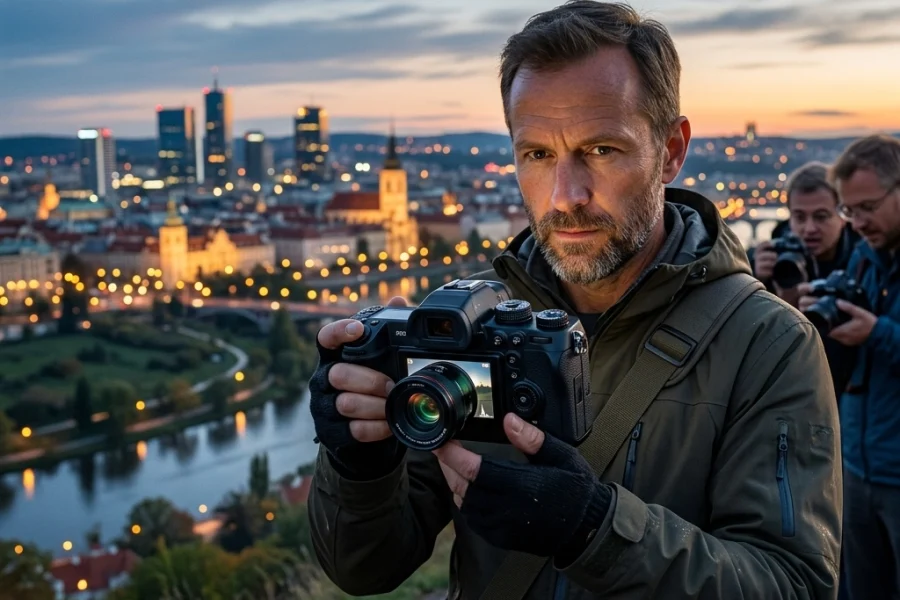
11. Photograph the Photographers
We live in a world where everyone is a photographer. One of the most interesting subjects on the street is other people taking pictures. Whether it’s a tourist with a selfie stick or another "pro" with a massive lens, capturing the act of capturing is a great way to document our modern culture. They are usually so focused on their own shot that they won't even notice you.
12. Focus on the Hands and Feet
You don't always need a face to tell a story. Sometimes, a person’s hands or their choice of footwear says more about them than their expression. Focus on the weathered hands of a street vendor or the shiny shoes of a businessman in a hurry. By isolating these details, you leave the rest of the story up to the viewer's imagination. This is a great exercise for mastering light; check out these 10 things you should know about mastering light.
13. The Power of Pairs
There is a specific dynamic that happens when two people interact. Look for pairs: couples holding hands, friends laughing, or two strangers sitting on a bench but looking in opposite directions. The relationship (or lack thereof) between two subjects creates a much stronger narrative than a single person standing alone.
14. Color Blocking
Choose one color: let’s say red: and spend the entire day only taking photos of things that are red. A red coat, a red fire hydrant, a red car. This forces your brain to stop looking for "subjects" and start looking for "elements." It trains your eye to see the city as a composition of colors. When you put these photos together in a series, they look incredibly professional and intentional.
15. Intentional Camera Movement (ICM)
This is for the experimental souls. Set your shutter speed to about half a second and intentionally move your camera as you take the shot. You can jiggle it, rotate it, or zoom in while the shutter is open. The result is an abstract wash of color and light that looks more like a painting than a photograph. It’s a great way to break a creative block.
16. Shooting Through Glass and Distortions
Storefront windows are a goldmine. Not only can you get reflections, but you can also get distortions from the glass itself. If the glass is old or curved, it will warp the people on the other side. This adds a layer of abstraction that makes the viewer stop and wonder what they are actually looking at. For more tips on using natural elements to your advantage, see this guide on fixing natural light portrait mistakes.
17. The "Pockets of Light" Strategy
In cities with tall buildings, you often get "pockets" of light: narrow beams that hit the street while everything else is in deep shadow. Find one of these spots and wait. When someone walks into that beam of light, they will be perfectly illuminated against a dark background. It’s like having a natural spotlight in the middle of the city.

18. Follow the Cyclists
Cyclists move at the perfect speed for street photography. They are faster than pedestrians but slower than cars. Use a slightly slow shutter speed to capture a bit of motion blur in their legs or wheels while keeping their torso sharp. It conveys the frantic energy of city life perfectly. If you want to dive deeper into technical settings, our OM System OM-1 Mark II settings for sports can actually be applied to fast-moving street subjects too.
19. Double Exposures (In-Camera)
Many modern cameras, like those from Canon and Sony, allow you to create double exposures in-camera. Try overlaying a texture: like a brick wall or a rainy window: over a street portrait. It’s a classic fine-art technique that can add a lot of "soul" to your portfolio. If your camera doesn't do it, you can easily replicate this effect in Luminar using layers.
20. Capturing "The Wait"
Street photography is usually about action, but there is beauty in the stillness. Photograph people waiting for the bus, waiting for a light to change, or waiting for a friend. There is a certain vulnerability in people when they are "waiting": they aren't performing for anyone; they are just existing. These quiet moments often make the most powerful portraits. You can see examples of this kind of storytelling at blog.edinchavez.com.
21. The Monochrome Geometry Challenge
Take all the color out of the equation. Shoot in Black and White mode (or convert later). Without color to distract the eye, you are forced to focus on light, shadow, and geometry. Look for leading lines, repeating patterns, and stark contrasts. This is the foundation of great street photography.
22. Rain as Liquid Diamonds
Don't go inside when it starts raining. Rain creates atmosphere that you can't fake. Use a fast shutter speed to freeze the raindrops in mid-air. If there are streetlights nearby, the drops will catch the light and look like little diamonds falling from the sky. Just make sure your gear is weather-sealed!
23. The "Decisive Interaction"
This is the holy grail. It’s when two or more independent elements in a frame come together to create a single, unified story. A man pointing at a sign that says "THIS WAY," while a dog looks in the opposite direction. It’s about timing and anticipation. It requires you to see the photo before it actually happens.
24. Utilize Rear-Curtain Sync
If you are using flash at night, set your camera to "Rear-Curtain Sync." This tells the camera to fire the flash at the end of the exposure. This results in a sharp subject with light trails trailing behind them, rather than in front of them. It looks much more natural and creates a fantastic sense of speed.
25. The Silhouette Story
Find a strong light source (like the setting sun at the end of a street) and expose for the highlights. This will turn anyone walking toward you into a perfect silhouette. Without facial features, the subject becomes "everyman." It turns a specific person into a symbol, making the image feel more universal. For more fine art inspiration, check out EdinFineArt.com.

Elevate Your Portfolio with Intentionality
The biggest mistake street photographers make is just walking around and "hoping" to see something. While serendipity is part of the game, the best portfolios are built on intentionality. If you go out with one of these 25 ideas in mind, you’ll start seeing the world differently. You’ll stop looking for "stuff" and start looking for "light, shape, and story."
Don't be afraid to fail. For every great street shot, there are a thousand terrible ones. That’s just the nature of the beast. The more you experiment with these unconventional ideas, the more likely you are to capture something that truly stands out.
If you really want to master these techniques and get a handle on the technical side of things, you should check out the daily photography tutorials we offer. They cover everything from basic settings to advanced composition.
Ready to take your street photography to the next level? Head over to https://learn.shutyouraperture.com/ and join our community of photographers. Whether you're looking for deep dives into gear or creative workshops, we've got everything you need to succeed.
Street photography isn't just about the "street": it's about how you see the world. So grab your camera, get out there, and start breaking the rules. Your portfolio will thank you for it.