It’s Thursday, April 16, 2026, and if you haven’t checked your feed this morning, you’re already behind. The photography world is moving at a breakneck pace. Between the massive reveals at NAB 2026 and surprise drops from manufacturers like Viltrox and GoPro, the "standard" workflow we’ve been using for the last few years is being completely rewritten.
At Shut Your Aperture, we’re always looking for ways to simplify the process. Whether you’re shooting a hi-end product shoot or capturing the raw streets of Varanasi, India, the gear you use and the software you edit with dictate how much time you spend behind a screen versus behind a lens.
Today’s news isn’t just about "new toys." It’s about tools that solve old problems. Let's dive into why these new releases are going to change the way you work starting today.
The Lens Revolution: High Performance for Less
The biggest news for the budget-conscious professional is the explosion of high-quality glass from third-party manufacturers. For a long time, if you wanted the best, you had to pay the "first-party tax." Not anymore.
Viltrox AF 15mm f/1.7 Air
Viltrox has officially dropped the AF 15mm f/1.7 Air. This is a fast, wide-angle prime designed specifically for APS-C sensors. Why does this matter? If you’re shooting on a Sony Alpha a6000 series or the latest Fujifilm X-T1 successors, you know that finding a wide, fast, and light autofocus lens can be a challenge.
This lens is feather-light, making it perfect for gimbal work or vlogging. It bridges the gap for Nikon Z shooters who have been waiting for more dedicated DX autofocus primes. It’s a game-changer for architecture and landscape photographers who need to pack light but don't want to sacrifice aperture.
Alt text: A photographer using a compact wide-angle lens on a mirrorless camera to capture an urban skyline at dusk.
Thypoch 24-50mm f/2.8
Then we have Thypoch. They are showing off the 24-50mm f/2.8 at the NAB show this week. This is being hailed as the first Chinese full-frame autofocus constant-aperture zoom lens. The "constant aperture" part is key. For years, third-party zooms often had variable apertures that made video work a nightmare. This lens signals that the competition is heating up, and we can expect more affordable, pro-grade zooms to hit the market soon. If you're looking to upgrade your kit, keep an eye on these developments over at Shut Your Aperture.
Software Shakeups: The Death of the Subscription?
Workflow isn't just about what's in your bag; it's about what's on your hard drive. 2026 is becoming the year that creators finally have viable alternatives to the Adobe ecosystem.
DaVinci Resolve’s "Photos Mode"
Blackmagic Design just dropped a bombshell. DaVinci Resolve has added a dedicated "Photos Mode." We all know Resolve is the king of color grading for video, but this move puts them directly in competition with Lightroom.
For hybrid creators, those of us who shoot both stills and video, this is massive. Imagine grading your photos with the same precision you use for your cinema projects, all within the same application. This consolidation means fewer subscriptions, a unified color pipeline, and a much faster delivery time. If you want to learn more about professional video workflows, check out www.proshoot.io.
AI Mastery with Luminar Neo
On the other side of the software world, Skylum has released Luminar Neo version 1.27. This update focuses heavily on creative automation. The new AI portrait tools and Bokeh AI are scary good.
We used to spend hours masking out hair or creating realistic depth of field in post. Now, Luminar handles it in seconds. For wedding photographers who have thousands of images to process, this kind of AI integration is a lifesaver. You can read more about Edin’s personal editing tips over at blog.edinchavez.com.
Alt text: A computer screen displaying an AI-powered photo editing software interface with a portrait being enhanced.
The Action Cam Reimagined: GoPro Mission 1 Pro
For a decade, GoPro has followed a "don't fix what isn't broken" philosophy. But today, they’ve broken the mold. The GoPro Mission 1 Pro has been unveiled, and it features, wait for it, interchangeable lenses.
This is a massive shift. Historically, if you wanted a different field of view on an action cam, you had to use digital cropping (which kills resolution) or weird adapters. The Mission 1 Pro changes the category from a monolithic device to a modular system.
For those of us filming drones and the skies of tomorrow, being able to swap a wide lens for a linear or even a macro lens on an action camera opens up shots that were previously impossible without a much larger rig. It changes the workflow for adventure photographers who need high-end quality in a crash-proof body.
The Analog-Digital Bridge: I'm Back Roll
There is a certain soul in film photography that digital often struggles to replicate. We’ve seen photographers like Poliana Devane capture incredible moments that feel timeless. But let's be honest: the cost of film and the time required for developing is a hurdle.
Enter the "I'm Back Roll." This digital back for old film cameras has just cleared its Kickstarter goal with over half a million dollars. It uses a 26MP APS-C Sony sensor that fits into your old 35mm SLR. You get the tactile feel of your vintage Nikon or Canon, but the images go straight to an SD card.
This is more than a novelty; it’s a way to keep historic gear in the professional workflow. Instead of letting your old gear sit on a shelf like classical sculptures, you can actually use it for modern assignments.
Alt text: A vintage 35mm film camera fitted with a modern digital back accessory on a wooden table.
NAB 2026: The Cinema Giants
The National Association of Broadcasters (NAB) show is where the heavy hitters play. This year, Canon and Nikon are going head-to-head in the cinema space.
Canon MS-510 and the Monster Zoom
Canon unveiled the MS-510 Multi-Purpose Camera. While it’s technically an industrial camera, the tech inside, specifically its low-light capabilities, is expected to trickle down to the next generation of consumer mirrorless cameras.
But the real show-stopper is the Canon Cine-Servo 40-1200mm T5.0-10.8 lens. Yes, you read that right: 1200mm. This is for the wildlife and sports shooters who need to see the sweat on a player's brow from the opposite end of the stadium. It’s a lens that redefines what "long-distance" photography means.
Nikon ZR Cinema Camera
Nikon, not to be outdone, has released the ZR cinema camera. Following their acquisition of RED, Nikon is finally taking the cinema market seriously. The ZR is a dedicated video body that uses the Z-mount, making it compatible with all those Nikon lenses you already own. This is a huge win for Nikon shooters who previously had to jump ship to Sony or RED for high-end video production.
Alt text: A professional cinema camera rig with a large cine-servo lens set up on a tripod at a sporting event.
How These Releases Change Your Workflow
So, why does any of this matter to you? If you’re a working pro or a serious hobbyist, these releases are about two things: Efficiency and Expansion.
- Lower Entry Barriers: With companies like Viltrox and Thypoch providing pro-grade glass at half the price, you can expand your creative toolkit without a massive loan. This allows you to say "yes" to more diverse jobs, like travel photography or high-end product work.
- Faster Delivery Times: AI tools in Luminar and the unified workflow of DaVinci Resolve mean you spend less time clicking and more time creating. In a world where clients want photos delivered before the event is even over, these tools are essential.
- New Creative Perspectives: The modularity of the GoPro Mission 1 Pro and the extreme reach of the new Canon lenses mean we can capture the world in ways that literally weren't possible yesterday.
The Industry Trend: Modular and AI-Driven
Looking at the landscape of April 2026, the trend is clear. We are moving away from the "one size fits all" camera and toward modular systems. Whether it’s putting a digital back on a 40-year-old camera or swapping lenses on a GoPro, the gear is becoming more flexible.
At the same time, AI is no longer a gimmick. It’s the engine under the hood. From autofocus tracking that never misses to Luminar’s ability to transform a flat image into a masterpiece, AI is the silent assistant in your studio.
If you’re feeling overwhelmed, don’t be. You don't need to buy everything at once. Pick the one tool that solves your biggest headache. Is it editing time? Try Luminar. Is it a lack of a wide-angle lens? Look at the Viltrox Air.
The goal of technology should always be to get out of the way of your vision. As the news continues to roll in from NAB 2026, we’ll be here to filter through the noise and tell you what actually matters for your craft.
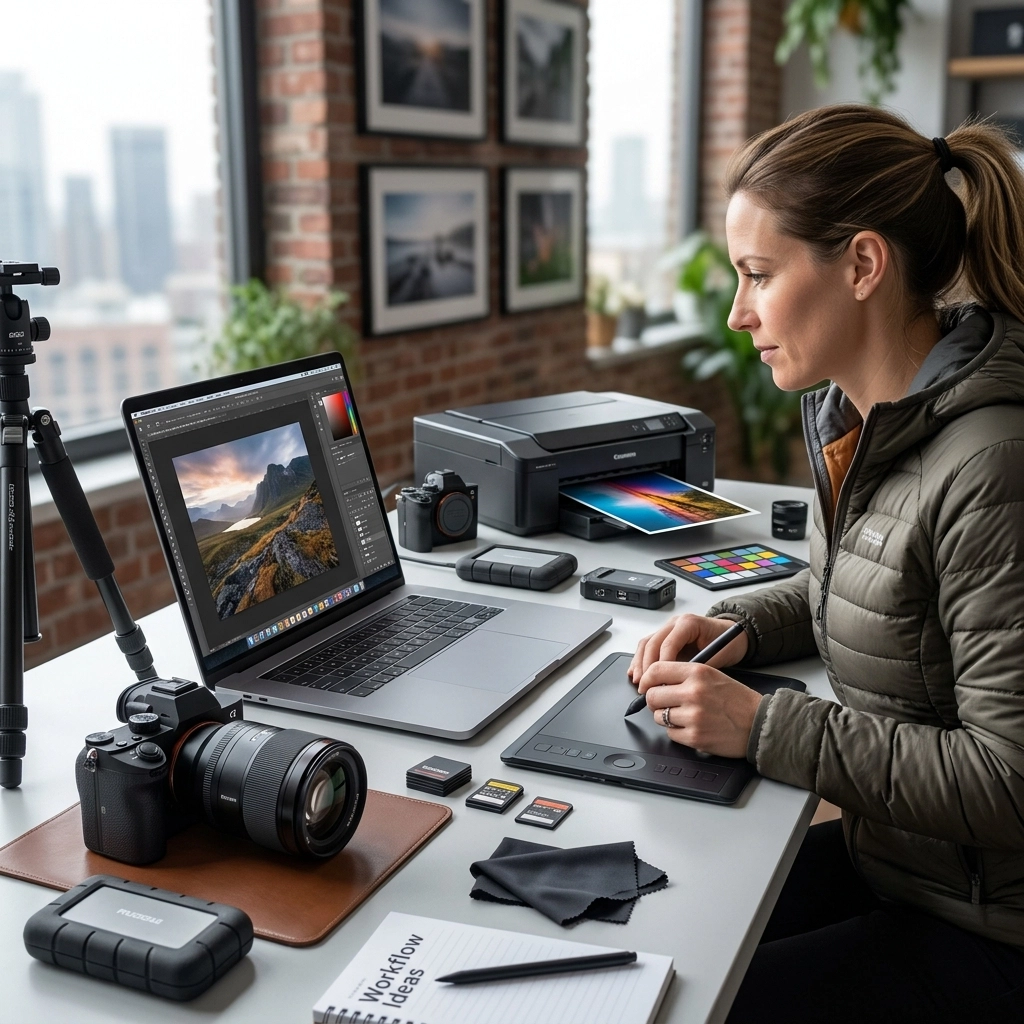
Alt text: A clean, modern photography studio setup with a camera, laptop showing editing software, and various lenses.
Photography is changing, but the core remains the same: it's about the story you tell. Whether you’re shooting with a Nikon D4s or the latest mirrorless beast, use these new tools to tell better stories, faster.
Check back often at Shut Your Aperture for more updates, and don't forget to check out the incredible fine art over at www.edinfineart.com for some inspiration on what to do with all that new gear. Stay creative, keep shooting, and maybe, just maybe, turn off the news for a few hours today and go take some photos.