For the underlying mechanics behind every choice below, our aperture photography guide is the fastest way to get fluent.
Let’s be honest: professional studio lighting is expensive. You look at those massive octaboxes and high-end strobes and suddenly your bank account starts sweating. But here’s a secret that the big gear companies don’t want you to know, light is just light. Whether it comes from a $3,000 Profoto flash or a $10 lamp from a thrift store, your camera doesn't know the difference. It only cares about how that light hits the subject.
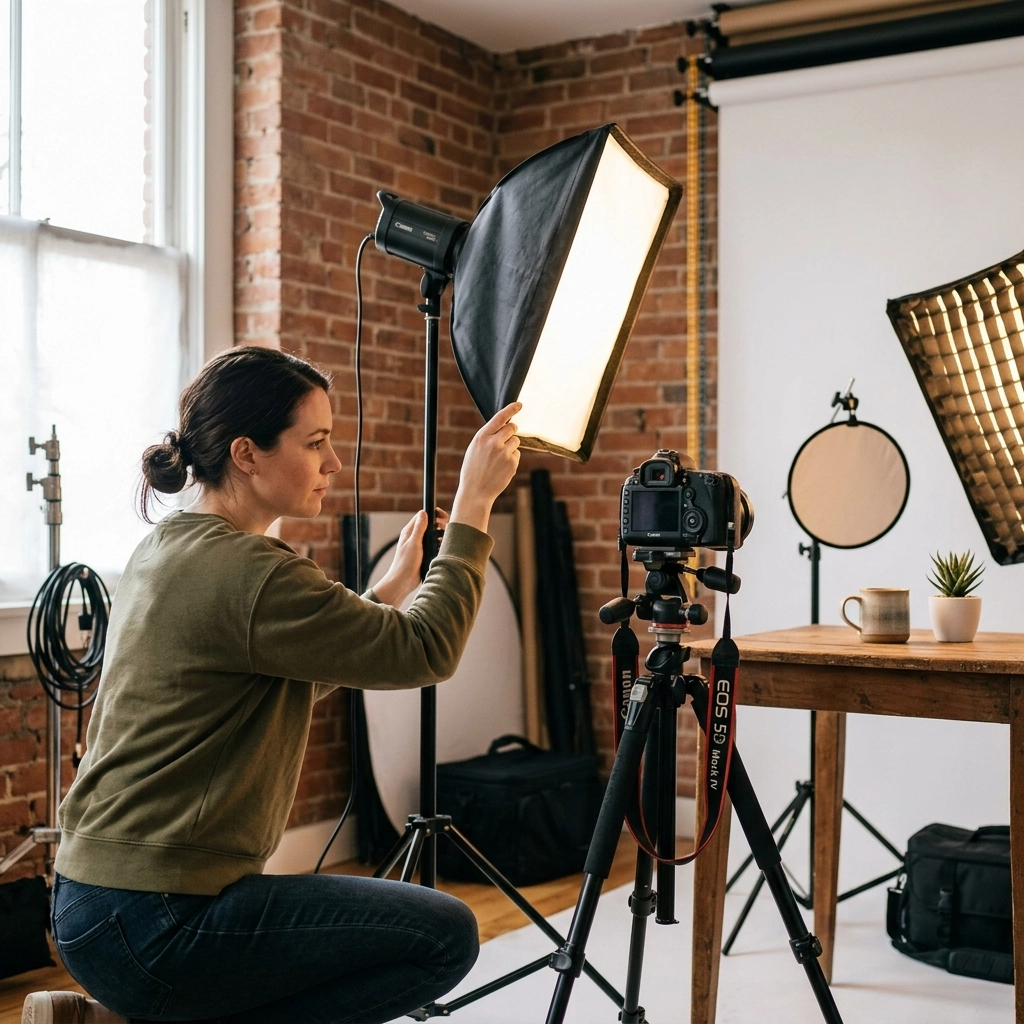
Setting up a home studio doesn't require a second mortgage. It requires a bit of creativity and a willingness to look at household objects as potential modifiers. If you’ve been struggling to get that "professional look," you’re in the right place. We’re going to dive into 20 lighting hacks that will turn your spare bedroom or even your kitchen table into a high-end photography studio.
1. The Milk Jug Diffuser
If you have an external flash (a speedlight), you know how harsh that direct light can be. It creates "deer in headlights" eyes and shadows that look like they were drawn with a permanent marker. The fix? An empty, translucent milk jug. Cut a hole in the side, slide it over your flash, and boom, you have a DIY softbox. The plastic diffuses the light, spreading it out and making it much softer on your subject’s skin.
2. The White Foam Board Reflector
Go to any craft store or even a dollar store and pick up a large white foam board. This is arguably the most important tool in any home studio. If you’re shooting with one light source (like a window), the other side of your subject’s face will be in deep shadow. Hold that white board on the dark side to "bounce" some of that light back. It’s subtle, but it makes a massive difference in filling those shadows.
3. The Pringle Can Snoot
A "snoot" is a tube that fits over a light to create a very narrow, focused beam. It’s perfect for highlighting hair or a specific part of a product. An empty Pringle can is the perfect size for most speedlights. Eat the chips, wipe out the grease, and slide it over your flash. If you want to get really fancy, you can line the inside with silver foil or even tape black straws inside the tube to create a "grid" effect, which makes the light beam even tighter.
4. The Shower Curtain Scrim
Need a massive softbox but don't have $200? Buy a plain white, frosted shower curtain. You can hang this in front of a window or even blast a cheap work light through it. Because the surface area is so large, the light becomes incredibly soft and wrap-around. This is a classic "pro" hack used by photographers who need to shoot large groups or soft portraits on a budget. You can find more gear tips over at Shut Your Aperture.
5. Tablet and Smartphone Backgrounds
If you are doing small-scale product photography (like watches or jewelry), your tablet is a secret weapon. Find a high-resolution image of a sunset, a bokeh forest, or even a solid color, and use it as your background. The screen is its own light source, which gives the product a beautiful, clean glow from behind. This is a great way to avoid the 7 mistakes you’re making with corporate headshots when you're practicing lighting for smaller subjects first.
6. The "Poor Man's" Ring Light
Ring lights give that cool circular reflection in the eyes (catchlights). To make one, take a piece of cardboard, cut a large circle, and then a smaller hole in the middle for your lens. Line the cardboard with tinfoil (the crinkly side out for more diffusion) and point your flash toward the foil. The light will bounce off the silver and wrap around your lens. It’s not a $500 LED ring, but for a headshot, it works surprisingly well.
7. Parchment Paper Diffuser
If your kitchen lights are too yellow or your desk lamp is too bright, tape a piece of parchment paper (baking paper) over the light. Unlike regular paper, it won’t catch fire easily (though you should still be careful and never leave it unattended) and it creates a beautiful, neutral diffusion. It’s perfect for macro photography where you need to get the light close without blowing out the highlights.
8. Use a Mirror for Hard Rim Light
Sometimes you want a "rim light", that thin line of light that separates the subject from the background. Instead of buying a second light, place a small mirror behind your subject, angled back toward them. Position your main light so it hits the mirror. The mirror will reflect a hard, focused beam of light onto the back of your subject. It’s an easy way to make your photos look three-dimensional.
9. Black Foam Core "Flags"
In photography, sometimes the best thing you can do is remove light. Black foam core boards (the opposite of our white bounce boards) are used as "flags." If light is spilling onto your background and you want it to be dark, use a black board to block the light. This is how you get those moody, low-key portraits where the subject seems to emerge from the darkness.
10. Christmas Lights for Bokeh
Don't put those fairy lights away after December. If you drape them in the background and use a wide aperture (like f/1.8 or f/2.8), they turn into beautiful, soft orbs of light. This adds a ton of depth to a home studio that might otherwise look a bit boring. If you're shooting on a modern mirrorless camera, like we discussed in the Panasonic Lumix S5 II vs Sony A7 IV comparison, the eye-autofocus will keep your subject sharp while those lights melt into the background.
11. The Window and Foil Combo
Natural light is your best friend. Find the biggest window in your house. However, window light can be "one-sided." To balance it out, take a piece of cardboard and wrap it in aluminum foil. Use the shiny side for a "harder" fill light and the matte side for a "softer" fill. This is the ultimate budget setup for food photography or portraits.
12. DIY Color Gels
Professional color gels are just colored pieces of plastic. You can get the same effect using colored plastic folders from an office supply store. Tape a piece of red or blue folder over your flash to change the mood of your shot. This is especially effective for coloring your background while keeping your subject naturally lit.
13. Using a White Wall as a Softbox
This is the simplest hack on the list. If you have a speedlight, don't point it at your subject. Point it at the white wall or ceiling behind you. The light will hit the wall, spread out, and bounce back as a massive, soft light source. It’s the easiest way to light a room evenly without any fancy modifiers. If you want to see how these techniques look in a professional setting, check out Edin Chavez’s blog.
14. Halogen Work Lights
If you don't have a flash, go to the hardware store and buy a portable halogen work light. They are incredibly bright and very cheap. The downside? They get hot enough to cook an egg, so keep them away from anything flammable. They also have a very "warm" (orange) color temperature, which can look great for moody, golden-hour style portraits in your garage.
15. The Slinky or Glass Prism
Want some "light leaks" or weird, ethereal flares? Hold a glass prism or even a metal Slinky right in front of your lens while a light source hits it from the side. It will reflect light into the lens, creating rainbows and flares that look like they were done in post-processing. It adds a creative, "artsy" vibe to your studio work.
16. Pantyhose over the Lens
This is an old-school Hollywood trick. If you want that soft, dreamy, glowing skin look, stretch a piece of black pantyhose over the front of your lens and secure it with a rubber band. It acts as a natural diffusion filter, softening the highlights and making the skin look flawless. It’s much cheaper than buying a Pro-Mist filter.
17. Cardboard Gobos
"Gobo" stands for "Go Between." It’s something you put between your light and your subject to create a pattern. Cut slits in a piece of cardboard to mimic window blinds, or poke random holes in it to create a "dappled sunlight" effect. It’s an instant way to add texture to a flat studio shot. This is a great tip for those moving from landscape photography into the studio, where you have to create your own "nature."
18. Phone Torch Light Painting
Turn off all the lights in your room. Set your camera on a tripod with a long exposure (around 10-20 seconds). Use your phone’s flashlight to "paint" light onto your subject. You can highlight exactly what you want and leave the rest in shadow. It’s a fun, experimental way to create images that look totally unique.
19. The White Sheet Backdrop
You don't need a professional backdrop stand. A clean, ironed white bedsheet taped to a wall works perfectly. If you place your subject far enough away from the sheet and light the sheet separately, it will turn pure white. If you don't light the sheet, it will fall into a soft gray. It’s two backdrops for the price of… well, something you already own.
20. Finishing Touches in Luminar
Even with the best DIY hacks, sometimes you need a little help in post-processing to make those lights pop. I highly recommend using Luminar. Its AI tools can enhance the glow of your DIY lights, fix any color temperature issues from using hardware store bulbs, and add professional-level finishing touches with just a few clicks. Whether you’re trying to fix a skin tone or add a sun flare that your DIY snoot didn't quite catch, Luminar is a lifesaver for home studio photographers.
Why DIY Matters
The reason these hacks are so valuable isn't just about saving money (though that’s a huge plus). It’s about understanding the physics of light. When you build your own softbox or figure out how to bounce light off a mirror, you’re learning how light moves, how it softens, and how it reacts to different surfaces.
This knowledge is what separates a "button-pusher" from a photographer. Once you master the milk jug and the foam board, stepping up to professional gear feels like a breeze because you already understand the fundamentals.
For more inspiration on how to use light to create high-end art, take a look at the gallery at Edin Fine Art. You'll see how professional lighting principles: the same ones we've discussed here: are applied to create world-class imagery.
Keep Up With the Tech
While DIY is great, it’s always good to know what’s happening in the professional world. Technology is moving fast, and staying updated on the latest gear and software is crucial. You can stay in the loop by reading our latest updates on photography news and gear.
So, clear off your kitchen table, grab a Pringle can, and start shooting. The only thing standing between you and a great photo isn't a lack of expensive lights: it's just a lack of practice. Go get creative!