Let’s be real for a second. If you’ve picked up a camera or opened a laptop in the last year, you’ve been hit with a tidal wave of "AI this" and "AI that." It’s everywhere. It’s in our phones, it’s in our mirrorless bodies, and it’s definitely in our editing suites.
Some photographers are looking at AI like it’s the end of the world, the "death of the art form." Others are embracing it like a long-lost friend who finally showed up to help carry the heavy gear. Here at Shut Your Aperture, we lean toward the latter. Why? Because the tech isn't going away, and frankly, it’s making our lives a whole lot easier.
It is Friday, May 1, 2026, and the landscape of photography has shifted more in the last three years than it did in the previous twenty. If you aren't talking about AI, you're missing out on the biggest evolution since the transition from film to digital.
The "Dirty Word" That Isn't So Dirty Anymore
For a while, "AI" was a dirty word in the photography community. It felt like cheating. If the computer was doing the work, were you even a photographer? But let’s look back at history. People said the same thing about autofocus. They said the same thing about digital sensors. They even said the same thing about Photography 101: A Beginner’s Guide to Mastering Your First Camera when people stopped developing their own film in darkrooms.
The truth is, AI in photography isn't just about "generating" fake images from scratch. It’s about computational photography, using math and machine learning to overcome the physical limitations of glass and light. It’s about spending less time staring at a progress bar and more time behind the lens.

Workflow: The Silent Killer of Creativity
Ask any pro photographer what they hate most about their job, and 9 out of 10 will say "culling." Standing in a room with 3,000 photos from a wedding and having to pick the best 400 is a special kind of purgatory.
This is where AI is a literal lifesaver. Modern tools can now scan your entire catalog, identify eyes that are closed, blurry shots, or that one uncle who always makes a weird face, and filter them out in seconds. What used to take a whole Sunday now takes the time it takes to brew a pot of coffee.
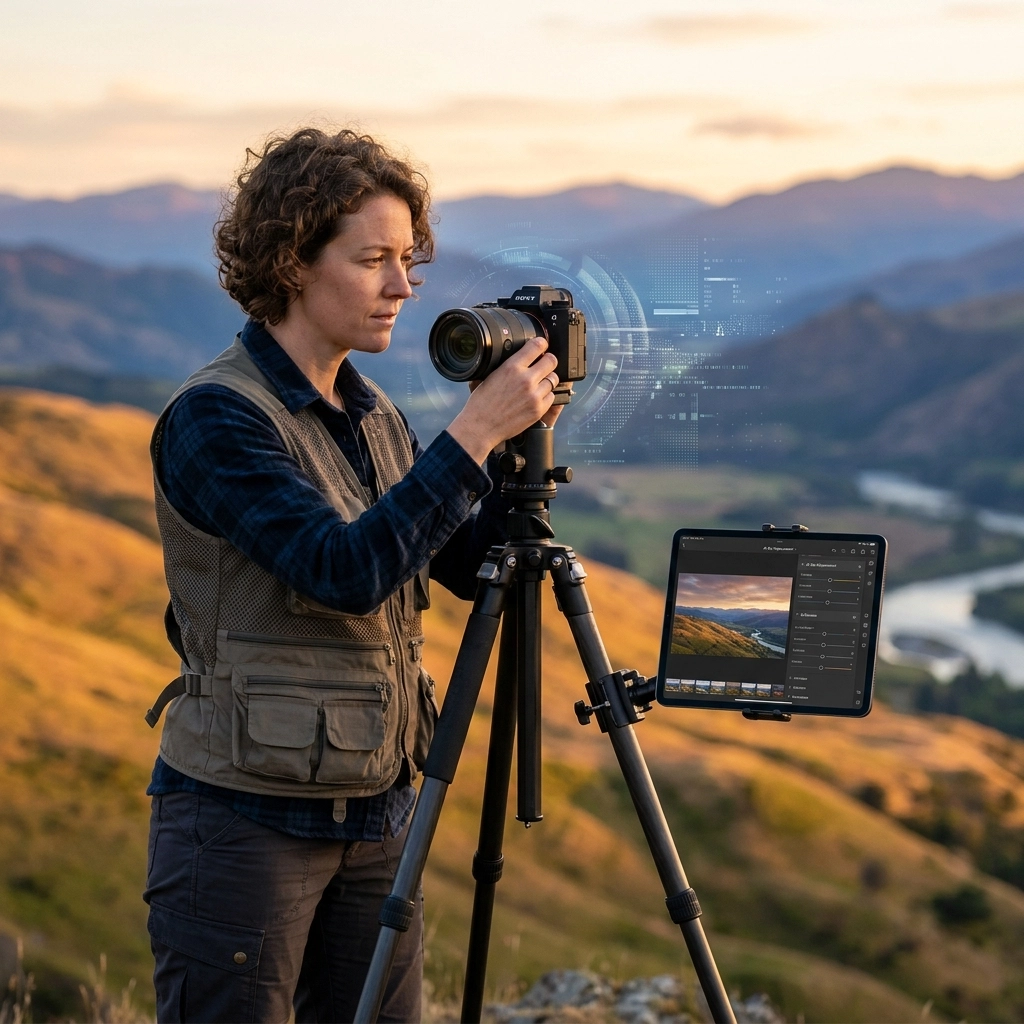
And then there’s the editing. We’ve all spent hours masking out a sky or trying to fix a grainy shadow. Software like Luminar has turned these complex tasks into simple sliders. Need to enhance the structure of a building? Done. Want to replace a grey sky with a dramatic sunset? One click. You can see how this tech allows for incredible creative expression over at blog.edinchavez.com, where the focus is often on the final vision rather than the technical slog.
AI Inside the Camera: The Tech You’re Already Using
You might think you’re an "AI-free" photographer, but if you’ve bought a camera in the last two years, you’re probably lying to yourself. AI-powered mirrorless tech is the new standard.
Think about subject tracking. Old-school phase detection was great, but modern AI-driven autofocus can distinguish between a human eye, a bird’s wing, or the front tire of a motorcycle. It doesn't just "see" contrast; it "recognizes" the subject. This is exactly why everyone is talking about AI-powered mirrorless tech lately. It has made the "keeper rate" for action and event photographers skyrocket.
Even for something as high-pressure as a wedding, having the right Canon EOS R6 Mark II settings for wedding photography means leaning into those AI features to ensure you never miss the kiss because the camera decided to focus on a flower arrangement in the background.

The Ethics: Where Do We Draw the Line?
Now, we have to talk about the elephant in the room: Authenticity. If you use AI to add a mountain range that wasn't there, is it still a photograph?
This is a hot debate on sites like PhotoGuides.org, and there isn't one "right" answer. It depends on your goal. If you are a photojournalist, AI manipulation is a hard no. You’re there to document reality. But if you’re a digital artist or a commercial photographer, AI is just another brush in your kit.
The key is transparency. There’s a big difference between using AI to clean up sensor dust and using it to generate a person who wasn't at the shoot. As AI becomes more powerful, our value as photographers will shift from "the person who took the picture" to "the person with the vision and the ethics to use the tools correctly."
If you’re just starting out and feeling overwhelmed by these questions, I highly recommend checking out 5 steps: how to master manual mode. Learning the fundamentals of light and manual control gives you the foundation to know when to use AI and when to rely on your own skills.
Democratizing Greatness
One of the coolest things about AI is how it’s opening doors for beginners. Photography has always had a steep learning curve. You had to understand the exposure triangle, focal lengths, and complex post-processing just to get a "decent" shot.
AI lowers that barrier. It allows a hobbyist to get professional-looking results without five years of art school. Some pros hate this because they feel it devalues their expertise. But look at it this way: when everyone has access to great tools, the only thing that separates you is your unique eye and your ability to tell a story.
If you want to sharpen that eye, you should dive into some of the resources at https://learn.shutyouraperture.com/. We focus on the "why" of photography, not just the "how." Because even the smartest AI in the world can't tell you why a certain moment is worth capturing. It can't feel the emotion of a bride’s father seeing her in her dress for the first time. It just sees pixels.

The Post-Processing Revolution
Let’s talk about the specific tools making waves. Luminar has been a leader in this space, introducing "Generative Erase" and "Sky AI" long before the big players caught up. These tools aren't just for making things look "pretty"; they are for fixing mistakes.
We’ve all been there, you capture the perfect corporate headshot, but there’s a stray hair across the eye or a distracting exit sign in the background. In the old days, that was a 20-minute clone-stamp job. Now? It’s a 5-second AI fix.
This speed allows photographers to handle higher volumes of work without burning out. It means you can deliver a gallery to a client in 48 hours instead of two weeks. That is a massive competitive advantage. You can see the result of high-end, polished work that utilizes these modern workflows by browsing the collections at www.edinfineart.com.
Will AI Replace Photographers?
The short answer: No.
The long answer: It will replace photographers who refuse to evolve.
An AI can generate a "sunset on a beach," but it can't go to your specific beach at 5:42 AM, smell the salt air, and decide that the way the light is hitting that specific piece of driftwood is the shot that matters.
Photography is about the human experience. It's about being in the room. AI is a tool, like a tripod or a flash. It helps us execute our vision, but it doesn't provide the vision itself. The photographers who are thriving right now are the ones using AI to handle the "grunt work" so they can focus on directing their subjects and finding unique angles.

Tips for Embracing AI Without Losing Your Soul
- Use it for the boring stuff first. Start with AI culling and noise reduction. These don't change the content of your photo; they just make the technical quality better.
- Experiment with Generative Fill. Don't be afraid to try adding or removing elements in your personal work. It’s a great way to see what the tech is capable of without the pressure of a client project.
- Stay updated on software. Programs like Luminar update constantly. Spend an hour a month just playing with the new features.
- Focus on storytelling. As "perfect" images become easier to create, "meaningful" images become more valuable. Spend more time thinking about the story you want to tell.
- Check your ethics. Decide where your personal line is. Will you tell clients if you used AI to change the background? Setting these rules for yourself now will save you a headache later.
Final Thoughts
The conversation around AI in photography is loud because it’s a big deal. It’s changing the gear we buy, the way we edit, and how we define "a photograph." But at the end of the day, a camera is still just a box that captures light. Whether that light is processed by a chemical, a digital sensor, or an AI algorithm, the goal remains the same: to stop time and share a piece of the world.
Don't run away from the future. Grab your camera, keep an open mind, and use every tool at your disposal to make something incredible. If you're looking for more tips on how to navigate this changing world, keep hanging out with us here or head over to PhotoGuides.org for more deep dives into the craft.
Photography has always been a marriage of art and technology. AI is just the latest chapter in that story. So, why is everyone talking about it? Because for the first time in a long time, the only limit to what we can create is our own imagination. And that’s a pretty exciting place to be.