
It is May 2026, and if you are still spending three hours watching a video on how to manually mask a stray hair in a portrait, you are basically using a flip phone in a smartphone world. The world of photography news moves fast, but the world of photo editing is moving at light speed. We’ve reached a point where AI isn't just a "helper" tool; it is fundamentally rewriting the script on how we learn to edit our photos.
Remember the days of searching for photography tutorials and finding a 45-minute video where the first 20 minutes were just the creator talking about their coffee? You’d sit there, scrubbing through the timeline, trying to find the one specific part where they show you how to use the Pen Tool without making the selection look like a jagged mess. Those days are gone. AI has turned the "how-to" into "what-if."
In this deep dive, we’re going to look at why photo editing tutorials are changing forever, how photography for beginners has become a completely different beast, and why your choice of the best mirrorless cameras now depends as much on the software as the glass.
The Death of the "Click-by-Click" Tutorial
For decades, learning photo editing was about muscle memory. You had to learn where the buttons were, what the keyboard shortcuts did, and the technical physics of how layers interact. If you wanted to master landscape photography tips, you spent months learning how to blend exposures manually.
But look at Luminar or the latest Adobe updates. They’ve replaced the "how" with the "what." Instead of a tutorial teaching you how to use the Dodge and Burn tools to make a mountain pop, modern photo editing tutorials are shifting to teach you how to guide the AI’s intent.
We are moving from being technical operators to being creative directors. When the AI can recognize a sky, a foreground, and a subject instantly, the tutorial no longer needs to show you how to draw a mask. It needs to show you how to choose the right mood. This is a massive shift in photography news that many traditionalists are still struggling to wrap their heads around.

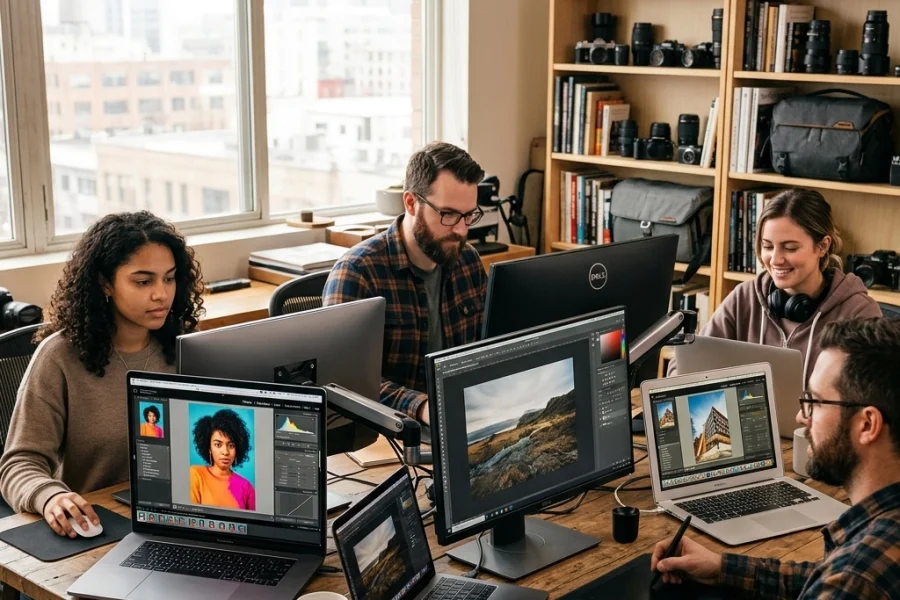
Alt text: A photographer sitting at a sleek, modern desk with a dual-monitor setup, using a tablet to edit a vibrant landscape photo where AI elements are highlighted in a futuristic HUD interface.
Photography for Beginners: The Learning Curve has Leveled Out
If you’re just starting, you’ve picked a great time. In the past, photography for beginners usually started with a heavy dose of frustration. You’d take a decent photo, open it in an editor, and realize you didn't have the technical skill to make it look the way it did in your head.
Now, with AI-driven tools, that gap is closing. Beginners can now achieve professional-grade results in seconds. Does this mean the skill is gone? No. It means the barrier to entry has moved. The tutorial of 2026 isn't about "how to remove a person from the background"; it’s about 30 creative street photography ideas for your next urban adventure and how to use AI to enhance the story you’re already telling.
If you are looking to get started with the basics of the craft, you should still learn how to use manual mode camera because understanding light is something AI can enhance, but it can’t replace your artistic vision.
Landscape Photography Tips in the AI Era
Landscape photographers are perhaps the most affected by this shift. Traditional landscape photography tips used to involve carrying heavy graduated neutral density filters and spending hours in cold weather waiting for the "perfect" light. While we still love a good sunrise, AI tools like those in Luminar allow us to relight a scene realistically after the fact.
The new wave of tutorials focuses on "Generative Expand" and "Sky AI." If your wide-angle lens wasn’t quite wide enough to capture that epic cliffside, AI can now fill in the blanks with startling accuracy. Tutorials are now teaching photographers how to maintain authenticity while using these powerful tools. It’s a fine line, and that’s exactly what the new generation of educators is focusing on.
You can find more advanced insights on these techniques over at PhotoGuides.org, where the focus is on merging traditional skills with new-age tech.
Street Photography Ideas and the AI Cleanup
Street photography is all about the "decisive moment." But sometimes, that moment is ruined by a trash can or a distracting neon sign. In the old days, you’d either live with it or spend an hour with the Clone Stamp tool.
Now, street photography ideas often involve "cleaning the frame" using AI. Tutorials for street photographers have shifted toward composition and ethics. The technical "how" is just a button click away, so the conversation has moved to: "Just because you can remove that person, should you?"
This is a recurring theme in today’s morning photography news. We are constantly debating the reality of the image in a world where AI can change anything.
Alt text: A busy city street scene at night with neon lights, showing a side-by-side comparison of a raw photo and an AI-edited version where distracting elements have been seamlessly removed.
Portrait Photography Techniques: Retouching is Now Instant
If you've ever followed portrait photography techniques, you know that high-end skin retouching (frequency separation, anyone?) used to be the "final boss" of photo editing. It took forever to learn and even longer to do.
Today, AI-powered "Face Recovery" and "Skin AI" do 90% of the work in three seconds. Consequently, photo editing tutorials for portraits are now focusing more on color grading and lighting styles. We aren't teaching people how to fix blemishes anymore; we’re teaching them how to emulate the look of classic film stocks or high-fashion editorials.
The focus has shifted from "fixing" to "styling." This is great news for creators who want to spend more time shooting and less time squinting at pixels. For a deeper look at professional portraiture and fine art, check out Edin Fine Art for inspiration on how high-level concepts are still king.
Camera Gear Reviews: It’s All About the Processor
When we look at camera gear reviews in 2026, we aren't just talking about megapixels or burst rates. We’re talking about the AI chips inside the bodies. Take the Canon EOS R5 vs Sony A7R V debate. Both are incredible cameras, but their AI-driven autofocus and subject recognition systems are what really set them apart.
Tutorials for these cameras are no longer just about which dial does what. They are about how to configure the AI to recognize a bird’s eye vs. a human’s eye in a split second. Even the best mirrorless cameras are now essentially computers with lenses attached.
If you're a beginner looking for the best mirrorless cameras, you need to consider how well the camera’s internal AI plays with your external editing software. The ecosystem matters more than ever.
Why Manual Mode Still Matters (But Differently)
You might think that with all this AI, learning how to use manual mode camera is a waste of time. On the contrary, it’s more important than ever. AI is great at guessing what you want, but it’s still a guess.
If you don't understand the fundamentals of shutter speed, aperture, and ISO, you won't know how to tell the AI when it’s wrong. The best photography tutorials today are those that ground you in the basics while showing you how to use AI to amplify those basics. Think of AI as an assistant, not the boss. You still need to know how the job is done to manage the assistant effectively.

Alt text: A close-up of a high-end mirrorless camera lens with the manual focus ring being adjusted by a photographer's hand, blurred lights in the background creating beautiful bokeh.
The Integration of AI in Professional Workflows
For pros, the shift is about time. If I’m shooting a wedding, I might come home with 3,000 images. Traditional photo editing tutorials would suggest a workflow that takes days. In 2026, AI culls the images for me, identifies the ones where people are blinking, and applies a consistent base edit across the entire set.
This isn't just "cheating": it’s survival. The "news" part of photography news is that clients now expect faster turnarounds because they know this tech exists. If you aren't using Luminar or similar AI tools to speed up your batch processing, you’re going to get left behind by photographers who can deliver their galleries in 24 hours.
The Future of Tutorials: Prompting and Curation
As we move forward, the most popular photo editing tutorials will likely focus on "Prompt Engineering for Photographers." We already see this with Adobe Firefly. Instead of using a brush to add a lens flare, you might just type "add a subtle warm lens flare coming from the top right corner, matching the existing light temperature."
The tutorial of the future will teach you the vocabulary of light and art history so you can communicate with the AI more effectively. We are seeing a return to the importance of "Visual Literacy." If you want to stay ahead, you should follow blogs that focus on the intersection of art and tech, like Edin Chavez’s personal blog.
The Ethics of the AI Image
We can't talk about photography news without touching on ethics. As tutorials show us how to swap bodies, change backgrounds, and generate entire landscapes, the line between "photography" and "digital art" is blurring into oblivion.
New tutorials are starting to include sections on "Ethical AI Use." This is vital. As creators, we have a responsibility to be transparent about what is a captured moment and what is a generated one. The "Morning Tech Truth" often dives into whether ultra-high resolution and AI manipulation really matter if the soul of the photo is lost.

Alt text: An artistic representation of a human eye merging with a digital camera sensor, symbolizing the fusion of human vision and artificial intelligence in modern photography.
How to Stay Relevant as a Photographer
So, how do you keep up?
- Don't ignore the tech: Even if you love film and manual settings, you need to know what AI can do. It’s a tool in your kit, like a tripod or a flash.
- Focus on the "Why," not the "How": AI can handle the "how." You need to provide the "why." Why this composition? Why this color palette? Why this subject?
- Learn the Fundamentals: Go to learn.shutyouraperture.com and master the basics. You can't break the rules effectively if you don't know what they are.
- Stay Updated: Photography news changes daily. Whether it’s a new plugin for Luminar or a groundbreaking firmware update for your Sony, staying informed is half the battle.
The Shift from Software to Ecosystems
In the past, you bought a piece of software, and that was it. Now, you’re buying into an ecosystem. When you look for photo editing tutorials, you aren't just looking for "Photoshop tips"; you’re looking for how Adobe's AI integrates with your cloud storage, your mobile devices, and even your camera’s metadata.
This interconnectedness means that a tutorial on landscape photography tips might now include how to use your phone to pre-visualize a scene using AR, which then syncs with your camera’s AI to set the optimal exposure before you even press the shutter. It’s wild, it’s exciting, and it’s a little bit scary.

Alt text: A digital artist using a stylus on a large touchscreen monitor to manipulate a 3D-like photograph, with AI suggestions appearing as floating nodes around the image.
Conclusion: Emboldening the Creative Spirit
At the end of the day, AI is changing photo editing tutorials because it is removing the "grunt work" of being a photographer. For some, this feels like a loss of craft. But for many others, it is an invitation to spend more time on the creative side of the brain.
We no longer have to spend hours doing things a computer can do better. This frees us up to explore more street photography ideas, to master more complex portrait photography techniques, and to truly understand the heart of our images.
The tutorials are changing because we are changing. We are no longer just "picture takers." We are visual storytellers with a supercomputer in our pockets and an AI assistant in our editing suites.
Stay curious, keep shooting, and don't be afraid to click that "AI" button: just make sure you’re the one still calling the shots. If you want to stay on top of the latest gear and how it’s evolving, make sure to keep an eye on our latest photography news and tech updates.
The future of photography isn't just about the sensor or the lens; it's about how we use the incredible tools at our disposal to see the world in a new way. And that, more than anything, is worth a tutorial or two.