It’s 2026, and if you’re still lugging around a DSLR that sounds like a closing garage door every time you take a photo, we need to talk. Mirrorless technology hasn't just "caught up" to traditional cameras; it has sprinted past them, hopped over a fence, and is now sitting at a café sipping an espresso while the old tech tries to catch its breath.
The gear we have available this year is nothing short of sorcery. We’re talking about autofocus systems that can predict where a bird is going to fly before the bird even knows, and sensors that see in the dark better than most nocturnal animals. At Shut Your Aperture, we believe the best camera is the one that stays out of your way so you can actually create something meaningful.
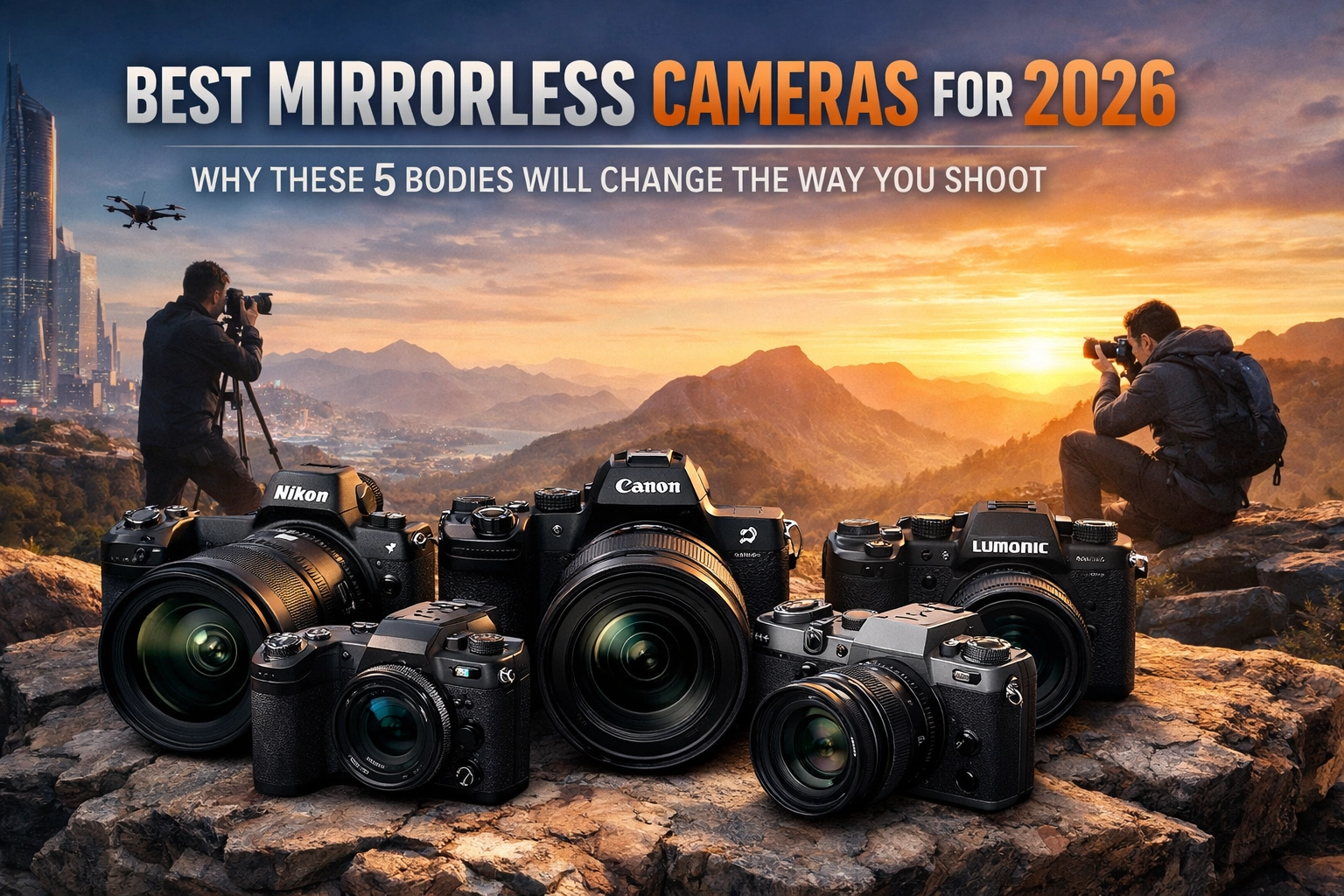
In 2026, these five camera bodies are the ones doing exactly that. They aren't just incremental upgrades; they are tools that fundamentally change how we interact with light and motion. Whether you are hunting for hidden gem locations for travel photography or trying to capture ethereal landscapes for captivating shots, the right body makes all the difference.
1. The Canon EOS R5 Mark II: The Gold Standard for Everyone
If you wanted a camera that could do it all without breaking a sweat, the Canon EOS R5 Mark II is the reigning champion of the "do-everything" category. Canon took everything we loved about the original R5 and polished it until it glowed.
The standout feature here is the AI-powered subject-detection autofocus. It doesn’t just find eyes anymore; it understands human movement. If you’re shooting a basketball game and a player turns their back, the R5 Mark II knows it’s still that same person and keeps the focus locked on the back of their head until they turn around. It’s spooky, but in a way that makes your job ten times easier.
For the video shooters, this thing is a beast. We’re looking at 8K video at up to 60 frames per second. That much data allows you to crop in, stabilize, and still have a crisp image that looks like it belongs on a cinema screen. If you’re editing these massive files, you’ll definitely want to check out Luminar to handle the post-processing with ease, as its AI tools complement the R5’s internal tech perfectly.

2. The Nikon Z9: The Professional Workhorse
The Nikon Z9 is the camera you take to a war zone or a rainforest. It’s built like a tank, weighs a bit like one too, but it’s arguably the most reliable piece of kit on this list. Nikon famously ditched the mechanical shutter entirely with this line, and in 2026, the Z9 remains the pinnacle of that "no moving parts" philosophy.
What makes the Z9 special for professionals is the buffer. You can fire off 20 frames per second in RAW and basically never stop. It can capture over 1,000 shots in a single burst without the camera needing to pause and "think." For wildlife and sports photographers, this is the difference between getting the shot of the year and getting a photo of a blurry tail.
At around $5,500, it’s a serious investment, but it’s actually cheaper than many of its predecessors while offering double the performance. It’s the kind of camera that makes you feel like you can’t fail. If you want to see what this kind of power looks like in action, head over to www.edinfineart.com to see how high-end gear translates into gallery-quality prints.
3. The Sony A1 II: The Speed Demon
Sony has always been the tech-forward sibling in the photography family. The Sony A1 II is their "flex" on the rest of the industry. It combines ultra-high resolution with the kind of speed that shouldn't be physically possible.
The A1 II uses a dedicated AI processing chip. This isn't just a buzzword; the chip is designed specifically to run algorithms that identify birds, insects, cars, and even airplanes. If it moves, the A1 II can track it. This makes it an incredible choice for those who specialize in lesser-known vistas for enigmatic photos, where you might only have a split second to capture a rare animal in its habitat.
The ergonomics have also seen a massive improvement. Sony used to get flak for having "boxy" cameras, but the A1 II feels like it was molded for a human hand. It’s fast, it’s smart, and it’s arguably the best high-resolution mirrorless camera ever made. For more technical deep dives on Sony’s lens ecosystem, Shut Your Aperture is a fantastic resource to bookmark.
4. The Sony A7R V: The Landscape Photographer's Dream
While the A1 II is about speed, the Sony A7R V is about detail. The "R" stands for resolution, and boy, does it deliver. If you are the type of photographer who likes to print your photos the size of a garage door, this is your camera.
The 61-megapixel sensor captures every tiny detail. We’re talking about being able to see the individual dew drops on a leaf from fifty yards away. This level of detail is perfect for photographers who love using rare textures for tangible aesthetic photography. When you have that many pixels to play with, you can crop into a photo and still have more resolution than most cameras have to start with.
The A7R V also features an incredible 4-axis multi-angle LCD screen. It sounds like a small thing until you’re trying to take a photo from a weird angle near the ground and you realize you don’t have to lay in the mud to see your composition. It’s these little quality-of-life improvements that make Sony a leader in the space.
5. The Nikon Z6 III: The Best Value for Creators
Not everyone has five or six thousand dollars burning a hole in their pocket. That’s where the Nikon Z6 III comes in. It is widely considered the "sweet spot" of the 2026 market. It’s the camera we recommend to wedding photographers, event shooters, and serious enthusiasts who want pro results without the pro price tag.
The Z6 III is fast, handles low light like a champ, and has dual card slots: a must-have for anyone shooting a once-in-a-lifetime event like a wedding. You don’t want a card failure to be the reason you have to tell a bride you missed the kiss. The Z6 III gives you that peace of mind.
It’s also an incredible hybrid tool. If you’re jumping between high-quality stills and 4K video for social media, the Z6 III handles the transition seamlessly. It’s lightweight enough to carry all day but robust enough to handle a bit of rain. For those looking to rent gear before they buy, check out www.proshoot.io to see if you can take one for a spin.
Why These Cameras Change Everything
You might be wondering, "Do I really need a new camera in 2026?" The answer depends on what you’re trying to do. If you’re just taking photos of your cat (no judgment, cats are great), your phone is probably fine. But if you’re trying to push the boundaries of what’s possible, these five bodies change the game in three specific ways:
1. The Death of Out-of-Focus Shots
The AI autofocus in these machines has reached a point where missing focus is almost a choice. In the past, you had to master back-button focusing and focus-and-recompose techniques. Now, the camera handles the "math" of focus so you can focus on the "art" of composition. It frees up your brain to look for light and emotion rather than worrying if the lens is locked on.
2. Low Light is No Longer a Limit
In the DSLR days, shooting at ISO 6400 meant your photo would look like it was covered in sand. With the sensors in the Nikon Z9 or the Sony A7R V, you can push your settings into territories that were previously unthinkable. This opens up blue-hour photography and indoor event shooting without the need for intrusive flash setups.
3. Workflow Integration
Modern mirrorless cameras are basically computers with lenses attached. They sync to your phone, they upload to the cloud, and they work hand-in-hand with software like Luminar. The time between "pressing the shutter" and "sharing the masterpiece" has never been shorter.
Choosing the Right Body for Your Style
Picking a camera is like picking a pair of shoes. It doesn't matter how expensive they are if they don't fit what you're doing.
- For the Globetrotter: If you spend your life on planes looking for hidden gem locations for travel photography, look at the Nikon Z6 III or the Sony A7R V. They offer the best balance of weight and power.
- For the Studio Pro: If you have a controlled environment at www.edinstudios.com and need every bit of texture, the Sony A7R V is your best friend.
- For the Action Junkie: If you’re at the sidelines of a stadium or deep in the woods, the Nikon Z9 or the Canon EOS R5 Mark II are the only ways to go.
The Role of Post-Processing in 2026
No matter which of these five bodies you choose, you’re going to be dealing with a lot of data. The RAW files coming out of these sensors are incredibly "stretchy," meaning you can recover highlights and shadows that look lost.
To get the most out of these files, we highly recommend using Luminar. Its AI-driven tools like Relight AI and Structure AI allow you to enhance the incredible detail captured by these 2026 sensors without spending hours masking and layering. It’s the perfect companion for the modern mirrorless shooter.
If you’re looking for more inspiration on how to use this gear, you can always check out blog.edinchavez.com for behind-the-scenes stories and shooting tips from the field.
Final Thoughts
The jump in technology we’ve seen by 2026 is staggering. Whether it’s the sheer resolution of the Sony A7R V or the indestructible nature of the Nikon Z9, there has never been a better time to be a photographer.
These cameras don't take the photos for you: you still need the eye, the patience, and the passion. But what they do is remove the barriers. They allow you to capture exactly what you see in your mind's eye without the technical limitations of the past.
So, if you’ve been waiting for a sign to upgrade, this is it. Go find a camera that inspires you, grab a few lenses, and get out there. The world is waiting to be photographed, and with these five bodies, you won't miss a single beat.
For more guides on how to master your gear, don't forget to visit Shut Your Aperture. Now, go shut your aperture and start shooting!