Best Photography Spots in Kyoto: 14 Locations With GPS

Tours & experiences disclosure: This guide includes affiliate links to Viator, the world’s largest tour and experiences marketplace. If you book through these links, ShutYourAperture may earn a small commission at no extra cost to you.

Kyoto photography guide hero imageSave

Skip the planning. Get the Kyoto PDF. All locations, GPS coordinates, golden-hour times, gear tips. Instant download.

Kyoto, Japan is one of the most photogenic cities in the world. If you have a camera and the patience to show up before dawn, Kyoto will give you images that last a career — but only if you know where and when to point it.

This is the definitive field guide to the 14 best photography spots in Kyoto, with GPS coordinates you can drop straight into Google Maps, exact camera settings tuned to Kyoto’s unique light, precise timing for every location, and the access notes nobody else bothers to document. It mirrors the intel inside our Kyoto Ultimate Photographer’s Guide ($47 PDF) — a downloadable field guide with full-page hero images, GPS maps, seasonal tables, a city safety briefing, and a complete photographer’s packing list. Get the guide →

Planning multi-city travel? See also: U.S. cities photography hub and the National Parks Photography Guides.

Kyoto Ultimate Photographer’s Guide — $47
14 GPS-mapped locations · Exact camera settings · Multi-season shooting calendar · Free annual updates

Download the PDF guide →

Quick jump to the 14 spots

  1. Fushimi Inari Taisha — Senbon Torii
  2. Kiyomizu-dera — Wooden Stage and Pagoda Viewpoint
  3. Arashiyama Bamboo Grove — Sagano Path
  4. Kinkaku-ji — Golden Pavilion Reflection Pond
  5. Gion — Hanamikoji Street and Shirakawa Canal
  6. Yasaka Pagoda — Hokan-ji Five-Story Tower
  7. Philosopher’s Path — Tetsugaku-no-Michi Canal Walk
  8. Tofuku-ji — Tsutenkyo Bridge Autumn Ravine
  9. Tenryu-ji Garden and Togetsukyo Bridge — Arashiyama
  10. Pontocho — Lantern Alley at Dusk
  11. Nijo Castle — Ninomaru Garden and Cherry Blossom
  12. Ginkaku-ji — Silver Pavilion and Kogetsudai Sand Garden
  13. Kyoto Tower — Nidec Observatory
  14. Sanjusangendo — Long Hall and Exterior

A look inside the Kyoto Photographer’s Guide

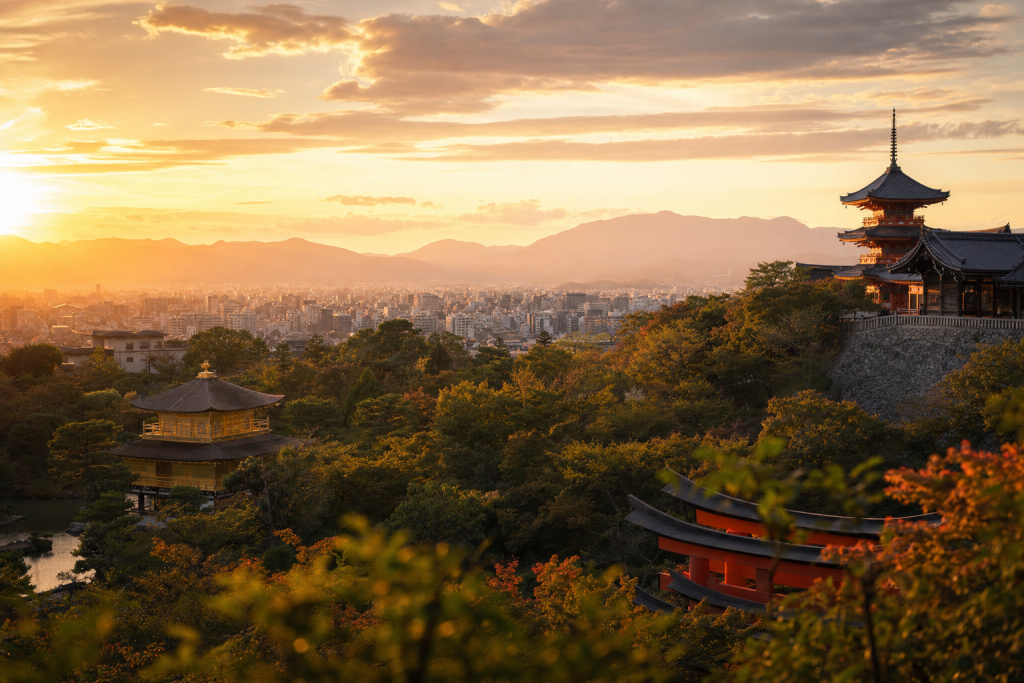
Here are three of the actual shots you’ll find inside the PDF — cinematic full-page references for the exact spots, lenses, and lighting conditions documented in the guide. The full guide includes 14 locations, each with a hero image, GPS map, settings table, and a five-shot list.

Fushimi Inari Taisha — Senbon Torii — from the Kyoto Photographer's GuideSave
Fushimi Inari Taisha — Senbon Torii — sample reference photo from the Kyoto Photographer’s Guide PDF

Before you shoot Kyoto: the essentials

  • Free public access: Fushimi Inari Taisha grounds (open 24/7, free), Arashiyama Bamboo Grove path (open 24/7, free), Togetsukyo Bridge (free), Philosopher’s Path walkway (free), Gion district streets including Hanamikoji and Shirakawa Canal (free public access), Nishiki Market alley (free), Maruyama Park (free). Paid entry: Kiyomizu-dera ¥500, Kinkaku-ji ¥500, Ginkaku-ji ¥500 (rising to ¥1,000 from April 2026), Nijo Castle ¥800 general/¥1,300 with Ninomaru Palace, Tofuku-ji Tsutenkyo ¥600 (¥1,000 in autumn season), Tenryu-ji garden ¥500, Sanjusangendo ¥600, Kyoto Tower observatory ¥900
  • Commercial permits: Personal and tourist photography in all public spaces and temple exteriors is unrestricted for non-commercial use. Commercial shoots (advertising, film, professional editorial) require advance permission: city streets and public spaces require application to the Kyoto Media Support Center via ja.kyoto.travel/support/en. Temples and shrines each manage their own commercial photography permits separately — apply directly to the individual institution. Gion district has strict rules against intrusive photography of geiko and maiko; professional-grade cameras may require permit in Hanamikoji area. Tripods are prohibited inside most temple buildings; some locations ban tripods on ground altogether during busy seasons. Drones require Civil Aeronautics Bureau authorization and are prohibited over World Heritage sites and central Kyoto without special clearance.
  • Best photography seasons: Late March–early April (cherry blossom peak with pink-canopied streets and illuminated sakura at dusk) and mid-November (peak autumn foliage when every temple turns crimson and gold, clear blue skies)
  • Blue hour notes: Kyoto sits at 35.02°N, giving a moderate sun arc somewhat lower than subtropical cities but higher than northern European capitals. Blue hour lasts 18–28 minutes after sunset. In summer, sunset falls as late as 7:15 PM; in winter, as early as 4:45 PM. The Kamo River banks, Shirakawa Canal in Gion, and Fushimi Inari’s upper torii gates are most spectacular during this window — warm lantern light and painted vermillion contrast beautifully against deep cobalt sky. Kiyomizu-dera’s wooden stage and pagoda glow during seasonal night illuminations, extending the shooting window until 9:30 PM on special dates.
  • Drone policy: Drone laws vary widely by country and city — many capital and tourist zones are no-fly. Verify the local civil aviation authority’s current rules before launching.
  • Local resource: Official visitor information

The full-resolution version of every map below — plus seasonal calendars, gear notes per location, sun-angle diagrams, and a complete photographer’s packing checklist — is inside the Kyoto Photographer’s Guide PDF ($47).

1. Fushimi Inari Taisha — Senbon Torii

Fushimi Inari is the head shrine of 30,000 Inari shrines across Japan and hosts the world’s most photographed torii gate tunnel — over 10,000 vermillion gates donated by businesses stretch 4 km up the wooded slopes of Mt. Inari to 233 m elevation. The sheer repetition of the gates creates a hypnotic compression tunnel effect that no other location in the world replicates. Early light between the gates alternates orange and shadow in geometric patterns that reward wide-angle and telephoto lenses equally. The upper mountain, almost always crowd-free, rewards the 90-minute full ascent with forest shrines, fox deity statues draped in red bibs, and sweeping views south toward Osaka Bay.

  • GPS: 34.9672, 135.7727
  • Elevation: 52 ft
  • Best time of day: Pre-dawn to 30 minutes after sunrise (5:30–7:00 AM in summer, 6:30–8:00 AM in winter) when the tunnel of vermillion gates is empty of crowds and low-angle light penetrates the gaps between gates in warm golden shafts; alternatively 30 minutes after sunset when lanterns along the lower paths cast amber pools between the torii and the mountain feels otherworldly at night
  • Sun direction: The main Senbon Torii tunnel at the base runs roughly northeast–southwest. At summer sunrise (azimuth ~60° NE), sunlight enters the tunnel from the northeast end and creates dramatic alternating bands of light and shadow across the orange gates — a strong reason to arrive from the JR Inari station side. By 8 AM the sun clears the low ridgeline and becomes overhead, bleaching the orange with flat direct light. The upper mountain path (Yotsutsuji junction, ~200m elevation) faces west and southwest, so afternoon light from the west catches the gate faces beautifully between 3–5 PM. In winter the sun arcs to the south, meaning the tunnel receives more side-lighting from the south; shooting northward toward the gates from inside the tunnel creates silhouette-rich compositions at noon. Night photography eliminates all solar dependency — lanterns light the path continuously.
  • Access: Inari Station on JR Nara Line, 5 minutes from Kyoto Station (¥150, covered by JR Pass); alternatively Fushimi-Inari Station on Keihan Line (¥170 from Gion-Shijo). Both stations are a 5-minute walk to the main torii. Open 24 hours, 365 days a year; no admission fee. No parking on-site; paid lots 10 minutes’ walk away along Inari Taisho-dori. Tripods are permitted but impractical at the base during busy hours — carry a compact travel tripod and use it 30+ minutes up the trail. No commercial photography without written permission from the shrine office.
  • Difficulty: easy to moderate
  • Recommended settings: Dawn Golden Hour Tunnel: f/8, 1/125 sec, ISO 400, 24mm  ·  Night Lantern Long Exposure: f/4, 8 sec, ISO 400, 24mm, tripod  ·  Upper Forest Dappled Light: f/2.8, 1/500 sec, ISO 800, 50mm  ·  Overcast Diffuse Color: f/8, 1/60 sec, ISO 400, 16mm

Shots to chase:

  • Classic infinity tunnel at the main Senbon Torii: squat low, center the path, shoot along the converging gate tops with 24mm at pre-dawn to empty the scene entirely
  • Detail shot of a single torii base with the Japanese kanji inscription of a business donor in low side-light at dawn, showing the donation culture behind the gates
  • Upper mountain Yotsutsuji junction wide view: the dense cedar forest with torii receding in both directions and Osaka Bay visible faintly on the horizon on clear winter days
  • Night long-exposure from inside a dense gate section, with lantern light creating warm orange streaks on a 10-second exposure and stars barely visible above the canopy gap
  • Telephoto compression (200mm) from 100m behind the tunnel entrance: the gates stack into a solid wall of orange with a tiny figure walking through the center

Pro tip: The lower Senbon Torii gates are perpetually crowded from 8 AM onward in peak season; a 4:30 AM arrival on a weekday gives you 60–90 minutes alone with the main tunnel in twilight. The upper mountain past Yotsutsuji junction thins dramatically — even on a busy Saturday only a dozen people are present above 150m elevation. Carry a headlamp for pre-dawn arrivals as the path is unlit until the lanterns turn on. The west-facing viewpoint at Yotsutsuji is the best spot for city sunset photography with the gate path as a foreground element. Hire a jinrikisha (rickshaw) to scout lower gate angles you might miss on foot.

Common mistake to avoid: Using a very wide lens (14mm) distorts the parallel gate rows into curves at the edges; 24–35mm is optimal for keeping gates parallel. Shooting at midday when harsh overhead sun strips all color and shadow drama from the orange paint. Turning back at the dense lower section and missing the quieter, equally beautiful upper gates. Not shooting backward (away from the mountain) through the tunnel — the reverse perspective offers the same infinite effect with different framing.

2. Kiyomizu-dera — Wooden Stage and Pagoda Viewpoint

Kiyomizu-dera’s famous wooden stage — a 13m-high platform built without a single nail, cantilevered over the Otowa ravine on 139 keyaki pillars — is one of Japan’s most iconic architectural feats. From the stage, the panoramic view sweeps northwest over Kyoto’s rooftops framed by maple, cherry, and zelkova trees that change color with the seasons. The opposing viewpoint from Okuno-in Hall across the ravine delivers the most reproduced temple photograph in Japan: the main hall, stage, pagoda, and wooded mountainside layered in one frame. The UNESCO World Heritage site also contains the Otowa waterfall, three-story pagoda, and multiple sub-shrines providing endless compositional variety.

  • GPS: 34.9949, 135.785
  • Elevation: 820 ft
  • Best time of day: Golden hour before closing (4:00–6:00 PM in summer) when the main hall is lit from the west and the three-story pagoda turns golden against the wooded hillside; or seasonal night illuminations (late March and mid-November) when the stage and pagoda are bathed in colored spotlight and the city spreads below in glowing amber
  • Sun direction: Kiyomizu-dera sits on a southeast-facing hillside at about 240m above sea level. The wooden stage faces northwest toward the city. At sunrise, the sun rises from the northeast (azimuth ~65° in summer), backlighting the stage from behind — great for dramatic silhouette shots of the stage jutting out over the valley. By mid-morning, the sun swings south and lights the front face of the stage directly, revealing its massive wooden pillar construction. The three-story pagoda to the southwest of the main hall faces south-southeast; late afternoon sun from the west catches its red lacquer brilliantly between 3 and 5 PM. The opposing hillside viewpoint (Okuno-in balcony or the Koyasu Pagoda path below) faces east-northeast toward the main hall, making sunrise the ideal time from those vantage points when warm light hits the hall’s face directly.
  • Access: Bus 100 or 206 from Kyoto Station to Gojo-zaka or Kiyomizu-michi stop (~15 minutes, ¥230); then 10-minute uphill walk along souvenir-lined Sannen-zaka and Ninen-zaka lanes. No direct train; Kiyomizu-Gojo Station (Keihan) is a 25-minute walk uphill. Open daily 6:00 AM to 6:00 PM (extended to 9:30 PM last entry during seasonal illuminations). Admission: ¥500 adults, ¥200 elementary and junior high school students; cash only at gate, no advance booking required. No tripods inside the temple grounds; no drones. Limited parking lots on lower Gojo-zaka (¥300–500/hour) but road access is restricted in busy periods.
  • Difficulty: easy
  • Recommended settings: Golden Hour Stage Front: f/8, 1/250 sec, ISO 200, 35mm  ·  Night Illumination Long Exposure: f/5.6, 4 sec, ISO 400, 24mm, tripod  ·  Autumn Foliage From Viewpoint: f/8, 1/125 sec, ISO 200, 50mm  ·  Wide Panorama From Stage: f/11, 1/125 sec, ISO 200, 16mm

Shots to chase:

  • Classic temple and pagoda composition from Okuno-in balcony or the hillside path south of the main hall at golden hour, framing the entire structure against the wooded slope
  • Low-angle shot looking up at the wooden stage pillars from the Otowa ravine below — the scale of the 13m pillars against the sky is breathtaking
  • Night illumination long exposure with the stage glowing amber and the city spreading as a carpet of warm light below and behind the structure
  • Cherry blossom or autumn maple branches overhanging the stone courtyard in foreground with the pagoda rising behind in soft morning light
  • The famous three-stream Otowa waterfall below the stage, with visitors using cups on long poles to drink the water — intimate human interest shot at 85mm

Pro tip: The best opposing viewpoint for the classic hall-and-pagoda framing is from the small path that runs south of the Okuno-in sub-hall; a second excellent angle is from the Koyasu Pagoda path on the lower hillside. Both are marked by the standard tourist path signs. Arrive exactly at 6:00 AM opening to get 30–45 minutes before tour groups arrive and shoot the main courtyard in clean light without crowds. During night illuminations, the queue to enter can be 30–45 minutes; get there 15 minutes before the 6:30 PM opening time for illumination events.

Common mistake to avoid: Shooting only from the wooden stage looking outward and missing the classic hall-from-across-the-ravine composition. Using a very wide lens from the stage edge produces barrel distortion in the pagoda. Visiting midday when harsh overhead sun flattens the three-dimensional pillar structure under the stage. Forgetting that tripods are not allowed — use image stabilization and increase ISO for hand-held shots in low light. Not checking the seasonal illumination schedule in advance; these sell out early.

3. Arashiyama Bamboo Grove — Sagano Path

Arashiyama’s bamboo grove is one of the world’s most unique natural corridors — towering Moso bamboo culms (Phyllostachys edulis) reach 15–20 meters, their lime-green canopy filtering light into a luminous greenish haze that makes the path feel otherworldly. The rustling sound of bamboo is itself registered as a ‘sound we want to preserve’ by the Japanese government. In the breeze, the culms creak and sway producing a cinematic acoustic backdrop. In diffuse or overcast light, the path glows with an almost supernatural green luminosity that no other forest in the world quite matches.

  • GPS: 35.0168, 135.672
  • Elevation: 138 ft
  • Best time of day: Sunrise to 7:30 AM on weekdays (late June the sun rises as early as 4:45 AM; in December as late as 7:00 AM) — the only window for crowd-free photography; the path becomes impassably congested by 9–10 AM daily. Overcast days with diffuse light suppress harsh contrast between the translucent green culms and dark ground.
  • Sun direction: The main Sagano bamboo path runs north-northwest to south-southeast. In summer, the sun rises to the northeast (azimuth ~60°) and by 6:30 AM begins penetrating the bamboo canopy from the eastern side, casting long diagonal light shafts through the culms that create dramatic striped lighting on the path. This is the most photographically sought-after effect — arriving when the sun is still below the ridge ensures diffuse pre-dawn bluish light first, then the sudden golden shafts as the sun clears. The path faces roughly northwest from its southern entrance, meaning afternoon light enters from the west between 3–5 PM and can produce golden backlighting through the culms in that direction. In winter the sun angle is lower, creating stronger contrast between light bamboo and shadowed floor all morning.
  • Access: JR Sagano Line from Kyoto Station to Saga-Arashiyama Station (¥240, 15 minutes) then 10-minute walk; or Keifuku Randen tram to Arashiyama Station (¥250). Bamboo grove path open 24 hours, free admission. Parking available in the Arashiyama area along Kogen-cho street (¥500–800/hour). No tripods with wide legs on the path due to pedestrian congestion during busy hours; a compact carbon fiber travel tripod is manageable in the early morning. No fee to enter the path itself; Tenryu-ji garden adjacent is ¥500.
  • Difficulty: easy
  • Recommended settings: Dawn Shaft Light: f/5.6, 1/125 sec, ISO 800, 24mm  ·  Overcast Green Glow: f/4, 1/60 sec, ISO 800, 35mm  ·  Detail Culm Texture: f/8, 1/250 sec, ISO 400, 85mm  ·  Sunrise Silhouette Backlight: f/8, 1/500 sec, ISO 200, 50mm

Shots to chase:

  • Pre-dawn blue-hour composition with the path vanishing into dark green infinity and no crowds, shot at 24mm from ground level at the widest section
  • Golden shaft light penetrating the canopy diagonally as the sun clears the ridgeline — wait for a gust of wind to set the culms swaying for motion blur at 1/15 sec
  • Telephoto compression (200mm) from the southern entrance: the parallel culms stack into a solid green wall with a single figure walking away for scale
  • Twig fence (wattle and daub fence) along the eastern side at ground level with shallow depth of field — bamboo bokeh beyond gives context while keeping the artisanal fence sharp
  • Look upward through the canopy with an ultra-wide lens: the converging culm tops create a circular green star pattern against the sky at f/11 for maximum sharpness

Pro tip: Leave central Kyoto by 4:30 AM in summer to arrive before civil twilight; the first light through the bamboo before 6 AM is magical and you will have the path nearly alone. After 7:30 AM on any day, fence-to-fence crowds make crowd-free photography nearly impossible. Walking to the far northern end of the path (past the turn-off toward Jojakko-ji temple) brings you to a quieter secondary bamboo section that most tourists skip. Bring a telephoto lens (70–200mm) as well as wide-angle — the compression shot of stacked culms is one of the most distinctive bamboo grove images possible.

Common mistake to avoid: Arriving at 9 AM and finding wall-to-wall tourists, then shooting with an ultra-wide lens that makes the bamboo look thin and the path feel cramped. Shooting only the main path and missing the quieter northern extension and the bamboo-lined back streets behind Tenryu-ji. Using flash, which creates harsh flat light and destroys the natural glow of the culms. Not experimenting with slightly slower shutter speeds (1/30–1/60 sec) to capture the subtle swaying motion of the culm tops.

4. Kinkaku-ji — Golden Pavilion Reflection Pond

Kinkaku-ji (the Golden Pavilion, officially Rokuon-ji) is the most photographed single building in Japan: a three-story Zen Buddhist temple whose top two floors are entirely covered in pure gold leaf, floating above Kyokochi pond in a traditional strolling garden. The reflection doubles the building’s visual impact into a perfect symmetrical gold-on-water composition. Originally built in 1397 as a retirement villa for shogun Ashikaga Yoshimitsu and converted to a temple after his death, the current structure is a 1955 reconstruction after the 1950 arson fire. The pavilion’s genius lies in its triple-architecture fusion: ground floor in Shinden aristocratic style, middle floor in Bukke samurai style, top floor in Zen Chinese style — each story more ornate, culminating in the gold-lacquered Phoenix finial.

  • GPS: 35.0393, 135.729
  • Elevation: 328 ft
  • Best time of day: 9:00–10:00 AM (opening hour) in autumn or winter when the sun is in the southeast and hits the gold-leaf façade from the front-left at a low angle, maximizing the reflection in Kyokochi pond; overcast mornings in spring produce evenly lit gold without blown highlights; winter snowfall creates rare shots of white snow against the gleaming gold — extremely sought-after but unpredictable
  • Sun direction: Kinkaku-ji faces roughly southeast across Kyokochi (Mirror Pond). At summer sunrise (azimuth ~60° NE), the sun rises behind and to the left of the pavilion, backlighting the gold leaf and rendering the pond reflection darker. By 9:00–10:00 AM in summer the sun has moved sufficiently south to light the façade from the left side, producing beautiful warm gold reflection in still water. In autumn and winter the sun arc shifts south: at 9:00 AM in December the sun is still at azimuth ~120° SE, providing perfect low-angle front-left lighting on the gold and a mirror reflection in the barely-rippled morning pond. This makes autumn and winter mornings the prime windows. Avoid midday: overhead sun washes the gold to pale yellow and creates harsh reflections.
  • Access: Bus 101 or 205 from Kyoto Station to Kinkakuji-mae stop (~40 minutes, ¥230); also reachable from Kitaoji subway station (Karasuma Line) by bus 204 or 102. Open daily 9:00 AM to 5:00 PM, 365 days. Admission: ¥500 adults, ¥300 elementary/junior high students; paid at main gate, cash preferred (IC cards accepted at some gates). On-site parking: 250 cars at ¥400 first 60 minutes, ¥200 per additional 30 minutes. No tripods on the main viewing path during peak hours; tripods allowed before 10 AM on uncrowded mornings. No drones.
  • Difficulty: easy
  • Recommended settings: Morning Reflection Still Water: f/8, 1/250 sec, ISO 200, 50mm  ·  Winter Snow Scene: f/8, 1/500 sec, ISO 200, 70mm  ·  Overcast Soft Gold: f/8, 1/125 sec, ISO 400, 35mm  ·  Telephoto Pavilion Detail: f/5.6, 1/500 sec, ISO 200, 200mm

Shots to chase:

  • Classic reflection composition: position at the main lower viewing deck at water’s edge at 9 AM with the pavilion perfectly mirrored in still Kyokochi pond, using 50mm to avoid distortion
  • Telephoto detail of the gold-leaf Phoenix finial (鳳凰) at the top of the pavilion against a deep blue autumn sky at 200mm
  • Winter snow: when snowfall dusts the pine trees and garden rocks around the pond, the contrast of white snow against pure gold leaf creates a uniquely Japanese scene
  • Walking the garden path to the rear of the pavilion for the rear-angle view showing the three-story structure rising from the forest without the iconic pond — rarely photographed
  • Wide-angle environmental shot (16mm) including the foreground garden pine, the pavilion mid-frame, and the Kinugasa mountain backdrop to show the borrowed scenery (shakkei) design principle

Pro tip: The official viewing path only permits photography from a fixed curved embankment 40–60 meters from the pavilion — you cannot go closer. A 50–70mm lens from this distance produces the most natural perspective without distortion. Arrive at exactly 9:00 AM opening to avoid the tour buses that fill the path by 9:30 AM. The best still-water reflections occur on calm, windless mornings after a cold night when there is no thermal convection disturbing the pond surface. A circular polarizer reduces glare on the water surface in bright conditions and deepens the gold tone of the pavilion.

Common mistake to avoid: Using a wide-angle lens (16–24mm) that makes the pavilion appear small relative to the garden surroundings — 50–85mm is ideal. Visiting on a windy day when the pond reflection is completely disrupted. Shooting in the midday period when the gold washes out to a pale yellow. Giving up after the main viewing embankment and missing the upper garden path, which offers a different elevated angle showing the pavilion against the water.

Want this in your pocket on the street?
The full-resolution version of every spot above — with full-page hero photography, GPS maps with gold location pins, sun direction diagrams, multi-season tables, and a complete safety + packing checklist — is inside the Kyoto Ultimate Photographer’s Guide PDF ($47). Print it, save it offline, take it on the walk. Get the guide →

5. Gion — Hanamikoji Street and Shirakawa Canal

Gion — Hanamikoji Street and Shirakawa Canal Kyoto photography sampleSave
Gion — Hanamikoji Street and Shirakawa Canal — cinematic reference from the Kyoto Photographer’s Guide PDF

Gion is Kyoto’s most storied entertainment district, home to geiko (Kyoto’s term for geisha) and maiko (apprentice geisha) who have maintained an unbroken tradition of arts performance since the 17th century. The neighborhood’s machiya townhouses — narrow wooden façades with bamboo lattices, persimmon-plaster walls, and paper-screen windows — are the best-preserved Edo-period streetscape in Japan. The Shirakawa Canal running through northern Gion is flanked by weeping cherry trees, stone lanterns, and traditional teahouse balconies overhanging the water, creating a composition that looks unchanged from 200 years ago. The occasional sight of a maiko in full kimono navigating these stone-paved lanes remains one of the most powerful travel images possible.

  • GPS: 35.0039, 135.7745
  • Elevation: 164 ft
  • Best time of day: 6:00–8:00 AM for empty cobblestone streets and soft sidewall light on machiya townhouses; 5:30–7:30 PM (dusk to blue hour) when ochaya lanterns ignite and the Shirakawa Canal reflects their warm light in still water with the deep blue twilight sky above — the most cinematic lighting of the day
  • Sun direction: Hanamikoji Street runs roughly north–south in the heart of Gion. The street is lined with close-set machiya buildings creating a narrow canyon that is shaded from direct sunlight most of the day. Best light enters from the south end in the morning (low sun from the southeast in summer, ~60°) illuminating the stone lanterns along the east side around 7–8 AM. The Shirakawa Canal, one block north, runs east–west; its south bank is lit from the south (afternoon sun) and the north bank falls into shadow — position on the north bank looking south for backlit willow trees. At dusk, neither street requires direct sun — the interior glow of the ochaya restaurants becomes the dominant light source, and a tripod or high-ISO hand-held shot at 50–85mm captures the warm amber lanterns against the blue-hour sky most effectively.
  • Access: Gion-Shijo Station (Keihan Main Line) or Shijo Station (Hankyu Kyoto Line), both 5-minute walk to Hanamikoji. Alternatively, bus 100, 201, or 203 to Gion stop. Free public access to all streets and canal path at all hours. Hanamikoji has restaurants and ochaya open roughly 6 PM to midnight. Note: Gion district has posted signs prohibiting photography on private properties and asking tourists not to photograph geiko and maiko without consent; Miyagawa-cho area has a photography ban on private alleys. No permit needed for personal photography on public streets.
  • Difficulty: easy
  • Recommended settings: Dawn Empty Street: f/5.6, 1/60 sec, ISO 800, 35mm  ·  Dusk Blue Hour Canal: f/4, 1/30 sec, ISO 1600, 50mm  ·  Maiko Environmental Portrait: f/2.8, 1/250 sec, ISO 800, 85mm  ·  Night Lantern Long Exposure: f/5.6, 2 sec, ISO 400, 35mm, tripod

Shots to chase:

  • Hanamikoji pre-dawn with stone lanterns glowing amber and wet cobblestones reflecting the light in a graphic foreground pattern at 35mm, no people
  • Shirakawa Canal at blue hour: weeping cherry (spring) or willow trees framing the canal, ochaya lanterns reflected in the dark water, deep cobalt sky at the top of frame
  • Looking south down Hanamikoji toward Gion Corner with the red lacquer gate and paper lanterns glowing, shot at f/2.8 with natural ambient light only
  • Narrow side alley behind Hanamikoji at dawn: weathered wooden fence, paper screen window glowing from within, stone path disappearing into shadow — intimate abstraction at 50mm
  • The small arched stone bridge at Shirakawa-Minami Dori crossing the canal: position on the bridge and frame the canal reflections with willow branches above in spring or autumn foliage in November

Pro tip: The absolute best blue-hour spot in Gion is the Shirakawa Canal at the Shinbashi intersection (35.0062°N, 135.7741°E) where a single cherry tree overhangs the water beside a stone lantern and an ochaya facade — it is Kyoto’s most romantically concentrated small scene. An 85mm lens from 4m away fills the frame perfectly. Early morning fog in autumn and spring adds atmospheric depth. Avoid photographing geiko and maiko at close range — it is considered deeply rude, and Gion’s community has reported these incidents to tourism authorities. Stay 10+ meters back and use a telephoto lens respectfully.

Common mistake to avoid: Visiting only at midday when the narrow lane canyons produce harsh top-lit, deep-shadowed scenes. Shooting with a wide-angle that includes distracting modern signage and tourist crowds. Using flash in the alleys, which destroys the ambient lantern atmosphere entirely. Missing the Shirakawa Canal (north of Shijo, 10-minute walk from Hanamikoji) which is arguably the more photogenic spot.

6. Yasaka Pagoda — Hokan-ji Five-Story Tower

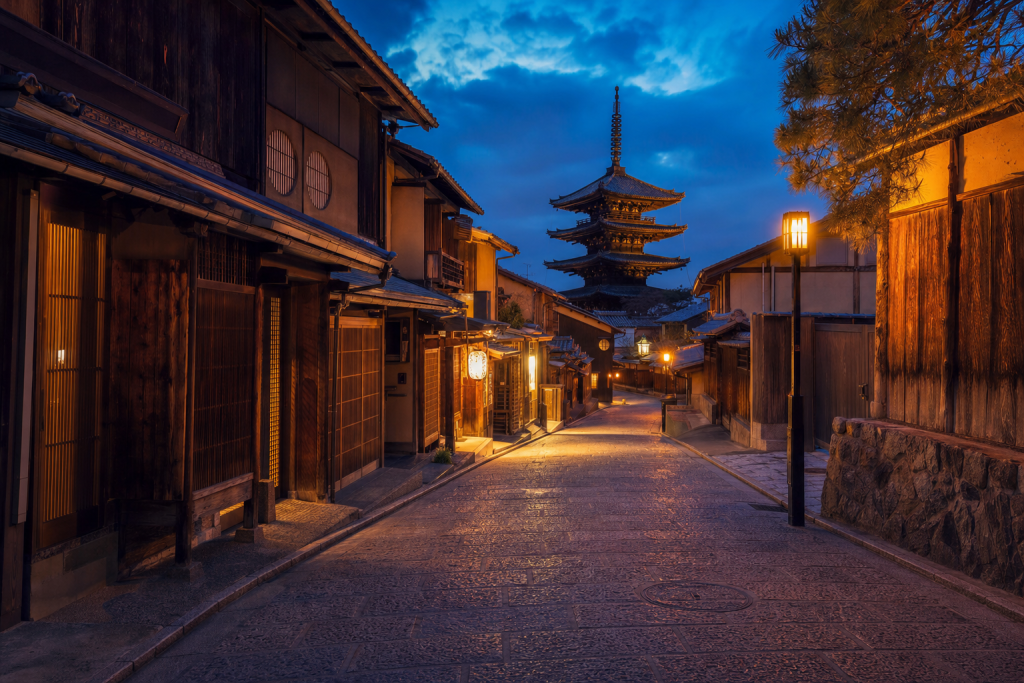
Yasaka Pagoda is Kyoto’s ultimate skyline icon — a five-story 46-meter Buddhist pagoda rising above the rooftops of Higashiyama’s machiya townhouses along the stone-paved Sannenzaka approach. Unlike isolated temple pagodas, Yasaka’s pagoda rises directly from the urban fabric of tile-roofed wooden townhouses, creating a uniquely layered cityscape shot that feels simultaneously ancient and intimate. It is Japan’s third-tallest five-story pagoda and the last remaining structure of Hokan-ji Temple, which was founded in 592 AD. The cobblestone lanes of Sannenzaka and Ninen-zaka curving toward the pagoda are among the most cinematic streetscapes in all of Asia.

  • GPS: 34.9986, 135.7793
  • Elevation: 344 ft
  • Best time of day: Pre-sunrise to 7:00 AM from the Sannenzaka cobblestone viewpoint (southwest-facing) when the pagoda is front-lit by the rising sun from the east and the stone-paved lane is empty of the thousands of tourists that fill it by 9 AM; also powerful at dusk when the pagoda’s structure silhouettes against a gradient sunset sky — it faces west so backlit against evening light is dramatic
  • Sun direction: The Yasaka Pagoda (Hokan-ji) faces roughly west-northwest. The most-photographed viewpoint is from Sannenzaka (Stone-paved Three-Year Slope) looking northeast — this vantage faces the pagoda’s southwest face. At sunrise in summer (azimuth ~60° NE), the rising sun arrives almost directly behind the camera at Sannenzaka and lights the pagoda’s western face warmly from the front-left. By 8 AM the sun swings southeast, cross-lighting the pagoda from the right and creating dimensional shadow on the tiered rooflines. At sunset the sun descends to the northwest (azimuth ~300° in summer), directly backlighting the pagoda from the photographer’s perspective at Sannenzaka — producing spectacular silhouette images with gradient sky. The pagoda sits atop the Higashiyama hills at about 105m elevation giving it a prominent skyline presence.
  • Access: Bus 100 or 206 from Kyoto Station to Kiyomizu-michi stop, then 5-minute walk south along Ninen-zaka and Sannenzaka lanes. Alternatively, Gion-Shijo Station (Keihan) then 15-minute walk uphill. The pagoda exterior can be photographed for free from the streets at all hours. Interior admission (rare open days): ¥600 adults; check local notices for open periods. Sannenzaka is a public street with no access fee. No tripods during busy hours on the narrow lane; use early morning window. Parking limited — use lots near Kiyomizu-dera.
  • Difficulty: easy
  • Recommended settings: Pre Dawn Street Empty: f/4, 1/30 sec, ISO 1600, 35mm  ·  Sunrise Front Lit: f/8, 1/250 sec, ISO 200, 50mm  ·  Sunset Silhouette: f/8, 1/500 sec, ISO 200, 50mm  ·  Overcast Street Scene: f/5.6, 1/125 sec, ISO 400, 35mm

Shots to chase:

  • Classic Sannenzaka composition at pre-dawn: the stone-paved lane curving uphill with tiled machiya rooflines on both sides and the pagoda centered at the vanishing point — use 35–50mm
  • Sunrise shot from middle of Sannenzaka with the pagoda front-lit orange-gold against a pale blue sky, cherry blossom branches overhanging from the left in late March
  • Sunset silhouette from the same viewpoint: dark pagoda and rooflines against a graduated orange-to-purple sky, often with a single figure walking up the slope in silhouette for scale
  • From below the pagoda on the northwest side, look up at 24mm to capture all five tiers receding into the sky with roof details and decorative finials visible against clouds
  • Telephoto 200mm from the west side near Maruyama Park: the pagoda rises sharply above a sea of grey tile rooftops, compressed into a dense urban layering

Pro tip: The precise photography spot for the classic Sannenzaka-pagoda image is at GPS 35.0016°N, 135.7787°E — stand in the center of the lane and face northeast. A 35–50mm lens at eye height produces the most natural perspective. In peak cherry blossom season, a pink canopy of sakura branches frames the pagoda from both sides of the lane — arriving by 5:30 AM on a clear April morning gives you 45 minutes before crowds. At night, the pagoda is gently lit and the stone lane takes on a mysterious quality — a 3-second exposure on a small tripod captures both the amber lanterns on storefronts and the pagoda detail.

Common mistake to avoid: Shooting at an angle from the side rather than centering the lane — the vanishing point composition requires the camera axis to align with the stone path. Visiting between 10 AM and 4 PM when both the crowd and midday light make meaningful photography difficult. Missing the fact that the most sought-after angle looks northeast (uphill) from Sannenzaka, not from above the pagoda.

7. Philosopher’s Path — Tetsugaku-no-Michi Canal Walk

The Philosopher’s Path is Kyoto’s most beloved walking route — a 2km stone path beside a narrow biwako canal lined with approximately 450 cherry trees whose branches interlock overhead in spring to form a complete pink tunnel. The path takes its name from Nishida Kitaro, the 20th-century Kyoto philosopher who walked it daily in meditation. In cherry blossom peak week, fallen petals (hanagaki) accumulate on the canal’s still surface in a pink carpet; in autumn the maple canopy turns the path into a corridor of crimson and gold. Small temples, independent coffee shops, and stone lanterns line the route, making it the most intimate and human-scaled of Kyoto’s great photography routes.

  • GPS: 35.0217, 135.791
  • Elevation: 272 ft
  • Best time of day: Cherry blossom season (late March–early April): sunrise pre-dawn arrival (4:45–6:00 AM in early April) before crowds arrive; petals accumulate on the canal surface by petal-fall week, creating a pink carpet on water that disappears by 9 AM when foot traffic disturbs it. Autumn (November): entire canal flanked by red maple canopy; early morning mist from the canal between 6 and 8 AM. Spring and autumn sunrise times optimal for warm side-lighting on the flanking trees.
  • Sun direction: The Philosopher’s Path runs roughly north-northeast to south-southwest for 2 kilometers. The canal beside it runs parallel. In spring, cherry trees line both banks; in autumn, maples replace them with red. At sunrise in late March/early April (sun azimuth ~85° nearly due east), the sun rises almost perpendicular to the canal alignment, catching the near side of cherry trees from the east and creating warm side-lit blossoms. By 8 AM the sun rises enough to strike the water surface and cause glare. The most photogenic section for morning light is the southern half where the canal faces more east, capturing the first light best. Evening sun (northwest in spring/summer) backlights cherry petals on the water and the overhanging branches warmly at 4–5 PM.
  • Access: Bus 5 from Kyoto Station to Nanzen-ji Eikando-michi stop, then 5-minute walk to the south end of the path (near Nanzen-ji). Alternatively, bus 100 to Ginkaku-ji-mae for the north end. Keage Station (Tozai Line subway) is 10-minute walk to south end. Path open at all hours, free admission. Narrow stone path with no vehicles; low stone wall separates it from the canal. No formal parking; use bus.
  • Difficulty: easy
  • Recommended settings: Cherry Blossom Dawn: f/5.6, 1/125 sec, ISO 400, 50mm  ·  Petal Carpet On Water: f/4, 1/250 sec, ISO 200, 85mm  ·  Autumn Canal Mist: f/5.6, 1/60 sec, ISO 800, 50mm  ·  Overcast Tunnel Compression: f/8, 1/60 sec, ISO 800, 85mm, telephoto compression

Shots to chase:

  • Cherry blossom tunnel from inside the path at 35mm: interlocking pink canopy above, stone path below, occasional stone lantern for scale, shot at pre-dawn when path is empty
  • Canal surface covered in fallen sakura petals at still water — flat angle from the bridge railing with a 200mm lens compressing the petal layer into a dense pink carpet
  • Autumn morning mist: maple trees in red-gold, canal surface with wisps of mist, stone path and bridge arching over the canal in 3/4 angle at 50mm
  • Detail shot of a small wooden bridge crossing the canal with sakura branches and petals framing the arch — focus at f/2.8 on the texture of aged wood against soft pink bokeh
  • Late afternoon: the canal as a leading line from a low angle, cherry trees mirrored in still water, with Ginkaku-ji’s hillside visible in the soft background at 35mm

Pro tip: Petal-fall week (usually 3–5 days after peak bloom, typically April 5–10) is the highest-value photography window — petals on the water are more striking than blossoms on the tree. Check Japan Meteorological Corporation sakura forecasts for exact timing. The small pond near the Okazaki area at the path’s south end captures reflections of the cherry canopy with no current disturbing the surface. In autumn, the maples near Eikan-do temple (one block east of the path’s south end) have some of the most brilliantly lit foliage in Kyoto — combine both in a single morning walk.

Common mistake to avoid: Visiting at peak bloom but at 11 AM — the path becomes impassably crowded, making clean compositions impossible and disturbing any petal accumulation on the water. Overlooking autumn — November’s crimson maple canopy rivals spring’s sakura and draws far fewer tourists. Skipping the small side paths and cafes that branch off the main walkway, which offer intimate compositions without the main crowd.

8. Tofuku-ji — Tsutenkyo Bridge Autumn Ravine

Tofuku-ji is home to over 2,000 Japanese maple trees in its Sengyokukan Ravine — the densest concentration of autumn color of any Kyoto temple. The 100m Tsutenkyo covered bridge spans the ravine at mid-tree-height, putting photographers eye-to-eye with the maple canopy in a way impossible from ground level. The 360° panorama of solid crimson, orange, and yellow maple crowns below and beside the bridge is Kyoto’s most beloved single autumn view and the source of the majority of Kyoto November photography in international media. The geometric Hojo garden — modernist checkerboard moss-and-stone patterns designed by Mirei Shigemori in 1939 — is equally striking and far less crowded than the bridge.

  • GPS: 34.9712, 135.7714
  • Elevation: 164 ft
  • Best time of day: Mid-to-late November (typically November 15–25) at 8:30 AM sharp when the temple opens to the Tsutenkyo Bridge, allowing 20–30 minutes before crowds fill the covered walkway; the morning sun at southeast azimuth (~130° in November at this latitude) lights the maple canopy from the right as seen from the bridge, creating warm-lit orange treetops with shadowed depths in the ravine — the richest color contrast of any viewpoint in Kyoto
  • Sun direction: The Tsutenkyo covered walkway runs approximately east–west, spanning the Sengyokukan Ravine north-south. Looking from the bridge (facing west), the ravine drops below with 2,000 maple trees filling the valley. In late November at 35°N, the sun rises at azimuth ~120° (southeast) and in the morning hours casts warming light from the left (east) side onto the west-facing maple canopy, producing rich orange and crimson tones on the treetops visible from the bridge. By midday the sun moves south and top-lights the canopy, reducing the 3D structure. The Kaisando Hall viewpoint (looking east from the opposite bank) has the morning sun behind the camera and the maple ravine fully front-lit — another excellent perspective available before crowds fill the main bridge area. Tofuku-ji’s Hojo garden in the southeast corner receives full midday sun, making it best for afternoon visits in low autumn light.
  • Access: Tofukuji Station on JR Nara Line (2 min from Kyoto Station, ¥150) and Keihan Main Line (adjacent station), then 10-minute walk. Tsutenkyo Bridge (autumn season): ¥600 adults, ¥300 children — increases to ¥1,000 adults during November 11–December 3 peak autumn season. Regular season Hojo garden: ¥500 adults. Combination ticket: ¥1,000. Hours: 9:00–16:00 (April–October); 8:30–16:30 (November–early December); 9:00–15:30 (early December–March). Tripods and selfie sticks are prohibited throughout the grounds. Photography restrictions may be in force around Tsutenkyo and Gaunkyo bridges during peak autumn season — follow on-site guidance.
  • Difficulty: easy
  • Recommended settings: Autumn Ravine Bridge Wide: f/8, 1/125 sec, ISO 200, 24mm  ·  Telephoto Maple Compression: f/5.6, 1/250 sec, ISO 200, 200mm  ·  Hojo Garden Pattern: f/11, 1/125 sec, ISO 200, 16mm  ·  Overcast Flat Saturated: f/8, 1/60 sec, ISO 400, 35mm

Shots to chase:

  • From Tsutenkyo Bridge at 8:30 AM opening in mid-November: wide composition with the bridge handrails as strong leading lines disappearing into the crimson maple sea
  • Telephoto 200mm from the bridge end aimed down into the ravine: maple crowns fill the frame in orange and red with the dark stream visible between trunks far below
  • Kaisando Hall perspective from the opposite bank: classic shot of the covered Tsutenkyo bridge spanning the valley with maples exploding in color on both sides
  • Hojo garden abstract: the checkerboard pattern of square moss islands and raked white gravel seen from above at 16mm — a modernist counterpoint to the organic maple chaos outside
  • Gaunkyo Bridge in the southeast garden: this flat stone bridge with no handrails appears to float in mid-air above the moss-filled valley — a minimalist composition at 50mm

Pro tip: Opening day of the autumn admission season draws enormous queues — arrive 20–30 minutes before the 8:30 AM gate opening in November to be among the first on the bridge. On weekends, a 200-meter queue can form. The Kaisando Hall is reached by a separate path from the main visitor route and is significantly less crowded than the bridge itself. The Hojo garden’s north face (looking toward the maple ravine through the garden’s north veranda) is photographically wonderful and rarely shown in tourism imagery — frame the geometric garden in the foreground with autumn color visible through the open halls behind.

Common mistake to avoid: Arriving at 10 AM on a November weekend — the bridge becomes shoulder-to-shoulder and clean compositions are impossible. Overlooking the spring and early summer visit when the maples are brilliant fresh green (ao-momiji), which attracts far fewer visitors. Assuming photography restrictions don’t apply and setting up a tripod on the bridge in autumn season — you will be asked to stop immediately and cause friction with other visitors.

9. Tenryu-ji Garden and Togetsukyo Bridge — Arashiyama

Tenryu-ji Garden and Togetsukyo Bridge — Arashiyama Kyoto photography sampleSave
Tenryu-ji Garden and Togetsukyo Bridge — Arashiyama — cinematic reference from the Kyoto Photographer’s Guide PDF

Togetsukyo (Moon-Crossing Bridge) is the photographic symbol of Arashiyama — a 155m span across the Oi River backed by the forested Arashiyama mountain whose slopes turn brilliant white-pink in cherry blossom season and fiery crimson in November. The bridge and mountain create one of the most quintessentially Japanese landscape compositions: a wooden horizontal bridge counterbalancing a vertical forested peak reflected in slow river water. Tenryu-ji’s Sogenchi garden, designated Japan’s first Special Place of Scenic Beauty, uses the Arashiyama and Kameyama mountains as shakkei (borrowed scenery) framed behind its immaculately raked pond — a 14th-century garden designed by Zen master Muso Soseki that remains among the finest in Japan.

  • GPS: 35.016, 135.6738
  • Elevation: 151 ft
  • Best time of day: Togetsukyo Bridge: sunrise to 8:00 AM in late March (cherry blossoms on Arashiyama mountain) or mid-November (full autumn color on the slopes) when the bridge and mountain reflection appear in the Oi River with near-zero wind and soft pink/crimson mountain backdrop. Tenryu-ji garden: 8:30 AM opening hour for the pond garden with Arashiyama mountain as borrowed scenery (shakkei) and dew on the moss.
  • Sun direction: Togetsukyo Bridge runs east–west across the Oi River. The most photographed viewpoint is from the north bank of the river looking south toward the bridge with Arashiyama mountain behind. At sunrise (azimuth ~60–80° depending on season), the sun rises behind and to the left of this viewpoint (from the east), catching the underside of the bridge structure and the mountain slopes warmly. In autumn, the Arashiyama mountain behind the bridge faces south and is front-lit in the morning from the east-southeast, making its crimson foliage brilliant against the morning sky when viewed from the north bank. Afternoon light from the west backlights the mountain and bridge together for silhouette opportunities. Tenryu-ji’s Sogenchi pond garden has its main temple building on the north side of the pond; photographers stand on the south bank looking north with Arashiyama mountain as backdrop — morning east light from the right cross-lights the garden best.
  • Access: JR Saga-Arashiyama Station (JR Sagano Line, 15 minutes from Kyoto Station, ¥240); Keifuku Arashiyama Station (Randen line, ¥250 from Shijo-Omiya); Hankyu Arashiyama Station (Hankyu line). Togetsukyo Bridge: free, open at all hours, 1-minute walk from Keifuku Arashiyama Station. Tenryu-ji garden: open 8:30 AM–5:00 PM (April–October), 8:30 AM–5:00 PM (October–March with earlier 16:30 last admission). Admission: ¥500 garden only (¥800 with buildings, ¥1,000 with Dharma Hall and cloud dragon painting). Parking available in commercial lots along Saga Arashiyama at ¥500–700/hour. No tripods inside Tenryu-ji buildings.
  • Difficulty: easy
  • Recommended settings: Bridge Reflection Dawn: f/11, 1/60 sec, ISO 200, 35mm  ·  Autumn Mountain Telephoto: f/8, 1/500 sec, ISO 200, 200mm  ·  Garden Pond Morning: f/8, 1/125 sec, ISO 200, 24mm  ·  Cherry Blossom River Panorama: f/8, 1/250 sec, ISO 200, 35mm

Shots to chase:

  • Togetsukyo bridge from the northeast bank of the Oi River at dawn: the bridge spanning the river as a horizontal line with Arashiyama’s forested peak rising behind, cherry blossoms or autumn maples covering the slopes
  • River-level long exposure from the south bank: slow water creates a silky surface reflecting the bridge span and pale pink mountain in late March, with trailing cormorant fishing boats
  • Tenryu-ji garden pond from the south bank with the curved stone bridge and central island in the foreground and Kameyama mountain rising behind the temple buildings
  • Telephoto 200mm from the north bank compressing the bridge and mountain together into a flat tapestry — autumn crimson mountain fills the entire frame above the dark bridge line
  • Early morning: low river mist over the Oi River with the bridge emerging from the fog and mountain ghosted behind — a monochromatic grey atmosphere rare but spectacular

Pro tip: The north bank viewpoint for Togetsukyo is from the small riverside park near Nakanoshima Park, west of the bridge (GPS ~35.0078°N, 135.6700°E) — this is the classic wide-angle bridge view. For the autumn mountain view behind the bridge, position yourself slightly east of the bridge on the north bank using a 100–200mm lens to compress the mountain and bridge. The best river still-water reflections occur in calm early mornings before the tourist boat traffic disturbs the surface from 9 AM onward.

Common mistake to avoid: Standing on the bridge itself (a common tourist behavior) instead of the riverbank, which eliminates the primary compositional element of the bridge as a horizontal subject. Visiting at midday when flat overhead light eliminates shadow depth on the mountain slopes. Missing Tenryu-ji’s back garden bamboo grove (a quieter extension of the Sagano grove with fewer crowds and the same aesthetic).

Want this in your pocket on the street?
The full-resolution version of every spot above — with full-page hero photography, GPS maps with gold location pins, sun direction diagrams, multi-season tables, and a complete safety + packing checklist — is inside the Kyoto Ultimate Photographer’s Guide PDF ($47). Print it, save it offline, take it on the walk. Get the guide →

10. Pontocho — Lantern Alley at Dusk

Pontocho is one of the narrowest and most atmospheric restaurant alleys in the world — a 500-meter stone lane flanked by traditional machiya buildings converted into high-end kaiseki restaurants, intimate bars, and geisha ochaya. Red paper lanterns line both sides continuously, creating a corridor of warm amber light that transforms photography into something cinematic. In summer, restaurants extend yuka (elevated wooden riverbank platforms) over the Kamo River, making Pontocho the best place in Japan to dine literally over flowing water beneath the open sky. The occasional maiko passing through on her evening rounds in full formal kimono remains one of Kyoto’s most iconic photographic encounters.

  • GPS: 35.0051, 135.7711
  • Elevation: 157 ft
  • Best time of day: 6:00–9:00 PM (dusk to nightfall) when the red and white lanterns glow amber and cast warm pools on the damp stone alley, restaurant windows backlight the screen doors in warm orange, and the narrow alley has enough restaurant-goers for human interest but before the late-night crush; blue hour 6:30–7:30 PM balances lantern warmth against cobalt sky above
  • Sun direction: Pontocho is an extremely narrow alley (1–2 meters wide) running north–south between Shijo and Sanjo streets, one block west of the Kamo River. The alley is too narrow for direct sunlight to reach the ground surface except at high summer noon — it is essentially perpetually in shade during the day. This makes daytime Pontocho photography flat and uninteresting; the alley is designed for evening visits when the restaurant lanterns become the primary light source. The ambient sky above the alley glows during blue hour and creates a natural blue backdrop against the warm lantern colors — the narrow strip of sky visible above is the key compositional element for ‘looking up’ shots.
  • Access: Shijo Station (Hankyu Kyoto Line) or Gion-Shijo Station (Keihan Main Line), both adjacent to Shijo bridge. Pontocho alley entrance is 5-minute walk from either station on the west bank of Kamo River between Shijo and Sanjo bridges. Open public alley at all hours; free access. Restaurants typically open 5:30–11:00 PM. No admission fee; most restaurants require reservation for dinner. Noryo-yuka riverside decks (summer only, May–September) are available above the river at some establishments. No parking — arrive by train or on foot.
  • Difficulty: easy
  • Recommended settings: Blue Hour Lantern Street: f/2.8, 1/60 sec, ISO 1600, 35mm  ·  Lantern Long Exposure: f/8, 2 sec, ISO 400, 35mm, tripod  ·  Night Environmental Portrait: f/2, 1/125 sec, ISO 3200, 50mm  ·  Looking Up Sky Strip: f/2.8, 1/30 sec, ISO 1600, 24mm

Shots to chase:

  • Centered alley composition at blue hour: lanterns on both sides creating parallel light lines vanishing to a point, the narrow strip of cobalt sky visible above, and a solitary figure in the distance
  • Looking straight up from the center of the alley at 24mm: the strip of cobalt sky flanked by glowing lanterns and warm window-light on both sides — a unique graphic vertical composition
  • A maiko or restaurant staff member in kimono walking toward camera at f/2, 1/125 sec, ISO 3200 in ambient lantern light only — capturing authentic movement without flash
  • Wet stone alley after rain: puddles reflect the lanterns and window light, doubling the warm color palette at ground level — arrive just after rain for maximum reflection
  • Summer yuka riverside: from Shijo Bridge, telephoto shot of the elevated wooden platforms extending over the Kamo River with Pontocho buildings lit behind — a quintessential Kyoto summer scene at 200mm

Pro tip: Pontocho is empty of serious restaurant-goers early in the morning (before 11 AM) and before 6 PM, making it unambiguously photogenic only in the evening. For clean lantern-only shots, visit on a Tuesday or Wednesday evening in October–November or January–February when tourist density is lowest. A 35mm f/1.8 or 50mm f/1.4 lens is the ideal tool for this location — wide apertures collect ambient lantern light without flash and keep shutter speed hand-holdable at ISO 1600–3200. The alley’s uniform narrow width makes a 28–35mm lens the maximum practical focal length without capturing distorted perspective.

Common mistake to avoid: Visiting in the daytime — the alley in flat daylight is an unimpressive shade-bound lane with no magic. Using flash, which kills all ambient atmosphere. Trying to photograph from the very center of the alley at dinner rush (7–8:30 PM) when pedestrian traffic is constant. Missing the side alleys branching off Pontocho (especially toward the Kamo River) which have equally atmospheric lanterns with fewer crowds.

11. Nijo Castle — Ninomaru Garden and Cherry Blossom

Nijo Castle is the finest surviving example of Momoyama Period castle architecture in Japan — the official Kyoto residence of the Tokugawa shogunate, built in 1603 and declared a UNESCO World Heritage Site. The Ninomaru Palace interior features the famous ‘nightingale floors’ (uguisubari) that chirp when walked upon to alert guards to movement, and the grand audience halls are decorated with some of the most extravagant gold-leaf screen paintings in existence. Photographically, the castle offers diverse subjects: the Karamon gate’s carved wooden decorations, the Ninomaru garden pond with its cherry and pine plantings, the massive stone-walled moats, and the elevated Honmaru keep base providing a rare panoramic skyline view of central Kyoto.

  • GPS: 35.0142, 135.7475
  • Elevation: 213 ft
  • Best time of day: Early April (cherry blossom peak): 8:45 AM opening for 30 minutes before tour groups arrive, allowing clean shots of the pink weeping cherry trees reflected in the Ninomaru garden pond; late November for crimson maples; spring nighttime illumination events (late March–April) when the castle grounds are lit dramatically with no crowds after 8 PM
  • Sun direction: Nijo Castle grounds cover a large east–west rectangle. The Ninomaru Palace faces south across the Ninomaru garden pond. At morning opening (8:45 AM), the sun in spring (azimuth ~80° E in April) provides warm side-lighting from the east on the palace’s east-facing walls and the cherry trees in the garden. The Karamon Gate (ornate main entrance gate) faces east and is best photographed at morning with the sun to the right of the camera. The Honmaru keep base viewpoint on the east side of the inner ring provides a northwest-facing perspective over the outer moat and outer walls — afternoon sun from the west illuminates the moat walls and stone facing from behind the camera, ideal for 2–4 PM photography. Cherry trees in the west garden near Seiryu-en face north and receive filtered morning light.
  • Access: Nijo-jo-mae Station (Tozai Line subway), 1-minute walk. Bus 9, 50, or 101 from Kyoto Station to Nijo-jo-mae stop (~15 minutes, ¥230). Open daily 8:45 AM to 5:00 PM (last entry 4:00 PM); closed Tuesdays in July, August, December, and January; closed December 26–January 3. Admission: ¥800 adults (castle grounds); ¥1,300 adults with Ninomaru Palace. Ninomaru Palace: additional ¥500 if purchased after entry. Honmaru-goten Palace requires separate timed advance reservation (¥1,000). Tripods prohibited inside the Ninomaru Palace interior; permitted in the exterior garden. Paid parking adjacent to east gate.
  • Difficulty: easy
  • Recommended settings: Cherry Blossom Garden Morning: f/8, 1/250 sec, ISO 200, 50mm  ·  Karamon Gate Detail: f/8, 1/125 sec, ISO 200, 85mm  ·  Spring Illumination Night: f/5.6, 4 sec, ISO 400, 24mm, tripod  ·  Moat Reflection: f/8, 1/250 sec, ISO 200, 35mm

Shots to chase:

  • Ninomaru garden at 8:45 AM in early April: weeping cherry tree (shidarezakura) reflected in the garden pond with the palace walls behind at 50mm from the south bank
  • Karamon gate close-up at 85mm: carved wooden phoenix, peony, and tiger decorations in the gate archway painted in red, gold, and indigo against the white plaster walls
  • Spring illumination event at night: long exposure of the moat with stone walls lit from below in white-blue light and cherry blossoms cascading over the outer walls at 24mm
  • Honmaru keep base elevated view northwest: the inner moat, the outer ring’s white kura storehouses, and Kyoto’s tile-roofed cityscape spreading to the mountains — shot at 35mm from the stone steps
  • East outer moat from the southeast corner: the 10m stone embankment wall reflected in the glassy moat water with overhanging cherry branches at dawn — long exposure for still water mirror effect

Pro tip: The most spectacular single photography event at Nijo Castle is the spring nighttime illumination (usually late March to early April), when the 400 cherry trees are lit against the castle’s white plaster walls and dark wooden gates. These events require separate timed tickets and sell out well in advance. The Honmaru keep-base viewpoint requires the Honmaru-goten ¥1,000 timed ticket but delivers the best elevated panoramic perspective in the castle grounds. Photography is prohibited inside the Ninomaru Palace interior — use the time inside to focus entirely on experiencing the nightingale floors and gold screens rather than struggling for phone shots.

Common mistake to avoid: Visiting only the exterior and missing the dramatic gold-screen interior of the Ninomaru Palace rooms (despite no photography allowed, the experience is central to understanding the castle’s importance). Arriving late in the day when the garden is in complete shade and cherry blossoms lose their translucent quality. Overlooking the outer moat from outside the castle walls on the east and north sides — these views show the complete castle silhouette reflected in the moat and are free to photograph.

12. Ginkaku-ji — Silver Pavilion and Kogetsudai Sand Garden

Ginkaku-ji (Temple of the Silver Pavilion) is the aesthetic counterpart to Kinkaku-ji — but where the Golden Pavilion announces its wealth in gold leaf, Ginkaku-ji expresses the Higashiyama culture’s wabi-sabi philosophy through studied restraint, unpainted aged wood, and the magnificent Ginshadan raked-sand garden. The Kogetsudai, a truncated cone of sculpted white quartz sand 180cm high, was designed to reflect moonlight onto the pavilion and garden at night — a concept of pure poetic beauty with no utilitarian purpose. The garden is considered the high point of muromachi garden design. Surrounding forested hillsides descend to the pond garden and provide a shaded aesthetic that autumn turns crimson.

  • GPS: 35.0267, 135.7983
  • Elevation: 295 ft
  • Best time of day: 8:30–9:30 AM in autumn (late October–November) when the grounds open and morning light from the east hits the Kogetsudai sand cone directly, casting a long westward shadow that emphasizes its geometric perfection; also excellent in winter after snowfall when the Ginshadan raked gravel waves and the sand cone are dusted white and reflect cold blue winter light
  • Sun direction: Ginkaku-ji faces west toward the Higashiyama foothills. The famous Kogetsudai (Moon-Gazing Platform) truncated sand cone faces west in the center of the Ginshadan gravel garden. At morning opening (8:30 AM), the sun rises in the east behind the temple buildings, casting the Kogetsudai’s shadow dramatically westward across the raked gravel — the longer the shadow, the more dramatic the geometry, making early autumn and winter mornings ideal (lower sun angle = longer shadows). By 10 AM the sun rises sufficiently to illuminate the cone from the southeast, revealing its formal geometric striped surface perfectly. The Silver Pavilion (Kannon-den) two-story structure faces the pond garden; morning east light from behind creates a silhouette effect; afternoon west light front-lights the pavilion for detail photography.
  • Access: Bus 5 or 17 from Kyoto Station to Ginkakuji-mae stop (~40 minutes, ¥230); bus 100 from Sanjusangendo to Ginkakuji-mae. The north end of the Philosopher’s Path connects directly to Ginkaku-ji — 30-minute walk from Nanzen-ji through the canal path. Open: 8:30 AM–5:00 PM (March–November), 9:00 AM–4:30 PM (December–February). Admission: ¥500 adults, ¥300 students until March 31, 2026; rising to ¥1,000 adults and ¥500 students from April 1, 2026. No tripods inside the main grounds circuit. Parking unavailable at temple; use nearby commercial lots.
  • Difficulty: easy
  • Recommended settings: Kogetsudai Morning Shadow: f/11, 1/125 sec, ISO 200, 35mm  ·  Pavilion Reflection Pond: f/8, 1/250 sec, ISO 200, 50mm  ·  Winter Snow Gravel: f/8, 1/500 sec, ISO 200, 24mm  ·  Autumn Hillside Foliage: f/8, 1/250 sec, ISO 200, 85mm

Shots to chase:

  • Kogetsudai sand cone at 8:30 AM with its long shadow across the Ginshadan raked gravel and the raked wave patterns perfectly preserved before footfall disturbs the scene — 35mm centered composition
  • Silver Pavilion from the pond garden at morning: the unadorned dark-wood two-story structure reflected in the Kinkyochi pond with mossy banks and maple trees framing the composition at 50mm
  • Winter snow cover on Ginshadan: the raked gravel waves dusted with white, the sand cone topped with a white cap, and the pavilion dark against grey winter sky — stark monochromatic beauty
  • Autumn maple fire: the forested hillside above the upper strolling path erupts in crimson; view from the highest garden path looking down over the entire composition including both garden and pavilion
  • Ginshadan raked wave patterns in extreme close-up at 100mm: the parallel ridges of quartz sand catch morning sidelight, revealing texture invisible in flat light

Pro tip: Arrive exactly at 8:30 AM on a weekday to get the Kogetsudai in its optimal early morning shadow condition. The upper garden path (a forested hillside circuit above the main garden level) is often skipped by visitors but provides an elevated overview of the entire Ginshadan, Kogetsudai, pond, and pavilion in a single frame — the best comprehensive garden composition available. Ginkaku-ji’s neighbor Nanzen-ji (15 minutes south on foot) and the Aqueduct arch are ideal for a half-day Higashiyama photography circuit combined with the Philosopher’s Path.

Common mistake to avoid: Arriving at midday when the overhead sun creates flat, shadowless light on the Kogetsudai and eliminates all the textural depth in the raked gravel. Using a wide-angle lens that makes the small pavilion appear far away and architecturally unimpressive — 50–85mm captures it at the right size relative to its garden context. Missing the upper hillside path and its aerial overview of the entire garden composition.

13. Kyoto Tower — Nidec Observatory

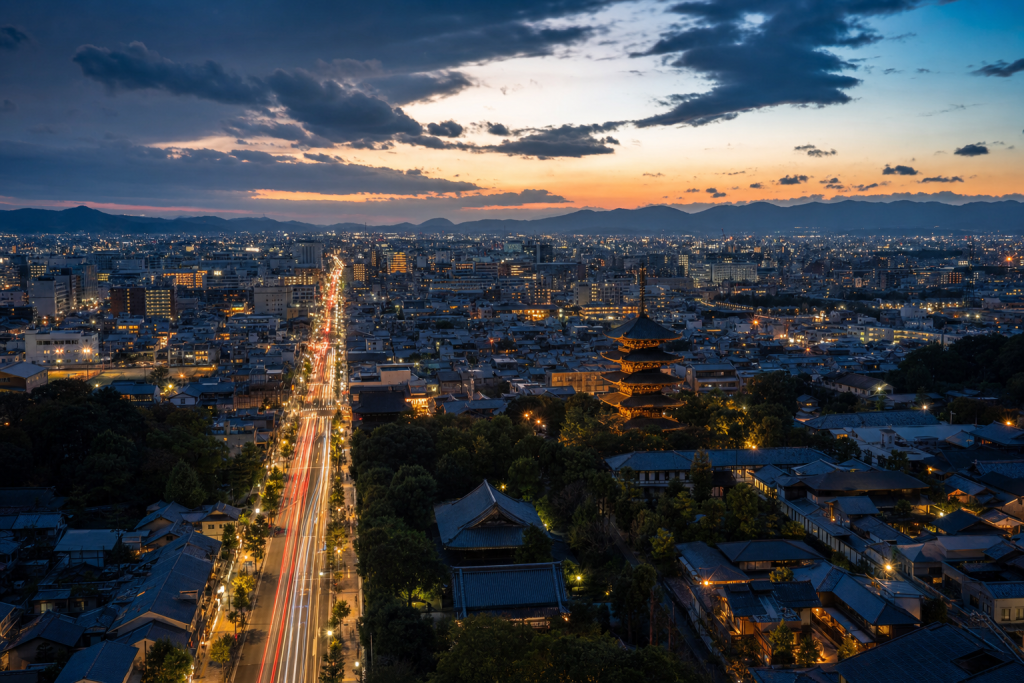
At 100 meters (131m total tower height), Kyoto Tower is the tallest structure in a city that prohibits new high-rises to preserve its historic skyline — making the observation deck the only location from which to see Kyoto’s extraordinary concentration of UNESCO World Heritage temples from above. The view includes a remarkable overhead angle of Kyoto Station’s massive titanium-and-glass barrel-vault roof to the south — a famous 1997 piece of deconstructivist architecture rarely visible from above at close range. To the east, the entire chain of Higashiyama temples including Kiyomizu-dera, the Yasaka Pagoda, and Tofuku-ji are visible spread across the forested hillside. On exceptionally clear days, Osaka is visible to the southwest.

  • GPS: 34.9875, 135.7591
  • Elevation: 328 ft
  • Best time of day: 30 minutes before sunset to 45 minutes after (approximately 6:30–8:00 PM in summer, 4:00–5:30 PM in winter) when the cityscape transitions from golden hour warmth to blue-hour glow; the tower is open until 9 PM allowing the full city-lights display to develop. Clear winter days (December–February) also offer spectacular afternoon views of Higashiyama temples and snowcapped peaks
  • Sun direction: The Kyoto Tower observation deck is at 100m height above Kyoto Station’s south exit. The 360° viewing deck faces all directions. The most photogenic view is north and east toward Higashiyama, Kiyomizu-dera, and the temple-covered eastern hills. At sunset the sun descends to the northwest (~300° in summer, ~240° in winter) — this means the western view toward Arashiyama and the Nishiyama hills is backlit and moody at sunset, while the eastern Higashiyama view is front-lit by the last warm light. The north view toward central Kyoto’s grid shows the grid street pattern dramatically in low evening light. At full night, the city spreads in 360° of amber and white light against the black mountain ridges.
  • Access: 2-minute walk from JR Kyoto Station Central Exit, crossing the bus terminal. Tower address: 721-1 Higashishiokoji-cho, Shimogyo Ward, Kyoto. Observation deck open 10:00 AM to 9:00 PM daily (last admission 8:30 PM; August 16 closes early at 6:30 PM). Admission: ¥900 adults (18+), ¥700 youth (15–17), ¥600 child (6–14), ¥200 child (3–5). Payment at ground floor ticket counter. Free telescopes on the observation deck. Photography through windows permitted; glass is low-reflection but a lens hood prevents hotspots. No tripods on the observation deck. Access by elevator from lobby.
  • Difficulty: easy
  • Recommended settings: Golden Hour City Panorama: f/8, 1/250 sec, ISO 400, 24mm  ·  Blue Hour City Lights: f/8, 1/30 sec, ISO 800, 35mm  ·  Full Night City Glow: f/5.6, 1/15 sec, ISO 1600, 24mm  ·  Telephoto Temple Detail: f/5.6, 1/500 sec, ISO 400, 200mm

Shots to chase:

  • Sunset transition: looking northeast at Higashiyama temple ridge with the last golden light illuminating forested slopes and the grid of tile-roofed machiya neighborhoods in the foreground — 24mm wide
  • Overhead view of Kyoto Station’s barrel-vault roof to the south at a 45° downward angle — the gridded titanium-and-glass structure fills the lower frame with the Toji pagoda visible beyond at 50mm
  • Blue-hour 360° panorama in two images (north–east stitched): the city grid ablaze with amber lights and neon against deep cobalt sky, with the dark silhouette of mountain ridges on three sides
  • Telephoto 200mm on Kiyomizu-dera temple: the wooden stage and three-story pagoda visible on the Higashiyama hillside in clear evening light, compressed against the wooded slope
  • Night timelapse or slow-pan: looking north along the Karasuma Dori main axis, city lights converging to a vanishing point with the Kitayama mountains dark behind

Pro tip: Shooting through the observation deck glass requires pressing the lens hood firmly against the window to eliminate reflections and internal glare — this technique alone transforms the image quality. Arrive 30 minutes before sunset to claim a position at the eastern-facing windows for golden hour on Higashiyama; then rotate to the northwest for sunset sky. The free binoculars on the deck can be borrowed to scout temple locations before using your own telephoto lens. On clear winter mornings, the snow-capped Hiei and Kitayama peaks to the north are visible — a combination not achievable in most seasons.

Common mistake to avoid: Shooting at noon with flat light and haze — the tower’s photographic value is almost entirely in the golden-hour-to-night window. Not pressing the lens against the window glass and getting double-reflected images. Visiting on a humid summer day when Kyoto’s notorious summer haze reduces visibility to under 5 km, obscuring the Higashiyama temples.

14. Sanjusangendo — Long Hall and Exterior

Sanjusangendo is one of the most architecturally remarkable buildings in Japan — a 120-meter long Kamakura-period wooden hall (the longest wooden structure in the country) that houses 1,001 gilded thousand-armed Kannon bodhisattva statues arranged in 10 tiers across the entire length of the nave, a spectacle of overwhelming human artistry. Founded in 1164 AD, the current hall dates to 1266 and is a National Treasure. Though photography inside is prohibited, the exterior’s extraordinary horizontal scale — a single unbroken wooden roofline stretching the length of a football field — is one of the most striking architectural photography subjects in Kyoto. The Toshiya archery ceremony held annually along the west veranda is a photographic event of extraordinary cultural power.

  • GPS: 34.9871, 135.7735
  • Elevation: 154 ft
  • Best time of day: 8:30 AM opening in spring/summer (April–November 15) when soft east morning light rakes across the wooden hall’s exterior and the surrounding garden is dew-covered; the low autumn sun at 8:30 AM in October–November cross-lights the entire 120-meter long structure from the east at a low angle, revealing the deep shadow of the veranda recesses and the texture of the ancient roof tiles
  • Sun direction: Sanjusangendo’s Sanjusangendomawari (outer garden path) surrounds the 120m long hall, which runs north–south on its long axis. The hall faces west toward the garden. At morning opening (8:30 AM), the rising sun from the east (~80° azimuth in autumn) illuminates the eastern exterior wall and roof from behind. From the western garden path facing east toward the hall, morning light backlights the structure, creating dramatic silhouettes of the veranda columns and bracketing system. For detail shots of the carved wood bracketing on the west face, afternoon light from 1–4 PM provides the best side-lighting, revealing the intricate Kamakura-period woodwork in three dimensions. The famous January archery tournament (Toshiya) is held on the west exterior veranda — this event itself, held on the Sunday closest to January 15, is exceptional for human-interest photography.
  • Access: Bus 100, 206, or 208 from Kyoto Station to Sanjusangendo-mae stop (~10 minutes, ¥230); also walkable in 15–20 minutes east of Kyoto Station. Open April 1–November 15: 8:30 AM–5:00 PM; November 16–March 31: 9:00 AM–4:00 PM. Admission: ¥600 adults, ¥400 junior high students, ¥300 elementary students. Cash or IC card. Photography strictly prohibited inside the main hall (1,001 life-size gilded bodhisattva statues and 28 guardian deities are off-limits to cameras). Exterior of the hall, garden path, and outer grounds may be photographed freely. Tripods permitted in exterior garden.
  • Difficulty: easy
  • Recommended settings: Exterior Raking Morning Light: f/8, 1/250 sec, ISO 200, 35mm  ·  Long Hall Compression Telephoto: f/11, 1/125 sec, ISO 200, 200mm  ·  Garden Detail Texture: f/5.6, 1/250 sec, ISO 200, 85mm  ·  Overcast Soft Architecture: f/8, 1/125 sec, ISO 400, 24mm

Shots to chase:

  • Classic horizontal composition from the north end of the outer garden path: the 120m roofline receding into perfect diminishing perspective with stone lanterns and autumn maple framing at 50mm
  • Telephoto compression (200mm) from the south end: the roof and bracketing system stack into a dense horizontal tapestry of weathered wood and gray tile, the vertical pillars creating a repeating rhythm
  • Toshiya archery ceremony (January): archers in formal hakama drawing longbows along the 60m shooting range under the veranda eaves — compressed 200mm shot from the south end of the range
  • Close-up of the veranda wooden bracketing (tokyō) system: ancient keyaki wood with its grain pattern and red-lacquer accents in raking morning light at 100mm macro
  • Garden gate and lantern with the long hall as an even horizontal backdrop — a classic Japanese architectural framing with foreground stone lantern and moss at 50mm

Pro tip: The north end of the garden path provides the longest uninterrupted perspective of the entire building length — this is the only angle that captures the full 120-meter scale in one frame without a very wide lens. Arriving exactly at 8:30 AM puts you 15–20 minutes ahead of the first tour buses and allows tripod shooting along the exterior path without obstruction. Sanjusangendo is most evocatively photographed on a misty morning in October or November when wisps of mist hang in the garden and the old wood appears even more ancient. The hall’s interior is best experienced at the moment of opening before the crowds build.

Common mistake to avoid: Attempting photography inside the hall and being removed by staff — this is strictly enforced. Using a standard 50mm lens from the garden path, which requires 120m of distance to capture the full hall length and loses the architectural detail — the most interesting shots are at 35mm from 30m distance for partial views, or 200mm from the far end for compression. Visiting only for the interior experience and spending too little time appreciating the extraordinary exterior architecture.

When to photograph Kyoto: a year-round breakdown

Kyoto is photogenic every month of the year — but the conditions differ radically by season. Here is what to expect:

Late March–early April (cherry blossom peak with pink-canopied streets and illuminated sakura at dusk) and mid-November (peak autumn foliage when every temple turns crimson and gold, clear blue skies)

Photographer safety in Kyoto: read this

City photography has its own risks: gear visibility, neighborhood timing, traffic, weather. Read the briefing before you go.

  • Gear visibility: Use a discreet bag with no obvious camera branding. Keep a body strapped under a jacket on transit.
  • Neighborhood timing: Pre-dawn and post-sunset shoots reward early scouting. Cross-reference each location with current local guidance and choose well-lit transit routes.
  • Situational awareness: Headphones out. One eye in the viewfinder, one on the street.
  • Traffic: Bridges, medians, and bike lanes are not setup zones. Shoot from sidewalks and pedestrian areas only.
  • Weather: Summer storms move quickly; winter cold drains batteries. Layer up, keep gear dry, watch for ice on cobblestones at blue hour.

The complete safety briefing is inside the Kyoto Photographer’s Guide PDF.

Take this guide into the city

This post is the complete field reference. The Kyoto Ultimate Photographer’s Guide PDF is the field-deployable version: full-page resolution hero photography, GPS maps with gold pins for every location, multi-season shooting calendars, gear notes per location, sun-angle diagrams, the full city safety briefing, and a print-ready editorial layout in Framehaus black and gold. Save it offline. Print it. Take it on the walk.

Kyoto Ultimate Photographer’s Guide
Downloadable PDF · 14 GPS-mapped locations · Multi-season calendar · City safety briefing · Packing checklist

Get the Kyoto guide — $47

Combo Deal

Get the Kyoto Guide + Preset Pack

Photograph it. Edit it. Done.

$66
$54
Save $12
PDF Guide Every spot, GPS, golden hour
Preset Pack 20 Lightroom presets
Book your tours & experiences in Kyoto

All links go to Viator (a TripAdvisor company), the world’s largest marketplace for guided experiences. Tagged as affiliate per FTC.

Take Kyoto home in your pocket.

Every shot location, every angle, every time of day worth shooting. Printable PDF + GPS-tagged map.

Instant download. Works on phone, tablet, and printed.

Continue reading

← Back to International Cities Photography Guides

Related guides nearby

Three more photography guides within striking distance — perfect for combining into one trip.

  • Tokyo 370 km away · city · Japan
  • Seoul 837 km away · city · South Korea
  • Taipei 1756 km away · city · Taiwan

Browse all 78 guides → · Open the map