Best Photography Spots in Mexico City: 12 Locations With GPS

Mexico City, Mexico is one of the most photogenic cities in the world. If you have a camera and the patience to show up before dawn, Mexico City will give you images that last a career — but only if you know where and when to point it.
This is the definitive field guide to the 12 best photography spots in Mexico City, with GPS coordinates you can drop straight into Google Maps, exact camera settings tuned to Mexico City’s unique light, precise timing for every location, and the access notes nobody else bothers to document. It mirrors the intel inside our Mexico City Ultimate Photographer’s Guide ($47 PDF) — a downloadable field guide with full-page hero images, GPS maps, seasonal tables, a city safety briefing, and a complete photographer’s packing list. Get the guide →
Planning multi-city travel? See also: U.S. cities photography hub and the National Parks Photography Guides.
12 GPS-mapped locations · Exact camera settings · Multi-season shooting calendar · Free annual updates
Download the PDF guide →
Quick jump to the 12 spots
- Zócalo — Plaza de la Constitución & Metropolitan Cathedral
- Palacio de Bellas Artes — Finca Don Porfirio (Sears Rooftop Café)
- Torre Latinoamericana — 44th Floor Observation Deck
- Museo Frida Kahlo — Casa Azul (Blue House), Coyoacán
- Xochimilco — Trajineras on the Floating Gardens
- Castillo de Chapultepec — National History Museum
- Templo Mayor — Aztec Great Temple Ruins
- Basílica de Nuestra Señora de Guadalupe
- Roma Norte & La Condesa — Street Art, Boulevards, and Parque México
- Museo Nacional de Antropología — El Paraguas Courtyard
- Teotihuacán — Pyramids of the Sun and Moon (Day Trip)
- Biblioteca Vasconcelos — The Megabiblioteca
A look inside the Mexico City Photographer’s Guide
Here are three of the actual shots you’ll find inside the PDF — cinematic full-page references for the exact spots, lenses, and lighting conditions documented in the guide. The full guide includes 12 locations, each with a hero image, GPS map, settings table, and a five-shot list.
 Save
Save
Before you shoot Mexico City: the essentials
- Free public access: Zócalo plaza, Metropolitan Cathedral exterior and interior (free), Templo Mayor ruins and museum MX$100 (~US$5), Palacio de Bellas Artes exterior free / interior MX$90, Finca Don Porfirio café at Sears (Bellas Artes view) free to enter (food/beverage purchase suggested), Torre Latinoamericana observatory ~MX$280 (~US$17), Frida Kahlo Casa Azul MX$320 (~US$18) foreigners — advance online booking required, no walk-ups; Castillo de Chapultepec MX$100 (~US$6); National Museum of Anthropology MX$100 (~US$6); Templo Mayor MX$100 (~US$5); Basilica of Guadalupe complex free (museum MX$10); Xochimilco trajinera MX$750/hr per boat; Teotihuacán MX$100 (~US$5) general admission; Biblioteca Vasconcelos free; Roma Norte / Condesa streets free; Coyoacán plazas free
- Commercial permits: Personal and tourist photography in all public outdoor spaces is unrestricted. INAH-managed museums and archaeological sites (Templo Mayor, Chapultepec Castle, Anthropology Museum, Teotihuacán) require a small in-person camera permit (MX$30–200) for non-smartphone cameras with no flash and no tripod; purchase at entrance ticket desk. Professional/commercial photography at INAH sites requires advance authorization via tramites@inah.gob.mx at least 10 working days ahead plus fees. No photography in the Mexico City Metro system (trains or stations). Drones prohibited over federal properties including archaeological zones, museums, and natural reserves. Open-air tianguis (informal markets) often prohibit cameras — respect posted signs. Commercial use of images of INAH-owned monuments/artworks requires separate licensing from INAH regardless of photography permit.
- Best photography seasons: October–February (dry season, clearest skies, low smog after rains flush the basin) and March–April (warm, bright pre-rainy-season light; wildflowers in Chapultepec)
- Blue hour notes: Mexico City sits at 19.43°N — near-equatorial latitude means sun arcs almost directly overhead at noon and rises/sets nearly due east/west year-round. Blue hour is brief (10–15 minutes post-sunset) compared to higher-latitude cities. Sunset ranges from 6:00 PM (December) to 8:20 PM (June). The city’s high altitude (7,350 ft / 2,240 m) means thinner atmosphere and unusually brilliant stars on clear nights, but also rapid temperature drops after sunset — bring a layer. Afternoon smog (especially Dec–Feb dry season and Mar–Apr) can create dramatic hazy golden tones but reduces sharpness for cityscapes; best clarity comes on days after a overnight rain or strong north wind.
- Drone policy: Drone laws vary widely by country and city — many capital and tourist zones are no-fly. Verify the local civil aviation authority’s current rules before launching.
- Local resource: Official visitor information
The full-resolution version of every map below — plus seasonal calendars, gear notes per location, sun-angle diagrams, and a complete photographer’s packing checklist — is inside the Mexico City Photographer’s Guide PDF ($47).
1. Zócalo — Plaza de la Constitución & Metropolitan Cathedral
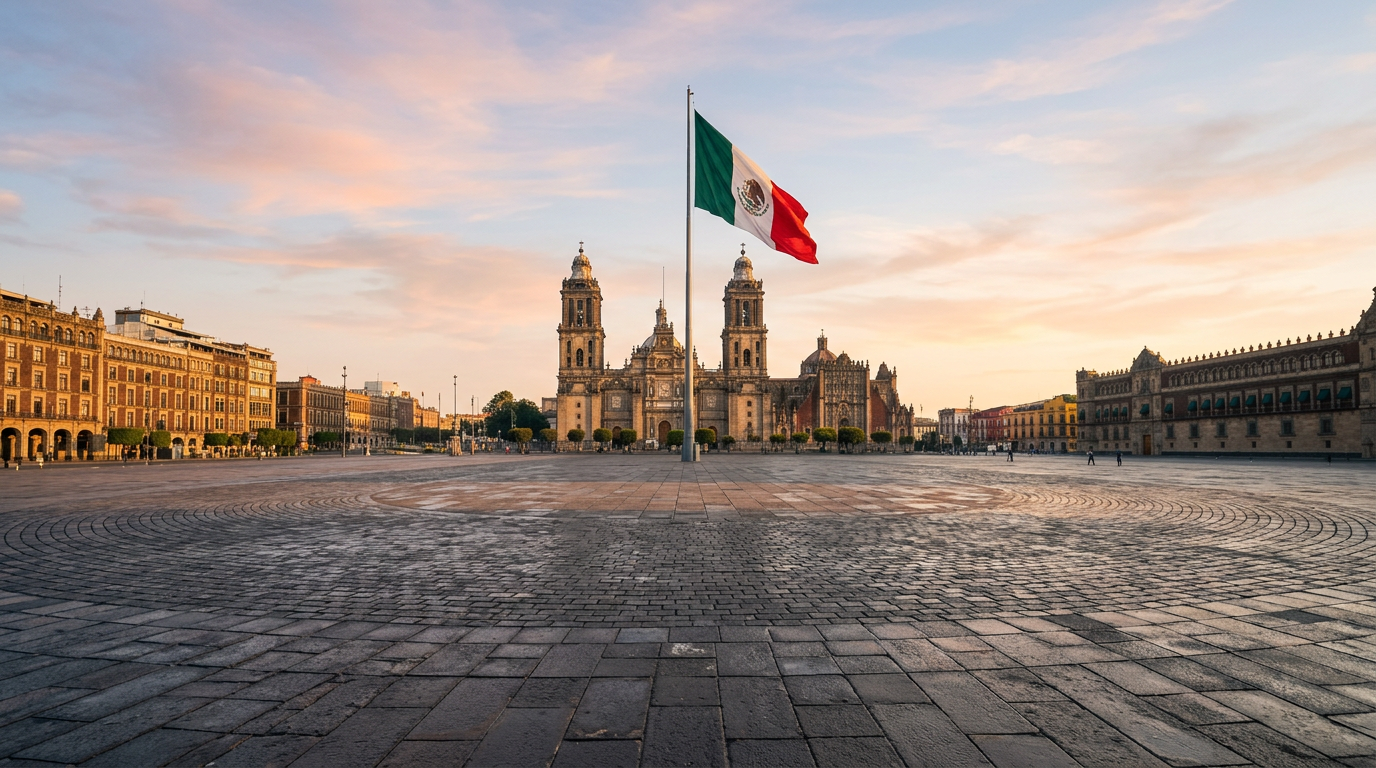
The Zócalo is the second-largest public square in the world (57,600 m²) and the political and spiritual heart of Mexico. The Metropolitan Cathedral — the largest in the Americas, built 1573–1813 across Baroque, Neoclassical, and Churrigueresque styles — flanks the north side with extraordinary sculptural detail. Beneath the square, Aztec Templo Mayor ruins are still being excavated. The sheer scale of the symmetrical plaza, the enormous tricolor flag, and the layered 700-year history visible in a single frame make this irreplaceable.
- GPS: 19.4326, -99.1332
- Elevation: 7,349 ft
- Best time of day: pre-dawn to 30 minutes after sunrise on weekdays — the massive square is nearly empty, the Cathedral’s twin Baroque towers glow in warm first light, and the changing of the guard / giant flag-raising ceremony begins at 7:20–8:00 AM; blue-hour post-sunset (6:10–6:25 PM December, 8:20–8:35 PM June) when both the Cathedral and National Palace are lit in warm yellow-gold floodlight
- Sun direction: CDMX sits at 19.43°N so the sun rises close to due east and sets nearly due west year-round. The Cathedral faces south onto the square; its twin bell towers are front-lit (south-facing) from mid-morning until mid-afternoon. At sunrise the eastern face of the National Palace on the square’s east side receives direct light. For the classic full Cathedral façade shot, late-afternoon west-southwest sun (azimuth ~250–260°) lights it obliquely from the left — ideal for texture. The giant flagpole at plaza center casts dramatic shadows toward the cathedral in morning light.
- Access: Centro Histórico, Cuauhtémoc, CDMX 06000. Metro Line 2 Zócalo station (exit directly into the square). Metrobús Line 4 Zócalo stop. The plaza is a public space open 24 hours. Metropolitan Cathedral open daily 7:00 AM–8:00 PM; free entry. National Palace (Diego Rivera murals) open Tue–Sun 9 AM–5 PM, free with valid ID/passport.
- Difficulty: easy
- Recommended settings: Blue Hour Cathedral: f/8, 4–8 sec, ISO 200, 24mm, tripod · Golden Hour Ambient: f/8, 1/250 sec, ISO 400, 35mm · Flag Ceremony Dawn: f/4, 1/500 sec, ISO 800, 70mm · Overcast Wide Plaza: f/11, 1/125 sec, ISO 400, 16mm
Shots to chase:
- Pre-dawn long-exposure with light trails from the few early buses on Calle 5 de Mayo, cathedral illuminated by streetlamps, sky transitioning cobalt
- Full-façade Cathedral shot from the south side of the plaza, 35mm, minimizing lens distortion on the twin towers
- Aerial perspective from Gran Hotel de la Ciudad de México rooftop bar (ask concierge) looking straight down at the geometric plaza with the cathedral on the far side
- Military flag ceremony at 8 AM: soldiers in formal dress march in formation to raise/lower the enormous Mexican flag — burst-mode telephoto 200mm
- Inside the National Palace, Diego Rivera’s murals in the stairwell — natural light only, no flash, wide-angle 17mm from lower staircase
Pro tip: Arrive 45 minutes before sunrise (around 5:45 AM winter, 6:15 AM summer) to set up your tripod on the south side of the plaza — security is heavy (government offices surround it), making it safer than most Centro locations at that hour. The rooftop terrace of the Gran Hotel Ciudad de México on the east side of the plaza offers a free elevated view; just buy a coffee at the lobby café. The flag ceremony is a genuine spectacle — position yourself on the south side early to get the cathedral as backdrop behind the ceremony. Safety note: One of the safest spots in CDMX at any hour due to heavy government security and constant police presence. Petty pickpocketing can occur in crowds; keep camera straps tight. Avoid solo night photography in the blocks immediately north of the cathedral.
Common mistake to avoid: Standing too close to the cathedral and shooting at 24mm or wider creates severe converging verticals on the towers — use a longer focal length (35–50mm) and step back to the south edge of the plaza for a more natural perspective. Visiting midday when the square fills with tour groups and the overhead sun flattens the intricate Baroque façade carvings. Forgetting the National Palace murals — arguably CDMX’s most photogenic interior — which are on the same block.
2. Palacio de Bellas Artes — Finca Don Porfirio (Sears Rooftop Café)
The Palacio de Bellas Artes is Mexico’s most photographed building — a masterwork combining Italian Art Nouveau exterior (white Carrara marble, Art Deco copper dome stained orange-green by oxidation) designed by Adamo Boari and completed 1934. The Finca Don Porfirio café on the Sears 8th floor across Eje Central is a local secret, offering a dead-on eye-level view of the dome and façade that is otherwise only achievable by drone. What appears in most Instagram posts to be a drone shot is actually this café angle. The Tiffany stained-glass curtain inside the main hall (nearly 1 million glass pieces) is equally legendary.
- GPS: 19.4352, -99.1414
- Elevation: 7,362 ft
- Best time of day: sunrise until 9 AM on a weekday — the Art Nouveau/Art Deco dome glows in orange-gold morning light and Alameda Central park is empty in the foreground; the café opens when the Sears does, typically 10 AM, so the rooftop shot is better taken from plaza level at dawn then revisited for café view mid-morning
- Sun direction: Bellas Artes faces east onto Avenida Hidalgo and Alameda Central. At sunrise the sun rises roughly behind the building from the Finca Don Porfirio vantage (the café is on the west side, looking east at the building). By 9–10 AM the eastern façade is front-lit by morning sun — ideal from the café or plaza. The Carrara marble dome transitions from rosy pink at dawn to brilliant white by noon. At sunset the western sun backlights the dome from the café perspective, creating a halo effect.
- Access: Eje Central Lázaro Cárdenas 1, Centro Histórico, CDMX 06010. Metro Line 2/8 Bellas Artes station. For the café view: enter the Sears department store at Avenida Juárez 18, take the elevator to the 8th floor. Finca Don Porfirio café (Sears rooftop) is typically open Mon–Sat 10 AM–8 PM; visits informally limited to ~40 minutes; drinks from MX$80–150 recommended. Bellas Artes palace exterior: free, open public access 24 hrs. Interior: MX$90 (~US$5) Tue–Sun 10 AM–5 PM.
- Difficulty: easy
- Recommended settings: Cafe Rooftop Architectural: f/8, 1/250 sec, ISO 400, 50–85mm (compresses distance, avoids wide distortion) · Plaza Dawn Wide: f/11, 1/60 sec, ISO 800, 24mm · Interior Stained Glass: f/4, 1/30 sec, ISO 1600, 24mm, no tripod · Blue Hour Dome: f/8, 2–4 sec, ISO 200, 50mm, tripod from plaza
Shots to chase:
- From Finca Don Porfirio café: 50–85mm shot of the dome centered between the window frame and alley below, ideally on a clear morning with blue sky backdrop
- Ground-level Alameda Central foreground: shoot through the park’s fountain or sculpture to frame the building at dawn with warm light on the marble
- Interior main hall: the Tiffany curtain viewed from below the stage — extreme upward angle at f/4 catches the glass mosaic backlit by stage lighting
- Night shot from the plaza: blue-hour 8-second exposure capturing the floodlit white marble dome against deep indigo sky with light trails from Eje Central taxis
- Wide 16mm from the southeast corner of Alameda to include park trees, water feature, and the full palace in one environmental composition
Pro tip: The café seats facing the building are limited (roughly 8–10 window seats); arrive at opening (10 AM) on a weekday to secure a window spot. Visits are politely limited to ~40 minutes. The barista-style coffee drinks and pastries are decent — order something to secure your seat. For exterior shots, Sunday mornings before 8 AM offer the cleanest foreground with no traffic and almost no pedestrians. The Sears building itself has a faded mid-century charm worth photographing. Safety note: Alameda Central and Bellas Artes area is well-patrolled and safe during daylight. Evening is generally fine on the main avenues; avoid the side streets immediately west of the park after dark.
Common mistake to avoid: Using a very wide lens (under 35mm) from the café creates barrel distortion on the dome and building edges; 50–85mm is the ideal compression range from that distance. Visiting only the exterior and skipping the interior — the Art Deco mosaics and Diego Rivera/Orozco murals on the upper floors are among the most photographically rich interiors in Latin America. Attempting to bring a tripod inside the museum (not permitted).
3. Torre Latinoamericana — 44th Floor Observation Deck
The Torre Latinoamericana, completed 1956 at 182 m, was the tallest building in Latin America for over a decade and remains the most iconic skyscraper in CDMX’s skyline. The 44th-floor open-air observation deck (partially enclosed with mesh) delivers an unobstructed 360° panorama of the world’s 4th-largest urban area. On clear winter days (October–February) you can see Popocatépetl volcano (5,426 m) still active with a visible steam plume — an otherworldly photograph of an ancient volcano above a megacity of 21 million.
- GPS: 19.4337, -99.1408
- Elevation: 7,362 ft
- Best time of day: 45 minutes before sunset until 30 minutes after (blue hour) — the slanting sun warms thousands of windows across the city’s glass towers, creating a shimmering mosaic of orange-gold reflections; at blue hour the grid of city lights ignites while the sky holds deep cobalt; avoid midday when smog is worst
- Sun direction: The tower stands at the intersection of Eje Central and Madero in Centro. From the 44th floor (181 m / 594 ft) the panorama is 360°. To the southwest, Paseo de la Reforma corridor and Chapultepec Park are visible; to the east, the Zócalo and the volcanic peaks of Popocatépetl and Iztaccíhuatl (visible on the clearest winter mornings). Morning east light illuminates the historic centro roofscape; afternoon west-southwest light (azimuth ~250°) catches the modern towers in Polanco and Santa Fe on the horizon.
- Access: Eje Central Lázaro Cárdenas 2, Centro Histórico, CDMX 06000. Metro Line 2/8 Bellas Artes, 3-minute walk. Tower open daily 10 AM–9 PM (last entry ~8 PM). Observation deck (44th floor) ticket: MX$280 (~US$17) purchased at the ground floor ticket window or online via official site; includes access to the Museo Bicentenario on lower floors. The 41st floor Miralto bar/restaurant offers the same views without an observatory ticket (food/beverage purchase required).
- Difficulty: easy
- Recommended settings: Blue Hour Cityscape: f/8, 4–8 sec, ISO 200, 24mm, tripod (mesh fence may require lens pressed against it) · Sunset Telephoto Volcano: f/8, 1/500 sec, ISO 400, 200mm · Daytime Wide Overview: f/11, 1/500 sec, ISO 200, 16mm · Night Light Trails: f/11, 15–20 sec, ISO 100, 24mm, tripod or monopod against railing
Shots to chase:
- Volcanic panorama (Oct–Feb, early morning): 200mm telephoto toward the southeast capturing Popocatépetl’s plume above the city haze
- Blue-hour 360° panorama: stitch 8–10 frames at 24mm for a seamless panoramic image of the entire megalopolis at dusk
- Paseo de la Reforma light trail: 20-second exposure looking southwest down the tree-lined boulevard toward Chapultepec, capturing car light trails as golden rivers
- Looking straight down at the Alameda Central park and the Bellas Artes dome — unusual compressed top-down perspective at 85mm
- Sunrise: the deck may be accessed from 10 AM but sunrise views from the 41st floor Miralto bar can be arranged with early reservations
Pro tip: Queue at the ticket window early — on weekends and around sunset a 30–45 minute line is common. The deck mesh fencing makes hand-holding difficult; press the lens gently against the mesh to eliminate grid shadows. For maximum smog-free clarity, visit 1–2 days after significant overnight rain or a strong norte (north wind) event which flushes the basin. The 41st-floor Miralto bar is a legitimate alternative if the observation deck is too crowded — same views, more comfortable, but pricier. Safety note: Safe — tourist-frequented attraction with security staff throughout. Centro Histórico around the tower is busy and fine during opening hours; use Uber/DiDi for travel to/from at night.
Common mistake to avoid: Visiting at midday in dry season when thermal inversion traps smog at rooftop level, reducing visibility to just a few kilometers. Forgetting that the deck closes at 9 PM — arrive by 7:30 PM at latest for blue-hour light. Overlooking the top-down perspective at Alameda and Bellas Artes, which is among the most unique views in the city.
4. Museo Frida Kahlo — Casa Azul (Blue House), Coyoacán
Frida Kahlo’s childhood home (born here 1907, died here 1954) is the definitive pilgrimage site of Mexican cultural photography. The electric cobalt blue exterior — La Casa Azul — against Coyoacán’s colonial cobblestone streets is one of the most-reproduced façades in Mexican photography. Inside, her studio, bedroom (with the mirror above her bed where she painted her self-portraits), personal belongings, pre-Colombian artifacts, and the tropical garden create an extraordinarily intimate encounter with a towering artistic life.
- GPS: 19.3553, -99.1629
- Elevation: 7,274 ft
- Best time of day: first entry slot (10 AM Tue–Sun; 11 AM Wed) on a weekday — courtyards and garden are photographed best with soft overhead diffuse light before midday; the cobalt blue exterior is beautifully saturated on overcast days which prevent harsh shadow from the garden trees
- Sun direction: The Casa Azul sits in Coyoacán at 19.35°N. The south-facing cobalt-blue front façade (Londres 247) receives direct sunlight from mid-morning to mid-afternoon — best photographed at 10–11 AM for even light across the full wall, or at 3–4 PM for warm low-angle south-southwest light casting long shadows of the doorway. The interior garden courtyard is open-sky; midday light floods it, which is actually desirable for the vibrant blue walls and tropical plants.
- Access: Londres 247, Del Carmen, Coyoacán, CDMX 04100. Metro Line 3 Viveros or Coyoacán station + 15-minute walk, or Uber (~MX$80 from Roma Norte). Museum hours: Tue–Sun 10 AM–6 PM, Wed 11 AM–6 PM; closed Monday. General admission: MX$320 (~US$18) for foreigners. ADVANCE ONLINE BOOKING MANDATORY — no walk-up sales. Book at museofridakahlo.org.mx. Photography of interiors: requires a separate photo permit (MX$30–50) purchased at the ticket desk; no flash, no tripod, no video. Exterior and courtyard photography included in admission.
- Difficulty: easy
- Recommended settings: Exterior Facade: f/8, 1/250 sec, ISO 200, 35mm (stand back to street to avoid distortion) · Interior Garden Courtyard: f/5.6, 1/125 sec, ISO 400, 24mm · Studio Interior No Flash: f/2.8, 1/60 sec, ISO 1600, 35mm · Exterior Cobblestone Foreground: f/8, 1/200 sec, ISO 200, 50mm — low angle with cobblestones in foreground
Shots to chase:
- Classic façade shot from across Londres street: 35mm at f/8, cobalt blue wall filling 80% of frame with wooden door and window detail, green plants cascading over the wall
- Garden courtyard: wide-angle 17mm looking upward through the bougainvillea and banana-leaf canopy to the open sky above the blue walls
- Frida’s bedroom: the four-poster bed with the mirror above (where she painted while bedridden) — shoot at ISO 1600 without flash to preserve the original lighting mood
- Exterior corner of the house at the London/Allende intersection in morning light when the adjacent lane is empty of tourists
- Detail shots: the Diego Rivera and Frida portraits on exterior tiles, the Mexican folk art embedded in the garden walls, the collection of Catrina figurines in the display cases
Pro tip: The museum sells out days in advance during high season (Oct–Dec Day of the Dead, Jul–Aug summer holidays) — book at minimum 1 week ahead; 2–3 weeks for weekends. The photo permit is worth purchasing even for smartphone shooters — it gives you an official sticker and prevents guards from intervening. The exterior north side (Allende street) has less pedestrian traffic than the London Street façade and gives a slightly different angle of the blue wall with overhanging vines. The Coyoacán neighborhood immediately around the museum rewards 30–60 minutes of wandering before or after your visit. Safety note: Coyoacán is one of CDMX’s safest neighborhoods for tourists — low crime, heavy foot traffic, well-lit plazas. Standard precautions apply (don’t leave bags unattended, be alert in crowded market areas on weekends).
Common mistake to avoid: Showing up without advance tickets and being turned away — the museum now has NO in-person ticket sales. Using flash inside (immediately confiscated and can result in removal). Attempting to film video anywhere on the premises (strictly prohibited). Shooting the exterior on a bright sunny midday — the intense Mexico City sun creates blown-out whites and jet-black shadows on the blue wall; overcast or morning light is far superior.
Want this in your pocket on the street?
The full-resolution version of every spot above — with full-page hero photography, GPS maps with gold location pins, sun direction diagrams, multi-season tables, and a complete safety + packing checklist — is inside the Mexico City Ultimate Photographer’s Guide PDF ($47). Print it, save it offline, take it on the walk. Get the guide →
5. Xochimilco — Trajineras on the Floating Gardens
 Save
Save
Xochimilco is a UNESCO World Heritage Site — the last surviving fragment of the ancient Aztec lake-island system of chinampas (floating agricultural gardens) that once covered the entire valley floor where CDMX now stands. The colorful hand-painted trajineras (flat-bottomed punted boats), the labyrinthine canals, floating flower vendors, mariachi bands drifting past on their own boats, and the chinampas planted with corn, cempasúchil (marigolds), and vegetables create a sensory explosion unlike anything in the urban core. The Isla de las Muñecas (Island of the Dolls) — a chinampa covered in thousands of hanging dolls — is a surreal side-trip.
- GPS: 19.2648, -99.1027
- Elevation: 7,218 ft
- Best time of day: weekday mornings 9–11 AM — the canal light is soft, mariachi and vendor boats are fewer, and the flower-covered trajineras reflect in the glassy water; Saturday afternoon is the peak party atmosphere (photogenic chaos) but extremely crowded; avoid Sunday when it is densest
- Sun direction: Xochimilco’s canal network runs primarily north-south and east-west on a flat lake bed. Morning east light rakes across the colorful boat canopies and gardens, casting long shadows from the willow trees along the canal banks. At midday overhead light can flatten the colors — but the saturated pinks, yellows, and greens of the trajineras are vibrant in most conditions. Late afternoon (4–6 PM) west light is particularly warm and cinematic, turning the canal water golden.
- Access: Embarcadero Nuevo Nativitas, Fernando Celada s/n, Xochimilco, CDMX 16010. Metro Line 2 to Tasqueña, then Light Rail (Tren Ligero) to Xochimilco station (~30 min). By Uber from Roma Norte ~45 min (MX$180–250). Trajinera rental: MX$750/hr per boat (government-regulated maximum, 2025); boats hold 10–20 people. Collective lancha colectiva available weekends only at MX$50/person one-way. Operating hours: daily 8 AM–9 PM. No separate entry fee to the pier area.
- Difficulty: easy
- Recommended settings: Canal Reflection Still Water: f/5.6, 1/250 sec, ISO 200, 35mm · Mariachi Boat Action: f/4, 1/500 sec, ISO 400, 85mm · Wide Canal Scene: f/8, 1/250 sec, ISO 200, 24mm · Golden Hour Water: f/5.6, 1/125 sec, ISO 400, 50mm
Shots to chase:
- Dead-on bow shot from your trajinera looking forward down a narrow canal lined with weeping willows and flower-decorated arches, reflected in the still water below
- Portrait-style: the boat’s boatman (trajinero) standing at the stern with his pole, backlit by morning light, reflected in the canal
- Vendor interaction: a floating flower seller or food vendor boat pulling alongside — shoot at f/4 from your railing, colorful marigolds filling the foreground
- Isla de las Muñecas: the nightmarish hanging dolls on their chinampa — telephoto 100mm for compressed, claustrophobic framing; wide 16mm for environmental context
- Aerial-style shot leaning over the boat bow with polarizer to eliminate surface glare and reveal the green submerged plants beneath the clear water
Pro tip: Negotiate hard on time — boatmen will push 3-hour bookings; for photography, 2 hours is ample. Bring cash (pesos) — the pier and all vendors are cash-only. A circular polarizing filter dramatically cuts glare on the canal surface and reveals the submerged garden beds. For the richest color in the boat photographs, wear or position subjects in solid-color clothing against the multi-hued boat canopies. Request a less-traveled route toward La Llorona chinampa to access narrower, more atmospheric canals away from the main party corridor. Safety note: The embarcaderos and canals are generally safe for tourists during daylight. Avoid arriving/departing Xochimilco on foot after dark. Use Uber/DiDi, not street taxis. Keep valuables inside the boat and off the railing when vendor boats press close.
Common mistake to avoid: Going on a Sunday afternoon — the canal becomes a gridlock of hundreds of boats and the photo backgrounds are cluttered. Relying on Uber and finding no return cars available in Xochimilco — plan a driver or take the Tren Ligero back. Forgetting sunscreen — the open canal offers almost no shade and CDMX’s high-altitude UV is intense.
6. Castillo de Chapultepec — National History Museum
Chapultepec Castle is the only castle in North America to have served as an official royal residence (Emperor Maximilian I, 1864–1867). Its hilltop position provides the finest view in the city of Paseo de la Reforma stretching east to the skyline, with the Mexico City Angel of Independence monument visible as a tiny golden figure on the boulevard below. The black-and-white marble checkerboard balcony floor — photographed in almost every travel Instagram of CDMX — frames Paseo de la Reforma as a receding perspective line. Inside, Orozco murals and Maximilian’s Hapsburg-decorated rooms are extraordinary.
- GPS: 19.42, -99.1817
- Elevation: 7,600 ft
- Best time of day: Tuesday–Friday opening (9 AM) when crowds are minimal — the castle hill offers the best early-morning view over Paseo de la Reforma with the morning light streaming from the east; the palace terrace facing the city is best lit between 9 AM and noon
- Sun direction: Chapultepec hill rises ~60 m above the surrounding park at 19.42°N. The castle’s main façade faces northeast toward the city center; morning east-northeast sun (azimuth ~70–80°) front-lights the façade from sunrise until about 10 AM, ideal for the iconic view of the white palace against a blue sky. The balcony-terrace on the south side (the checkerboard black-and-white tile floor balcony) faces the Lomas neighborhood and receives south-facing sun from mid-morning onward.
- Access: Primera Sección del Bosque de Chapultepec s/n, Miguel Hidalgo, CDMX 11580. Metro Line 1 Chapultepec station, 15-minute walk through the park. Open Tue–Sun 9 AM–5 PM (last entry 4:45 PM); closed Mondays. General admission: MX$100 (~US$6) per INAH 2025 prices (INAH official site 2025); free Sundays for Mexican nationals and residents; free for children under 13, seniors 60+, students with ID. Camera permit for DSLR/mirrorless: MX$30–50 at entrance. No tripods inside the museum rooms.
- Difficulty: moderate (15-minute uphill walk to castle entrance)
- Recommended settings: Balcony Paseo Reforma View: f/8, 1/500 sec, ISO 200, 24mm · Stained Glass Interior: f/4, 1/60 sec, ISO 1600, 24mm · Exterior Facade Morning: f/8, 1/500 sec, ISO 200, 35mm · Reforma Boulevard Telephoto: f/8, 1/500 sec, ISO 200, 200mm (compresses boulevard into dense city ribbon)
Shots to chase:
- The iconic checkerboard balcony: stand at the balcony railing with Paseo de la Reforma extending to the horizon — 24mm at f/8 captures both the geometric floor pattern and the full boulevard length
- Exterior castle façade from below on the access path: looking upward at the white palace perched on the volcanic rock cliff with trees framing left and right
- Interior stained-glass hall: early natural light from the courtyard windows creates color patterns on the marble floors — shoot at ISO 1600 without flash
- Telephoto cityscape: 200mm from the northeast terrace compresses the Reforma office towers into a dense Manhattan-like stack with Popocatépetl on the horizon on clear winter days
- Chapultepec lake from hillside path: a lower vantage through the forest on the ascent captures the rowing boats on the lake below in the morning mist
Pro tip: The walk up the hill takes about 15 minutes on paved paths through ancient ahuehuete (Montezuma cypress) trees — arrive 15 minutes before opening to be first through the gates. The balcony is crowded by 11 AM on weekends; weekday visits are dramatically calmer. A 24–70mm zoom is ideal — wide for the balcony perspective and the interior courtyards, tighter for the city views. The castle also hosts the National Museum of History, so budget 2–3 hours to do justice to both the architecture and the murals. Safety note: Chapultepec Park is safe during daylight, especially in the First Section near the castle. Stay on main paths; the western sections of the park are less patrolled. Use official entrance paths and do not photograph in isolated areas after closing time.
Common mistake to avoid: Visiting on Monday (closed). Arriving at noon on a weekend and finding the balcony packed 5-people deep. Skipping the interior murals and focusing only on the balcony view — the Orozco staircase mural and Maximilian’s apartments are among the most photographable interiors in Mexico.
7. Templo Mayor — Aztec Great Temple Ruins
Templo Mayor is the very center of the Aztec universe — the high pyramid of Tenochtitlán, destroyed by the Spanish in 1521 and only rediscovered by accident in 1978 during utility excavations, now sits in open-air ruins literally at the foot of the Metropolitan Cathedral, creating one of the world’s most dramatic juxtapositions: 14th-century Aztec sacrificial platforms in the shadow of a 17th-century Spanish Baroque cathedral. Eight successive phases of pyramid construction are visible simultaneously — like a geological cross-section of the Aztec empire. The adjacent museum houses the 3.5-ton Coyolxauhqui moon-goddess stone.
- GPS: 19.4346, -99.1319
- Elevation: 7,349 ft
- Best time of day: first 90 minutes after opening (9 AM Tue–Sun) on a weekday — the ruins receive angled east morning light that emphasizes the layered stone platforms and carved serpent heads; by 11 AM direct overhead sun flattens the carved details
- Sun direction: The ruins are oriented with the main pyramid axis facing west (ceremonial Aztec orientation toward the setting sun). The north (Tlaloc) side and south (Huitzilopochtli) side of the dual pyramid are best lit at different times: north face in afternoon light from the south, south face in morning light. The large stone Coyolxauhqui disc — the moon goddess stone — is in the museum at ground level, lit by careful indoor lighting (no flash).
- Access: Seminario 8, Centro Histórico, CDMX 06060 (one block north of the Zócalo). Metro Line 2 Zócalo, 5-minute walk. Open Tue–Sun 9 AM–5 PM (last entry 4 PM); closed Monday. General admission (ruins + museum): MX$100 (~US$5). Free for children under 13, seniors 60+, teachers and students with valid Mexican ID. Camera permit for DSLR/mirrorless: MX$30–50 at entrance ticket window. No flash, no tripod. Drones strictly prohibited (federal zone). A rooftop café terrace at the Porrúa bookstore on Calle Justo Sierra gives a free aerial view of the ruins from outside.
- Difficulty: easy
- Recommended settings: Ruins Morning Raking Light: f/8, 1/500 sec, ISO 200, 35mm · Serpent Head Close Detail: f/5.6, 1/250 sec, ISO 400, 85mm · Overview With Cathedral Backdrop: f/11, 1/250 sec, ISO 200, 24mm · Coyolxauhqui Disc Museum: f/4, 1/30 sec, ISO 1600, 24mm, no flash
Shots to chase:
- The definitive juxtaposition: 24mm from the northeast edge of the site, ancient pyramid stones in the foreground with the Metropolitan Cathedral’s Baroque towers rising immediately behind
- Stone serpent heads on the basal platform: 85mm macro-style shot catching the cracked volcanic stone surface texture in raking morning light
- Overview from the Porrúa bookstore café terrace on Justo Sierra street — free aerial perspective looking down onto the excavated ruins from the east
- Inside the museum: the Coyolxauhqui disc from above (viewing balcony) — 24mm wide shot capturing the full circular disc in its dimly lit display pit
- Blue-hour Zócalo and ruins: from the Zócalo’s northwest corner at dusk, the illuminated Cathedral and partially lit ruins visible simultaneously
Pro tip: The rooftop terrace of the Porrúa bookstore on Justo Sierra (1 block east) is a free, underused vantage; look for the signage and go to the top floor. Buy your camera permit at the ticket window when you buy your entry ticket — they will check at the entrance and it avoids holding up the queue. The museum (included in admission) is world-class; allow 60–90 minutes to photograph both the outdoor ruins and the indoor galleries. The Coyolxauhqui stone room has a viewing balcony — ideal wide-angle shot looking straight down. Safety note: The Templo Mayor site and museum are in the heart of the Zócalo area — well-guarded and tourist-dense. The surrounding Centro Histórico requires normal urban awareness; avoid wandering with equipment into less-populated side streets at dusk.
Common mistake to avoid: Arriving at midday when harsh overhead sun creates deep unflattering shadows in the excavated pits. Visiting on Monday (closed). Overlooking the upper floors of the museum where Aztec headdresses, jade masks, and ritual objects are displayed in beautifully lit cases — some of the best still-life photography in Mexico City.
8. Basílica de Nuestra Señora de Guadalupe
The Basílica de Guadalupe is the most visited Catholic pilgrimage site in the world outside the Vatican, receiving over 20 million visitors annually. The complex contains two extraordinary photographic subjects side by side: the sinking colonial Old Basilica (visibly tilted up to 2°, creating an uncanny optical effect when photographed with a level horizon) and the striking modern New Basilica — a 1976 circular tent-like structure with a distinctive copper ribbed roof designed by Pedro Ramírez Vázquez. Inside, the miraculous tilma of Juan Diego carrying the image of the Virgin is preserved behind the high altar.
- GPS: 19.4847, -99.1175
- Elevation: 7,270 ft
- Best time of day: weekday mornings 7–9 AM when the vast atrium plaza is relatively empty and the side-angled east morning light illuminates the modern basilica’s copper-toned roof and the tilting Old Basilica’s yellow dome simultaneously; avoid December 12 (Feast Day) when 10+ million pilgrims crowd the complex
- Sun direction: The complex sits at the base of Tepeyac hill facing south onto a large open atrium. The New Basilica (1976, circular blue roof) faces southwest; the Old Basilica (1709, sinking since earthquake damage) is to its east. Morning east light (azimuth ~80°) illuminates the yellow dome of the old basilica at sunrise while side-lighting the modern structure. The hill behind the basilicas — with the Capilla del Cerrito — is east-facing and best photographed in morning light.
- Access: Plaza de las Américas 1, Villa de Guadalupe, Gustavo A. Madero, CDMX 07050. Metro Line 6 La Villa/Basílica station (exit 1). Complex open daily 6 AM–9 PM. Basilica entry: FREE. Museum of the Basilica: MX$10 (~US$0.60). No entry ticket required for the basilicas themselves. Photography with handheld cameras is permitted inside both basilicas; no flash; tripods not permitted inside. The moving walkways beneath the altar allow close viewing of the miraculous tilma (Guadalupe image) — photography allowed from the walkway.
- Difficulty: easy
- Recommended settings: Atrium Wide Two Basilicas: f/11, 1/250 sec, ISO 200, 24mm (capture both buildings in one frame) · Old Basilica Sinking Tilt: f/8, 1/500 sec, ISO 200, 35mm (use grid lines to deliberately misalign the horizon) · Interior New Basilica: f/4, 1/60 sec, ISO 1600, 24mm, no flash · Hillside Capilla Del Cerrito: f/8, 1/500 sec, ISO 200, 50mm (hilltop chapel with city backdrop)
Shots to chase:
- Wide-angle 16mm: both basilicas in one frame from the center of the atrium, the tilting yellow dome of the old vs. the circular modern copper roof, pilgrims crossing the plaza as foreground movement
- Level-horizon shot of the Old Basilica that deliberately emphasizes its visible tilt — the door frames and horizontal stone courses are clearly angled vs. a level sky
- Moving walkway under the altar: the miraculous tilma image from below on the slow-moving people mover — shoot at ISO 1600, no flash, at a slight upward angle
- Hillside path to Capilla del Cerrito: looking back down at the basilica complex with the city spreading to the southern horizon — best around 10 AM when the hill is less crowded
- Detail of the outdoor rose garden (site of the 1531 apparition): close-up of the Castilian roses with the old basilica dome as soft-focus backdrop
Pro tip: The complex is enormous — plan at least 2 hours. The sinking Old Basilica (currently closed to entry but photogenic from outside) and the Capilla del Cerrito (Tepeyac hilltop chapel) are undervisited compared to the New Basilica and are more interesting photographically. A wide-angle 16–24mm lens captures both basilicas in a single frame from the atrium. Arrive before 8 AM on weekdays; by 10 AM the atrium fills with tour groups from the combined Teotihuacán + Guadalupe package tours. Safety note: The basilica complex is well-patrolled by security and Mexico City police. The surrounding Tepeyac / Villa de Guadalupe neighborhood is working-class and requires normal awareness; use Uber/Metro rather than walking long distances in the area. The complex itself is safe at all hours during operating times.
Common mistake to avoid: Visiting on December 12 (Feast of Our Lady of Guadalupe) — over 10 million pilgrims make photography nearly impossible and create a serious crush. Focusing only on the New Basilica and ignoring the visually richer tilting Old Basilica and the Tepeyac hillside chapels. Attempting to use flash inside the New Basilica, which has clear no-flash signage throughout.
Want this in your pocket on the street?
The full-resolution version of every spot above — with full-page hero photography, GPS maps with gold location pins, sun direction diagrams, multi-season tables, and a complete safety + packing checklist — is inside the Mexico City Ultimate Photographer’s Guide PDF ($47). Print it, save it offline, take it on the walk. Get the guide →
9. Roma Norte & La Condesa — Street Art, Boulevards, and Parque México
 Save
Save
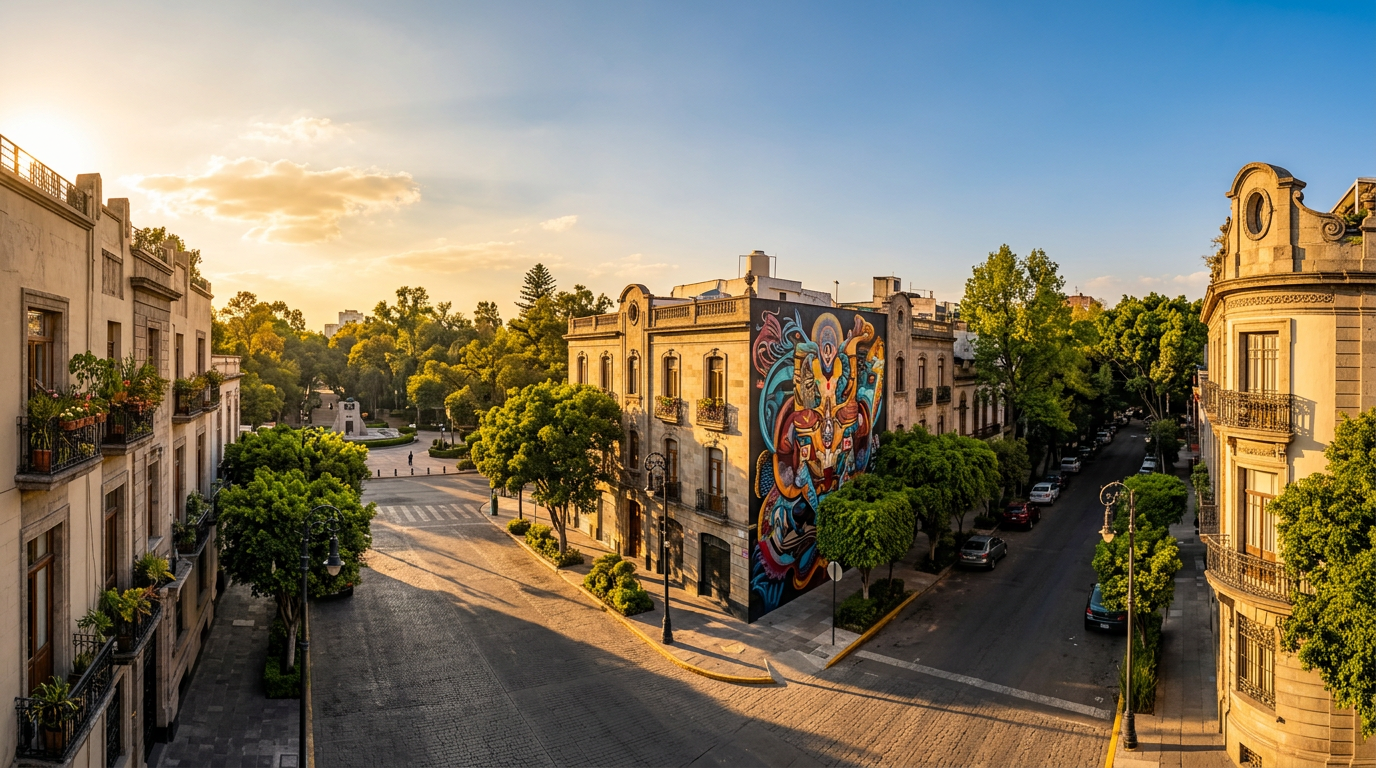
Roma Norte and La Condesa are CDMX’s most photogenic residential neighborhoods — the Williamsburg/Marais of Mexico. Rows of early 20th-century French-influenced and Art Deco apartment buildings, bougainvillea cascading from Juliet balconies, massive Indian laurel trees forming natural archways over the avenues, and world-class street murals on almost every block. Parque México — a 1927 Art Deco park following the oval track of a former horse-racing circuit — has the Charles Lindbergh Forum (an open-air Art Deco amphitheater) and beautiful ponds with lily pads. During February–April, jacaranda season turns the streets into a purple canopy.
- GPS: 19.4178, -99.1617
- Elevation: 7,349 ft
- Best time of day: weekday golden hour (1 hour before sunset) — the tree-canopied Avenida Álvaro Obregón and Amsterdam Boulevard create cathedral-like tunnels of warm backlit foliage; or early morning 7–9 AM when café tables are empty and the Art Deco residential buildings are cleanly lit with no parked cars blocking doorways
- Sun direction: Both neighborhoods run on CDMX’s grid at ~19.42°N. The primary photography boulevard — Avenida Álvaro Obregón — runs east-west; morning east light travels down the corridor creating a warm glow through the trees. At golden hour the west-setting sun backlit the jacaranda trees (Feb–April, vivid purple blossoms) or ash trees, creating a glowing canopy effect. Amsterdam Blvd in Condesa is an oval ring — one half receives morning east light and the other afternoon west light throughout the day.
- Access: Roma Norte is bounded by Insurgentes, Álvaro Obregón, Sonora, and Orizaba. Condesa bounded by Insurgentes, Sonora, Eje 2, and Eje 3. Metro Line 1 Insurgentes station (Roma Norte boundary) or Line 3 Chapultepec (Condesa edge). All streets are free and open 24 hours. Parque México: free, open daily 6 AM–8 PM.
- Difficulty: easy
- Recommended settings: Boulevard Golden Hour: f/5.6, 1/250 sec, ISO 400, 50mm · Street Mural Detail: f/8, 1/250 sec, ISO 200, 35mm · Art Deco Facade: f/8, 1/500 sec, ISO 200, 50mm (avoid wide distortion on buildings) · Jacaranda Canopy Spring: f/4, 1/500 sec, ISO 200, 35mm (shoot slightly upward into canopy backlit by sun)
Shots to chase:
- Álvaro Obregón corridor: 50mm mid-street level at golden hour, the tree canopy arching overhead creating a golden tunnel effect with dappled shadows on the sidewalk
- Parque México oval track path: the original racing-circuit path lined with benches and Art Deco lamp posts — 24mm wide from inside the curve
- Charles Lindbergh Forum in Parque México: the two Art Deco pergolas flanking the open amphitheater stage — symmetrical 35mm composition at 9 AM
- Roma Norte street murals: Plaza Luis Cabrera where converted buses and cars serve as mural canvases — 35mm environmental portraits with the painted vehicles as context
- Jacaranda season (Feb–April): Campeche street or Sonora looking east toward Insurgentes — extreme telephoto 200mm compresses hundreds of purple-blooming trees into a dense violet wall
Pro tip: La Condesa and Roma Norte are best explored on foot in a 3–4 hour loop. Start at Parque México at sunrise, walk east on Michoacán to Roma Norte, down Álvaro Obregón, and back via Orizaba. The bookstore El Péndulo in Roma Norte (Álvaro Obregón 86) has a beautiful plant-covered interior worth photographing. For street murals, the lanes around Calle Zacatecas and Tonalá (Roma Norte) have the highest mural density. Jacaranda season (late February–early April) turns the entire neighborhood into a purple-blossomed spectacle — arguably the single most photogenic seasonal event in all of CDMX. Safety note: Roma Norte and Condesa are among CDMX’s safest neighborhoods for photographers. Camera use on the street is common and unremarkable here. Evening photography is fine on main streets; standard precautions (camera strap, no phone out unnecessarily) suffice.
Common mistake to avoid: Shooting at midday when parked cars clutter every frame and flat overhead light kills the building texture. Forgetting to look upward — many of the best balcony details and bougainvillea cascades require a 35mm tilted 45° upward. Skipping Condesa’s circular Amsterdam Boulevard which has a completely different architectural character from Roma.
10. Museo Nacional de Antropología — El Paraguas Courtyard
The National Museum of Anthropology is the greatest pre-Columbian museum on earth, housing the Aztec Sun Stone, the original Olmec giant heads, Mayan jade funeral mask of Pakal, and over 45,000 artifacts. But for photographers, the real star is the building itself — a 1964 masterwork by Pedro Ramírez Vázquez. The entrance is marked by the colossal Tláloc monolith (rain god statue, 7 m tall, 168 tonnes, controversially relocated from Coatlinchán in 1964). The central courtyard features El Paraguas — a 4,200 m² concrete and bronze umbrella suspended from a single central pillar, with a continuous waterfall cascading from its edges — one of the most architecturally extraordinary interior spaces in Mexico.
- GPS: 19.4262, -99.186
- Elevation: 7,415 ft
- Best time of day: Tuesday–Friday 10 AM opening (before group tours arrive around 11 AM) — the El Paraguas central courtyard is best lit with diffuse morning light when the sun is not directly overhead creating harsh shadows under the canopy; overcast days are ideal for even illumination of the carved stone monolith
- Sun direction: The museum’s main entrance faces east onto a ceremonial approach from Paseo de la Reforma. The Tláloc monolith (7 m / 23 ft tall, 168 tonnes) stands on the exterior approach path outside the entrance — it faces east and is front-lit from sunrise through mid-morning. The central courtyard with El Paraguas (the massive single-pillar concrete umbrella fountain, 4,200 m² canopy) is an open sky well; overhead midday sun creates beautiful downward cascades of water from the canopy but also harsh shadows. Early morning (~10 AM) diffuse light is ideal for the exterior.
- Access: Paseo de la Reforma y Gandhi s/n, Bosque de Chapultepec, Miguel Hidalgo, CDMX 11560. Metro Line 7 Auditorio station, 10-minute walk through Chapultepec Park. Open Tue–Sun 10 AM–5 PM (last entry 4 PM); closed Monday. Admission: MX$100 (~US$6) per INAH 2025 rates; free Sundays for Mexican nationals and residents; free for children under 13, teachers, students, seniors with valid Mexican ID. Camera permit for DSLR/mirrorless: MX$30–50 at entrance. No flash, no tripod inside galleries.
- Difficulty: easy
- Recommended settings: El Paraguas Courtyard Wide: f/8, 1/250 sec, ISO 400, 16mm (extreme wide to capture umbrella canopy edge-to-edge) · Tlalock Monolith Exterior: f/8, 1/500 sec, ISO 200, 35mm · Paraguas Waterfall Detail: f/8, 1/250 sec, ISO 400, 85mm (telephoto captures water cascade curtain against pillar) · Gallery Aztec Sun Stone: f/4, 1/60 sec, ISO 1600, 35mm, no flash
Shots to chase:
- El Paraguas from inside the courtyard: 16mm extreme wide from ground level tilted upward, the single central pillar soaring out of frame with the bronze canopy spreading to all four edges
- Tláloc monolith exterior approach: 35mm from directly in front on the ceremonial path, the 7-meter carved stone deity with the museum entrance arch behind
- Water curtain close-up: the cascade of water falling continuously from El Paraguas edges — telephoto 85mm captures the sheets of water as a blurred veil against the dark interior
- Gallery walkway reflection: the polished stone corridor floors reflect the exhibits above — 24mm low angle for the double-image reflection composition
- Aztec Sun Stone (Piedra del Sol) in Room 7: the 3.6-meter basalt disc is the most photographed object in Mexican archaeology — 24mm from the viewing ramp above, no flash
Pro tip: The museum requires at minimum 3 hours to photograph properly; allocate half a day. The exterior Tláloc monolith is often overlooked by visitors who go straight inside — it’s one of the most physically overwhelming sculptures in the Americas. The El Paraguas courtyard doubles as a rain shelter, so photography is excellent in light rain. On Sundays (free for Mexican residents) the museum becomes very crowded — Tuesday mornings are the quietest. The bookstore near the exit has excellent prints and postcards showing the original architectural rendering — worth studying as a composition guide. Safety note: The museum and Chapultepec Park surroundings are safe, well-patrolled tourist areas. Use the official main entrance on Paseo de la Reforma rather than secondary park entrances.
Common mistake to avoid: Skipping the exterior Tláloc approach. Attempting to use flash in the galleries (strictly prohibited and immediately challenged by multiple guards). Trying to photograph the Sun Stone from ground level — the elevated viewing ramp/balcony gives a far superior angle. Under-allocating time and rushing the galleries.
11. Teotihuacán — Pyramids of the Sun and Moon (Day Trip)
Teotihuacán (‘place where the gods were created’) was the largest city in the pre-Columbian Americas, reaching 125,000 inhabitants circa 450 AD — contemporary with the Roman Empire. The Pyramid of the Sun (65 m / 213 ft tall, 225 m base) is the third-largest pyramid on earth. The Avenue of the Dead — a 2-km ceremonial boulevard flanked by smaller platforms — provides one of the world’s great long-exposure perspectives when photographed from the Moon Pyramid’s first platform looking south. On clear winter mornings (Oct–Feb), the volcanoes Popocatépetl and Iztaccíhuatl are visible on the southern horizon above the pyramids.
- GPS: 19.6925, -98.8438
- Elevation: 7,546 ft
- Best time of day: arrive at Gate 2 (Puerta 2) immediately at 8 AM opening on a Tuesday–Thursday (not Sunday — busiest day of week) — the first 90 minutes provide golden-hour raking light on the Pyramid of the Sun’s western face, near-empty Avenue of the Dead, and dramatic long shadows; leave before noon to avoid the worst heat and crowds
- Sun direction: Teotihuacán sits at 19.69°N on a high plateau 48 km northeast of CDMX. The site is oriented with the Avenue of the Dead running roughly north-south (slightly tilted ~15° from true north, aligned with astronomical events). At sunrise, east light bathes the west face of the Pyramid of the Sun and illuminates the Moon Pyramid from the front. By mid-morning the Sun Pyramid’s north and south flanks receive angled light that defines each construction tier. Afternoon golden hour (4–5 PM) before closing creates warm west light on the eastern face of the Moon Pyramid and long Avenue of the Dead shadows — but this requires special late-access arrangements as the site closes at 5 PM.
- Access: Zona Arqueológica de Teotihuacán, San Juan Teotihuacán, Estado de México 55800 (~50 km northeast of central CDMX). By bus: Terminal Central del Norte (Metro Autobuses del Norte, Line 5), Autobuses México–Teotihuacán, ~1-hour journey (MX$90 round trip); first bus ~7 AM, arrive by 8 AM opening. By Uber/DiDi: ~45 min from Roma Norte, MX$500–700; best for early access. Entry: MX$100 (~US$5) general admission 2025 (INAH rate); includes on-site Teotihuacán Culture Museum. Camera permit for video recording: MX$45 at ticket window. Personal photography (no video, no tripod): no additional fee. Drones: strictly prohibited. Pyramid climbing: Pyramid of the Moon — climbing restored to first platform only (2025, managed time slots). Pyramid of the Sun — climbing NOT permitted. Open daily 8 AM–5 PM.
- Difficulty: moderate (extensive walking on uneven stone, 3–5 km; high-altitude sun exposure)
- Recommended settings: Avenue Of Dead Wide: f/11, 1/500 sec, ISO 200, 24mm (from Moon Pyramid platform looking south) · Pyramid Sun Morning Texture: f/8, 1/500 sec, ISO 200, 50mm (raking light on stone tiers) · Sunrise Silhouette: f/8, 1/1000 sec, ISO 200, 50mm (shoot east into rising sun with pyramid as silhouette) · Avenue Long Exposure Dawn: f/11, 1/30 sec, ISO 100, 16mm (tripod before crowds arrive — if INAH staff permit)
Shots to chase:
- From the first platform of the Pyramid of the Moon: 24mm looking south down the full 2 km Avenue of the Dead with smaller pyramid platforms receding to the horizon — the classic Teotihuacán composition
- Pyramid of the Sun close approach: from the northwest corner looking up along the diagonal edge with morning raking light defining each individual stone tier
- Temple of Quetzalcoatl (La Ciudadela): carved feathered-serpent heads alternating with goggle-eyed Tláloc heads on the south face — 85mm macro-style in the afternoon light that catches the three-dimensional carving depth
- Long Avenue of the Dead shot with a single person walking: 50mm from the north end with the scale dwarfed by the massive platforms on either side
- Hot air balloon (pre-dawn tour): aerial photography of the pyramid layout from ~300 m altitude shows the city plan and astronomical alignments invisible from ground level — requires advance booking
Pro tip: Arrive at Gate 2 (Puerta 2), not Gate 1 — it deposits you directly at the Pyramid of the Sun’s base. Tuesday morning is the least crowded weekday. Bring 2 liters of water minimum — there is essentially no shade and CDMX high-altitude UV is extreme. The pyramid climbing ban on the Pyramid of the Sun has been in force since ~2021; the Moon Pyramid’s first platform was re-opened in 2025 with time-slot management. For the classic Avenue of the Dead composition, the Moon Pyramid first platform at 8 AM before other visitors arrive is the definitive viewpoint. A circular polarizer filter dramatically darkens the blue sky and increases stone contrast. Safety note: Teotihuacán is a major tourist site with good visitor infrastructure and security. The primary risk is heat exhaustion and falls on uneven stone — wear solid footwear and carry water. The Teotihuacán town surrounding the site has higher ambient crime; use official tour transport or Uber/DiDi direct to the gates and do not linger in the market stalls after hours.
Common mistake to avoid: Arriving after 10 AM when hundreds of tour buses have already unloaded and the avenue is crowded. Visiting on Sunday (free for Mexican residents — extremely dense). Not bringing enough water and sunscreen — the site has little shade and moderate vendor food availability. Expecting to climb the Pyramid of the Sun (not permitted since approximately 2021). Overlooking the Temple of Quetzalcoatl in the Ciudadela at the south end of the avenue — it has the finest carved stonework on the site.
12. Biblioteca Vasconcelos — The Megabiblioteca
Designed by Alberto Kalach and opened in 2006, the Biblioteca Vasconcelos is one of the most photographically distinctive public buildings in Latin America. The interior is a towering multi-level atrium (9 floors visible) with suspended shelving ‘islands’ — literally floating books — hanging from a concrete skeleton structure, connected by transparent walkways. The glass walls bathe the entire interior in natural light, making it function as a massive camera-friendly diffuser. A whale skeleton sculpture (Gabriel Orozco’s ‘Mátrix Móvil’) is suspended in the central void. The botanical garden (partially enclosed) adds living texture to the brutalist concrete.
- GPS: 19.4475, -99.1475
- Elevation: 7,349 ft
- Best time of day: weekday mornings 9–11 AM when the library is quiet and natural light floods in from the floor-to-ceiling glass façades, creating even illumination on the suspended bookshelf stacks; midday works well for the symmetry shots as overhead sky light eliminates directional shadow
- Sun direction: The library sits at 19.45°N on Eje 1 Norte in Buenavista. The building is oriented east-west with large glass walls on both long faces. Morning east light enters from the main glass façade and creates bright illumination on the lower bookshelf levels. Afternoon west light enters from the opposite glass wall. Midday provides the most even, shadowless light throughout the atrium — ideal for symmetrical long-exposure compositions. The hanging gardens (accessible from upper levels) face upward and receive direct sky light.
- Access: Eje 1 Norte s/n, Buenavista, Cuauhtémoc, CDMX 06350. Metro Line B or Suburban (Tren Suburbano) Buenavista station, 2-minute walk. Open daily 8:30 AM–7:30 PM (occasional unannounced temporary closures; verify on official site or Google before visiting). Entry: FREE for all visitors — no ticket required. Photography for personal use: free and unrestricted in all public spaces. Professional/commercial shoots: request a permit (typically granted at no charge) from staff at the information desk.
- Difficulty: easy
- Recommended settings: Atrium Symmetry Long Exposure: f/11, 2–4 sec, ISO 100, 16mm, tripod on floor-level landing (check with staff) · Suspended Shelves Upward: f/8, 1/60 sec, ISO 400, 24mm (tilted vertically to emphasize height) · Whale Skeleton Wide: f/8, 1/125 sec, ISO 400, 16mm · Glass Facade Exterior: f/11, 1/500 sec, ISO 200, 35mm
Shots to chase:
- The definitive Vasconcelos shot: stand on the central ground-floor landing, level 16mm ultra-wide, looking straight up the full atrium height — the suspended bookshelf ‘islands’ receding upward like a Borgesian infinite library
- From the 4th floor walkway: look down through transparent floors at lower levels with the whale skeleton suspended in the void below at eye-level
- Symmetry from the staircase landings: step onto any floor landing and shoot level 24mm — the left-right mirror symmetry of the suspended bookshelves is perfect for geometric abstractions
- Botanical garden: the lower-floor garden section with living plants growing between the concrete columns and natural sky light above — 24mm environmental wide shot
- Night exterior: after dark the glass walls transmit warm library light to the exterior — 35mm from the plaza, the building glows like a lantern against the dark sky
Pro tip: The ground-floor staircase landings are the best vantage points — you can see four or five levels of bookshelves both above and below. On busy afternoons patrons are seated throughout and human figures in the frame add scale but also create wait times for clear symmetrical shots. Weekday mornings (9–10 AM) offer nearly empty aisles. A wide-angle lens 16–24mm is essential — the building rewards extreme wide-angle perspectives. The library staff are photo-friendly; if you want to use a tripod, simply ask at the information desk (permit is typically free and issued on the spot). Safety note: Buenavista neighborhood near the library is a transit hub and broadly safe during daylight, though less touristic than Roma/Condesa. The library itself has security staff. Use Uber/DiDi to reach it rather than walking from the metro after dark.
Common mistake to avoid: Bringing only a standard zoom (24–70mm) and missing the dramatic ultra-wide perspectives the atrium demands. Visiting on a day of unannounced labor closures — check social media or Google hours before traveling across the city. Skipping the exterior: the building’s glass-and-concrete façade with the botanical garden surroundings is excellent for exterior architectural photography.
When to photograph Mexico City: a year-round breakdown
Mexico City is photogenic every month of the year — but the conditions differ radically by season. Here is what to expect:
October–February (dry season, clearest skies, low smog after rains flush the basin) and March–April (warm, bright pre-rainy-season light; wildflowers in Chapultepec)
Photographer safety in Mexico City: read this
City photography has its own risks: gear visibility, neighborhood timing, traffic, weather. Read the briefing before you go.
- Gear visibility: Use a discreet bag with no obvious camera branding. Keep a body strapped under a jacket on transit.
- Neighborhood timing: Pre-dawn and post-sunset shoots reward early scouting. Cross-reference each location with current local guidance and choose well-lit transit routes.
- Situational awareness: Headphones out. One eye in the viewfinder, one on the street.
- Traffic: Bridges, medians, and bike lanes are not setup zones. Shoot from sidewalks and pedestrian areas only.
- Weather: Summer storms move quickly; winter cold drains batteries. Layer up, keep gear dry, watch for ice on cobblestones at blue hour.
The complete safety briefing is inside the Mexico City Photographer’s Guide PDF.
Take this guide into the city
This post is the complete field reference. The Mexico City Ultimate Photographer’s Guide PDF is the field-deployable version: full-page resolution hero photography, GPS maps with gold pins for every location, multi-season shooting calendars, gear notes per location, sun-angle diagrams, the full city safety briefing, and a print-ready editorial layout in Framehaus black and gold. Save it offline. Print it. Take it on the walk.
Mexico City Ultimate Photographer’s Guide
Downloadable PDF · 12 GPS-mapped locations · Multi-season calendar · City safety briefing · Packing checklist
Get the Mexico City guide — $47
Get the Mexico City Guide + Preset Pack
Photograph it. Edit it. Done.
All links go to Viator (a TripAdvisor company), the world’s largest marketplace for guided experiences. Tagged as affiliate per FTC.
Take Mexico City home in your pocket.
Every shot location, every angle, every time of day worth shooting. Printable PDF + GPS-tagged map.
Instant download. Works on phone, tablet, and printed.
Continue reading
- International Cities Photography Guides — every city, mapped
- U.S. Cities Photography Hub
- National Parks Photography Guides
- Travel photography destinations
- Travel photography pillar
- How to shoot golden hour like a pro
- Blue hour photography settings and locations
← Back to International Cities Photography Guides
Related guides nearby
Three more photography guides within striking distance — perfect for combining into one trip.
- San Antonio 1111 km away · city · USA
- Houston 1206 km away · city · USA
- New Orleans 1484 km away · city · USA