
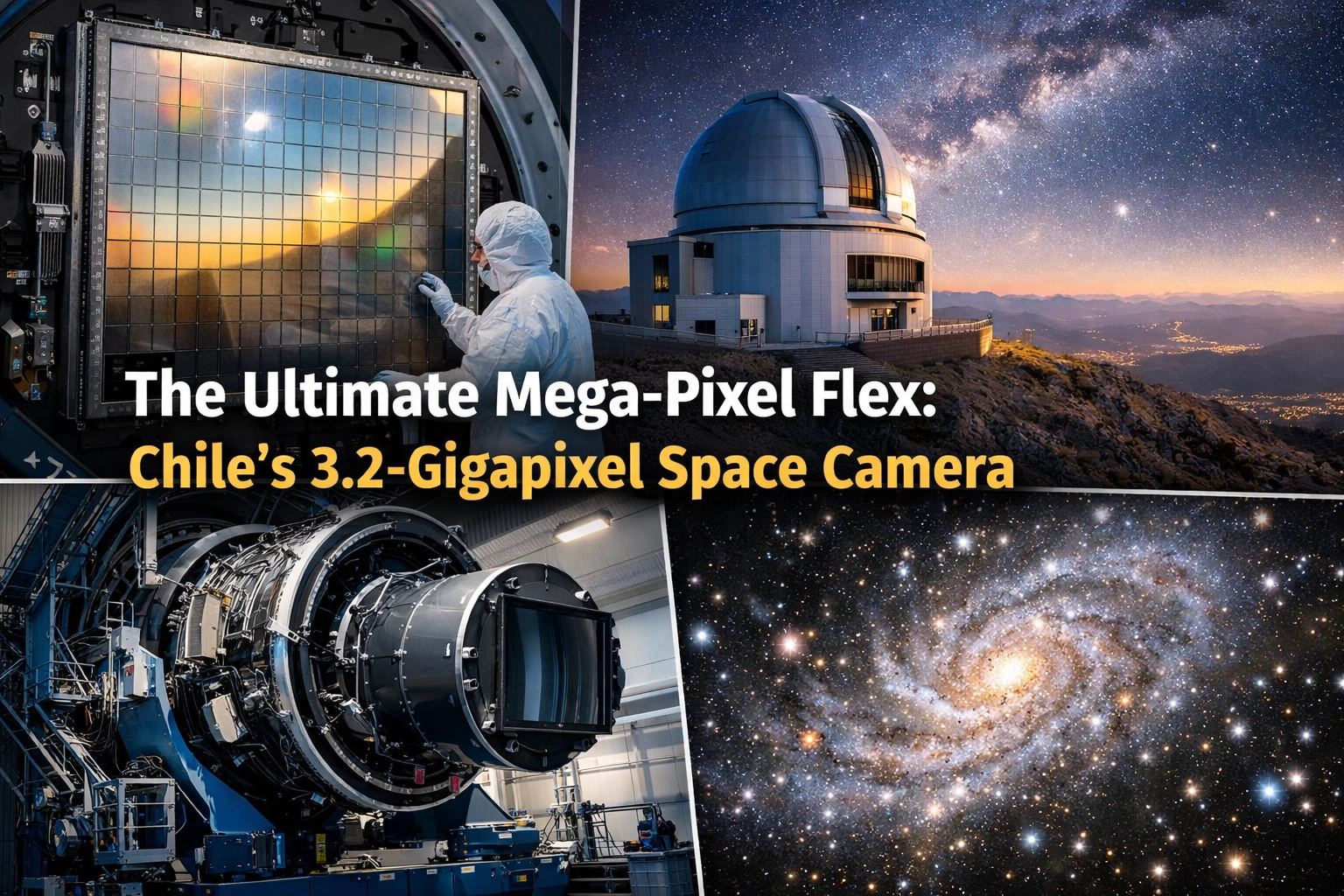
If you’ve ever felt a twinge of gear envy when your buddy walks in with a brand-new 61-megapixel Sony A7R V, I have some news that might make both of you feel very, very small. While we’re over here arguing about sensor noise at ISO 6400 and whether we really need a medium format setup for our weekend hikes, the folks at the SLAC National Accelerator Laboratory have been busy building a "camera" that makes everything else on Earth look like a toy.
Meet the LSST (Legacy Survey of Space and Time) Camera. It is the heart of the Vera C. Rubin Observatory in Chile, and it is officially the largest digital camera ever built.
How large? Try 3.2 gigapixels. That is 3,200 megapixels. For those of you doing the math at home, that’s about 130 times the resolution of your standard "pro" mirrorless body. If you wanted to display just one of its full-resolution images, you’d need 1,500 high-definition TV screens tiled together.
This isn't just another piece of photography news; it’s a milestone in how we view the universe. Let’s dive into why this beast is the ultimate flex for anyone obsessed with camera gear reviews and high-end glass.
The Specs: A Car-Sized Body and a 5-Foot Lens
When we talk about "camera gear reviews," we’re usually debating whether a lens is too heavy at 2 lbs. The LSST Camera weighs 3,000 kilograms. That’s roughly the weight of a small SUV. It’s about the size of a car, and you definitely aren’t fitting this in your Peak Design backpack.
The front lens alone is a marvel of engineering. It’s 1.5 meters (nearly 5 feet) across. Imagine trying to find a circular polarizer or an ND filter for that element. This lens has been recognized as the largest high-performance optical lens ever made. Behind that massive front element sits a focal plane that is just as impressive.
The focal plane itself is composed of 201 individual custom-designed CCD sensors. Each one is 16 megapixels, but they aren't your average consumer sensors. They are laid out with incredible precision: the gaps between them are narrower than a human hair. This allows the camera to capture a massive field of view. To put it in perspective, a single shot from this camera covers an area of the sky about 40 times the size of a full moon.
The Resolution: Seeing a Golf Ball from 25 Kilometers
The most mind-blowing stat that the team at the Vera C. Rubin Observatory likes to toss around is the resolution power. They claim the LSST Camera can resolve a golf ball from 25 kilometers (about 15 miles) away.
While you won’t be using this for your next sports photography gig or to find hidden gem locations for travel photography, that kind of resolving power is necessary when you are trying to map billions of galaxies that are millions of light-years away.
The sensors are designed to capture the faintest light in the universe. We’re talking about objects 100 million times dimmer than what the naked eye can see. If you think your mirrorless camera has great low-light performance, the LSST Camera is playing a completely different sport.
The 10-Year Time-Lapse of the Universe
Most of us feel pretty productive if we go out and take 500 photos in an afternoon. The LSST Camera is on a much more rigorous schedule. Once it’s fully operational at the observatory on Cerro Pachón in Chile, it will take a massive 3.2-gigapixel exposure every 15 to 40 seconds.
The goal? To photograph the entire visible southern sky every few nights for a solid decade.
This 10-year mission is called the Legacy Survey of Space and Time. By the time it’s done, we will have the most detailed "movie" of the universe ever created. It’s essentially a 10-year-long time-lapse that will help scientists track how the universe is changing. This includes mapping dark matter, studying dark energy, and keeping an eye out for near-Earth asteroids that might be getting a little too close for comfort.
Location, Location, Location: Why Cerro Pachón, Chile?
In the world of landscape photography, we’re always looking for top spots for stunning nature imagery. For astronomers, the criteria are a bit more strict than just "does it look good at sunset?"
Cerro Pachón in the Chilean Andes was chosen because of its unique atmospheric conditions. It’s high, it’s dry, and it’s incredibly dark. To get the kind of clarity needed for a 3.2-gigapixel sensor, you need to be above as much of the Earth’s "soupy" atmosphere as possible. Chile has become the world’s capital for astronomy because it offers some of the clearest skies on the planet, making it the perfect spot for discovering ethereal landscapes for captivating shots.
Handling the Data: 15 Terabytes a Night
If you think you have a storage problem with your 45MP RAW files, spare a thought for the IT team in Chile. The LSST Camera will generate about 15 terabytes of data every single night.
That’s not just a lot of external hard drives; that’s a massive pipeline of data that needs to be processed, categorized, and stored. Every night, the system will automatically compare new images to old ones. If something has moved or changed: like a supernova exploding or an asteroid drifting: an alert is sent out to the global scientific community within 60 seconds.
It’s real-time storytelling in photography on a cosmic scale. Instead of telling the story of a wedding or a mountain range, this camera is telling the story of the expansion of the universe itself.
Bringing it Back to Earth
Obviously, none of us are going to be mounting a 3-ton camera to a tripod anytime soon. But the technology being developed for projects like this eventually trickles down to the gear we use. The advancements in sensor sensitivity and data processing are what eventually lead to the tech we see in our everyday kits.
While we wait for 3-gigapixel sensors to hit the consumer market (which might take a while), we have to make do with what we have. Thankfully, software like Luminar allows us to push our "puny" 24 or 45-megapixel files to their absolute limit, bringing out details in the stars and landscapes that we never thought possible.
If you're looking to improve your own night sky photography or just want to learn the basics of best camera settings for stunning water landscapes (or starscapes), there are plenty of resources out there. For deep dives into technique and gear that doesn't require a government budget, check out Shut Your Aperture. They have a wealth of information for those of us shooting with cameras that weigh less than a ton.
Why This Matters to Photographers
You might be wondering why a 3.2-gigapixel camera in the middle of a Chilean desert matters to someone who just wants to take better photos of their kids or local landscapes.
It matters because it reminds us of the power of the lens. Photography, at its core, is about observation. Whether you are using a smartphone or a car-sized telescope, you are capturing a moment in time that will never happen again. The LSST Camera is just doing it on a scale that humbles the imagination.
It’s also a reminder that gear is just a tool for a mission. The mission for the Vera C. Rubin Observatory is to solve the mysteries of dark energy and dark matter. Our mission might just be to capture a beautiful sunset or a candid moment. Both require the right settings, the right light, and a whole lot of patience.
So, the next time you’re feeling frustrated because your autofocus missed a bird in flight or your sensor has a bit of dust on it, just think about the team in Chile. They have to keep 201 sensors perfectly aligned while hurtling through space on a rock, all while trying to photograph things that are literally invisible to the human eye.
Suddenly, cleaning a few dust spots off a mirrorless sensor doesn't seem so bad, does it?
The Future of the LSST
The camera has already undergone its first tests, capturing stunningly detailed images of nebulae and nearby galaxies. But the real work begins when the full survey starts. For 10 years, this camera will be the most watchful eye on the planet, staring deep into the void and bringing back answers to questions we haven't even thought to ask yet.
For those of us obsessed with the latest photography news, the LSST Camera is the ultimate reminder of how far optical technology has come. We’ve gone from grainy black-and-white plates to 3.2-billion-pixel digital arrays in a little over a century.
If you ever find yourself in the high altitudes of Chile, looking for lesser-known vistas for enigmatic photos, keep an eye out for the dome of the Rubin Observatory. Inside sits the most impressive piece of camera gear on the planet: a true testament to our obsession with seeing the world (and the universe) in the highest resolution possible.
Stay tuned here for more updates on gear, tech, and the occasional 3,000-kilogram camera review. In the meantime, get out there and use whatever megapixels you’ve got to capture something amazing. You don't need a gigapixel sensor to tell a great story: though it certainly doesn't hurt the "flex" factor.