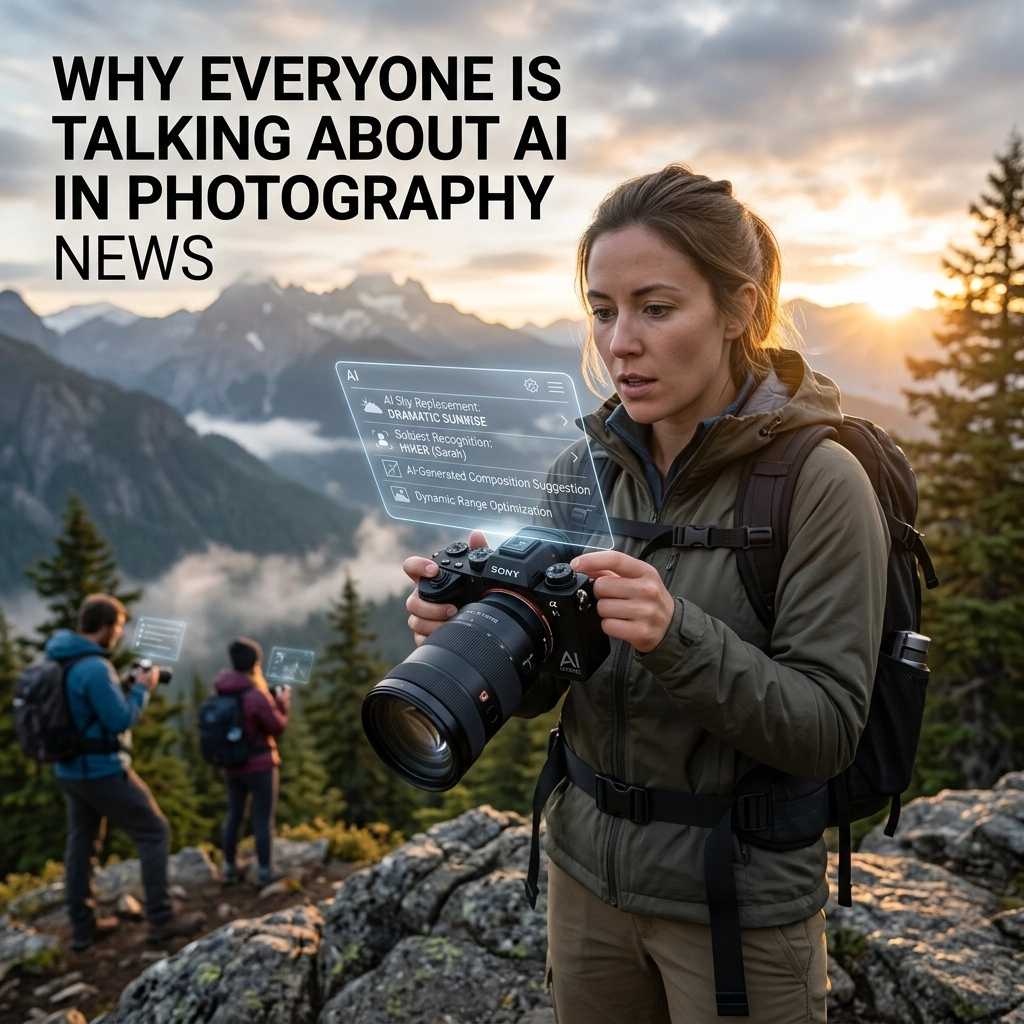
It’s Monday, April 27, 2026, and if you’ve scrolled through any photography forum or news site this morning, you’ve probably seen the word "AI" about a thousand times. A few years ago, we were all arguing about whether AI was "cheating." Today, that argument feels as old as the debate over whether digital was "real" photography compared to film.
In 2026, AI isn't just a buzzword; it’s the backbone of the industry. Whether you’re shooting weddings in Miami or capturing fine art landscapes in the Pacific Northwest, AI is touching your workflow. If you aren't paying attention to the news surrounding machine learning and generative tools, you aren't just falling behind: you're working twice as hard for half the result.
Let’s break down why everyone: from the gear-obsessed hobbyist to the high-end pro: is talking about AI right now and why it’s time for you to lean in.
The Death of the "Editing Grind"
Remember when a weekend wedding shoot meant a Monday-to-Thursday editing marathon? Those days are officially in the rearview mirror. The biggest reason AI is dominating the headlines is its ability to give photographers their lives back.
Workflow automation has reached a level of maturity in 2026 that we only dreamed of a few years ago. AI-driven culling tools can now look at 3,000 images from a gala, identify the sharpest shots, recognize the key subjects, and filter out the "blinkers" in less time than it takes you to pour a cup of coffee.
But it’s not just about picking the photos; it’s about the look. Software like Luminar has pioneered the "creative assistant" model. Instead of moving sliders for hours, photographers are using AI to analyze the lighting of a scene and apply complex color grading that used to require years of color theory knowledge. When news breaks about a new update to Luminar, the industry listens because it usually means another 20% of the manual labor has been vaporized.

AI in the Camera Body: It’s Not Just Software Anymore
While we often think of AI as something that happens on a computer, the latest headlines are focused on what’s happening inside the glass. In our recent look at 5 major camera releases and software updates, we talked about how modern sensors are practically miniature AI supercomputers.
In 2026, autofocus isn't just about finding an eye. It’s about predicting movement. The newest mirrorless bodies use deep learning to understand human kinetics. If a skateboarder is about to go behind a pillar, the camera’s AI knows where they will emerge and keeps the focus plane locked on that empty space, waiting for them. This level of predictive tech is why sports and wildlife photographers are currently obsessed with the latest firmware updates.
If you want to see how these advancements translate into high-end gallery work, you can check out the latest pieces at www.edinfineart.com. You’ll see that even in the world of fine art, the precision offered by AI-assisted hardware is pushing the boundaries of what’s possible to capture in a single frame.
The Generative Revolution: Fixing the Unfixable
Generative AI has moved past the "weird fingers" phase and into the "professional utility" phase. The news cycle is currently dominated by how photographers are using generative fill to save "ruined" shots.
We’ve all been there: a perfect portrait, but there’s a distracting trash can in the background that’s partially overlapping the subject. Or a landscape where the sky was just a flat, gray mess. AI news in 2026 is full of stories about tools that don't just "clone" pixels but "understand" the scene.
Generative tools can now extend a canvas, realistically lighting the new areas to match the original shot. This has turned "saving it in post" from a desperate prayer into a legitimate professional strategy. For a deeper dive into how to balance these tools with traditional skills, PhotoGuides.org has some excellent tutorials on maintaining a natural look while using generative tech.

Why You Should Care (The Competitive Edge)
You might be thinking, "That’s cool, Penny, but I like doing things the old-fashioned way." And that’s fine: if you’re a hobbyist. But if you’re running a business under the Shut Your Aperture mindset, you need to understand the economics of 2026.
The photographers who are making the most money right now are the ones who have integrated AI to lower their overhead. If Photographer A spends 20 hours editing a session and Photographer B spends 2 hours using AI-assisted tools (and they both produce high-quality work), Photographer B is going to win every time. They can charge less, deliver faster, or simply spend those 18 extra hours finding new clients.
I was chatting with Sonny, our Social Media Manager, about this last week. He’s seeing a massive shift in how content is consumed. Audiences today expect a faster turnaround. If you wait two weeks to post photos from a trending event, the world has moved on. AI allows you to get those high-quality, polished images onto social media while the topic is still hot. This synergy between blog updates and social presence is exactly how we keep the community engaged.
The Ethics of Authenticity: The C2PA Standard
One of the "hotter" topics in photography news right now isn't about how to use AI, but how to prove you didn't use it: or at least, how you used it responsibly.
With the rise of deepfakes and fully synthetic images, the industry is pushing back with the C2PA (Coalition for Content Provenance and Authenticity) standard. You’ll see this mentioned in almost every major tech update this year. It’s essentially a digital "paper trail" for your photos. It tracks the image from the moment the shutter clicks through every edit made in Luminar or Photoshop.
Why does this matter to you? Because as AI becomes more prevalent, "real" photos become more valuable. Clients, news agencies, and collectors want to know that what they’re looking at is a captured moment, not a generated one. Staying informed on these standards is crucial if you want to maintain your credibility as a professional.

The "Human" Element in an AI World
With all this talk about machines, you’d think the photographer is becoming obsolete. The news, however, suggests the exact opposite. As AI handles the technical "grunt work," the value of a photographer’s unique eye and personal brand is skyrocketing.
AI can color grade a photo, but it can't tell a nervous bride a joke to get a genuine smile. It can't navigate the tricky lighting of a narrow alleyway in a foreign city while also keeping an eye out for a pickpocket. The "news" here is that we are moving toward a "Centaur" model of photography: half human, half machine. The human provides the soul and the direction; the AI provides the speed and precision.
For more insights into the philosophy behind the camera, I highly recommend checking out blog.edinchavez.com. Edin has been talking about the intersection of soul and technology for a long time, and his perspective on keeping your "human" touch in a digital world is more relevant now than ever.
Breaking Down the "Hype" vs. Reality
It’s easy to get caught up in the hype. Every week, there’s a new "game-changing" AI tool announced. Part of being a smart photographer in 2026 is knowing what to ignore.
The stuff that matters: the stuff we cover here at Shut Your Aperture: is the tech that actually solves a problem.
- Noise Reduction: AI has made ISO 12,800 look like ISO 400. That’s a real win.
- Upscaling: Being able to print a heavy crop as a 40×60 gallery wrap. That’s a real win.
- Object Selection: Making a complex mask of a person’s hair in one click. That’s a massive win.
The "hype" stuff: like AI that completely replaces a background with a Martian landscape: is fun, but it’s often a distraction from the tools that actually make you a better, more efficient photographer.

How to Stay Updated Without Losing Your Mind
The pace of change is exhausting. If you tried to read every AI research paper coming out of Silicon Valley, you’d never have time to actually take a photo. Here’s how to stay in the loop without the burnout:
- Follow the Software Leaders: Keep an eye on updates from Luminar and Adobe. They are the ones filtering the high-level AI tech into usable tools for us.
- Watch the Firmware: Check your camera manufacturer's newsroom once a month. The days of "you bought the camera, and that’s it" are over. Firmware updates are now giving old cameras entirely new AI features.
- Engage with the Community: Whether it’s through our posts here or discussions on social media, stay vocal. Ask questions. Share what’s working for you.
Looking Ahead: The Rest of 2026 and Beyond
As we move further into 2026, the conversation is going to shift from "What can AI do?" to "What should we let AI do?" We are entering a period of refinement. The tools are here; now we just have to learn how to use them with style.
AI in photography isn't a threat; it's the biggest gift to the creative process since the invention of the digital sensor. It’s taking the "boring" parts of being a photographer: the culling, the masking, the file management: and automating them so we can get back to what we love: capturing light and telling stories.
If you’ve been sitting on the fence, waiting for the "AI fad" to pass, it’s time to hop down. The news is clear: AI is the new standard. Embrace it, learn it, and use it to push your creative boundaries further than they’ve ever gone before.

Key Takeaways for the Modern Photographer
To wrap this up, if you’re feeling overwhelmed by the constant flood of AI news, just remember these three things:
- Speed is your friend. Use AI to cut down your editing time so you can focus on shooting or growing your business.
- Quality is non-negotiable. AI tools like Luminar allow you to produce high-end results that were previously only possible for those with a massive retouching team.
- Stay Human. The more the world is filled with AI-generated content, the more people will crave authentic, human-captured moments. Use the tech to enhance your vision, not replace it.
Keep an eye on this space. As the news breaks, we’ll be here to filter out the noise and tell you exactly what you need to know to keep your aperture open and your shutter clicking.