For the underlying mechanics behind every choice below, our aperture photography guide is the fastest way to get fluent.
Look, I get it. The word "computational" sounds like something your IT guy yells about when the Wi-Fi goes down. It’s clinical, it’s techy, and for a long time, purists looked at it as "cheating." But here we are in May 2026, and if you haven’t embraced computational photography yet, you’re basically trying to win a Formula 1 race on a horse.
The reality is that the gap between "taking a picture" and "making an image" has never been smaller, and it’s all thanks to the silicon chips living inside our gear. Whether you’re shooting with the latest smartphone or a high-end mirrorless beast, your camera is doing more math in a millisecond than you did in four years of high school.
So, why is everyone obsessed with it? And more importantly, why should you care? Let’s dive into the digital guts of modern imaging and see how it’s changing the game for all of us.
What Exactly Is Computational Photography?
In the old days, you know, like ten years ago, photography was mostly about physics. You had a piece of glass (the lens), a shutter, and a sensor. Light hit the sensor, the sensor recorded the data, and that was that. If you wanted a better shot, you needed bigger glass or a bigger sensor. Physics is a harsh mistress; you can’t argue with the size of a photon.
Computational photography is what happens when software steps in to tell physics to sit down and shut up.
Instead of just recording a single frame of light, a computational camera captures a massive amount of data, often multiple frames at different exposures or focal points, and uses an onboard processor to stitch, blend, and enhance them into a single, perfect shot. It’s the difference between a painter sitting in front of a canvas and a digital artist using a thousand layers to create a masterpiece.

The Smartphone Revolution: The Tail Wagging the Dog
We have to give credit where it’s due. The reason we’re even having this conversation is because of the tiny cameras in our pockets. Because smartphones have tiny sensors and even tinier lenses, they hit a "physics wall" very early on. To compete with DSLRs, engineers at Apple, Google, and Samsung had to get creative.
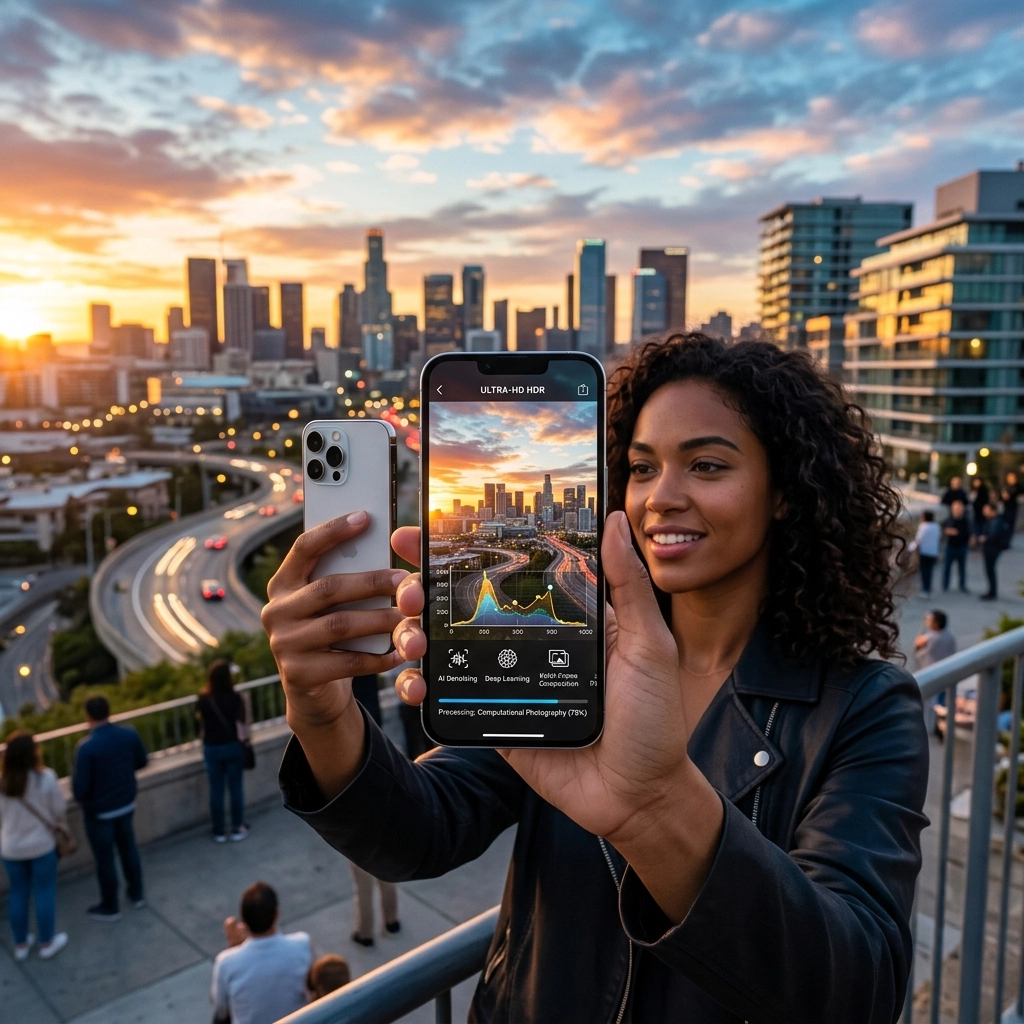
They invented things like "Night Sight" and "Smart HDR." When you tap the shutter on your phone, you aren’t just taking one photo. Your phone is actually taking 10 to 15 frames, some before you even pressed the button, and blending them to find the best detail in the shadows and the highlights.
This tech has become so good that for most people, a smartphone photo looks "better" than a raw file from a $3,000 camera because the phone has already done the heavy lifting of color grading and dynamic range management. If you’re just starting out and feeling overwhelmed by the tech, check out our Photography 101 guide to see how the basics still apply, even when the software is doing the chores.
Why Pro Cameras Finally Joined the Party
For a while, "real" photographers turned up their noses at this. We wanted our big sensors and our manual controls. But eventually, the manufacturers realized that if a phone could do it, a pro camera could do it better.
Today, we see Sony, Canon, and Nikon integrating deep-learning AI into their bodies. We’re talking about autofocus systems that can distinguish between a bird’s eye and a plane's cockpit in a split second. We’re seeing "Pixel Shift" modes that move the sensor by half a pixel to create 200-megapixel files from 40-megapixel sensors.
Take the Nikon Zf, for example. It looks like a vintage film camera, but under the hood, it’s a computational monster. If you’re using it for work, like I often do, knowing the right Nikon Zf settings for real estate or landscape can make the difference between a flat image and one that pops off the screen.
The industry has moved from "how many megapixels do you have?" to "how smart is your processor?" And honestly? It’s about time.
The Magic of AI-Powered Post-Processing
Computational photography doesn’t end when you hear the click of the shutter. In 2026, the "darkroom" is entirely driven by AI.
We used to spend hours in Photoshop trying to mask out a sky or remove a stray power line. Now, tools like Luminar allow you to replace an entire sky, enhance skin texture, or relight a portrait with a single slider. This isn't just about saving time; it's about expanding what's possible.
If you’ve ever shot a landscape and felt like the raw file looked "muddy," you’re likely seeing the limitations of the sensor’s dynamic range. AI tools can now reconstruct that lost data using generative models. However, it's a double-edged sword. There are 7 mistakes you’re likely making with AI photo editing that can make your photos look like a plastic CGI movie if you aren't careful. The goal is to enhance reality, not erase it.
Creative Freedom vs. "The Uncanny Valley"
Here is where the debate gets spicy. If the camera is doing the HDR, the focusing, and the color grading, are you still the photographer?
I argue that computational photography actually gives you more creative freedom. Think about it. When you don't have to worry about whether your focus hit the eye or if your highlights are blown out, you can focus on the thing that actually matters: composition and emotion.
You can try creative street photography ideas that would have been impossible before because you couldn't get the exposure right in a split second. You can shoot in lighting conditions that would have sent a film photographer home crying.
The danger, of course, is the "Uncanny Valley." We’ve all seen those smartphone portraits where the background blur (bokeh) looks fake around the edges of the hair. That’s the "computational" part failing. As the tech improves, those glitches are disappearing, but as a pro, you still need to know when to override the machine. This is why mastering manual mode is still essential. You need to know what the camera should be doing so you can tell if it’s messing up.
Why You Should Care Right Now
If you're a hobbyist, a pro, or even someone just taking photos of their kids, computational photography is your best friend for three main reasons:
- Low Light is No Longer an Enemy: Noise reduction algorithms have reached a point where ISO 12,800 looks cleaner than ISO 800 did a decade ago. This opens up a whole new world of indoor and nighttime shooting.
- Accessibility: You don't need a $10,000 kit to get professional results. A mid-range mirrorless camera with AI-assisted features can produce stunning work.
- Speed: For those of us in the corporate world, speed is everything. If I’m shooting corporate headshots, having eye-tracking that never misses means I can finish a shoot in half the time.
Sonny, our social media manager, has been telling me that our community is split on this. Some love the tech; some hate it. But the engagement numbers don't lie, people are drawn to the hyper-clear, perfectly exposed images that computational tech provides. If you want to stay relevant in the 2026 landscape, you have to lean in.
Is This Still "Photography"?
The "is it art?" debate has been around since the first person developed a piece of film. People said digital wasn't photography. People said Photoshop wasn't photography. Now they say AI isn't photography.
At its core, photography is about capturing a moment. Whether that moment is captured by a silver halide crystal or a series of algorithms doesn't change the intent of the person behind the lens. In fact, AI-powered mirrorless tech is simply another tool in our bag, like a flash or a tripod.
We’re even seeing this impact niche fields. In landscape photography, we can now use "Live ND" features to blur water without needing a physical glass filter. Is the water "really" blurred? No, it’s a composite of 50 images. Does it look better? Usually, yes. Does it allow you to travel lighter? Absolutely.
Looking Toward the Future (2027 and Beyond)
We’re already seeing hints of where this is going. Imagine a camera that doesn't just see light, but sees depth in every pixel. We’re talking about "light field" technology where you can change the focus of a photo after you’ve taken it, with zero loss in quality.
We’re looking at sensors that are "invisible," hidden under screens, and AI that can literally see around corners by analyzing how light bounces off walls. It sounds like science fiction, but as we’ve seen with the latest photography news stories, the future arrives a lot faster than we expect.
For those of you looking to stay ahead of the curve, I highly recommend checking out PhotoGuides.org for deep dives into the technical specs of these new sensors. They do a great job of breaking down the "how" behind the "wow."
How to Get Started Without Losing Your Soul
If you’re feeling a bit overwhelmed, don’t worry. You don’t need to be a computer scientist to benefit from this. Here’s a quick roadmap to embracing the computational age:
- Update Your Firmware: Most manufacturers (especially Sony and Nikon) release "computational updates" that improve autofocus and processing for free.
- Experiment with AI Editing: Download a trial of Luminar and see what the "Relight" and "Structure AI" tools can do for your older, flatter photos.
- Trust the AF: Stop manually moving your focus point for every shot. Try the Subject Tracking modes on your camera. You’ll be surprised at how often it’s smarter than you.
- Learn the "Why": If you want to truly master these tools, you need a solid foundation. Visit learn.shutyouraperture.com to dive into our tutorials that bridge the gap between old-school technique and new-school tech.
Final Thoughts
Computational photography isn't a trend; it's the new baseline. It’s the reason your memories look more vibrant, your professional work looks more polished, and your gear feels more capable.
The "magic" isn't in the chip, though: it’s in how you use it. Use the tech to remove the barriers between your vision and the final image. Don't let the camera make the creative choices for you; let it provide the data you need to make better choices yourself.
The conversation about AI and computation is only going to get louder. You can either be the person complaining about "the good old days" or the person using the most powerful tools ever invented to create the best work of your life. I know which one I’d rather be.
If you want more tips on how to handle the modern digital workflow, check out our blog over at edinchavez.com or see the results of these techniques in my latest galleries at edinfineart.com.
Now, get out there, stop worrying about the math, and start shooting. The machines have your back.