To turn these ideas into a fast, repeatable edit, our Lightroom presets library gives you a head start you can build on.
Let’s be honest: the photography world moves at a breakneck pace. If you took a nap in 2022 and woke up today, on May 12, 2026, you probably wouldn’t even recognize the editing software on your desktop. We aren't just pushing sliders anymore; we are essentially collaborating with high-level intelligence to realize visions that were technically impossible just a few years ago.
The news hitting the wires this morning isn't just another incremental update. It’s a fundamental shift in how we process light, color, and pixels. If you’ve been following the same old "how to use the brush tool" tutorials, you are officially working harder, not smarter. Today, we’re diving deep into why the latest industry shake-ups are forcing a total rewrite of your post-processing playbook.
The 2026 Camera Shift: Hardware is the New Software
We’ve reached a point where the distinction between what happens inside the camera and what happens in post-production is blurring. If you haven't checked out the photography news secrets revealed, you might have missed the memo on the "2026 Camera Shift."
The big news today revolves around "Computational RAW" files. Manufacturers like Sony and Canon are no longer just handing you data; they are handing you pre-optimized datasets. When you look at the Canon EOS R5 vs Sony a7R V debate in 2026, the winner isn't decided by megapixels anymore. It’s decided by how much metadata is embedded in the file to assist your editing AI.
This means your tutorials need to change. You don't need a 20-minute video on noise reduction if the camera’s internal AI already mapped the sensor heat and neutralized the grain before you even opened the file. Your focus now needs to be on intent rather than repair.

Why Traditional Tutorials Are Becoming Obsolete
For a decade, photo editing tutorials followed a predictable pattern:
- Fix the exposure.
- Adjust the white balance.
- Remove spots.
- Color grade.
In 2026, that workflow is archaic. Why? Because the "fix" part is being automated. Today’s news highlights that major software developers are moving toward "Semantic Editing." This is the idea that the software understands what is in your photo, not just the pixels. It knows it’s a face; it knows it’s a mountain; it knows it’s a product.
If you want to keep up, you need a new foundation. I highly recommend checking out The Ultimate Guide to Photography Tutorials and News. It covers how to pivot your learning from technical button-mashing to creative direction.
The Luminar Factor: AI as Your Creative Partner
One of the biggest drivers of this change has been the evolution of Luminar. While other programs were busy adding more complex menus, Luminar focused on results. The latest news confirms that generative AI is now fully integrated into the standard workflow.
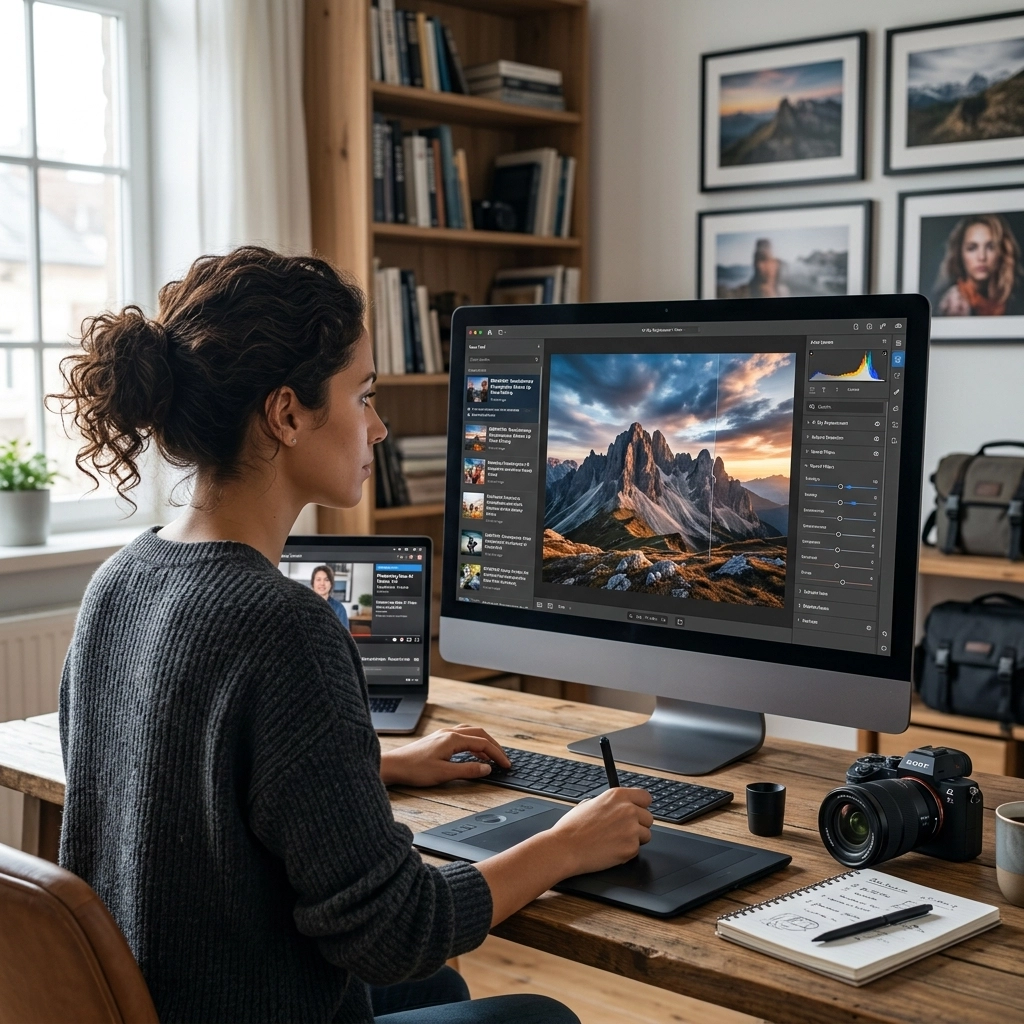
We aren't just talking about replacing a sky anymore. We’re talking about changing the lighting direction of an entire scene based on a text prompt. If your current tutorial library doesn't explain how to prompt an AI to "relight this portrait with 4 o'clock golden hour sun," you’re using a hammer to do the job of a laser.
The beauty of tools like Luminar is that they allow you to spend 90% of your time on the "vibe" and 10% on the "work." This is a complete reversal from the old days. If you’re still masking trees by hand, stop. The news today is clear: the robots have won the masking war, and we should let them have it.
Genre-Specific Shifts: From Sports to Real Estate
The way you approach tutorials also depends heavily on what you shoot. The news today isn't just about general photography; it’s about specialized algorithms. For example, the OM System has made massive waves this year. If you’re a pro, you’ve likely seen the specialized setups for different niches.
Check out these tailored approaches that are redefining the game:
- OM System OM-1 Mark II settings for Product Photography
- OM System OM-1 Mark II settings for Sports Photography
- OM System OM-1 Mark II settings for Real Estate Photography
The tutorials for these genres have shifted. In sports, the news is all about "Predictive Focus Editing," where the software helps reconstruct motion blur based on the camera’s movement data. In real estate, the focus is on "Instant HDR Synthesis" that looks natural, not like a 2012 psychedelic fever dream. If you aren't learning these specific 2026 workflows, your portfolio is going to look dated fast.
Sony vs. Canon: The Editing Software War
It’s not just about the cameras; it’s about the ecosystems. The news today suggests that the rivalry between the Sony a7 IV vs Canon EOS R6 Mark II has moved into the cloud. Both companies are launching proprietary cloud-editing bridges that apply your favorite "look" the moment the photo is snapped.
This changes the "tutorial" from a post-production lesson to a "pre-visualization" lesson. You are now editing before you shoot. If you are a Sony shooter, your tutorial path is diverging from the Canon path because the AI interprets color science differently at the chip level. This level of technical nuance is something we talk about constantly at Shut Your Aperture Academy, where we focus on these modern shifts.
Learning to "Prompt" Your Edits
The most controversial news in the industry right now is the rise of prompt-based editing. For the purists, this is a nightmare. For the modern creator, it’s a superpower. Instead of spending three hours on skin retouching, you can now use a prompt like "natural skin texture, remove temporary blemishes, preserve character lines."
The tutorials of the future (and by future, I mean today) are about language. How do you describe what you want? If you can’t articulate your creative vision to an AI, you can’t edit effectively in 2026. This is why we see a huge surge in "Prompt Engineering for Photographers" on sites like PhotoGuides.org.
The Impact on Wildlife and Landscape Photography
If you think the "news" only affects portrait photographers, think again. Wildlife photography has been turned upside down. With the Sony ZV-E10 II settings for wildlife photography, we’re seeing entry-level cameras perform like the flagships of five years ago.
In landscape photography, the news is all about "De-Hazing" and "Atmospheric Reconstruction." We can now literally remove the smoke from a wildfire-impacted horizon or add a scientifically accurate Milky Way based on the GPS coordinates and time of day stored in the EXIF data. Your tutorials need to teach you the ethics of this as much as the "how-to." Where do we draw the line between a photo and a digital composite? That’s a conversation happening in every photography forum right now.
Why You Need to Re-Learn Everything (Sort Of)
Don't panic. Your eye for composition still matters. Your understanding of light is still the most important skill you own. But the tools you use to refine that light have changed.
The news today tells us that the "Undo" button is being replaced by "Iterate." Instead of going back one step, we are asking the software for three different versions of the same edit. This is a non-linear way of working that most traditional tutorials don't cover.
If you want to see how this works in practice, look at the OM System OM-1 Mark II settings for Portrait Photography. It’s a masterclass in how hardware settings dictate how much work you’ll have to do later in Luminar.
The Death of the "Secret Sauce"
In the past, photographers were protective of their editing "secrets." They sold presets like they were liquid gold. Today’s news effectively kills the preset market. Why? Because AI can now analyze any image you like and "reverse engineer" the look onto your own photo with 99% accuracy.
The "Secret Sauce" is no longer the edit; it’s the vision. Your tutorials should focus on developing your personal style. Use resources like blog.edinchavez.com to see how a professional eye interprets a scene. The "how" is becoming cheap; the "why" is becoming priceless.
Practical Steps to Update Your Workflow Today
If you’re feeling overwhelmed by today’s photography news, here is a simple checklist to get your editing workflow into 2026:
- Audit Your Software: Are you using the latest AI-enabled versions? If you haven't tried Luminar lately, you are missing out on the most intuitive generative tools on the market.
- Master Your Metadata: Understand what your camera (be it a Sony, Canon, or OM System) is recording. The more data you feed your editing software, the better the AI can assist you. Check out OM System OM-1 Mark II settings for Street Photography for a look at how data-heavy shooting works.
- Learn to Prompt: Start practicing how to describe your edits in words. "More contrast" is okay, but "Increase local contrast in the mid-tones while maintaining a matte shadow aesthetic" is what 2026 software wants to hear.
- Join a Community: Stop learning in a vacuum. The news changes every day. You need a place where experts are vetting these tools in real-time. Head over to Shut Your Aperture Academy and get updated.
- Study the Greats: Technology changes, but the principles of fine art do not. Visit www.edinfineart.com to see how high-end photography maintains its soul even in the age of AI.
The Future is Already Here
The "Photography News" we’re discussing isn't just a headline: it’s a lifestyle shift. We are moving away from being "editors" and toward being "curators" of our own creativity. The way you approach your photo editing tutorials should reflect that.
Stop looking for "how to fix a dark photo." Start looking for "how to use AI to enhance the emotional narrative of a scene." The tools are faster, the sensors are smarter, and the possibilities are literally endless.
If you are still stuck in the 2020 mindset of manual brushing and layer masking for hours on end, you aren't just wasting time: you’re missing the boat on the most exciting era in photography history. The news of 2026 isn't a warning; it’s an invitation to spend less time behind a screen and more time behind a lens.
Go out, shoot something incredible, and let the new era of editing tools help you bring it to life. For more deep dives into the technical side of things, check out PhotoGuides.org. They have some fantastic breakdowns of the latest sensor tech that will help you understand the why behind the how.
Keep your shutter clicking and your aperture shut (when necessary)! The world of photography is changing, and it’s never been a better time to be a part of it. Check back with us at Shut Your Aperture for the latest updates as we navigate this new era of digital art together.