How to Photograph Kolmanskop Ghost Town: GPS, Gear & Legal Access Guide
~14 min read · 2026-05-09 For practitioners, see our breakdown of export presets for the web.
shutyouraperture-20). Buying through these links costs you nothing extra and helps fund our free guides.
Kolmanskop Ghost Town is a German colonial diamond town being slowly swallowed by Namib desert sand. This guide gives you the photographer’s framework: when to be there for the light, what gear works on site, the legal access reality, and the specific vantage points with GPS coordinates that produce frames worth carrying home. The genre rewards photographers who plan with the same rigor they bring to wedding work or commercial assignments — the difference between an evocative frame and a wasted trip is rarely talent. It is usually preparation.
What follows is the working photographer’s brief: every section maps to a specific decision you have to make before you arrive, on site, and in the edit. Skip the section that does not apply to your trip. Read the one that does twice.
Why Kolmanskop Ghost Town is worth photographing
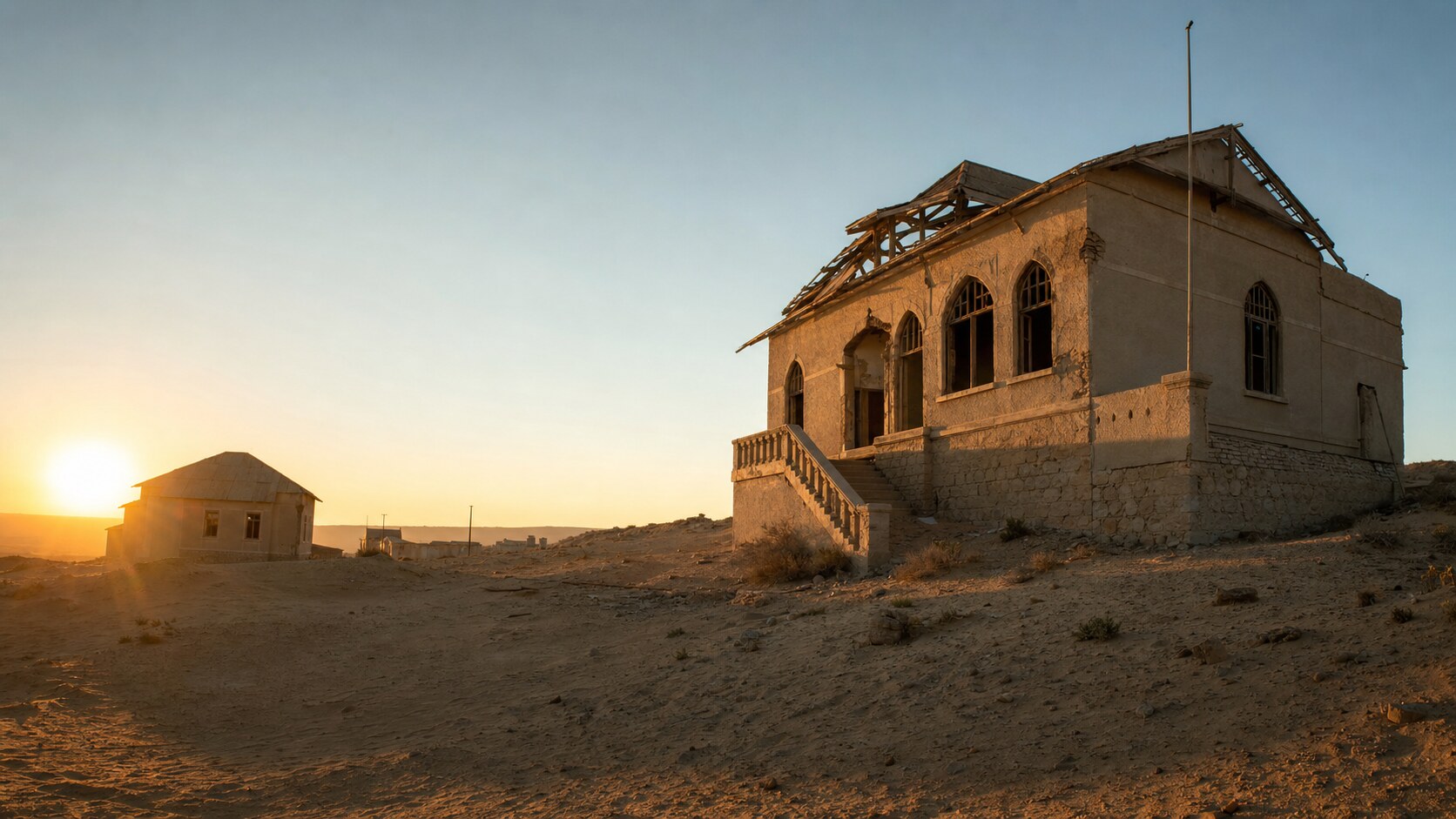
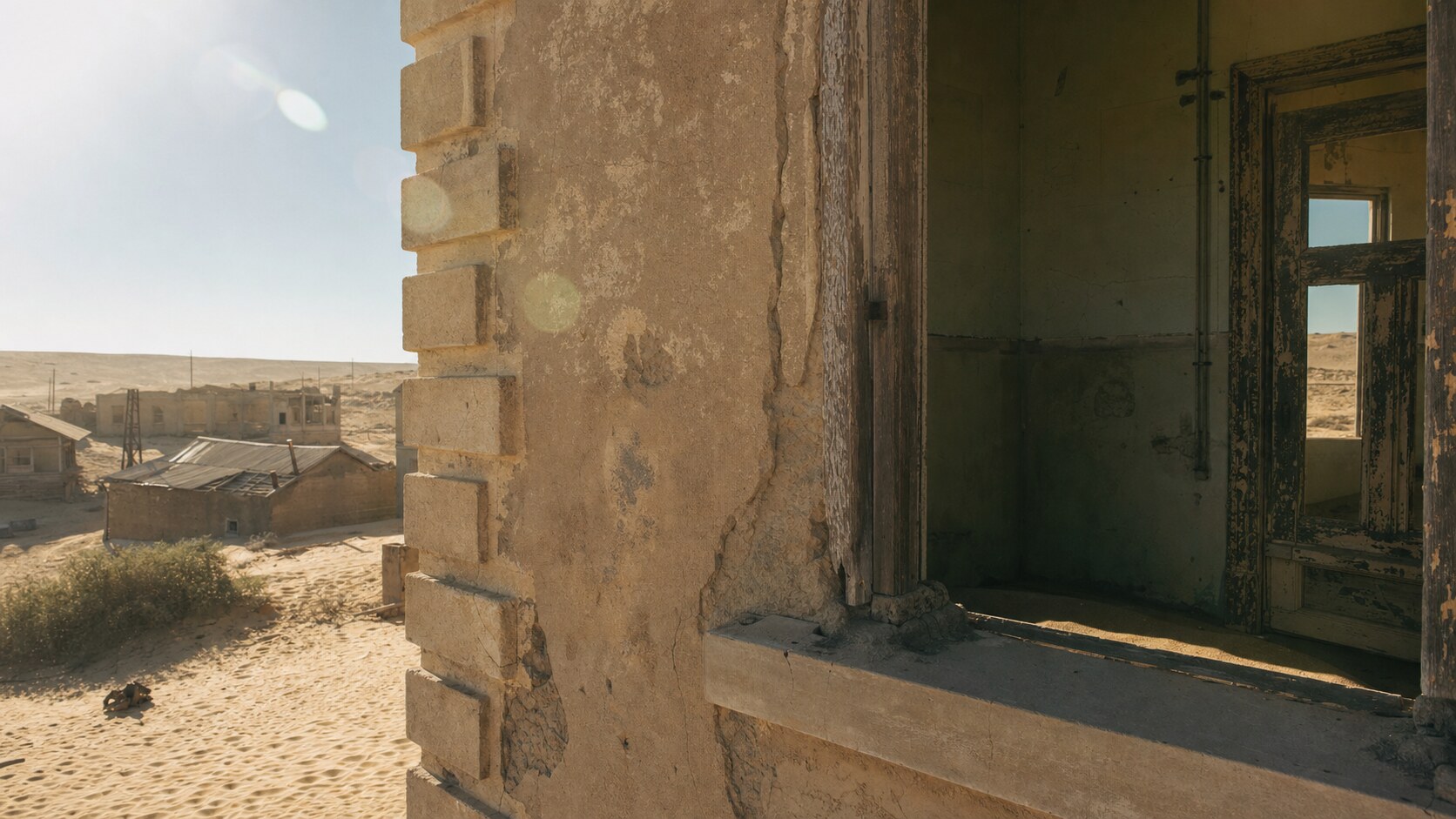
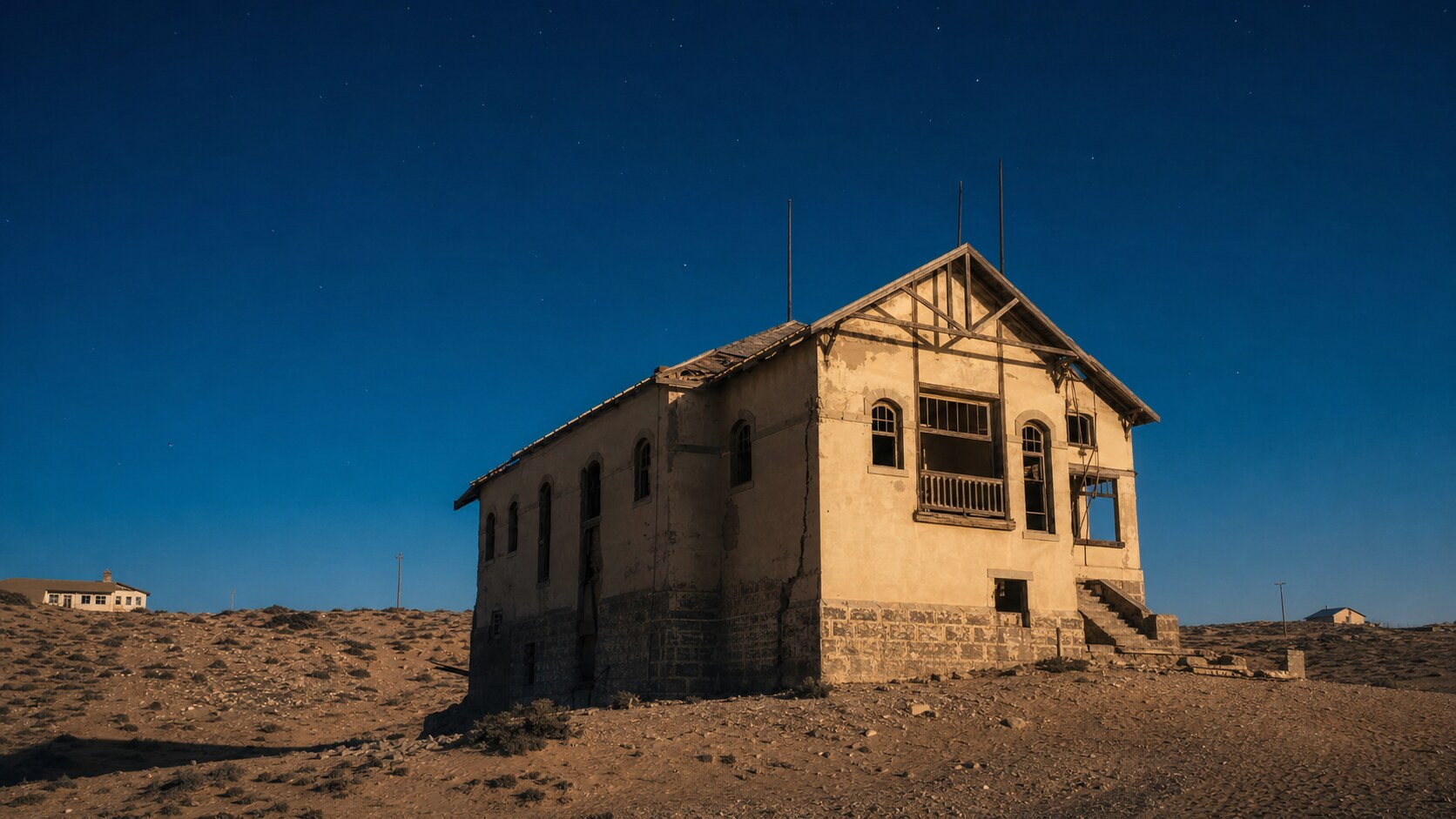
Founded 1908 after a railway worker found a diamond in the sand. By the 1950s the diamond fields moved south and Kolmanskop was abandoned. Today the desert has reclaimed it — sand drifts pour through doorways and pile up in living rooms, creating one of the most photographed urbex scenes on Earth.
The frames that come out of Kolmanskop Ghost Town reward a particular sensibility: patience for light, willingness to walk, and an editing approach that respects the location’s natural mood instead of pushing it into a cartoon version of itself. Photographers who treat abandoned places like cinematic film sets — thinking about color palette, foreground anchors, and the story a single frame implies — consistently produce better work than photographers who run-and-gun every angle.
The historical context matters for how you photograph it. Knowing that this site has a specific past changes the kind of frame you make. A photograph that captures the weight of that history is what separates documentary urbex work from generic ruin-shooting. Read at least one substantial historical source before you go. Bring questions, not just gear.
 Save
SaveWhen to go: best months and light
May through September (austral winter). Mornings are cold but light is best.
Photographers visiting abandoned places almost always benefit from the shoulder seasons — fewer crowds, softer light, and weather that creates atmosphere rather than baking the scene. Plan your trip around the morning and evening blue and golden hours; midday in most of these locations is harsh and unflattering. If you have only one full day, prioritize blue hour at sunrise and the 90-minute window before sunset. Skip the middle four hours, eat lunch, scout your evening compositions, and come back when the light returns.
Weather is your collaborator, not your obstacle. Overcast skies are a gift for abandoned-place work — even diffuse light suits weathered wood, peeling paint, and rusted metal far better than direct sun. Light rain darkens surfaces and saturates color. Fog reduces a chaotic scene to clean compositional silhouettes. Photographers who only shoot the location in clear weather are leaving most of their best frames on the table.
 Save
SaveLegal access and what you actually need
Permit required from Namibia Diamond Corporation (NamDeb). Photography permits sold at the gate or through Luderitz tour operators. Sunrise/sunset photo permits cost more but are essential.
The legal status of abandoned-place photography is the most misunderstood part of the genre. “Abandoned” rarely means ownerless. Almost every site is either: (a) actively managed by a state, national, or private trust; (b) on private property with active owners; or (c) on land where access is technically prohibited even if not posted. The honest, sustainable approach: pay the entry fee, take the tour, get the permit. The frames you can keep using forever are the ones you got legally — you can sell prints, license them, post them, and never worry about a takedown notice or a trespassing charge surfacing years later.
Photographers planning international trips should also verify visa-and-press credentials. Many countries treat photography of strategic infrastructure (former military sites, exclusion zones, border regions) as a separate legal category from tourism. A press pass or a tour-operator-issued photography permit clears most of these issues. A casual tourist visa does not.
 Save
Save5+ vantage points with GPS coordinates
The vantage points below are organized roughly in the order a photographer working a half-day on site would shoot them — establishing wide, then mid-distance, then detail. Each entry includes a recommended focal length and a brief composition note. Use this as a shot list, not a script: the best frame is often something you notice once you are standing there. The list keeps you from missing the obvious ones.
| Vantage point | GPS | Notes |
|---|---|---|
| Pink room with sand dune | -26.7042, 15.2306 | The signature shot. Wide, 16-35mm, mid-morning when sun rakes the sand. |
| Blue room interior | -26.7041, 15.2305 | Tighter, 35mm. Color contrast against sand. |
| Long hallway with sand floor | -26.7043, 15.2308 | 24mm leading line composition. |
| Bowling alley facade | -26.7045, 15.2310 | Exterior wide, 16mm. |
| Hospital wing windows | -26.7044, 15.2309 | 50mm prime for window-frame light. |
If you have additional time on site, work each vantage point twice — once at golden hour for warm tones, once at blue hour for cooler atmospheric mood. The same composition photographed 90 minutes apart looks like two different locations. That is the abandoned-place photographer’s edit advantage: light variety from a single trip.
Camera settings cheat sheet
Abandoned-place photography lives in a wider exposure range than most travel work. Interiors are often 4-8 stops darker than exteriors. The settings cheat sheet below covers the most common scenarios. Use auto-ISO with a maximum cap (3200 on most modern bodies, 6400 if you trust your sensor) so you can stop worrying about ISO and concentrate on aperture and shutter:
| Scenario | Aperture | Shutter | ISO | Notes |
|---|---|---|---|---|
| Exterior, golden hour | f/8 | 1/250 | 200 | Polarizer for sky |
| Interior, available light | f/2.8 | 1/60 | 1600-3200 | Tripod recommended |
| Interior, long exposure | f/8 | 2-15s | 100 | Tripod required |
| Detail with shallow DOF | f/1.8 | 1/200 | 400 | 50mm prime |
| Compressed telephoto | f/5.6 | 1/500 | 400 | 70-200mm handheld |
Bracketing is your friend. A three-frame bracket at +/- 1 stop captures the full dynamic range of most scenes and gives you HDR options in post without committing to the look at capture time. Modern sensors recover shadows beautifully — expose to the right, protect highlights, and lift the shadows in Lightroom rather than blowing the sky.
Lens recommendations
16-35mm essential. A 35mm prime for color-room intimacy. Tripod for low-light interiors.
If you can only bring two lenses for an abandoned-place trip, the workhorse pair is a 16-35mm f/2.8 wide zoom and a 35mm or 50mm fast prime. The wide handles environments and tight interior corners; the prime handles low-light intimacy and isolated detail. A 70-200mm becomes useful when you have meaningful background depth — distant mountains, forest reclaiming structures, or compressed industrial geometry. Photographers who insist on bringing all three should also bring a sturdy tripod and accept the weight.
For mirrorless shooters: a single body with a 24-70mm f/2.8 plus a 14mm or 16mm prime is a viable lighter kit. The compromise is shallow-depth detail work — a 50mm f/1.8 weighs almost nothing and earns its bag space the first time you find a single window-lit interior.
Photo restrictions and on-site etiquette
No drones without separate permit. Standard tours end mid-morning — photo permits extend access. Some buildings are unsafe; follow guide.
Beyond the location-specific rules, the universal photographer’s code: take nothing physical, leave nothing physical, and do not geotag locations that are being actively damaged by visitor traffic. If you see active vandalism in your frame, ask whether including it in your shared work normalizes it. Memorials and sites of historical tragedy are not photo opportunities — they are subjects that demand a different kind of attention.
Drone rules deserve special caution. Default assumption for any abandoned-place trip: drones are not allowed. National parks ban them. Most international sites either ban them outright or require specific permits. Even where they are technically legal, flying a drone over an active tour group or a memorial is a fast way to get your gear seized and your name on a list. If you must fly, do it before the site opens, with permission, and far from any other visitors.
Post-processing mood
enhance the warm sand tones, push the wall paint colors carefully (pink/blue/yellow signature), keep shadows clean.
The dominant aesthetic for abandoned-place work is restrained — earth tones, lifted shadows, careful highlight retention, and a clear refusal to push HDR-style local contrast that flattens the natural mood of the scene. Lightroom’s HSL panel with reduced saturation on greens and oranges, combined with a slight teal-and-orange split tone, produces the cinematic urbex look without crossing into kitsch.
A practical post-processing sequence that works on most abandoned-place RAW files: (1) lens correction and chromatic aberration first; (2) basic exposure with shadows pushed and highlights pulled; (3) HSL desaturation on green and orange, slight saturation boost on blue; (4) split toning teal in shadows, warm orange in highlights at low intensity; (5) clarity at +10 maximum on a frame, never higher; (6) a subtle vignette to draw the eye in. Save the result as a preset and use it as a starting point for the rest of the trip’s frames.
Quick Amazon shortcuts to the gear most useful for this kind of shot. Use them if Prime shipping or Amazon credit makes more sense than B&H. As an Amazon Associate ShutYourAperture earns from qualifying purchases.
Frequently asked questions
Is it legal to photograph Kolmanskop Ghost Town?
Access type for this location is permit paid. Permit required from Namibia Diamond Corporation (NamDeb). Photography permits sold at the gate or through Luderitz tour operators. Sunrise/sunset photo permits cost more but are essential. Always verify current rules — site policies change.
What is the best time of year to photograph Kolmanskop Ghost Town?
May through September (austral winter). Mornings are cold but light is best.
Can I bring a drone to Kolmanskop Ghost Town?
Drone rules vary by location and country. Default assumption: drones are not permitted at protected, restricted, or memorial sites. Check current local aviation rules and site-specific policy before flying.
More abandoned places worth photographing: browse the full hub →
All links go to B&H Photo Video, the trusted pro source. Tagged as affiliate per FTC.
What to Pack
A focused landscape kit handles every shot at Kolmanskop Ghost Town without breaking your back. Here is the working photographer's pack list — every link goes to B&H Photo Video (our primary supplier) or Amazon (for accessories and same-day delivery in the US).
| What & Why | B&H | Amazon |
|---|---|---|
Wide-angle zoom (14-35mm range) The single most important lens for sweeping vistas. Pair with a circular polarizer for skies and water. | Shop B&H → | Shop Amazon → |
Sturdy travel tripod Carbon fiber, packs to 15 inches, holds steady in wind off the coast. Essential for blue-hour and long-exposure work. | Shop B&H → | Shop Amazon → |
Circular polarizer (77mm or 82mm) Cuts haze, deepens sky, reveals texture in water. Non-negotiable for landscape work. | Shop B&H → | Shop Amazon → |
10-stop ND filter For 30-second exposures that turn moving water and clouds into silk. | Shop B&H → | Shop Amazon → |
Extra batteries (3 minimum) Cold weather and long exposures eat batteries. Carry triple what you think you need. | Shop B&H → | Shop Amazon → |
Fast SD/CFexpress cards V90 or CFexpress depending on your body. Two cards minimum so a failure mid-trip is recoverable. | Shop B&H → | Shop Amazon → |
Microfiber lens cloths Salt spray, mist, and dust will ruin every shot if you don't carry a cloth. | Shop B&H → | Shop Amazon → |
B&H and Amazon links are affiliate links. We earn a small commission on purchases at no extra cost to you. We only recommend gear we use or would buy ourselves.