Before going further, make sure your aperture fundamentals are locked in: our aperture photography guide walks through it shot by shot.
For decades, if you walked into a room of street photographers and suggested that a zoom lens was better than a prime, you’d probably get laughed out of the building. The "holy trinity" of primes, the 35mm, 50mm, and 85mm, has been the gold standard for anyone trying to capture the raw, unscripted pulse of the city. But it’s May 2026, and the conversation is changing faster than a shutter click at 1/8000s.
The question isn’t just provocative; it’s becoming a reality for many professionals. Are prime lenses dead? Well, "dead" might be a strong word, but they’re definitely on life support in the bags of many street photographers. Between the massive leaps in mirrorless tech and the integration of AI directly into our workflows, the old rules of "prime for quality, zoom for convenience" are being rewritten.
The 2026 Reality: Why We’re Even Having This Talk
If you’ve been following the latest photography news secrets revealed, you know that the "2026 camera shift" is all about versatility. We’ve moved past the era where a zoom lens meant a compromise in sharpness or a massive, heavy piece of glass that made your wrist ache after an hour in the West Village.
Today’s zooms, like the latest iterations of the 28-70mm f/2 or the newer 50-150mm f/2 monsters, are challenging the very reason primes existed. We used to buy primes for two things: low light and sharpness. But modern sensors are so good that shooting at ISO 12,800 is no longer a death sentence for your image. When you combine that with AI-powered mirrorless tech, the gap between f/1.4 and f/2.8 practically vanishes for the average viewer.
The Death of the "Sneaker Zoom"
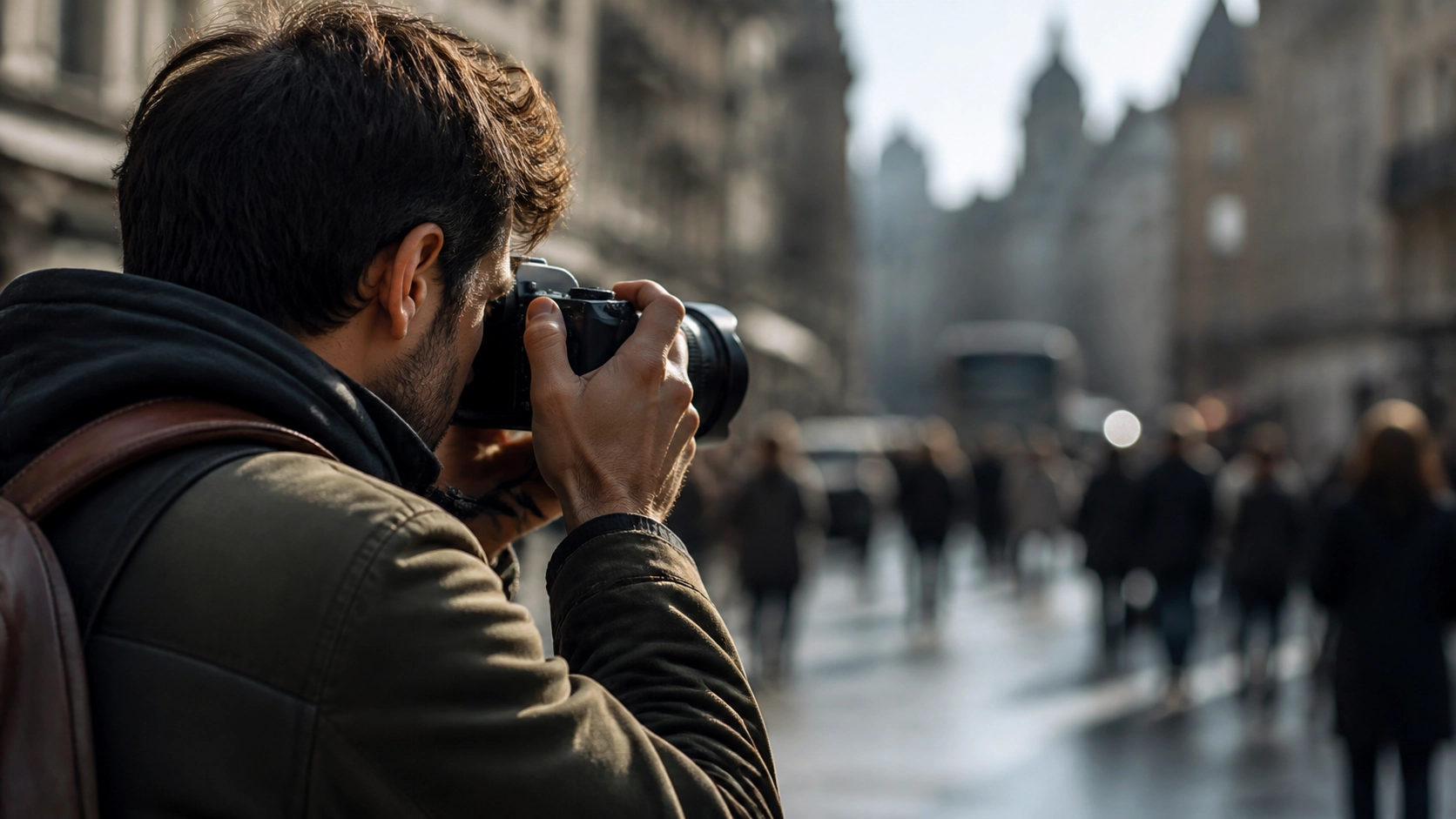
The old-school advice for street photographers was always "zoom with your feet." It was supposed to make you more engaged with the scene. If you wanted a tighter shot of that busker, you had to physically move closer. This discipline was touted as the only way to truly "see" a photograph.
But let’s be real: sometimes you can’t move your feet. There’s a taxi in the way, a crowd of tourists, or a physical barrier. In the fast-paced world of 2026 street photography, missing the shot because you were restricted to a single focal length is becoming unacceptable.
Today’s street scene is chaotic. We’re not just taking photos; we’re capturing moments that are often gone in a fraction of a second. The ability to go from a wide 24mm environmental shot to a tight 70mm portrait without fumbling with a lens pouch is a game-changer. It’s the difference between getting the shot and having a great story about the shot you missed.
AI: The Silent Prime Killer
One of the biggest reasons people stuck with primes was the "look", that creamy bokeh and the ability to isolate a subject. But have you seen what Luminar can do lately? AI depth mapping has reached a point where it can realistically simulate the fall-off of an f/1.2 lens even if you shot the photo at f/4.
This is why everyone is talking about AI photography news. If you can achieve the "prime look" in post-production with 99% accuracy, why would you carry three heavy lenses when one versatile zoom does the job? For the street photographer, gear weight is everything. If you’re lighter, you stay out longer. If you stay out longer, you take better photos.
For those just starting, check out photography 101 to understand how these basics are evolving. You don't necessarily need the most expensive glass to get professional results anymore; you need to understand how to leverage the tech available to you.
The Street Photographer’s Dilemma: Size vs. Versatility
Now, I can hear the purists screaming already. "What about the size?" Yes, primes are generally smaller. A Fuji X100V or a Leica Q3 fits in a jacket pocket. A 24-70mm f/2.8 zoom does not. For many street photographers, being "invisible" is the most important part of the job.
But even this is changing. The latest mirrorless cameras for your 2026 kit are getting smaller, and the lenses are following suit. We’re seeing "compact zooms" that are barely larger than a standard 50mm prime.
If you're still struggling with the technical side of things, like manual settings, don't worry. You can find some great tips on how to master manual mode over at our learning center. And honestly, mastering your settings is way more important than whether your lens is fixed or not. If you want to dive deep into the technical weeds, I always recommend checking out PhotoGuides.org for some solid breakdowns.
Where Primes Still Win (For Now)
Despite the onslaught of high-tech zooms, primes aren't going to disappear from the face of the earth tomorrow. There is still a specific "soul" to a prime lens that a zoom can't quite replicate.
- Intentionality: When you’re locked into one focal length, your brain starts to see the world in that frame. You know exactly where to stand before you even lift the camera. This "pre-visualization" is a muscle that zooms can sometimes make "lazy."
- The Extreme Ends: If you need f/1.2 or f/1.4 for legitimate low-light performance (and not just for the blur), zooms can’t touch you yet.
- The Price Point: You can get a killer 50mm f/1.8 for a couple of hundred bucks. A zoom that matches its sharpness will cost you thousands. For a beginner, the prime is still the best bang for your buck.
If you’re a beginner and you’re worried about making mistakes, you’re not alone. I see people making the same 7 mistakes with manual mode all the time. Whether you use a prime or a zoom, the fundamentals remain the same.
The "Sonny" Workflow: Why Social Media is Driving the Change
I was talking to Sonny, our Social Media Manager, about this the other day. He’s seeing a huge shift in the type of content that performs well. People don't care if a photo was shot on a $10,000 prime or a $500 zoom. They care about the moment.
In the world of TikTok and Instagram, speed is king. If you’re out on the street and you see a perfect moment happening 20 feet away, and you have a 35mm prime on your camera, you’re stuck. By the time you run over there, the moment is gone. With a zoom, you’re in. You get the shot, you post it, and you move on.
This is a recurring theme on blog.edinchavez.com, where we often talk about the intersection of art and commercial reality. If you want to see how these shots look when they're pushed to the limit, take a look at the gallery at edinfineart.com. You'll notice that the emotion of the scene always trumps the technical specs of the gear.
The Economic Shift
Let’s talk money. In the past, you’d buy a 35mm for street, an 85mm for portraits, and a 24mm for landscapes. That’s three lenses to buy, three lenses to clean, and three lenses to carry.
Today, a single high-quality zoom can cover all those bases. While the initial price tag might be higher, the total cost of ownership is often lower. Plus, you’re not constantly exposing your sensor to dust every time you switch glass on a windy city corner. For the modern professional, the "one lens to rule them all" philosophy is becoming the standard.
If you're looking to upgrade your kit this year, make sure you're not making common errors. Check out 7 mistakes you're making with AI photo editing because, as we mentioned, the software is doing a lot of the heavy lifting that the glass used to do.
How to Adapt Your Street Photography in 2026
If you’re feeling a bit overwhelmed by the "death" of the traditional prime lens era, don't be. It’s actually an exciting time to be a photographer. Here is how you can stay ahead of the curve:
- Embrace the Hybrid Approach: Keep a small prime for those days when you want to feel "minimalist," but don't be afraid to lean on a high-end zoom for serious work.
- Invest in Software: If you're worried about the f/2.8 aperture of your zoom, get comfortable with Luminar. Use its AI tools to enhance your subject separation.
- Focus on Composition: Gear is just a tool. A bad photo shot on a 35mm Summilux is still a bad photo. Spend more time learning portrait photography techniques and light behavior.
- Keep Learning: The tech is moving so fast that what was true six months ago might not be true today. We’re constantly updating our guides at learn.shutyouraperture.com to keep up with these shifts.
Final Thoughts: Are They Dead?
So, back to the big question: Are prime lenses dead?
No. They’ve just been demoted from "mandatory" to "optional."
In 2026, the street photography scene is more about flexibility and the "final look" than it is about the purity of the gear. We are seeing a democratization of quality. You no longer need a bag full of expensive primes to capture world-class images. You need a good eye, a solid understanding of your camera, and the right tools: whether that’s a versatile zoom or a piece of AI software: to bring your vision to life.
Street photography has always been about the "decisive moment." And in today's world, that moment doesn't care what lens is on your camera. It only cares that you were ready to catch it.
If you're still trying to figure out which direction to go with your gear, remember that the best camera is the one you have with you: and in 2026, that camera is likely attached to a very powerful, very sharp zoom lens. Keep shooting, keep experimenting, and don't let the gear snobs tell you there's only one way to see the world.
For more in-depth guides and the latest in the world of photography, keep an eye on our photography for beginners 101 resources. We’re here to make sure you’re not just taking photos, but making art.