edinchavez01-20). Buying through these links costs you nothing extra and helps fund our free guides.
Let’s be honest: choosing a camera in 2026 feels a little bit like buying a spaceship. Technology has moved so fast that even "entry-level" cameras today would have made professional photographers ten years ago weep with joy. The mirrorless revolution is over: mirrorless won. DSLRs are essentially vintage collectibles now.
If you are looking for the best mirrorless cameras to kick off your creative journey or upgrade your professional kit, you’ve come to the right place. At Shut Your Aperture, we live and breathe this stuff. Whether you’re deep into landscape photography tips or you’re just starting out and need photography for beginners resources, we’ve got your back.
The State of Mirrorless in 2026
We are currently in the era of AI-driven autofocus, global shutters, and computational photography features that were once sci-fi. Brands like Sony, Canon, and Nikon aren't just fighting over megapixels anymore; they are fighting over how smart the camera can be.
When looking for a camera this year, you aren't just buying a sensor and a box; you’re buying into an ecosystem. Before we dive into the specific models, let's talk about what actually matters when you're standing in a shop (or browsing online) trying to decide where to drop your hard-earned cash.
1. The Sensor: Full-Frame vs. APS-C
In 2026, the gap between full-frame and APS-C (crop sensor) has narrowed in terms of image quality, but the physics remains the same. Full-frame sensors are generally better for low-light situations and offer a shallower depth of field. APS-C cameras, however, are smaller, lighter, and often faster. If you’re into street photography ideas, a compact APS-C might be your best friend. If you’re doing portrait photography techniques for high-end clients, full-frame is still the gold standard.
2. AI-Powered Autofocus
This is the biggest change in recent years. Modern cameras don't just "focus"; they recognize eyes, faces, birds, cars, and even trains. If the camera you’re looking at doesn’t have robust subject-tracking AI, it’s already outdated.

Top Mirrorless Cameras of 2026 Compared
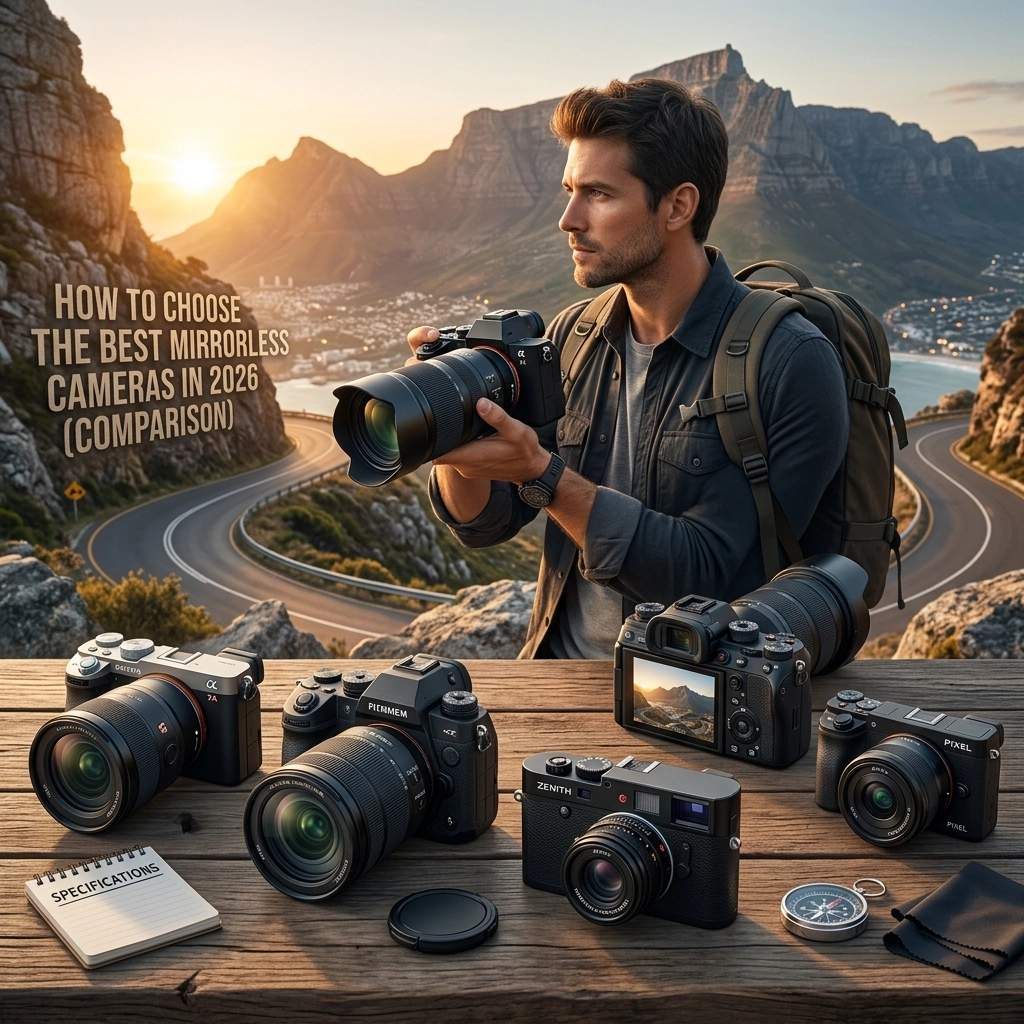
To make this simple, I’ve broken these down by category. We’ve tested these extensively, and while every camera on this list is great, they each have a specific "personality."
The "Do-Everything" King: Canon EOS R5 Mark II
The Canon R5 Mark II is arguably the most versatile camera on the market right now. With its 45MP sensor and 8K video capabilities, it’s a beast for both stills and motion.
- Pros: Incredible ergonomics, 8K 60fps video, and a focus system that feels like it’s reading your mind.
- Cons: It’s pricey, and the lenses can be heavy.
- Best for: Professionals who do a mix of everything, from majestic sunset photography to commercial studio work.
The Speed Demon: Nikon Z9
If you are into sports or wildlife, the Nikon Z9 is the tank you want in your bag. It’s built like a brick and features no mechanical shutter: everything is electronic. It can fire off frames faster than you can blink, ensuring you never miss the peak of the action.
- Pros: Indestructible build, unlimited buffer, and top-tier weather sealing.
- Cons: It’s huge and heavy.
- Best for: Wildlife pros and sports photographers. Check out ProShoot.io for more detailed camera gear reviews on the Z9.
The Resolution Monster: Sony a7R V
For those who need every single pixel, the Sony a7R V remains the resolution champion. It’s the go-to for landscape photography tips and fine art. When paired with high-end glass, the detail is breathtaking.
- Pros: 61MP sensor, incredible lens ecosystem, and great AI autofocus.
- Cons: File sizes are massive (you'll need a lot of hard drives).
- Best for: Landscape and fine art photographers. If you want to see what this sensor can do in the hands of a pro, check out Edin Fine Art.
Photography for Beginners: Where to Start?
I get asked this all the time: "I want to start taking pictures, but everything is so expensive. What do I buy?"
For photography for beginners, you don’t need a $6,000 professional body. You need something that teaches you the ropes without making you go bankrupt. The Nikon Z50 II or the Sony A6700 are perfect entry points. They offer great "bang for your buck" and give you access to incredible lenses.
When you're starting out, your focus should be on learning how to use manual mode camera settings. Understanding ISO, Shutter Speed, and Aperture is more important than having the most expensive sensor. Once you master the basics, you can start exploring photography tutorials to level up your game.

Choosing Based on Your Style
For the Travel Photographer
If you’re constantly on a plane or hiking up mountains, weight is your enemy. You want something like the Fujifilm X-T5 or the OM System OM-1 Mark II. These cameras are compact but punch way above their weight class. They are perfect for capturing hidden gem locations for travel photography or trekking through secluded paradises.
For the Portrait Professional
Portraiture is all about skin tones and eye-autofocus. The Sony a1 II or the Canon R6 Mark II are incredible here. They handle portrait photography techniques like a dream, and the eye-tracking is so sticky it almost feels like cheating.
For the Hybrid Creator (Video + Photo)
If you spend as much time in a video editor as you do in a photo editor, look at the Sony A7S III or the Panasonic GH7. These are built with a "video first" mentality, offering features like internal ProRes recording and cooling fans to prevent overheating during long shoots at Edin Studios.

The Importance of Lenses
Here is a pro tip: The camera body is the "brain," but the lens is the "soul." You are better off buying a slightly cheaper camera body and spending more on high-quality glass.
In 2026, the lens market is wider than ever. Third-party manufacturers like Sigma and Tamron are producing lenses that are just as good (and sometimes better) than the native Sony or Nikon versions for a fraction of the price. If you’re just starting, a 35mm or 50mm prime lens is a great way to learn composition. For those into water photography, a fast telephoto lens or a specialized macro lens will change your life.
Post-Processing: Making Your Images Pop
Even the best mirrorless camera in the world produces a "raw" image that needs a little love. Photo editing tutorials will tell you that the magic often happens in the edit.
For 2026, the tool of choice for many of us is Luminar. Its AI tools allow you to enhance skies, retouch portraits, and fix lighting issues in seconds rather than hours. Whether you are editing ethereal landscapes or enigmatic vistas, having a solid workflow is key.
If you're stuck, head over to Shut Your Aperture for some deep dives into editing workflows that work for any style.

Workflow and News: Staying Up to Date
The world of photography moves fast. New firmware updates can literally turn an old camera into a "new" one by adding features. Keeping an eye on photography news is vital. We work closely with Sonny, our Social Media Manager, to ensure that our latest tips on camera gear reviews and street photography ideas are always fresh on our feeds.
Final Thoughts on Choosing Your Camera
At the end of the day, the "best" camera is the one that you actually want to take out of the house. Don't get bogged down by spec sheets. If a camera feels too heavy, you won't carry it. If the menu system is too confusing, you won't use it.
Go to a shop, hold them in your hands, and see which one feels right. Whether you’re shooting fine art nude poses or stunning nature imagery, your gear should be an extension of your vision, not a barrier to it.

Quick Checklist for Your 2026 Purchase:
- Budget: Be realistic. Factor in lenses and extra batteries.
- Ergonomics: Does it fit your hand? Are the buttons where you want them?
- Autofocus: Does it have subject recognition for what you shoot?
- Ecosystem: Are the lenses you want available and affordable?
- Video: Do you need 4K/120fps or 8K, or is 4K/60fps enough?
Photography is a journey. Your camera is just the vehicle. Now, quit reading about gear and go out and shoot something! For more inspiration, check out the latest work over at blog.edinchavez.com and keep pushing your creative boundaries.
Quick Amazon shortcuts for the camera categories covered in this guide. Use them if Prime shipping or your existing Amazon credit makes more sense than B&H. As an Amazon Associate ShutYourAperture earns from qualifying purchases.