If you are still holding onto that clunky DSLR from five years ago, I have some news for you: the mirrorless revolution didn't just happen; it won. It’s 2026, and the tech inside these compact bodies is bordering on science fiction. We’re talking about autofocus that can track a bird's eye through a thicket of branches and sensors that see better in the dark than most nocturnal animals.
Choosing the best mirrorless cameras today isn't just about picking a brand name. It’s about finding the tool that fits your hands and your creative vision. Whether you are hunting for landscape photography tips or trying to master portrait photography techniques, the gear you choose will be your best friend or your worst enemy.
In this guide, we’re going to break down the heavy hitters of 2026, look at the latest camera gear reviews, and help you figure out which camera belongs in your bag.
Why Mirrorless is Still the King in 2026
Back in the day, people worried about battery life and electronic viewfinders (EVF) looking like a pixelated mess. Those days are gone. The 2026 lineup of mirrorless cameras offers refresh rates so high you can’t tell the difference between the EVF and an optical finder. Plus, the weight savings are a lifesaver for anyone into street photography ideas.
For those just starting out, photography for beginners has never been more accessible. Mirrorless cameras show you exactly what your exposure looks like before you even click the shutter. If you change your shutter speed, the screen gets darker or brighter in real-time. This makes learning how to use manual mode camera way more intuitive than the old "guess and check" method of the DSLR era.

Alt text: A photographer holding a sleek 2026 mirrorless camera overlooking a mountain range during sunrise.
The Landscape Specialist: Detail and Dynamic Range
If you live for the golden hour, you need a sensor that can handle the extreme contrast between a bright sky and dark shadows. In 2026, the Nikon Z9 and the Sony A7r V are still the kings of this domain.
The Nikon Z9 is a total workhorse. It’s built like a tank and features a 45MP sensor with an unlimited buffer. For landscape photography tips, I always say: get the most resolution you can afford. The Z9 allows you to crop in without losing the fine details of a distant ridicgeline. If you want to see what professional-grade landscape prints look like from these sensors, check out Edin Fine Art.
On the Sony side, the A7r V is a monster for resolution. Its AI-driven autofocus isn't just for people; it recognizes landscapes and helps optimize sharpness across the frame. When you combine this camera with some solid landscape composition techniques, your work will look professional in no time.
The All-Rounder: Best Bang for Your Buck
Not everyone has $6,000 to drop on a flagship body. Most of us need a camera that can do a bit of everything: photos of the kids, some travel shots, and maybe a few professional gigs on the side.
Nikon Z6 III: The New Gold Standard
The Nikon Z6 III has taken the world by storm this year. It features a "partially stacked" sensor, which is a fancy way of saying it’s incredibly fast without the astronomical price tag of a fully stacked sensor. It’s arguably the best camera for travel in 2026 because it’s light, ergonomic, and the IBIS (In-Body Image Stabilization) is rock solid.
Canon EOS R6 Mark II: The Reliable Partner
Canon hasn't slowed down either. The R6 Mark II is the "best bang for your buck" camera for many. Its autofocus is legendary, and it handles low light like a champ. If you are practicing portrait photography techniques, the way this camera renders skin tones is just beautiful. It’s a favorite for wedding photographers who need reliability in unpredictable lighting.
Sony A7 IV: The Hybrid King
Even a couple of years after its peak, the Sony A7 IV remains a top contender in camera gear reviews. It’s the perfect middle ground for someone who does 50% photo and 50% video. The lens ecosystem for Sony is also the most mature, meaning you can find great glass at every price point. For more in-depth comparisons on these setups, PhotoGuides.org has some great technical breakdowns.
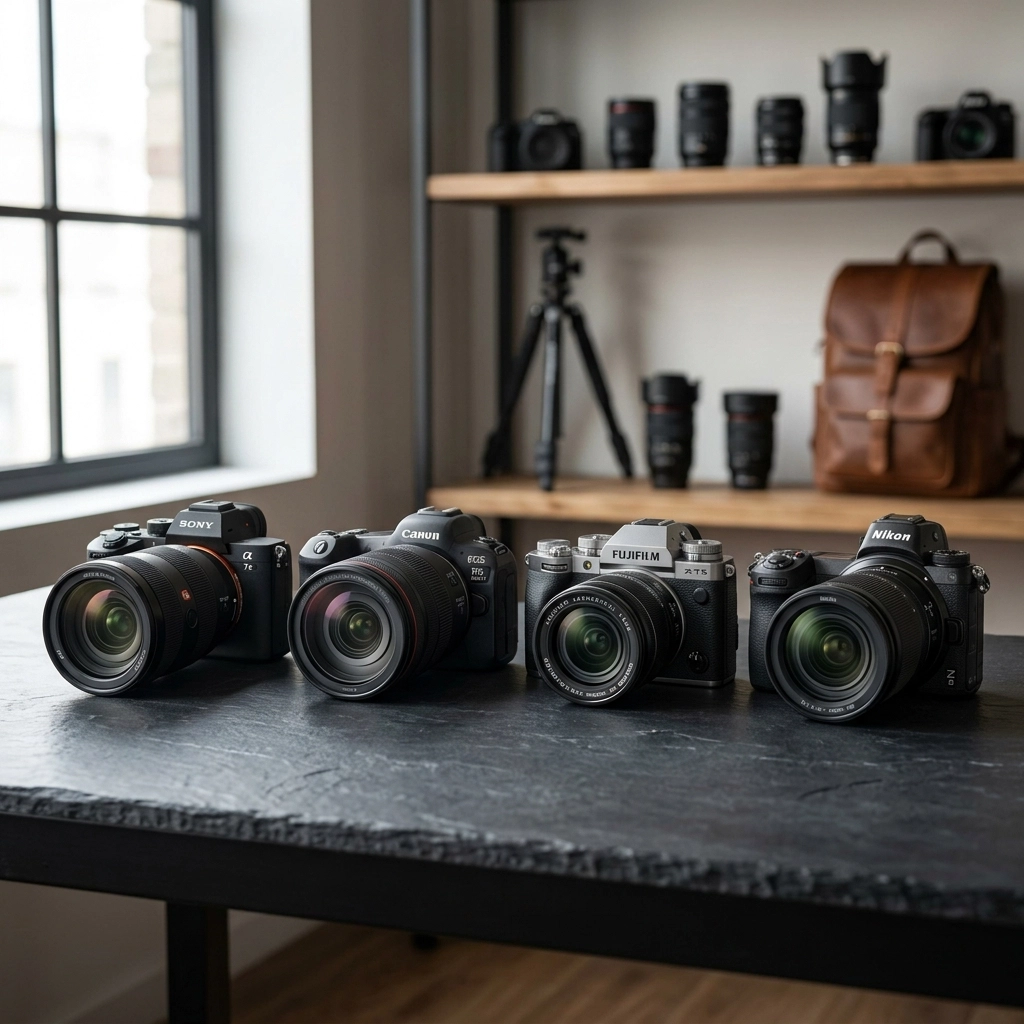
Alt text: A comparison of three different mirrorless camera bodies on a wooden table, showing the size and lens variations.
Photography for Beginners: Where to Start?
If you are new to the game, don't get distracted by the $5,000 bodies. You don't need them yet. In 2026, entry-level full-frame cameras like the Nikon Z5 II or APS-C models like the Fujifilm X-T5 are incredible starting points.
The Fujifilm X-T5 is a blast to use because it has physical dials for everything. This is a huge help when you are looking for photography tutorials on how to use manual mode camera. Instead of digging through digital menus, you just turn a knob for your shutter speed and a ring for your aperture. It makes the learning process feel "tactile" and fun.
If you are looking for a place to really master the craft, our photography school is designed to take you from "I don't know what this button does" to "I'm selling my prints" in record time.
Mastering the Tech: How to Use Manual Mode Camera
Modern mirrorless cameras have so many "Auto" features that it’s tempting to never leave "P" mode. But if you want to be a creator, not just a button-pusher, you need to master manual mode.
- Aperture: Controls your depth of field. Use a low number (like f/1.8) for those blurry backgrounds in portraits.
- Shutter Speed: Controls motion. High speeds (1/1000s) freeze action; slow speeds (1/10s) blur it.
- ISO: Controls light sensitivity. Keep it as low as possible to avoid "noise" or grain.
The beauty of 2026 mirrorless tech is the "Live View." You can see the effect of these settings instantly. It’s like having a built-in photography tutorial right in your viewfinder. For the latest photography news on how firmware updates are making manual mode even easier with AI overlays, stay tuned to our daily news updates.
Street Photography Ideas and the Mirrorless Advantage
Street photography is all about being invisible. You can't do that with a giant DSLR and a lens the size of a bazooka. This is where mirrorless truly shines. Cameras like the Ricoh GR III (or its 2026 successor) or the Sony A7C II are tiny but pack full-frame sensors.
When you're out looking for street photography ideas, you want a camera that is fast and quiet. The silent electronic shutters in today's mirrorless cameras mean you can take a photo standing three feet away from someone and they won't hear a thing. This allows for candid, authentic moments that are impossible to capture otherwise.
Alt text: A street photographer capturing a candid moment in a busy urban alleyway with a compact mirrorless camera.
Post-Processing: Bringing Your Files to Life
Picking the best mirrorless cameras is only half the battle. Once you have those high-resolution RAW files, you need to process them. 2026 has brought us some insane photo editing tutorials and tools.
While Adobe is still the industry standard, many photographers are moving toward faster, AI-driven workflows. Luminar has become a staple for many because it automates the tedious parts of editing: like sky replacement or skin retouching: so you can focus on the creative side.
If you're feeling overwhelmed by the options, we’ve put together a guide on choosing the best photo editing tutorials for your specific skill level. And for a look at the future, don't miss our breakdown of AI photo editing tools in 2026.
The 2026 Mirrorless Comparison Matrix
To make your life easier, here is a quick breakdown of the top picks for this year:
| Camera Model | Best For | Key Feature |
|---|---|---|
| Nikon Z9 | Wildlife & Action | Unlimited Buffer & 45MP |
| Sony A7r V | Landscapes | 61MP & Advanced AI AF |
| Nikon Z6 III | Travel / All-Rounder | Partially Stacked Sensor |
| Canon R6 II | Portraits / Low Light | Incredible AF Tracking |
| Fujifilm X-T5 | Enthusiasts / Style | Analog Dials & Great Color |
Alt text: A detailed chart comparing the specs of Nikon, Sony, and Canon mirrorless cameras on a digital display.
Final Thoughts on Choosing Your Gear
At the end of the day, the "best" camera is the one you actually want to take out of the house. Don't buy a Nikon Z9 if you hate heavy cameras. Don't buy a Fujifilm X-T5 if you need to shoot professional sports at 30 frames per second.
Read the camera gear reviews, but also try to get the camera in your hands. How does the grip feel? Are the menus confusing? For more personal insights and behind-the-scenes looks at how these cameras perform in the wild, I always recommend checking out Edin’s Blog.
The tech in 2026 is better than it has ever been. Whether you are looking for landscape photography tips to use on your next trip or you are a beginner just trying to understand the exposure triangle, there is a mirrorless camera designed exactly for you.
If you need more help or want to dive deeper into the world of photography, explore the rest of Shut Your Aperture. We’ve got everything from golden hour tips to the latest evening photography news.
Now, stop reading about gear and go take some photos!