Best Photography Spots in Singapore: 12 Locations With GPS
Singapore, Singapore is one of the most photogenic cities in the world. If you have a camera and the patience to show up before dawn, Singapore will give you images that last a career — but only if you know where and when to point it.
This is the definitive field guide to the 12 best photography spots in Singapore, with GPS coordinates you can drop straight into Google Maps, exact camera settings tuned to Singapore’s unique light, precise timing for every location, and the access notes nobody else bothers to document. It mirrors the intel inside our Singapore Ultimate Photographer’s Guide ($47 PDF) — a downloadable field guide with full-page hero images, GPS maps, seasonal tables, a city safety briefing, and a complete photographer’s packing list. Get the guide →
Planning multi-city travel? See also: U.S. cities photography hub and the National Parks Photography Guides.
12 GPS-mapped locations · Exact camera settings · Multi-season shooting calendar · Free annual updates
Download the PDF guide →
Quick jump to the 12 spots
- Marina Bay Sands SkyPark Observation Deck
- Gardens by the Bay — Supertree Grove
- Merlion Park
- The Helix Bridge
- ArtScience Museum
- Singapore Flyer
- Cloud Forest — Gardens by the Bay
- Henderson Waves Bridge
- Pinnacle@Duxton SkyBridge
- Chinatown — Buddha Tooth Relic Temple
- Kampong Glam — Sultan Mosque & Haji Lane
- Marina Barrage Rooftop — Skyline Panorama
A look inside the Singapore Photographer’s Guide
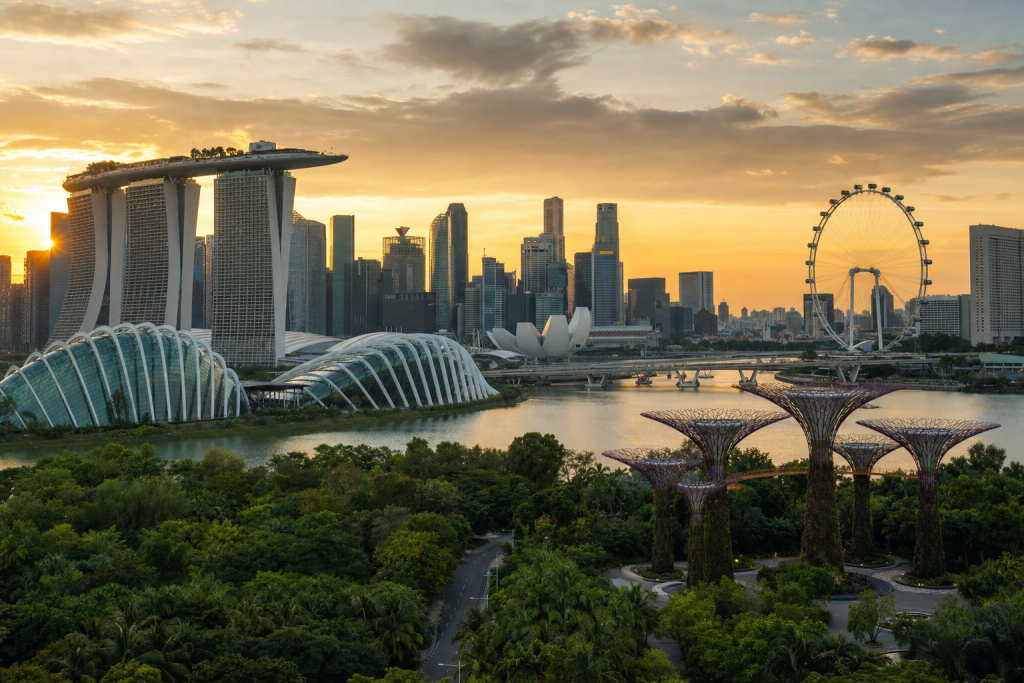
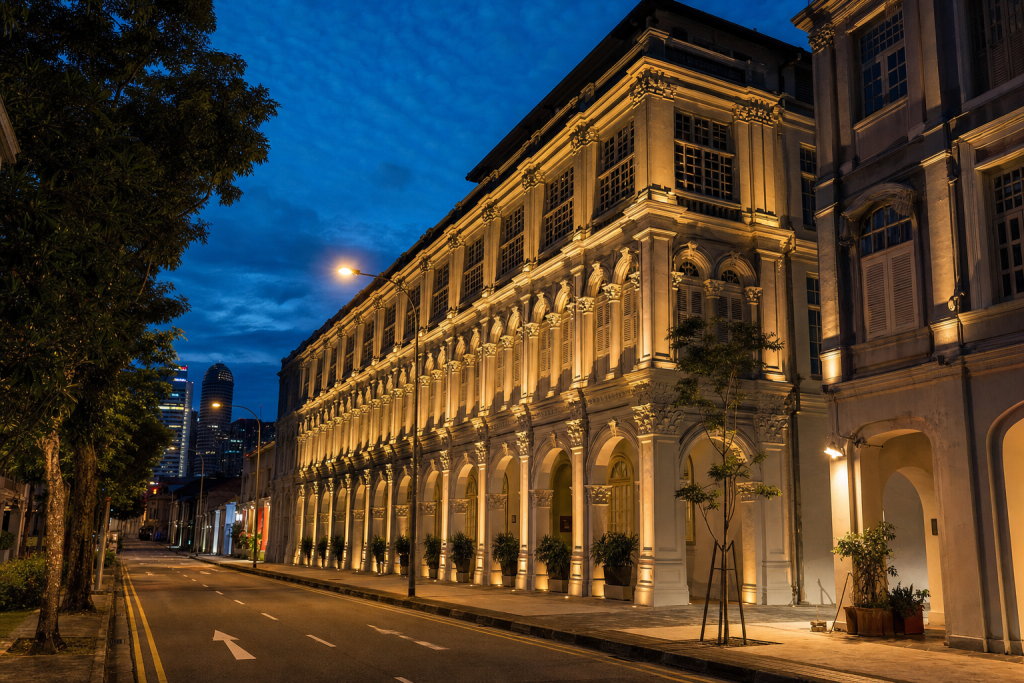
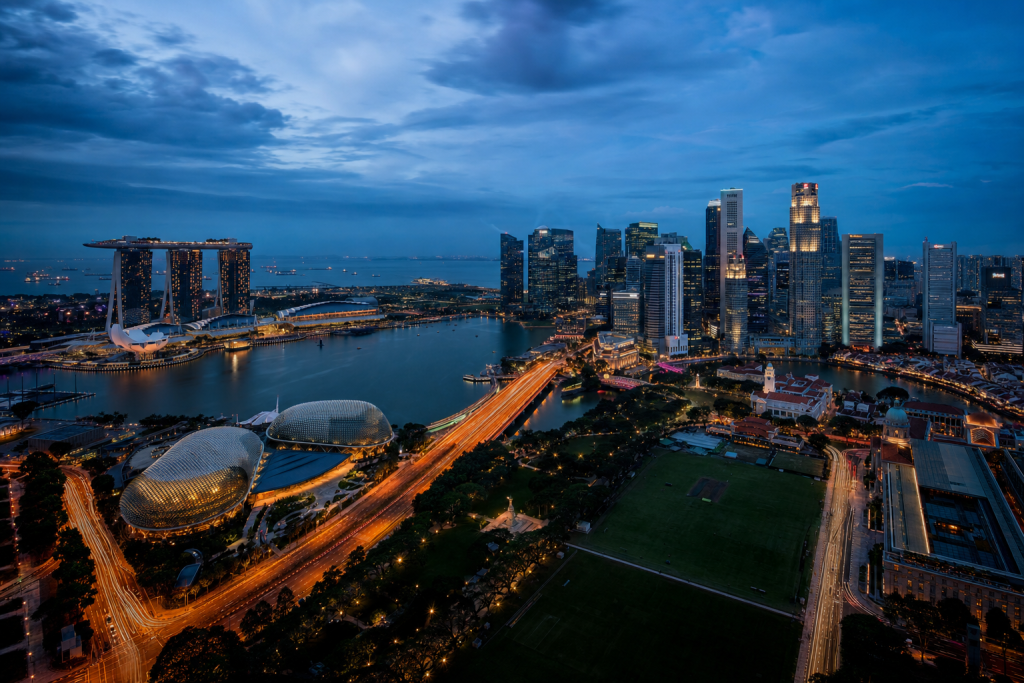
Here are three of the actual shots you’ll find inside the PDF — cinematic full-page references for the exact spots, lenses, and lighting conditions documented in the guide. The full guide includes 12 locations, each with a hero image, GPS map, settings table, and a five-shot list.
Save
Before you shoot Singapore: the essentials
- Free public access: Merlion Park, Helix Bridge, Marina Barrage rooftop, Supertree Grove ground level, Henderson Waves Bridge, Singapore Botanic Gardens (main gardens), Kampong Glam streets including Sultan Mosque exterior, Chinatown Heritage streets and Buddha Tooth Relic Temple exterior and main hall, Esplanade Theatres exterior and waterfront, East Coast Park, and Pinnacle@Duxton 50th-floor SkyBridge are either free or nominal-fee (S$6 for Pinnacle). Paid highlights: Marina Bay Sands SkyPark Observation Deck S$35–39/adult; Cloud Forest + Flower Dome S$46/adult (non-resident); ArtScience Museum from S$30/adult; Singapore Flyer S$40/adult; National Orchid Garden S$15/adult (non-resident).
- Commercial permits: Personal and tourist photography in all public outdoor spaces is unrestricted. Commercial photography (advertising, editorial shoots, film crews) in national parks, Gardens by the Bay, and government-owned public spaces requires a permit from the National Parks Board (nparks.gov.sg) or the relevant venue; fees and lead times vary. Drone photography requires a permit from the Civil Aviation Authority of Singapore (caas.gov.sg) and is prohibited without clearance over the Central Area, Changi Airport zones, and military areas. Photography inside Sultan Mosque is restricted to exterior and lobby areas; no photography in the prayer hall during prayer times. Buddha Tooth Relic Temple prohibits photography on the 4th floor relic chamber. No flash photography inside any place of worship.
- Best photography seasons: February–April (dry northeast monsoon tail, low humidity, clear skies, softer golden-hour light) and September–October (inter-monsoon, dramatic cloud formations, manageable heat, lower tourist crowds than December peak)
- Blue hour notes: Singapore sits at 1.29°N — essentially on the Equator — giving it a rapid, consistent twilight. Blue hour lasts only 15–20 minutes after sunset (or before sunrise), far shorter than temperate cities. The sun sets nearly vertically rather than at an oblique angle, so the transition from golden hour to blue hour to full dark is swift. Sunset times are remarkably stable year-round, ranging from about 6:50 PM to 7:20 PM. For Marina Bay, the blue-hour window immediately after the 7:00–7:10 PM sunset is the prime slot: the city illumination fires up, the Gardens by the Bay Supertrees begin their OCBC Garden Rhapsody light show at 7:45 PM and 8:45 PM, and Marina Bay Sands’ Spectra light show runs at 8:00 PM and 9:00 PM nightly. Set an alarm — the optimal window is precise.
- Drone policy: Drone laws vary widely by country and city — many capital and tourist zones are no-fly. Verify the local civil aviation authority’s current rules before launching.
- Local resource: Official visitor information
The full-resolution version of every map below — plus seasonal calendars, gear notes per location, sun-angle diagrams, and a complete photographer’s packing checklist — is inside the Singapore Photographer’s Guide PDF ($47).
1. Marina Bay Sands SkyPark Observation Deck
The SkyPark sits atop three 55-storey hotel towers connected by a 340-metre-long sky deck — longer than the Eiffel Tower on its side. At 200 m elevation, it delivers unobstructed 360° views of Singapore’s entire skyline: the Central Business District glass towers to the west, Gardens by the Bay’s Supertrees directly below and to the east, Marina Bay Sands’ own pools in the foreground, and on clear days the Indonesian islands to the south. No other viewpoint in Singapore places you above the Supertrees and the bay simultaneously. The infinity pool (residents only) creates the illusion of water melding into the sky at the horizon.
- GPS: 1.2848, 103.8609
- Elevation: 656 ft
- Best time of day: peak session (5:00–10:00 PM) — golden hour light bathes Gardens by the Bay and the bay in warm tones, followed immediately by blue hour and then the Spectra light show at 8:00 PM visible from above; sunrise (from 7:00 AM) is also exceptional when morning mist drifts over the bay
- Sun direction: The observation deck faces west-northwest over the bay and Gardens by the Bay. At sunrise (azimuth ~70° east-northeast), the sun rises over East Coast Park and illuminates the Marina Bay water and Supertrees from behind the observation deck — ideal for warm sidelight on the cityscape. At sunset (azimuth ~285–290° west-northwest), the sun sets almost directly into the camera’s view from the deck’s south-facing edge, creating dramatic silhouette opportunities of the CBD skyline and Singapore Flyer. The deck’s north-facing side overlooks Gardens by the Bay and gets warm evening sidelight from the setting sun. Being at 200 m elevation means the photographer looks down on the Golden Hour light falling across rooftops.
- Access: 10 Bayfront Ave, Singapore 018956, Hotel Tower 3, Level 56. MRT: Bayfront station (CE1/DT16), Exit C or D, walk along hotel exterior from Tower 1 to Tower 3. Non-peak admission (10:00 AM–4:30 PM, last entry 4:00 PM): S$35 adult, S$31 concession. Peak admission (5:00–10:00 PM, last entry 9:30 PM): S$39 adult, S$35 concession. Family package (2 adults + 2 children): S$110 non-peak, S$126 peak. Book online at marinabaysands.com to guarantee a time slot. Open daily 10:00 AM–10:00 PM.
- Difficulty: easy
- Recommended settings: Blue Hour Cityscape: f/8, 4 sec, ISO 100, 24mm, tripod on railing ledge · Golden Hour Supertrees: f/8, 1/250 sec, ISO 200, 70mm · Spectra Light Show From Above: f/5.6, 1/60 sec, ISO 800, 35mm · Midday Haze Skyline: f/11, 1/500 sec, ISO 100, 16mm
Shots to chase:
- Wide-angle shot from the south-facing edge at blue hour with the CBD glass towers lit up in warm gold below the cobalt sky, Singapore Flyer glowing at the right edge
- Compression shot at 200mm from the east-facing side with the Supertrees in the midground and the full CBD skyline stacked behind them
- Spectra light show laser beams shooting across the bay surface captured from above with a 15-second exposure
- Pre-dawn long exposure with light trails from the Benjamin Sheares Bridge expressway below
- Telephoto shot of the ArtScience Museum’s lotus petals from directly above, framed against the bay’s reflection
Pro tip: Book the first slot of the peak session (5:00 PM) and you get both golden-hour and blue-hour light in one visit, plus front-row position before the evening crowd builds. The south-facing corner — closest to the Marina Bay water — is the most coveted tripod position; arrive early to claim it. On weekdays the deck is significantly less crowded than weekends. Bring a jacket: the elevation creates stronger wind and feels 3–4°C cooler than street level. The glass railings cause reflections; hold your lens close to the glass or use a rubber lens hood pressed against it.
Common mistake to avoid: Visiting only during the day and missing the entire blue-hour and night spectacle that makes this deck world-famous. Using a very wide lens (10–14mm) from the corner positions distorts the symmetry of the skyline; 24–50mm is more flattering. Expecting to see the infinity pool — it is reserved exclusively for hotel guests on the same platform but behind a partition.
2. Gardens by the Bay — Supertree Grove
The 18 Supertrees — vertical gardens standing 25–50 m tall — are unlike anything else on Earth. Each is a living, breathing structure clad in ferns, orchids, bromeliads, and climbing plants, with photovoltaic cells that harvest solar energy and a rainwater collection system. At night their bespoke LED array transforms them into luminous alien flora for the Garden Rhapsody show. The 50-metre-tall Supertree Observatory offers the only vantage point looking across to Marina Bay Sands at the same height as the skypark pool. The reflective lake (Dragonfly Lake) at the grove’s east side mirrors the Supertrees in its still surface before the show begins.
- GPS: 1.2816, 103.8636
- Elevation: 16 ft
- Best time of day: OCBC Garden Rhapsody light show: 7:45 PM and 8:45 PM nightly (free, 15 minutes each); blue hour 7:00–7:20 PM for balanced sky and lit Supertrees; early morning 6:00–7:30 AM for empty grove and soft directional light
- Sun direction: The Supertree Grove sits on the eastern end of Gardens by the Bay. The largest Supertrees (tallest at 50 m) face west toward Marina Bay Sands. At golden hour (sunset ~7:00 PM), the sun sets to the west-northwest (azimuth ~285°) and backlit the trees from the west side — shooting from the eastern edge of the grove gives warm-rimlit Supertrees against a glowing sky. For the light show, the LED-embedded foliage illuminates from within; ambient sky light should be balanced with tree light, so the 20-minute post-sunset window is ideal. Morning sun rises to the east-northeast and front-lights the tree trunks from the bay-facing side.
- Access: 18 Marina Gardens Dr, Singapore 018953. MRT: Bayfront (CE1/DT16), Exit B, walk approximately 10 minutes through The Shoppes to the Gardens entrance. Supertree Grove ground level: free, open daily 5:00 AM–2:00 AM. OCBC Skyway (elevated walkway between Supertrees): S$14 adult, S$10 child (non-resident); S$10 adult, S$7 child (resident); open daily 9:00 AM–9:00 PM. Supertree Observatory (top of tallest Supertree): S$14 adult, S$10 child (non-resident); open daily 9:00 AM–9:00 PM, last admission 8:30 PM.
- Difficulty: easy
- Recommended settings: Rhapsody Show Wide: f/5.6, 1/30 sec, ISO 800, 16mm, handheld with IS · Rhapsody Long Exposure: f/8, 8 sec, ISO 100, 24mm, tripod, Dragonfly Lake reflection · Ocbc Skyway Golden Hour: f/8, 1/250 sec, ISO 200, 35mm · Dawn Tree Trunks: f/4, 1/60 sec, ISO 1600, 50mm
Shots to chase:
- Ultra-wide upward shot from directly beneath the tallest Supertree, filling the frame with its fern-covered underside and the sky beyond
- Long exposure of the Dragonfly Lake from its east bank at blue hour, capturing the Supertrees reflected in still water with Marina Bay Sands glowing in the background
- From the OCBC Skyway walkway at 22 m elevation: compression shot along the Skyway bridge with Supertrees flanking the path and MBS in the distance
- Garden Rhapsody show with a 15-second exposure to capture the LED color sweep across all 12 grove trees in a single frame
- Single Supertree portrait with a 200mm telephoto compressing the vine-wrapped trunk against the other trees behind it, mid-morning light picking out the texture
Pro tip: The OCBC Skyway closes at 9:00 PM — enter at 8:30 PM (last admission) and you can watch the 8:45 PM Garden Rhapsody show from 22 m elevation while leaning over the railing. The best reflection position at Dragonfly Lake is the northeast corner of the lake, which places all 12 Supertrees and Marina Bay Sands in a single wide panorama. For the free ground-level view, the open plaza between the two clusters of trees (facing north toward the Cloud Forest) gives the clearest composition without obstructions.
Common mistake to avoid: Visiting at midday — harsh equatorial overhead light flattens the Supertrees’ texture and washes out the LED foliage accents that are always on. Not arriving 20 minutes early for the Rhapsody show to claim a reflection position at the lake before it fills with visitors. Using a telephoto lens for the grove — the Supertrees’ scale and their dense clustering is best captured with a 16–24mm wide angle.
3. Merlion Park
Merlion Park occupies the exact point where the Singapore River meets Marina Bay — the geographical and symbolic heart of the city. From this 2,500 sq m peninsula, a 360° pan encompasses Marina Bay Sands (north), the ArtScience Museum (northeast), the Helix Bridge (east), the Esplanade Theatres (northwest), the Fullerton Hotel heritage building (west), and the CBD skyline (south). The Merlion sculpture’s continuous water jet creates photographic foreground interest and, in the right light angle, produces a natural rainbow. It is the single most iconic photography position in Singapore — and it is free.
- GPS: 1.2868, 103.8545
- Elevation: 10 ft
- Best time of day: sunrise (6:30–8:00 AM) for golden sidelight on the Merlion with an almost empty park; blue hour (7:00–7:20 PM) for the city illumination firing up behind Marina Bay Sands; or during Spectra light show (8:00 PM and 9:00 PM) for the laser projections over the bay
- Sun direction: The Merlion faces due north toward Marina Bay Sands. At sunrise (azimuth ~70°), the low eastern sun provides warm sidelight across the Merlion’s left face and catches the water jet as a rainbow-lit mist. By late morning the sun is overhead and flattens the sculpture. At sunset (azimuth ~290°), the western sky turns warm amber behind the camera (shooting north), bathing the entire Marina Bay Sands complex in a golden glow while the Merlion is in soft foreground shadow — ideal silhouette opportunity. For the full composition of Merlion with MBS behind it, position yourself on the viewing platform directly in front of the fountain, not on the sides.
- Access: 1 Fullerton Rd, Singapore 049213. MRT: Raffles Place (NS26/EW14), Exit H — 5-minute flat walk straight toward the waterfront. Or Bayfront (CE1/DT16), Exit B, walk through The Shoppes. Open 24 hours, free admission. No tripod permit required for personal photography. Small kiosk food stalls operate on site. Limited taxi drop-off on Fullerton Road.
- Difficulty: easy
- Recommended settings: Sunrise Golden Mist: f/8, 1/500 sec, ISO 200, 35mm · Blue Hour Long Exposure: f/11, 10 sec, ISO 100, 24mm, tripod, silky bay water · Spectra Laser Show: f/5.6, 2 sec, ISO 400, 24mm, tripod · Midday Crowd Candid: f/8, 1/1000 sec, ISO 200, 50mm
Shots to chase:
- Classic full-frontal composition: Merlion in the left third of the frame, Marina Bay Sands centered in the background, reflected in smooth bay water with a 10-second blue-hour exposure
- Rainbow-in-the-mist: position at low angle at sunrise, shoot through the Merlion’s water jet with the low eastern sun behind you to split the mist into spectrum colors
- Silhouette at sunset: shoot back toward the Fullerton Hotel from the Jubilee Bridge with the warm western sky framing the old colonial building and Singapore River
- Spectra show laser beams raking across the Merlion Park waterfront with the 3D-mapped MBS towers as backdrop, 2-second exposure
- Pre-dawn reflection at 6:00 AM: still bay water mirrors the Merlion, MBS, and Esplanade in symmetrical near-perfect reflection before the morning ferry traffic begins
Pro tip: The best Merlion + Marina Bay Sands reflection composition requires still water — the bay is calmest on weekday mornings before 7:30 AM and on weeknights after 10:00 PM when pleasure boats stop running. The raised concrete platform behind the large Merlion gives a slightly elevated perspective that clears street-level clutter. For the Spectra show (8:00 PM, 9:00 PM), the Jubilee Bridge viewpoint 50 m east gives a wider angle than the Merlion Plaza itself.
Common mistake to avoid: Visiting exclusively at midday when the overhead equatorial sun creates harsh top-down shadows on the Merlion’s face and the water jet looks flat. Positioning yourself on the sides of the Merlion rather than directly in front — the Marina Bay Sands towers only align symmetrically from the central viewing platform. Forgetting to look behind you: the Fullerton Hotel and Anderson Bridge (west) are equally photogenic and often overlooked.
4. The Helix Bridge
The Helix is the world’s first double-helix bridge, its 280-metre span made of two intertwining spiral tubes of stainless steel and carbon steel inspired by the DNA double helix. At night, LED strips embedded in the structure light the helix in multiple color sequences, and the four canopy-shaded viewing pods extend over the water like jutting observation decks. From the central pods, the composition automatically includes the full Marina Bay Sands towers, the ArtScience Museum lotus, and the glowing bay in one frame — arguably the most cinematic single composition available for free in Singapore.
- GPS: 1.2876, 103.8606
- Elevation: 13 ft
- Best time of day: blue hour and night (7:00–10:00 PM) when the bridge’s LED lighting system activates, glowing in steel-blue and white tones that contrast with the warm gold of Marina Bay Sands; also excellent at sunrise for empty bridge and soft directional raking light on the double-helix steelwork
- Sun direction: The Helix Bridge runs northeast to southwest, crossing the Marina Channel. The Marina Bay Sands towers lie to the southwest when shooting from the Promenade side. At sunrise (azimuth ~70°), the low sun angles across the helix structure from the east, raking light emphasizing the twisted steel tubes and casting long shadows — ideal for architectural detail shots. At sunset (~7:00 PM, azimuth ~285°), the sun sets behind Marina Bay Sands creating a dramatic silhouette backlight. The four pod-shaped viewing platforms along the bridge face south and southwest toward the bay — sunset from these platforms puts the warm sky behind MBS.
- Access: Connecting Marina Centre and Marina South, 1 Esplanade Dr, Singapore 038981. MRT: Promenade (CC4/DT15), Exit A, 5-minute walk along Raffles Avenue. Open 24 hours, free. No permit required for photography. Tripod use is permitted in non-rush periods.
- Difficulty: easy
- Recommended settings: Night Led Structure: f/8, 4 sec, ISO 200, 24mm, tripod on viewing pod railing · Blue Hour Mbs Behind: f/8, 6 sec, ISO 100, 35mm, tripod · Morning Architectural Raking: f/11, 1/250 sec, ISO 100, 50mm · Handheld Night Candid: f/2.8, 1/30 sec, ISO 3200, 35mm
Shots to chase:
- From the first viewing pod (northeast end): 24mm wide composition with the helix leading lines disappearing toward Marina Bay Sands at blue hour, bay water glowing below
- Underneath the bridge from the waterfront walkway: looking up through the helix steel tubes to the lit structure above, with the bridge’s curve framing the sky
- Straight-on shot from Esplanade side at night with a 14mm lens capturing both helix tubes simultaneously arching overhead like a DNA double strand
- Human-scale portrait with the glowing helix structure filling the background, showing the bridge’s architectural scale in comparison to a person
- Long-exposure light trail from a pleasure boat or ferry moving beneath the bridge combined with the static LED helix structure above
Pro tip: The second pod from the Promenade (Esplanade) side positions you with Marina Bay Sands perfectly centered, the ArtScience Museum’s lotus roof in the near midground, and the helix curving into the foreground. This is the single strongest one-shot composition on the entire bridge. The LED sequence changes color every few minutes — watch one full cycle before shooting to pick the color palette you want. Security guards patrol and may ask you to move a stationary tripod during peak pedestrian flow (~8:00–9:30 PM on weekends); mid-week nights are much calmer.
Common mistake to avoid: Visiting only by day and missing the LED illumination entirely — the bridge is architecturally interesting but not remarkable in daylight compared to its nighttime transformation. Using only a single focal length: the bridge rewards both ultra-wide (14–16mm for the full helix sweep) and telephoto (100mm+ for compressed steel-tube texture) treatments. Standing at the very ends of the bridge where the viewing angle to MBS is oblique; the mid-bridge pods give the optimal framing.
Want this in your pocket on the street?
The full-resolution version of every spot above — with full-page hero photography, GPS maps with gold location pins, sun direction diagrams, multi-season tables, and a complete safety + packing checklist — is inside the Singapore Ultimate Photographer’s Guide PDF ($47). Print it, save it offline, take it on the walk. Get the guide →
5. ArtScience Museum
Save
Designed by Moshe Safdie and opened in 2011, the ArtScience Museum is shaped like a giant lotus flower — ten petal-like fingers rising from a circular base, each finger tipped with a skylight that funnels daylight into the galleries below. At night the building is lit from within and glows uniformly white, making it appear to float above the dark water. Its reflection in the bay’s still water creates a perfect circle — a design feature Safdie intended from the start. No other building in Singapore offers this kind of pure white sculptural form that photographs equally well from every angle.
- GPS: 1.2863, 103.8593
- Elevation: 13 ft
- Best time of day: blue hour to night (6:45–9:30 PM) when the white lotus building glows from internal and external lighting against the deep cobalt sky and is reflected in the Marina Bay waterfront pool; or golden hour for the pure white lotus backlit against a warm sky
- Sun direction: The ArtScience Museum’s iconic lotus structure faces west-northwest toward the open bay. At sunset (~7:00 PM, azimuth ~285°), the low western sun backlit the building from behind the camera if shooting from the south-facing waterfront promenade, casting warm light on the white petal-fingers and creating a strong warm-cool contrast. From the MBS waterfront promenade (shooting southeast), the museum faces the camera with the setting sun slightly left — ideal front-to-side lighting. The building’s pure white exterior acts as a natural reflector and looks best in warm directional light rather than overhead noon light.
- Access: 6 Bayfront Ave, Singapore 018974. MRT: Bayfront (CE1/DT16), Exit B, 5-minute walk. Exterior photography: free, 24 hours. Museum admission (permanent exhibition Future World: Where Art Meets Science): S$30 adult standard, S$25 local adult; concession S$25 standard; family S$85. Open Wednesday–Monday 10:00 AM–7:00 PM (last admission 6:00 PM); closed Tuesdays. Book tickets at marinabaysands.com.
- Difficulty: easy
- Recommended settings: Blue Hour Reflection: f/11, 8 sec, ISO 100, 24mm, tripod, bay waterfront · Golden Hour Backlit: f/8, 1/500 sec, ISO 200, 50mm · Night Interior Atrium: f/2.8, 1/30 sec, ISO 1600, 16mm · Overcast Architectural: f/8, 1/250 sec, ISO 400, 35mm
Shots to chase:
- From the south waterfront promenade at blue hour: the white lotus reflected in the still pool in front of it, perfectly symmetrical, with the warm Marina Bay Sands glow in the background
- From the Helix Bridge’s northeast-facing pod: the lotus in the midground with the MBS towers rising behind it in a three-layer architectural composition
- Interior Rain Oculus shot: lie on the floor of the museum’s atrium (permitted) and shoot upward through the 70-metre-high oculus at the sky above
- Sunset silhouette: shoot from across the waterfront pool with the museum’s petal fingers as dark angular shapes against the vivid western sky
- Night reflection with the museum lit pure white against the dark bay, exposed for the reflection to capture the inverted lotus image in the water
Pro tip: The front reflection pool is at its best on weekday evenings before 8:00 PM when the water surface is undisturbed by foot traffic. For the interior Rain Oculus (the circular skylight at the center of the building), a 14mm ultra-wide lens pointed straight up fills the frame with the dramatic funnel of the atrium. The best exterior angle that shows all ten petals is from approximately 50 metres south-southeast of the building, at roughly 30° elevation in the frame — use a 35–50mm lens so the full lotus shape is visible without distortion.
Common mistake to avoid: Shooting the building straight-on from the front (north side) in the middle of the day — the white surface blows out in harsh equatorial overhead light and the reflection pool is in deep shadow. Not cleaning the lens: the humid marina air deposits salt mist on glass that robs contrast from the pure-white exterior shots. Missing the interior — the Rain Oculus and Digital Light Canvas installation inside are genuinely remarkable photography subjects independent of the exterior.
6. Singapore Flyer
At 165 m, the Singapore Flyer is Asia’s largest observation wheel, taller than the London Eye. Its 28 air-conditioned capsules are each the size of a small room, and the glass enclosure provides a completely unobstructed 360° panorama. Unlike a static observation deck, the slow rotation continuously changes the composition — from the full Marina Bay skyline to the F1 street circuit, to East Coast Park, to the CBD canyons, to Gardens by the Bay. The Time Capsule exhibition at the base is one of Singapore’s best immersive history museums. For external photography, the Flyer’s circular form is one of Singapore’s most compositionally interesting shapes.
- GPS: 1.2893, 103.8631
- Elevation: 541 ft
- Best time of day: golden hour to blue hour (6:30–7:30 PM) for shooting the Flyer externally from the waterfront with warm sky and lit capsules; or board the Flyer itself from 6:00–7:30 PM for a full rotation that spans golden hour, sunset, and early blue hour over the city
- Sun direction: The Singapore Flyer faces west toward the Marina Bay skyline, and the observation capsules are on the outer west-facing arc for the most famous city view. At sunset, the sun sets directly behind the Marina Bay Sands complex to the west-southwest — from inside a capsule on the Flyer’s west side, this creates a near-perfect backlit golden silhouette of the three MBS towers. Externally, the Flyer is best photographed from the waterfront promenade to its south-southwest, where at sunset the wheel’s silhouette pops against the warm sky. From 165 m at the top of the wheel, the CBD, Gardens by the Bay, and on clear days Batam Island (Indonesia) are all visible.
- Access: 30 Raffles Ave, Singapore 039803. MRT: Promenade (CC4/DT15), Exit A, 8-minute walk. Open daily 10:00 AM–10:00 PM (last admission 9:30 PM). Standard ticket (includes Time Capsule exhibition): S$40 adult, S$25 child (age 3–12), S$25 local senior. Children under 3 free. Premium Champagne Experience: S$79. Book online at singaporeflyer.com. One rotation takes 30 minutes. Air-conditioned capsules seat up to 28 people.
- Difficulty: easy
- Recommended settings: Interior Capsule City Sunset: f/5.6, 1/250 sec, ISO 400, 35mm (account for movement) · Interior Capsule Night Exposure: f/2.8, 1/60 sec, ISO 1600, 24mm, brace against glass · Exterior Blue Hour Long Exposure: f/11, 15 sec, ISO 100, 24mm, tripod, waterfront · Exterior Golden Hour Silhouette: f/8, 1/500 sec, ISO 200, 85mm
Shots to chase:
- From inside the capsule at sunset: the three Marina Bay Sands towers backlit in brilliant gold, framed by the capsule’s curved glass ceiling for a natural vignette
- External long exposure from the Esplanade waterfront: 20–30 second exposure capturing the wheel’s circular LED light trail as a complete glowing ring against the dark sky
- From inside at 165 m altitude: panorama stitched from 4 images spanning the Supertrees (east), the F1 pit straight (north), the CBD skyline (west), and East Coast Park (south)
- External telephoto (300mm) from the Helix Bridge viewpoint: the Flyer compressed against the Marina Bay Sands towers, both lit at blue hour
- Time-lapse from ground level (tripod, 2-second intervals, 20 minutes): the full wheel rotation captured as a light-trail oval against the city backdrop
Pro tip: Board the capsule 45 minutes before sunset to guarantee you’re near the top of the rotation when golden hour peaks. The capsule glass has no UV-blocking coating — brace your camera against the glass (use a soft rubber lens hood as a buffer) to eliminate reflections and vibration. Do not use any flash — it reflects off the glass and ruins the shot. Weekday evenings are significantly less crowded, allowing you to move freely between the capsule’s four corners for different compositions during the 30-minute rotation.
Common mistake to avoid: Using a telephoto lens inside the capsule — the capsule walls are close and a wide-to-standard lens (16–50mm) is needed to capture the cityscape breadth through the glass panels. Shooting hand-held at night: at 165 m, any micro-movement of the capsule will blur a long exposure; ISO 1600–3200 with a fast prime (f/1.8–f/2.8) is needed for sharp handheld night shots. Arriving only in the morning, missing the definitive sunset panorama for which the Flyer is internationally recognized.
7. Cloud Forest — Gardens by the Bay
The Cloud Forest dome houses the world’s tallest indoor waterfall — a 35-metre cascade plummeting from the moss-covered Cloud Mountain that occupies the centre of the dome. The mountain is clad in carnivorous plants, ferns, orchids, and rare highland species from cloud forest biomes above 1,000 m altitude. Visitors ascend via aerial walkways to the mountain’s peak, then descend through living plant walls. The glass dome creates a cathedral-like diffused light that renders every shade of green with extraordinary saturation — no artificial lighting is needed. It is simultaneously one of the world’s great architectural spaces and one of the most photographically rich botanical environments in Asia.
- GPS: 1.283, 103.8643
- Elevation: 16 ft
- Best time of day: upon opening (9:00 AM) on weekdays for the emptiest interior; blue hour external shot of the dome from the waterfront; midday for interior waterfall photography (no harsh shadows inside the climate-controlled dome)
- Sun direction: The two glass conservatory domes — Cloud Forest and Flower Dome — sit side by side on the west end of Gardens by the Bay. The Cloud Forest dome’s glass exterior faces north and east. External photography of the dome from the Gardens’ main pathway at Bayfront Plaza captures both domes with Marina Bay Sands in the background: at sunset, the low western sun illuminates the south-facing side of the domes, and the glass catches fire in amber tones. Inside the dome, all light is controlled by the glass structure — soft, diffused, directionally neutral. The 35-metre-tall indoor waterfall is front-lit by the dome’s diffused daylight for most of the day.
- Access: 18 Marina Gardens Dr, Singapore 018953. MRT: Bayfront (CE1/DT16), Exit B. Open daily 9:00 AM–9:00 PM (last admission 8:00 PM). Admission (non-resident, Flower Dome + Cloud Forest combined — the only purchase option): S$46 adult, S$32 child (age 3–12). Singapore resident combined: S$34 adult, S$26 child. Book online at gardensbythebay.com.sg. Note: as of April 2025 the Cloud Forest is temporarily closed for Jurassic World renovation; check current status before visiting.
- Difficulty: easy
- Recommended settings: Waterfall Long Exposure: f/11, 1 sec, ISO 100, 24mm, tripod on walkway rail · Plant Macro Detail: f/4, 1/125 sec, ISO 800, 100mm macro · Aerial Walkway Wide: f/8, 1/125 sec, ISO 400, 16mm · Dome Interior Architecture: f/8, 1/60 sec, ISO 800, 14mm
Shots to chase:
- Long-exposure silky waterfall from the aerial walkway at the same altitude as the cascade midpoint, giving a dramatic side-on view of the full 35-metre drop
- Ultra-wide upward shot from the base of Cloud Mountain showing the glass dome ceiling, the hanging plants, and the waterfall all in a single frame
- Telephoto macro of the carnivorous pitcher plants (Nepenthes) on the upper walkways, with the soft green dome light as a naturally diffused background
- Aerial walkway leading-line composition looking down the walkway bridge toward the dome wall with the lush Cloud Mountain on one side
- External dome photograph at blue hour from the connector bridge between the two domes, with both glass structures lit from within against the deep blue sky and MBS behind
Pro tip: Bring a microfibre cloth — the interior humidity causes condensation on cold camera surfaces and lens elements within minutes of entering from the outdoor heat. A lens hood prevents water droplets from the waterfall mist drifting onto the front element. The top of Cloud Mountain (Level 7) is the least crowded section and offers the best downward view through the structure to the waterfall base. For the waterfall long exposure, use the railings of the aerial walkway as a tripod — a pocket tripod or bean bag pressed against the metal bar eliminates vibration.
Common mistake to avoid: Using a zoom lens at maximum aperture inside the dome without image stabilization — the diffused low light requires either IS/VR or higher ISO than most photographers expect. Forgetting the mist: within 10 minutes of entering, unprotected lens elements collect droplets; carry a lint-free cloth at all times. Rushing through in 20 minutes — the aerial walkways require at least 45–60 minutes to experience all levels properly and allow for unhurried photography.
8. Henderson Waves Bridge
Henderson Waves is Singapore’s highest pedestrian bridge at 36 m above Henderson Road, and its undulating wave form is entirely unique among pedestrian bridges worldwide. The 274-metre bridge is made of curved ribs of Balau hardwood that arch over the walkway creating a series of hollow wave shapes — each hollow is a shaded alcove with built-in benches. From the bridge’s apex, the view southward reveals the Southern Ridges rainforest extending to the sea, with no trace of the city — remarkable for a location 3 km from the CBD. The LED lit ribs at night create a glowing amber caterpillar visible from the Southern Ridges trail far below.
- GPS: 1.2761, 103.8155
- Elevation: 315 ft
- Best time of day: golden hour to early night (6:00–8:30 PM) when the LED lighting activates at 7:00 PM and illuminates the wave ribs in warm gold against the surrounding forest canopy; early morning 6:30–8:00 AM for soft mist in the Southern Ridges rainforest and empty bridge
- Sun direction: Henderson Waves runs roughly east-west, connecting Mount Faber Park (east) to Telok Blangah Hill Park (west). At sunset, the sun sets to the west (azimuth ~280°) beyond Telok Blangah Hill, creating a warm backlit glow visible from the bridge’s high point looking westward. The bridge is 36 m above Henderson Road, and from its center point the view looks out over the Southern Ridges forest canopy. At sunrise, the eastern sky brightens behind Mount Faber, and the bridge’s wave ribs catch warm raking light from the low east. The LED illumination runs from 7:00 PM–2:00 AM nightly.
- Access: Henderson Rd, Bukit Merah, Singapore. No MRT directly. By bus: take bus 124, 131, 145, 176, or 273 to ‘Bef Telok Blangah Hts’ stop and walk up the stairs to the bridge (~5 min). By MRT: Redhill (EW18), then 10-minute walk to the bus stop. By taxi/Grab: drop off at the staircase on Henderson Rd directly under the bridge. Open 24 hours, free admission. No permit required.
- Difficulty: moderate (requires a 10–25-minute uphill walk from the road level or bus stop)
- Recommended settings: Golden Hour Forest View: f/8, 1/250 sec, ISO 200, 24mm · Night Led Ribs Long Exposure: f/8, 10 sec, ISO 100, 24mm, tripod · Wave Rib Architectural Detail: f/8, 1/250 sec, ISO 200, 50mm · Misty Morning Forest: f/5.6, 1/125 sec, ISO 800, 35mm
Shots to chase:
- From the center of the bridge at night: looking east through the illuminated wave ribs as a series of glowing arches receding into the darkness of the forest beyond
- From the stairs leading up from Henderson Road: the full arc of the bridge sweeping above against the sky, the ribs silhouetted against the sunset
- Morning mist: wide shot from the west end of the bridge looking east, soft mist obscuring the forest floor below while the ribs glow in morning sun
- Aerial-perspective shot looking straight down from the bridge railing to the rainforest canopy 36 metres below — telephoto compression makes it appear impossibly high
- Long exposure at night from the forest trail below the bridge: the entire LED-lit bridge structure glowing amber against the black sky and forest silhouettes
Pro tip: The best photographic position on the bridge is the apex at the center — the wave ribs create the longest repeating-arch sequence in either direction from here. For the under-bridge shot (looking up at the curved ribs from below), descend the stairs to Henderson Road and step back 30 metres for a full elevation view of the entire underside. Visit on a weekday between 7:00 PM–9:00 PM for the LED illumination without the weekend crowd. The trail from Harbourfront MRT (via Marang Trail, 22 min walk) passes through verdant Southern Ridges rainforest and reaches the bridge from the west — a dramatically scenic approach.
Common mistake to avoid: Arriving exclusively on weekends in the afternoon — the bridge fills with joggers and family groups that clutter compositional lines. Not staying for the LED lighting at 7:00 PM, which transforms the bridge from an architectural curiosity to a genuinely spectacular nocturnal subject. Underestimating the hike: in Singapore’s humidity, even a 10-minute uphill walk requires proper shoes, water, and sun protection.
Want this in your pocket on the street?
The full-resolution version of every spot above — with full-page hero photography, GPS maps with gold location pins, sun direction diagrams, multi-season tables, and a complete safety + packing checklist — is inside the Singapore Ultimate Photographer’s Guide PDF ($47). Print it, save it offline, take it on the walk. Get the guide →
9. Pinnacle@Duxton SkyBridge
Save
The Pinnacle@Duxton is the world’s tallest public housing complex — seven 50-storey towers connected by two sky gardens, one at the 26th floor (residents only) and one at the 50th floor (public access for S$6). The 500-metre-long SkyBridge at Level 50 is one of the world’s longest public sky gardens and delivers a completely different perspective from the marina-facing tourist viewpoints: from here, you look across the entire HDB heartland of Singapore’s south-central district, with the CBD glass towers rising above it, and no other tourist infrastructure obscuring the view. It is the best value photography viewpoint in all of Singapore.
- GPS: 1.2767, 103.8414
- Elevation: 509 ft
- Best time of day: golden hour to blue hour (6:00–7:30 PM) for the warm city-light panorama; or early morning (8:00–9:00 AM) when the 50th floor is virtually empty; sunset from the west-facing side delivers the most dramatic CBD skyline silhouette
- Sun direction: The Pinnacle@Duxton’s 50th-floor SkyBridge runs east-west along the roofline of seven towers. The north-facing side of the skybridge looks toward Chinatown, the CBD skyscrapers, and the Marina Bay Sands towers visible above the intervening buildings. The south-facing side looks over HDB residential blocks, Tanjong Pagar, and out to Sentosa Island and the Strait of Malacca. At sunset (azimuth ~285°), the western sky illuminates the CBD towers with golden backlight from the south-facing vantage — a rare composition looking across the dense residential fabric of Singapore’s public housing landscape toward the glittering waterfront.
- Access: 1G Cantonment Rd, Singapore 080001. MRT: Outram Park (EW16/NE3/TE17), Exit G, 5-minute walk. To access: go to Block 1G, Level 1, locate the Managing Agent (MA) office. Fee: S$6 per person, payable by credit card at the machine near the MA office (no longer requires EZ-Link card as of 2025). Each person receives a QR code to scan at the 50th-floor turnstile. Open daily 9:00 AM–9:30 PM (last purchase by 9:00 PM). Maximum 200 public visitors at any time — no advance booking; arrive early.
- Difficulty: easy
- Recommended settings: Golden Hour Cbd Panorama: f/8, 1/250 sec, ISO 200, 24mm · Blue Hour Long Exposure: f/11, 8 sec, ISO 100, 24mm, tripod on the railing ledge · Hdb Rooftop Compression: f/11, 1/250 sec, ISO 200, 100mm · Pre Dawn Lights: f/8, 10 sec, ISO 400, 16mm, tripod
Shots to chase:
- West-facing panorama at golden hour: the densely packed HDB rooftops receding toward the CBD towers backlit in gold, Sentosa cable-car tower visible in the distance
- North-facing at blue hour: the illuminated Marina Bay Sands rising above the intervening towers, with the glow of Chinatown’s shophouse lights in the midground below
- East-west telephoto compression (200mm): the SkyBridge itself as a foreground frame, the seven residential towers receding into the frame behind each other
- Zenith shot: straight down over the railing at 50 stories of compressed HDB courtyard — the geometric precision of the courtyard gardens and car parks from above
- Pre-dawn: the entire city’s lights twinkle below the cobalt horizon while the eastern sky turns pale before sunrise — a rarely-photographed perspective of Singapore at dawn
Pro tip: The MA office is in a narrow alley off Cantonment Road between shophouses — follow the signage to Block 1G and look for the office tucked to the left of the lift lobby. The west end of the SkyBridge (above Block 1A and 1B) offers the best unobstructed view of the CBD skyline. Visit on a weekday morning between 9:00 AM–11:00 AM for the least crowded experience — weekend afternoons see waiting queues. Bring a tripod with a ballhead that can lock onto the railing for long exposures; benches are available along the bridge for camera bags.
Common mistake to avoid: Not bringing identification: the MA office may ask for ID when registering your entry, particularly for larger groups. Expecting Marina Bay views equal to the SkyPark — the CBD towers partially obstruct the bay from this vantage. Instead, embrace what’s unique: the HDB heartland panorama looking south toward Sentosa and the Strait of Malacca, which cannot be seen from any other public viewpoint in the CBD area.
10. Chinatown — Buddha Tooth Relic Temple
The Buddha Tooth Relic Temple is Singapore’s most architecturally dramatic religious building — a 2007 Tang dynasty-inspired construction with a five-storey pagoda facade, gilt roof curves, and red lanterns that have made it the visual anchor of Chinatown. The rooftop orchid garden on the top floor, home to 10,000 small Buddha images and a giant prayer wheel, is one of Singapore’s best-kept photographic secrets. The famous 5 Banda Street rooftop vantage from the neighboring HDB block gives the only elevated view of the temple juxtaposed against the CBD skyline behind it — a composition that captures Singapore’s unique layering of sacred and corporate in a single frame.
- GPS: 1.2814, 103.8444
- Elevation: 33 ft
- Best time of day: early morning (7:00–9:00 AM) for the temple exterior lit in raking light against the quiet pre-tourist-crowd Chinatown street; evening (6:00–9:00 PM) when the illuminated red lanterns on Pagoda Street glow against the dark sky with the temple behind; or Chinese New Year (Jan–Feb) for lantern-festooned streets
- Sun direction: The Buddha Tooth Relic Temple faces north on South Bridge Road. The temple’s ornate Tang dynasty-style facade is best lit in the morning when the east-northeast sun (azimuth ~70–90° in the first two hours after sunrise) casts warm raking light across the temple’s red-and-gold facade from the east-right side, picking out the intricate roof carvings. By afternoon, the temple falls in shadow as the sun passes to the southwest. For the elevated view from 5 Banda Street (the classic rooftop perspective), the temple is the foreground subject and the CBD skyline is the background — this view faces due north, and the best light on the CBD towers is at golden hour when the low western sun illuminates their glass faces.
- Access: 288 South Bridge Rd, Singapore 058840. MRT: Maxwell (TE18), Exit 2, 2-minute walk. Alternatively Chinatown (NE4/DT19), Exit A, 5-minute walk along Pagoda Street. Temple admission: free. Open daily 7:00 AM–7:00 PM (outer hall open longer; relic chamber on 4th floor has restricted hours). Dress code: covered shoulders and knees required; sarongs available at the entrance. Photography: permitted throughout the temple except the 4th floor relic shrine; no flash photography anywhere. The elevated rooftop perspective from 5 Banda Street (Block 5): free public housing block, open access, go to floor 12 NE stairwell.
- Difficulty: easy
- Recommended settings: Temple Facade Morning: f/8, 1/250 sec, ISO 200, 35mm · Lantern Street Night: f/2.8, 1/30 sec, ISO 1600, 24mm · 5 Banda St Elevated View: f/8, 1/125 sec, ISO 400, 35mm · Rooftop Orchid Garden: f/5.6, 1/125 sec, ISO 800, 50mm
Shots to chase:
- From 5 Banda Street floor 12 stairwell at blue hour: the illuminated temple roof curving in the foreground and the entire CBD skyline glowing behind it
- Pagoda Street at night: long shot down the shophouse corridor with red lanterns strung overhead framing the temple facade at the end of the street
- Temple facade at golden hour: the 5-storey Tang dynasty facade from ground level at a slight upward angle, using the Pagoda Street shophouses as lateral frame
- Rooftop orchid garden: the prayer wheel centered in the frame, orchids in the foreground, with the unexpected urban backdrop of CBD towers rising above the pagoda roof
- Interior main hall from the mezzanine: the Maitreya Buddha statue at the altar with the gilded ceiling and columns receding behind it, a 14mm ultra-wide shot
Pro tip: The 5 Banda Street viewpoint is at the Block 5 lift lobby on the NE stairwell of floor 12 — enter from the side nearest the K88 Coffee House, take the lift to floor 12, exit left, and walk to the far NE stairwell. Tripods are permitted. This is private residential property — be respectful, do not block passageways, and avoid early morning (before 8 AM) or late night use. Inside the temple, the rooftop orchid garden is accessed via the main lift to the 5th floor; most visitors miss it entirely, making it a peaceful photography opportunity.
Common mistake to avoid: Going exclusively to the temple exterior and missing the 5 Banda Street rooftop vantage, which is the most published photography composition in Chinatown. Visiting at midday in harsh overhead light when the temple roof’s curved eaves cast confusing deep shadows. Attempting flash photography inside the temple — besides being prohibited, flash destroys the warm lantern and incense-smoke atmosphere that defines the temple’s interior.
11. Kampong Glam — Sultan Mosque & Haji Lane
The Sultan Mosque’s twin golden onion domes are Singapore’s most iconic Islamic architecture — a 1928 masterpiece of Saracenic-Moorish style built on the site of the original 1826 mosque commissioned by Stamford Raffles. The unusual detail of glass bottle bases embedded in decorative bands at the base of each dome — placed by the original congregation using donated bottles — is a remarkable social history embedded in architecture. Immediately adjacent, Haji Lane is one of the world’s most compact street art corridors: a 150-metre alley of 3-storey shophouses entirely covered in commissioned murals, colourful facades, and independent boutique shop fronts, creating a layered visual feast for street and travel photographers.
- GPS: 1.3022, 103.859
- Elevation: 43 ft
- Best time of day: golden hour (5:30–7:00 PM) when the low afternoon sun lights the golden domes from the southwest and the surrounding Muscat Street shophouse facades are bathed in warm light; after Asr prayer (~3:30–4:00 PM) for access inside the mosque before the pre-sunset crowd
- Sun direction: Sultan Mosque faces roughly north-northwest on Muscat Street. The two golden domes are best illuminated by the late-afternoon/golden-hour sun approaching from the west-southwest (azimuth ~230–270° in the late afternoon). From the Muscat Street opposite-pavement vantage point (shooting south), the low afternoon sun front-lights the mosque’s main facade and makes the golden domes glow like burnished metal. The Haji Lane shophouse murals on the southern facing walls (facing north) are ideally lit in soft morning diffuse light or overcast conditions — avoid harsh afternoon sun which creates deep shadows in the narrow alleyway.
- Access: 3 Muscat St, Singapore 198833. MRT: Bugis (EW12/DT14), Exit B, 10-minute walk north on Victoria St, right on Ophir Rd, right on North Bridge Rd. Alternatively: Lavender (EW11), 10-minute walk. Mosque exterior: free, open 24 hours. Mosque interior (non-Muslims): free, open outside prayer times Saturday–Thursday 9:30 AM–12:00 PM and 2:00–4:00 PM; Fridays 2:30–4:00 PM. Dress code: full coverage required; robes provided. Haji Lane: free, open 24 hours (most boutiques open from 11 AM). No photography of worshippers during prayers.
- Difficulty: easy
- Recommended settings: Mosque Golden Domes Golden Hour: f/8, 1/500 sec, ISO 200, 85mm · Haji Lane Street Murals: f/5.6, 1/250 sec, ISO 400, 35mm · Mosque Night Illuminated: f/8, 4 sec, ISO 200, 50mm, tripod · Haji Lane Blue Hour Neon: f/2.8, 1/30 sec, ISO 1600, 35mm
Shots to chase:
- From Muscat Street looking south at golden hour: the full mosque facade with both golden domes lit against a warm sky, the shophouse rooftops leading the eye in from the sides
- From Arab Street corner (oblique angle): the dome rising above the rooftops of surrounding shophouses, with the decorated shophouse facades as a colorful foreground
- Haji Lane midday: standing at one end of the narrow alley with the murals and shopfronts converging toward a single vanishing point, a figure in the distance for scale
- Inside the mosque (during permitted hours): the main prayer hall carpet’s geometric pattern from a low wide-angle perspective leading to the mihrab (prayer niche)
- At night: the mosque illuminated against the dark sky, the golden domes reflecting artificial light, with the quiet Muscat Street shophouse awnings framing the foreground
Pro tip: The best mosque photo angle is from the middle of Muscat Street directly opposite the main entrance, using a 50–85mm lens to isolate the full facade without distortion. Arrive 30 minutes before Asr prayer (check prayer times daily at sultanmosque.sg) for the brief window when the prayer hall is accessible but attendance has thinned after Zuhr (midday) prayers. In Haji Lane, the best light for murals is soft morning overcast light — direct sun creates extreme contrast between lit and shaded walls. During Ramadan (variable each year), the entire precinct transforms at Iftar time with food stalls and festive lights, making it one of Singapore’s most extraordinary night photography environments.
Common mistake to avoid: Arriving during Friday prayer time (12:00–2:00 PM) when the mosque is closed to non-Muslims and the surrounding roads fill with parked cars obscuring compositions. Using a wide-angle lens for the mosque facade from Muscat Street — at close quarters a 14–20mm lens creates significant architectural distortion in the domes; 50–85mm is more proportionally accurate. Shooting Haji Lane’s murals in harsh afternoon sun when half the alley is in deep shadow.
12. Marina Barrage Rooftop — Skyline Panorama
Marina Barrage’s rooftop green lawn is Singapore’s best-kept photography secret among tourists. From its 14-metre elevation, the view encompasses the complete Marina Bay panorama from east to west — Marina Bay Sands, the Singapore Flyer, the Esplanade Theatres dome, the entire CBD skyline, and ArtScience Museum — all in a single 180° sweep that is simply not available from ground level anywhere. The rooftop is a popular spot for Singaporeans to fly kites, and the kite silhouettes against the city skyline create a uniquely Singaporean composition. The reflection of the skyline in the Marina Reservoir below is one of the longest and clearest water reflections of the city available from any public space.
- GPS: 1.2753, 103.8703
- Elevation: 43 ft
- Best time of day: golden hour to blue hour (5:30–7:30 PM) when the setting sun bathes the entire Marina Bay skyline from the northwest; the west-facing elevated rooftop lawn at the barrage gives the widest unobstructed skyline panorama available from any free public space in Singapore
- Sun direction: The Marina Barrage sits at the mouth of the Marina Channel, southeast of the Marina Bay Sands complex. The rooftop’s elevated lawn faces northwest toward the full width of the Marina Bay skyline. At sunset (azimuth ~285°), the sun sets behind and to the right of the MBS towers, casting long golden light across the entire skyline from the northwest and illuminating the glass CBD skyscrapers. The Singapore Flyer lies to the northwest and is lit from behind at sunset, creating a glowing silhouette. The open water of the Marina Reservoir extends between the camera and the skyline, providing a reflection surface that is best in the first 30 minutes after sunset when the water calms.
- Access: 8 Marina Gardens Dr, Singapore 018951. No MRT directly; take bus 400 from near Marina Bay MRT (get off at Marina Barrage), or taxi/Grab (~S$10 from CBD). Alternatively, walk 15 minutes from Gardens by the Bay across the Barrage pedestrian crossing. Open daily 24 hours (rooftop green roof accessible from 9:00 AM), free admission. Car park on site (S$1.07/30 min weekday, S$2.14/30 min weekends).
- Difficulty: easy
- Recommended settings: Golden Hour Panorama: f/11, 1/250 sec, ISO 200, 16mm, tripod · Blue Hour Cityscape Reflection: f/11, 8 sec, ISO 100, 24mm, tripod, panorama stitch · Kite Silhouette Skyline: f/8, 1/1000 sec, ISO 200, 85mm · Spectra Show Distant: f/5.6, 2 sec, ISO 400, 50mm
Shots to chase:
- Five-image panorama stitch at blue hour from the northwest corner of the rooftop, sweeping from the Singapore Flyer on the left to the ArtScience Museum on the right, all reflected in the Marina Reservoir below
- Kite + skyline: a kite flying against the gold-lit CBD towers at golden hour, compressed with a 200mm telephoto lens
- Sunset silhouette of the MBS three towers and Supertrees from this southeast vantage — entirely different perspective from the standard northwest-facing Merlion Park view
- Spectra light show at 9:00 PM viewed from 1 km distance, the blue-green laser beams fanning across the bay surface visible above the barrage waterline
- Long exposure of the water lock mechanism at the base of the barrage with the skyline in the background — unique industrial/urban composition unavailable from any other vantage
Pro tip: The absolute best position on the roof is the far northwest corner (toward the barrage dam structure), which provides the widest unobstructed skyline sweep and the most stable surface for a tripod. Arrive 30 minutes before sunset to set up and assess wind conditions — kite activity increases in the late afternoon and a gust can topple an unsecured tripod. The rooftop has no artificial lighting, so night photography after 8:30 PM requires a headlamp for equipment management. This spot is far enough from Marina Bay that the Spectra show is visible but the sound does not carry — use a longer exposure to capture the projected colors and lasers.
Common mistake to avoid: Not accounting for the bus wait time (bus 400 has long intervals at peak hours) — take a Grab taxi to ensure you arrive before golden hour. Positioning at the wrong (south-facing) side of the roof, which looks over the shipping channel toward Changi rather than the skyline. Missing the Marina Reservoir reflection — it requires calm water conditions (no wind, no boats); the best windows are dawn and the 30 minutes immediately after sunset before the evening sea-breeze picks up.
When to photograph Singapore: a year-round breakdown
Singapore is photogenic every month of the year — but the conditions differ radically by season. Here is what to expect:
February–April (dry northeast monsoon tail, low humidity, clear skies, softer golden-hour light) and September–October (inter-monsoon, dramatic cloud formations, manageable heat, lower tourist crowds than December peak)
Photographer safety in Singapore: read this
City photography has its own risks: gear visibility, neighborhood timing, traffic, weather. Read the briefing before you go.
- Gear visibility: Use a discreet bag with no obvious camera branding. Keep a body strapped under a jacket on transit.
- Neighborhood timing: Pre-dawn and post-sunset shoots reward early scouting. Cross-reference each location with current local guidance and choose well-lit transit routes.
- Situational awareness: Headphones out. One eye in the viewfinder, one on the street.
- Traffic: Bridges, medians, and bike lanes are not setup zones. Shoot from sidewalks and pedestrian areas only.
- Weather: Summer storms move quickly; winter cold drains batteries. Layer up, keep gear dry, watch for ice on cobblestones at blue hour.
The complete safety briefing is inside the Singapore Photographer’s Guide PDF.
Take this guide into the city
This post is the complete field reference. The Singapore Ultimate Photographer’s Guide PDF is the field-deployable version: full-page resolution hero photography, GPS maps with gold pins for every location, multi-season shooting calendars, gear notes per location, sun-angle diagrams, the full city safety briefing, and a print-ready editorial layout in Framehaus black and gold. Save it offline. Print it. Take it on the walk.
Singapore Ultimate Photographer’s Guide
Downloadable PDF · 12 GPS-mapped locations · Multi-season calendar · City safety briefing · Packing checklist
Get the Singapore guide — $47
Get the Singapore Guide + Preset Pack
Photograph it. Edit it. Done.
All links go to Viator (a TripAdvisor company), the world’s largest marketplace for guided experiences. Tagged as affiliate per FTC.
Take Singapore home in your pocket.
Every shot location, every angle, every time of day worth shooting. Printable PDF + GPS-tagged map.
Instant download. Works on phone, tablet, and printed.
Continue reading
- International Cities Photography Guides — every city, mapped
- U.S. Cities Photography Hub
- National Parks Photography Guides
- Travel photography destinations
- Travel photography pillar
- How to shoot golden hour like a pro
- Blue hour photography settings and locations
← Back to International Cities Photography Guides
Related guides nearby
Three more photography guides within striking distance — perfect for combining into one trip.
- Kuala Lumpur 317 km away · city · Malaysia
- Jakarta 894 km away · city · Indonesia
- Ho Chi Minh City 1102 km away · city · Vietnam