Photography has always been about "the truth," or at least that’s what we told ourselves while we spent four hours in a darkroom or tweaked Lightroom sliders until our eyes bled. But things have changed. In 2026, the conversation has shifted from "How do I take a better photo?" to "How do I hack my photo?"
If you haven’t heard the term "AI photo hacking" yet, you’re about to. It’s the buzzword dominating every photography forum from Reddit to the high-end galleries in New York. And no, it’s not about someone stealing your files (though that is a thing, we’ll get to that). It’s about using Artificial Intelligence to bypass the traditional, slow, and often frustrating limitations of the craft.
We are living in an era where the "perfect shot" is no longer just about being in the right place at the right time. It’s about having the right AI workflow to turn a "good" shot into a "masterpiece" in seconds. Let's dive into why everyone is obsessed with this and why you need to jump on the bandwagon before you’re left shooting in the dark.
What is AI Photo Hacking, Anyway?
The term is a bit of a double-edged sword. For most of us at Shut Your Aperture, AI photo hacking refers to the creative and productivity "hacks" that allow photographers to do things that were impossible five years ago. Think about it: remember when you had to wait for the "Golden Hour"? Now, you can hack the lighting in post-production with tools like Luminar to simulate a sunset so realistic even a seasoned pro couldn't tell the difference.
But there’s also the security side. Hackers are using AI to scrape images, create deepfakes, and even bypass security protocols. While that sounds scary, understanding how these "hacks" work is the first step to protecting your own work and using the tech for good.
In this guide, we are focusing on the creative revolution. We’re talking about hacking your workflow to save time, hacking your aesthetics to stay on trend, and hacking your gear to get more out of every click.
The Workflow Hack: From Hours to Seconds
The biggest reason everyone is talking about AI photo hacking is the sheer efficiency. In the old days: like, 2023: editing a wedding gallery could take weeks. You’d have to manually cull thousands of images, fix the white balance, retouch skin, and pray the sky wasn't blown out in the ceremony shots.
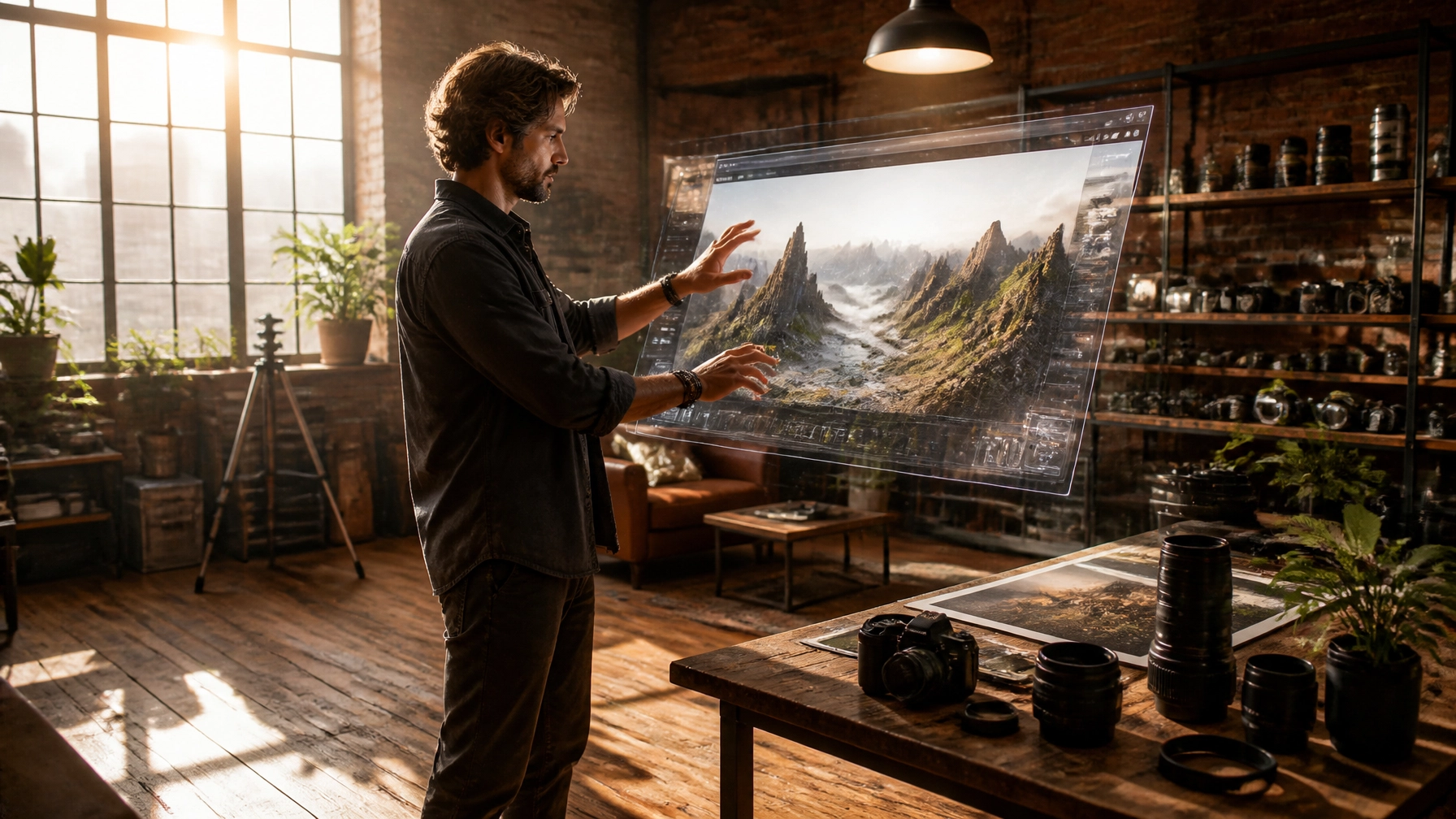
Now? AI does the heavy lifting. You can "hack" the culling process using AI that recognizes closed eyes or blurry shots instantly. Software like Luminar uses AI to mask subjects with terrifying precision. You don't need to spend 20 minutes with the Pen tool anymore. You just click "Subject," and boom: it's done.
This isn't just about laziness; it's about business. If you can deliver a gallery in 48 hours instead of four weeks, you're winning. You're hacking the competition.
Why You Should Care
If you're an aspiring photographer, you need to realize that the industry is moving at light speed. If you're still doing everything manually because you're a "purist," you're going to get left behind by the person who knows how to use AI to get 90% of the way there in 10% of the time. You can learn how to integrate these tools into your own style through our photography tutorials, where we break down the "hacks" that actually matter.
Hacking Aesthetics: The 2026 Trends
In 2026, the "look" of photography is being "hacked" by AI-generated styles. We aren't just talking about filters anymore. We’re talking about full-scale aesthetic shifts.
- The AI Polaroid Hack: Everyone is obsessed with the "analog" look, but nobody wants to pay $3 per frame for actual film. Photographers are "hacking" their digital shots to look like authentic 90s Polaroids, complete with chemical leaks and soft focus, using AI models that understand the physics of film.
- The Ghibli Shift: Turning your travel photos into Studio Ghibli-style illustrations is a massive trend. It's a way to "hack" a boring landscape into something magical.
- The Action Figure Hack: Ever wanted to see yourself as a boxed action figure? AI photo hacking makes this a one-click process. It’s whimsical, it’s viral, and it’s a great way to engage an audience on social media.
The Tool That’s Leading the Charge: Luminar
You can’t talk about AI photo hacking without mentioning Luminar. While Photoshop is the old-school giant trying to catch up, Skylum’s suite was built from the ground up with AI in its DNA.
Features like AI Sky Replacement were the original "hacks." Remember when you’d have to meticulously mask around tree branches to change a sky? Luminar does it in one click. And it doesn’t just stick a sky in there; it relights the entire scene to match the new light source. That is a hack. That is taking a shortcut that results in a better final product.
If you’re serious about "hacking" your photos for professional results, you need to be using Luminar. It’s the closest thing we have to a "make it look awesome" button, but it still gives you the control to fine-tune the results so they don't look "AI-generated."
The Industry Shift: AI-Powered Mirrorless Tech
It’s not just the software. The hardware is getting in on the hack, too. We’ve written before about why everyone is talking about AI-powered mirrorless tech, and it’s a crucial part of the "photo hacking" ecosystem.
Cameras are now shipping with AI chips that can predict where a subject is going to move before they even move. They can "hack" the noise out of a high-ISO shot before the RAW file even hits your memory card. When you combine AI hardware with AI software, you become a superhuman photographer.
Is It Still "Photography"?
This is the question that keeps people up at night. If you’re "hacking" the lighting, the sky, and even the subject’s expression with AI, is it still a photograph?
At Shut Your Aperture, we believe that photography has always been about vision. Whether you’re using a pinhole camera or a neural network, you’re the one making the creative choices. AI is just a more powerful brush.
Think about the early days of digital. "Real" photographers said digital wasn't "real" photography. They were wrong. Then they said Photoshop was cheating. They were wrong. Now they’re saying AI is hacking. They’re… half-right. It is hacking, but hacking isn't a bad thing. It's an evolution.
Check out some of the work over at Edin Fine Art to see how high-end art is embracing these new technologies to create things that were previously unimaginable.
How to Start "Hacking" Your Photos Today
If you want to get started with AI photo hacking, don't try to learn everything at once. Start with one or two "hacks" and build from there.
- Master Generative Fill: Use it to remove distracting elements that would have taken hours to clone out.
- Experiment with Style Transfer: Use Luminar to apply consistent color grading across an entire shoot in seconds.
- Use AI for Moodboards: Before you even pick up your camera, use an AI generator to create a moodboard. This "hacks" the pre-production phase and ensures you and your client are on the same page.
- Upscale Your Old Work: Got some great shots from 2010 that are too small for modern displays? Use an AI upscaler to "hack" the resolution and bring them back to life.
For more deep dives into these techniques, visit PhotoGuides.org. They have some excellent resources on the technical side of these "hacks."
The Dark Side: Security and Deepfakes
We have to talk about the elephant in the room. AI photo hacking isn't all neon landscapes and fast workflows. There is a security risk. In 2026, it’s easier than ever for someone to "hack" your identity using your public photos.
Deepfakes are becoming so realistic that they are being used for everything from corporate fraud to personal reputation attacks. As a photographer, you need to be aware of how your images are being used.
Pro-Tip for Security:
- Watermark your work: It’s not foolproof, but it’s a deterrent.
- Lower resolution for social media: Don't give the scrapers a high-res file to train their models on.
- Use Metadata: Ensure your copyright information is embedded in every file.
You can find more tips on professional image management in our article on professional corporate headshot tips. It covers a lot about how to present and protect professional imagery.
The Future of the "Hacked" Image
Where do we go from here? In the next few years, AI photo hacking will likely become the standard. We’ll stop calling it "hacking" and just call it "photography."
We’re already seeing cameras that can "see" through walls using AI-interpreted radio waves. We’re seeing software that can reconstruct a 3D scene from a single 2D photo. The line between "taking" a photo and "making" a photo is disappearing.
For those of us who love the craft, this is the most exciting time to be alive. We have more tools at our fingertips than ever before. We can tell stories that were too expensive, too difficult, or too dangerous to tell just a decade ago.
Don't Be Afraid to Break Things
The essence of "hacking" is curiosity. It’s about looking at a system: in this case, the photography workflow: and finding a better way to do things.
So, go ahead. Open up Luminar, push the sliders to the extreme, and see what happens. Use AI to create something weird. Use it to create something beautiful. Just don't use it to be boring.
If you’re looking for more inspiration, Edin often shares his thoughts on the intersection of art and tech over at blog.edinchavez.com. It’s a great place to see how a professional artist navigates these "hacked" waters.
And remember, the most important "hack" of all is your own eye. AI can move the pixels, but it can't tell the story for you. That part is still all yours.
Related Reading
- The Ultimate Guide to Photography Tutorials
- How to Navigate AI Ethics in Photography
- Fine Art in the Age of AI