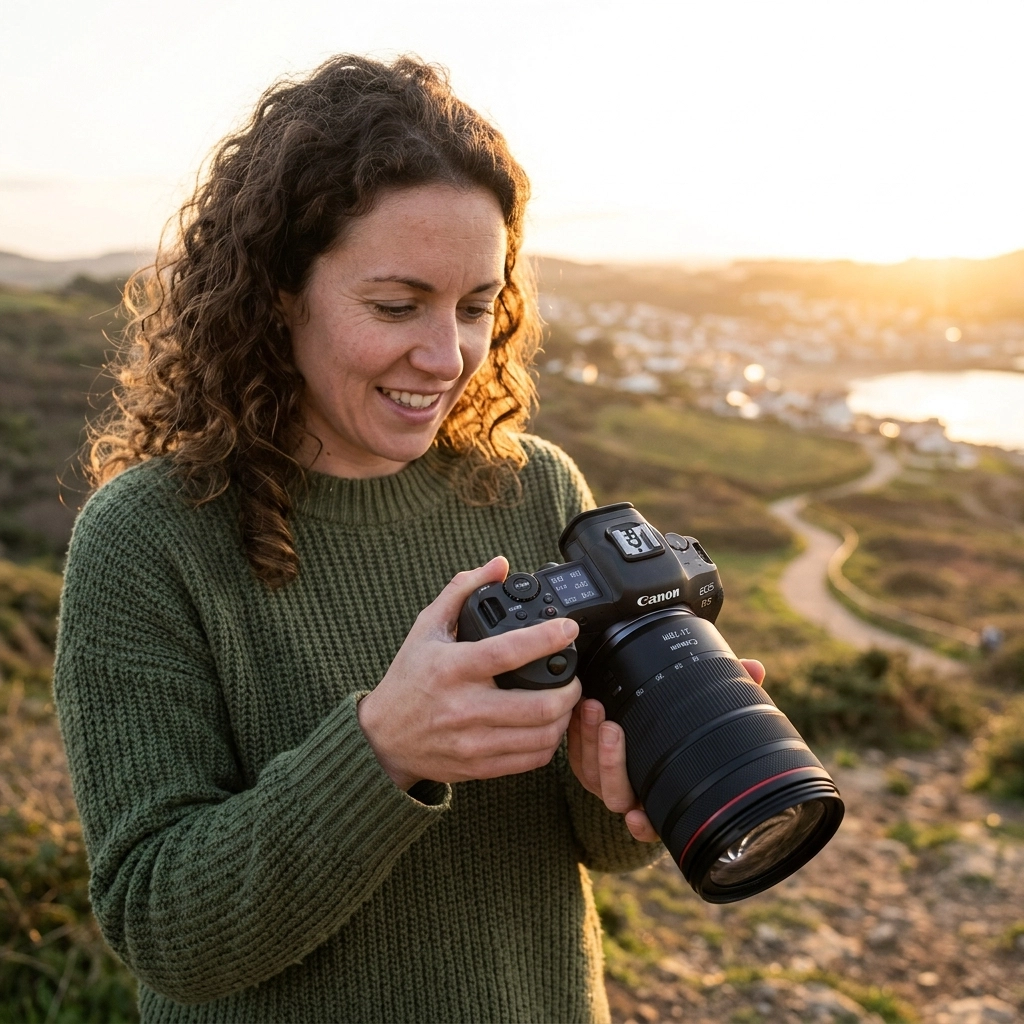
Let’s be real for a second. That little “M” on your camera dial is terrifying. It’s sitting there, staring at you, while you comfortably click away in Auto or Aperture Priority. You bought a nice camera because you wanted better photos, but right now, the camera is doing all the thinking.
If you want to move from "taking pictures" to "making photographs," you have to take the training wheels off. Manual mode isn't about being a snob; it’s about having the creative freedom to tell the camera exactly what you want the world to look like.
I’m Edin Chavez, and I’ve been through the struggle. I remember looking at my first DSLR and feeling like I was staring at the cockpit of a 747. But here’s the secret: it’s actually pretty simple once you understand the three main pillars of exposure.
In this guide, we’re going to break down Manual Mode so you can finally stop fearing your camera and start creating the images you’ve always dreamed of.
Why Even Bother with Manual Mode?
You might be thinking, "Edin, my camera is basically a supercomputer. Why shouldn't I let it do its job?"
The problem is that your camera is smart, but it doesn't have a soul. It doesn't know if you want that waterfall to look like silky ribbons or if you want to freeze a bird in mid-flight. It doesn't know you want that gorgeous, blurry background for a portrait. It just tries to make everything "medium grey."
When you master manual mode, you stop fighting the camera's internal logic. You can intentionally overexpose for a high-key, airy look, or underexpose for a moody, dramatic vibe. If you’re serious about your craft, check out our Photography 101 guide to lay the groundwork, but manual mode is where the real magic happens.
The Exposure Triangle: The Holy Trinity of Photography
Everything in manual mode revolves around three settings: Aperture, Shutter Speed, and ISO.
Think of exposure like a bucket of water. To get the perfect amount of water (light), you can leave the tap on for a long time (shutter speed), open the pipe wider (aperture), or use a more absorbent sponge (ISO). If you change one, you usually have to change another to keep the balance.
1. Aperture: The "Eye" of Your Camera
Aperture is the opening in your lens. It’s measured in f-stops (like f/1.8, f/4, or f/11).
- Low f-numbers (f/1.8, f/2.8): This means the hole is WIDE. More light comes in. This creates a shallow depth of field, which gives you that creamy, blurry background (bokeh).
- High f-numbers (f/11, f/16): This means the hole is TINY. Less light comes in. This makes everything from the foreground to the background sharp: perfect for landscapes.
If you’re struggling with getting those sharp shots, you might be making some common landscape photography mistakes.

2. Shutter Speed: The "Blink"
Shutter speed is how long your camera's sensor is exposed to light. It’s measured in fractions of a second.
- Fast Shutter Speed (1/1000s, 1/4000s): This freezes motion. Use this for sports, kids running around, or wildlife.
- Slow Shutter Speed (1/30s, 5 seconds): This lets in a lot of light and blurs motion. This is how you get those "milky" water shots or light trails in street photography.
Just remember: if your shutter speed is too slow and you aren't using a tripod, your shaky hands will make the whole photo blurry. A good rule of thumb is to not go slower than 1/60s if you're holding the camera.
3. ISO: The "Sensitivity"
ISO is your sensor’s sensitivity to light.
- Low ISO (100, 200): Use this when it’s bright outside. It gives you the cleanest, highest-quality image.
- High ISO (3200, 6400): Use this in low-light situations (like a dark church or a night scene).
The catch? High ISO introduces "noise" or grain. Modern AI-powered mirrorless tech is getting amazing at handling high ISO, but you still want to keep it as low as possible for the best results.
How to Read the Light Meter
When you switch to manual mode, your camera isn't totally leaving you in the dark. If you look through your viewfinder or at your screen, you’ll see a little scale with a "0" in the middle, "minus" numbers on the left, and "plus" numbers on the right. This is your Light Meter.
Your goal is usually to get that little tick mark to stay right in the middle at "0."
- If the mark is on the minus side, your photo is going to be too dark (underexposed).
- If the mark is on the plus side, your photo is going to be too bright (overexposed).
This is the secret to manual mode. You just tweak your Aperture, Shutter Speed, and ISO until that little needle hits the center. For a deeper dive on this, check out our 5 steps to master manual mode.

Putting It All Together: A Step-by-Step Workflow
When I’m out shooting, I don't just guess. I have a mental checklist. You can develop your own, but here is a simple workflow to get you started:
Step 1: Set Your Aperture
What’s the vibe? If it’s a portrait, I’m going wide (f/1.8 or f/2.8). If it’s a wide city scene, I’m going narrow (f/8 or f/11). Choose this first because it dictates the "look" of your image. If you’re shooting corporate headshots, your aperture choice is everything.
Step 2: Set Your ISO
Is it sunny? Set it to 100 and forget it. Is it getting dark? Bump it to 800 or 1600. Try to keep this as low as the lighting allows.
Step 3: Adjust Your Shutter Speed
Now, look at your light meter. Dial your shutter speed dial until the meter hits the center. Take a test shot. Does it look good? If it's too dark, slow the shutter down. If it's too bright, speed it up.
Step 4: Review and Refine
Check your LCD screen. Zoom in. Is it sharp? If it's blurry because the subject moved, you need a faster shutter speed. But wait: if you speed up the shutter, your photo gets darker. Now you have to either open your aperture more or raise your ISO to compensate.
This is the dance of the Exposure Triangle.
When Things Go Wrong (And How to Fix Them)
Manual mode is a learning curve, and you will mess up. I’ve come home from shoots with 500 blurry photos because I forgot I was in manual and left my shutter speed at 1/10s from the night before.
If you find yourself struggling, you’re probably making one of these 7 common manual mode mistakes.
Sometimes, you get the shot nearly perfect, but the colors are off or the shadows are too deep. That’s where post-processing comes in. I’m a huge fan of using Luminar for quick, powerful edits. It uses AI to help recover details you might have missed in the field. Just be careful not to overdo it: there are 7 mistakes people make with AI editing too!

Advanced "Basics": White Balance and Metering
Once you've got the triangle down, there are two more things you should peek at:
- White Balance: This tells the camera what "white" looks like under different lighting. "Auto White Balance" (AWB) is usually fine, but if you’re under weird yellow streetlights, you might want to manually set it to "Tungsten" or "Fluorescent" so your colors don't look wonky.
- Metering Modes: Your camera can measure light in different ways. "Evaluative" or "Matrix" metering looks at the whole scene. "Spot" metering only looks at the tiny dot in the middle. If you’re shooting a person against a bright sunset, Spot metering will make sure the person’s face is exposed correctly, even if the sky goes white.
For more technical breakdowns, I always recommend checking out PhotoGuides.org. They have some killer technical resources that compliment what we do here.
Practical Exercises to Master Manual Mode
Don't just read this and put your camera away. Go grab it right now. Here are three exercises to help you build muscle memory:
Exercise 1: The Depth of Field Test
Find an object (a coffee mug, a flower, a lens cap).
- Set your camera to its lowest f-number (like f/2.8). Adjust your shutter speed to get a good exposure. Take the shot.
- Now, change your aperture to f/11. Your light meter will tell you the photo is now way too dark.
- Slow down your shutter speed until the meter is back in the middle. Take the shot.
- Compare them. See how the background changed?
Exercise 2: The Motion Blur Test
Go to a busy street or find a fan in your house.
- Set your shutter speed to 1/1000s. Adjust your aperture and ISO until the exposure is right. Take the shot. The motion should be frozen.
- Now, set your shutter speed to 1/15s. (You might need a tripod or a steady surface). Your photo will now be way too bright.
- Close your aperture (higher f-number) until the meter is balanced. Take the shot.
- See that cool blur? That’s shutter speed in action.
Exercise 3: The ISO Grain Challenge
In a dimly lit room:
- Set your ISO to 100. You’ll notice your shutter speed has to be very slow to get enough light.
- Now, crank your ISO to 6400. Suddenly, you can use a much faster shutter speed.
- Take both photos and zoom in on the shadows on your computer. You’ll see the "noise" in the high ISO shot. This helps you learn how far you can push your specific camera before the quality drops.

Why You Should Never Stop Learning
Photography is a journey, not a destination. Even after years of shooting professionally and running Shut Your Aperture, I’m still learning new things every day. Whether it's keeping up with the latest AI photography news or testing out the newest mirrorless cameras, the tech is always changing.
But the fundamentals: Aperture, Shutter Speed, and ISO: never change. They are the physics of light. Master these, and you can pick up any camera from 1950 or 2026 and take a great photo.
If you want to fast-track your progress and get structured lessons, head over to Shut Your Aperture Academy. We’ve got deep dives that go way beyond a blog post.
Final Thoughts
Manual mode isn't about being perfect. It’s about being intentional. It’s okay to fail. It’s okay to get the exposure wrong. That’s how you learn. Every time you turn that dial, you’re telling the world how you see it.
So, turn the dial to "M." Take a deep breath. Look at the light meter. And start shooting.
For more tips, inspiration, and the latest gear news, keep an eye on our daily morning news updates and our nightly recaps.
And if you want to see how these settings apply to fine art, you can check out some of my personal work over at Edin Fine Art or read my more personal rants at blog.edinchavez.com.
Now get out there and shut your aperture!