If you feel like you’ve taken every possible photo of a person walking across a street, you aren't alone. Street photography in 2026 isn't just about pointing and clicking at strangers; it’s about finding a unique perspective in a world that’s already been photographed a billion times. To stand out, you need to stop looking for subjects and start looking for concepts. Whether it’s using neon reflections to build a cyberpunk narrative or mastering the "upside-down" puddle shot, these 25 ideas will kickstart your creativity and get you back out on the pavement with a fresh eye.
Street photography is the ultimate test of a photographer's patience and vision. It’s raw, unscripted, and occasionally a little nerve-wracking. But that’s the draw, right? Below, I’ve laid out 25 specific, actionable ideas that range from technical challenges to conceptual projects. Let’s dive in.
1. The Shadows Only Project
Forget the people; shoot the silhouettes they leave behind. In 2026, minimalist, high-contrast imagery is making a massive comeback. Head out during the "golden hour" or "harsh noon" when shadows are longest or sharpest. Focus your exposure on the highlights so the shadows fall into deep, inky blacks. Look for people crossing zebra stripes where their shadows stretch out like long, dark ghosts. This is a great way to practice seeing shapes rather than subjects.
2. Puddle Reflections (The 180-Degree Flip)
We’ve all seen puddle shots, but here is the twist: take the photo, then flip it 180 degrees in post-processing. Suddenly, the sky is at the bottom and the "ground" is a shimmering, liquid version of reality. It creates a dreamlike, inception-style vibe that works incredibly well in urban environments. If you want to refine these reflections further, check out our guide on how to create cinematic photos in Lightroom.

3. Cyberpunk Neon Narratives
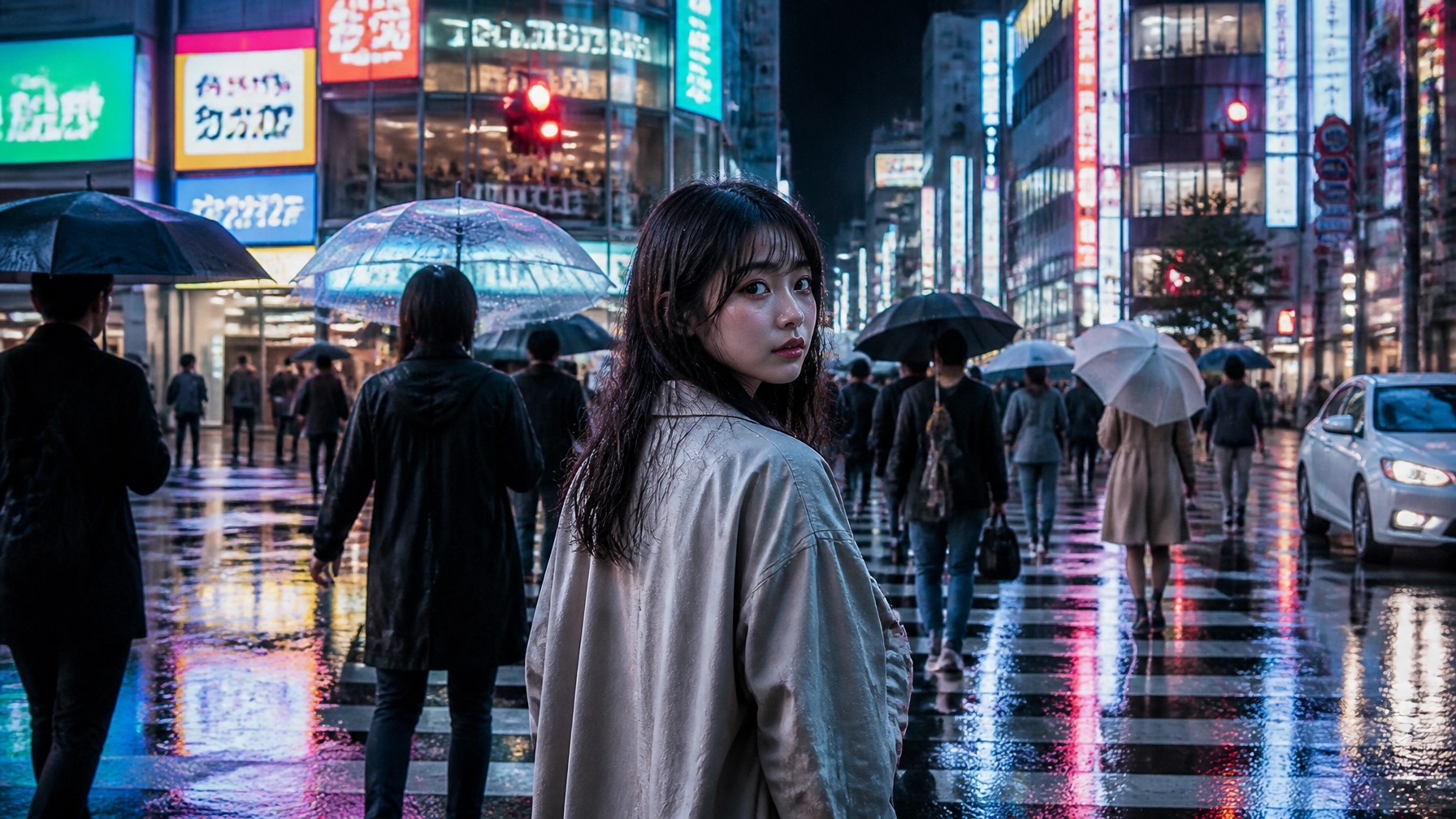
The world is getting brighter and more digital. Use the glow from LED billboards, bus stop ads, and shop signs to light your subjects. Instead of using a flash, let the magenta and cyan hues of the city do the work. This is where Luminar really shines, you can accentuate those neon glows and "re-light" the scene to give it a futuristic, Blade Runner feel. Set your white balance to Tungsten to really make those blues pop.
4. Static vs. Moving (The Shutter Speed Game)
Find a busy intersection and plant your tripod (or find a steady ledge). Use a slow shutter speed, somewhere around 1/4 to 1/15 of a second. Wait for that one person who is standing perfectly still while the rest of the world blurs past them. This contrast between the "still soul" and the "chaotic city" creates an instant story. It’s a classic technique that never goes out of style because it perfectly captures the pace of modern life.
5. The "Hands Only" Series
Faces tell stories, but hands tell secrets. Spend an entire afternoon photographing only hands. A street vendor's weathered hands counting change, a couple holding hands on a park bench, or someone gripped tightly to a subway pole. It’s an intimate way to capture human emotion without the "intrusion" of a full portrait. It also helps you get closer to your subjects without being quite as "in their face."
6. One Color Challenge
Pick a color, let’s say, vibrant red, and don’t press the shutter unless that color is the dominant element in your frame. You’ll start noticing red cars, red hats, red fire hydrants, and red lipstick in ways you never did before. This forces you to scan the environment with a filtered lens, which is an incredible exercise for your brain. For more deep dives into these kinds of challenges, head over to PhotoGuides.org.
7. Bird’s Eye View (Compression)
Stop walking and start climbing. Get to a pedestrian bridge, a parking garage rooftop, or a high-rise balcony. Shooting straight down compresses the world into a 2D plane. People look like miniatures, and the patterns of the street, the lines, the grids, the textures, become the primary subject. It’s a literal change in perspective that can yield some of your most professional-looking work.

8. Through the Transit
Bus and train windows are natural filters. They are often dirty, scratched, or covered in rain, which adds a layer of texture to your shots. Photograph people inside the transit looking out, or stand on the platform and photograph the blurred faces as the train pulls away. The "layered reality" of reflections on the glass mixed with the people inside creates complex, interesting compositions.
9. Geometric Hunting
Architecture isn't just for landscape photographers. Use the harsh lines of modern buildings to "frame" your street subjects. Look for triangles formed by shadows or rectangles formed by doorways. When a person walks into that specific geometric space, fire the shutter. It’s called "the stage technique", you find the perfect background and wait for the actor to enter. If you're struggling with the technical side, jump into our photography tutorials to master your framing.
10. The Irony of Signs
Street photography often thrives on humor. Look for signs that contradict the people near them. A "No Loitering" sign with a group of teenagers hanging out under it, or a billboard for a luxury watch next to a sleeping homeless person. These juxtapositions provide social commentary and a bit of wit to your portfolio. It requires a keen eye and a bit of luck, but the payoff is huge.
11. Street Animals: The Urban Wildlife
Cities aren't just for humans. Stray cats, dogs on leashes, pigeons fighting over a crust of bread, these are all valid street photography subjects. Treat them with the same respect you would a human subject. Get down on their level (worm’s eye view) to make them feel more heroic or prominent in the frame.
12. The Same Corner Series
Pick one street corner in your neighborhood and visit it at four different times of the day: sunrise, midday, sunset, and midnight. Observe how the light change transforms the mood of the same physical space. This project teaches you more about light than any textbook ever could. You can see how Edin Chavez approaches light and composition on his personal blog at blog.edinchavez.com.
13. Silhouettes against Shop Windows
At night, shop windows become giant softboxes. Position yourself so a passerby walks between you and the bright window. Expose for the window, and you’ll get a perfect, crisp silhouette of the person. This works exceptionally well in fashion districts or areas with high-end boutiques where the displays are artfully lit.
14. Motion Blur with a Flash (Rear Curtain Sync)
This is a more advanced technique but looks incredible. Use a slow shutter speed (1/10s) and fire your flash at the end of the exposure (Rear Curtain Sync). You’ll get a trail of motion blur behind the person, but their final position will be frozen sharp by the flash. It’s a high-energy, "fashion-street" look that’s very popular in 2026.
15. Environmental Portraits (The "Ask")
Sometimes the best street photo isn't a candid one. If you see someone with an incredible look, maybe a street performer or a colorful local, approach them. Ask if you can take their portrait. Most people are flattered. Include their environment (their shop, their instruments, their street) to tell a fuller story. For tips on how to interact with subjects, our street photography settings guide has some great nuggets.
16. Window Layering
This is the art of shooting through a window while capturing the reflection of what’s behind you at the same time. When done right, you get three layers: the person inside the shop, the texture of the glass itself, and the reflection of the street. It’s a "triple exposure" in a single frame. It’s confusing, beautiful, and very sophisticated.
17. The 25-Photo Challenge
Challenge yourself to take 25 distinct photos of the same subject (e.g., a specific statue, a street performer, or even a fire hydrant) from 25 different angles and distances. By the time you get to photo 15, you’ll be forced to get really creative. This is the ultimate cure for photographer's block.
18. Abstract Objects
Street photography doesn't always need people. Sometimes a discarded umbrella, a stack of colorful crates, or a tangled mess of power lines tells the story of the city just as well. Focus on the textures, colors, and patterns of the urban environment. Check out some of the fine art approaches to this at www.edinfineart.com.
19. Low Angle "Worm's Eye"
Place your camera almost on the ground. Use a wide-angle lens. This makes the buildings look like they are leaning in and the people look like giants. It’s an aggressive, powerful perspective that works well in big cities like New York or Tokyo.
20. High Key Overexposure
Most street photography is moody and dark. Flip the script. Overexpose your shots by 1 or 2 stops to blow out the background into a clean, white abyss. This works best on overcast days. It creates a minimalist, airy look that feels very modern and clean.

21. Double Exposure (In-Camera)
Many modern cameras in 2026 have a built-in double exposure mode. Layer a texture (like a brick wall or a rainy window) over a street portrait. It adds an artistic, ethereal quality to your work that moves it away from "documentation" and toward "art."
22. Monochrome Month
Switch your camera’s "Film Simulation" or "Picture Style" to Black and White and leave it there for a month. When you can’t rely on color to make a photo interesting, you have to rely on light, contrast, and composition. It’s the best way to "level up" your eye.
23. Frame within a Frame
Use the environment to create a "border" around your subject. This could be an archway, a gap between two parked cars, or even the space between someone's arm and torso. It directs the viewer's eye exactly where you want it to go.
24. Long Exposure Commuters (The "Ghost" Look)
Use a 10-stop ND filter in the middle of the day. Set your exposure to 30 seconds. The buildings will remain sharp, but the crowds of people will turn into a ghostly mist. It’s a haunting way to show the "flow" of a city without focusing on any single individual.
25. Document a Personal Subculture
Instead of just wandering aimlessly, find a subculture. Maybe it’s the local skate park, a weekend flower market, or a specific group of commuters. By focusing on a niche, you create a cohesive body of work rather than just a collection of random shots.
Why Street Photography Matters in 2026
In an era of AI-generated everything, street photography remains one of the few bastions of "the truth." It’s a record of how we lived, what we wore, and how our cities looked. Using tools like Luminar to enhance your vision is great, but the soul of the photo still comes from that split-second decision you made on a street corner.

If you’re just starting out, don’t worry about having the best gear. A phone or a basic mirrorless camera is more than enough. The most important tool you have is your curiosity. Get out there, break these "rules," and find your own voice. If you want to dive deeper into the technical side of things, our learning portal is packed with videos and guides to help you master your craft.
Street photography is about the hunt. It’s about that one frame in a hundred that makes you go, "Yes, that’s it." So grab your camera, hit the pavement, and show us what 2026 looks like through your lens.