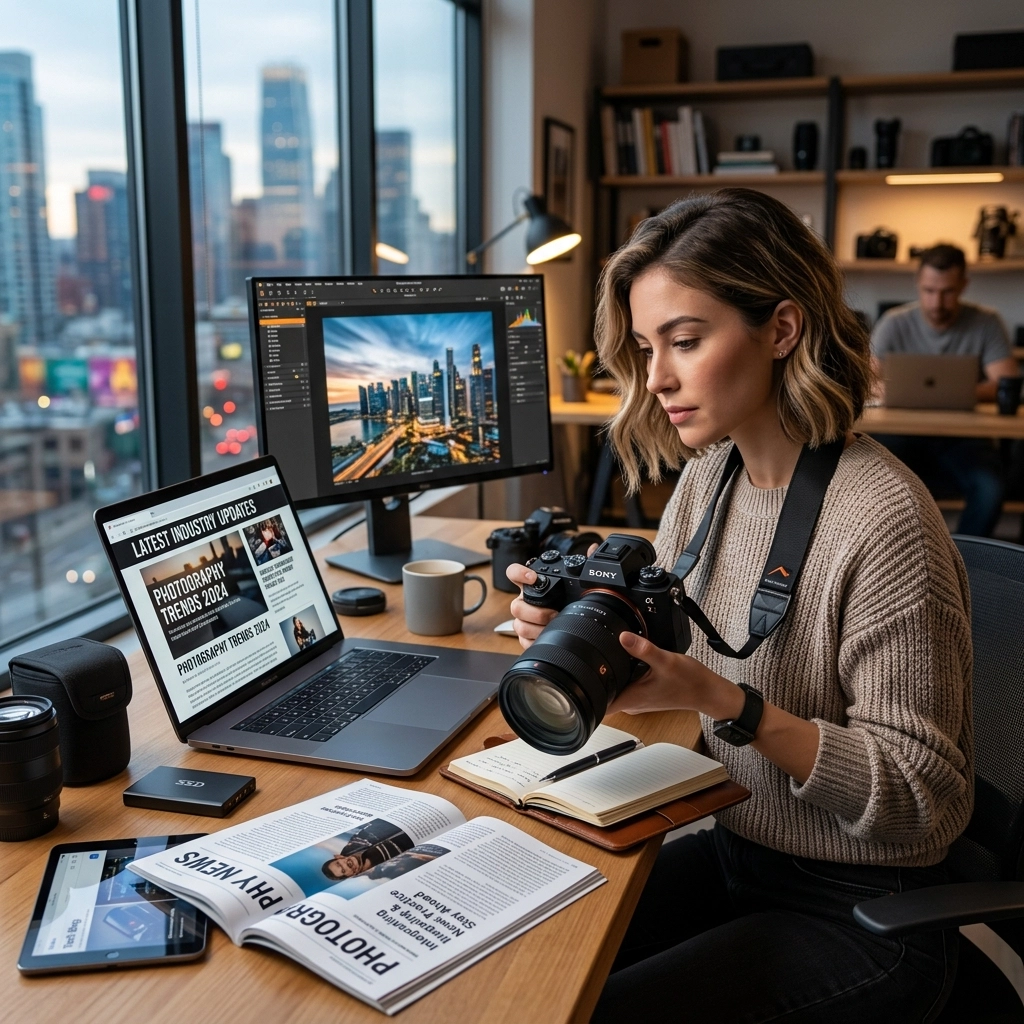
It’s May 2026, and the photography world is moving so fast it feels like your shutter speed is permanently set to 1/8000th of a second. Between AI-driven sensors and the complete overhaul of how we deliver images to clients, staying "good" at photography isn't enough anymore. You have to stay informed.
But here is the problem: there is too much noise. One day you’re hearing about a new mirrorless firmware that basically shoots the wedding for you, and the next, you’re reading about why the "film look" is back for the tenth time this decade. If you spend all your time reading the news, you never pick up your camera. If you ignore the news, you become a dinosaur before your next battery charge is finished.
Integrating industry news into your practice isn't about being a gear-obsessed tech nerd. It’s about knowing which way the wind is blowing so you can adjust your sails. Let’s talk about how to turn those headlines into actual skills and better business.
The News Fatigue is Real (And How to Fix It)
Most photographers treat industry news like doom-scrolling. They see a headline about a "revolutionary" sensor and feel a pit in their stomach because their current gear feels obsolete. That’s not integration; that’s anxiety.
To actually stay ahead, you need a filter. You need to distinguish between "Tech Specs" (which mostly don't matter) and "Market Shifts" (which definitely do). For example, knowing the exact megapixel count of a camera you aren't going to buy is useless. However, understanding why everyone is talking about AI photography news is vital because it changes how you charge your clients and how long you spend at your desk.
Start by dedicating 15 minutes a day, no more, to a curated list of sources. Check out Photography News Secrets Revealed to see what the pros are actually paying attention to this year.
Bridging the Gap: News vs. Practice
The biggest mistake photographers make is reading an article and then doing nothing with it. If you read that 2026 is the year of "Hyper-Authentic Portraiture," but you keep over-smoothing skin in post-production, you’ve failed to integrate.
Integration looks like this:
- Identify a Trend: You notice a shift toward AI-assisted autofocus that tracks eyes through sunglasses.
- Test the Impact: You realize this could revolutionize your street photography or high-fashion work.
- Adjust Your Kit or Technique: You look into how to choose the best mirrorless cameras for your 2026 kit to see if your current gear can handle the update or if it's time for a trade-in.
This turns a passive piece of information into an active improvement in your workflow. It’s about being proactive rather than reactive. If you’re just starting, don't get overwhelmed by the high-level shifts yet. Stick to the basics first with a Beginner’s Guide to Mastering Your First Camera.
Why You Should Care About the AI Shift
Let’s be real: you can’t talk about 2026 without talking about AI. It’s the elephant in the darkroom. But instead of fearing that a computer is going to take your job, look at how the news is reporting on AI integration.
The smart money is on AI-powered mirrorless tech. This isn't about "fake" photos; it's about the camera doing the heavy lifting on things like noise reduction and focus tracking so you can focus on the composition and the soul of the shot.
In the editing suite, tools like Luminar have already changed the game. If you’re still masking skies by hand for three hours, you’re losing money. The news tells you these tools exist; integration is actually downloading them and learning how to fix mistakes you’re making with AI photo editing.
 Save
Save
Authenticity as a Premium Product
As AI-generated images become more common, the industry news has started highlighting a counter-trend: the "Authenticity Premium." Clients are starting to crave images that look and feel human. This is a massive opportunity for photographers who know how to use news to pivot their branding.
When you see headlines about the rise of synthetic media, don't panic. Use it to market yourself. Highlight your "Human-First" approach. If you’re doing corporate work, check out these 10 things you should know about professional corporate headshots to ensure you're providing that real-world value that a prompt-engineer can't replicate.
This is where your technical skills in the real world pay off. Even with all the news about automation, the fundamentals of light don't change. Mastering portrait photography techniques and natural light is still the best way to stay ahead of any algorithm.
Workflow: The Silent Competitive Advantage
If there’s one thing that 2026 industry news focuses on, it’s speed. The time between "shutter click" and "Instagram post" or "Client Gallery" has shrunk to nearly zero.
Integrating news into your practice means looking at your workflow. Are you still using a slow, manual process? The industry is moving toward cloud-based, instant-preview systems. If you aren't reading up on these shifts, you’ll find yourself losing clients to photographers who can deliver previews before the reception is even over.
You can find more in-depth training on these modern workflows over at Learn Shut Your Aperture. It’s one thing to read a headline about "Instant Delivery"; it's another to actually set up the server and the tethering kit to make it happen.
Save
Don't Forget the Basics (Even in 2026)
It is very easy to get blinded by the "New Era of Digital Art." We see articles about The Ultimate Guide to Photography Tutorials and News and think we need to reinvent the wheel.
But here is the truth: the latest industry news often masks the fact that most people are still making the same old mistakes. You can have the smartest AI camera in the world, but if you don't understand your exposure triangle, you're just a person with an expensive paperweight.
If you find yourself struggling to keep up with the tech news, go back to the basics. Make sure you aren't making these 7 mistakes with manual mode. Once you master manual mode, the "news" about a new camera's ISO performance becomes much easier to understand because you actually know what ISO does for your specific style.
Landscape Photography in the Modern Age
Landscape photography is another area where news and practice often clash. You'll see news about drones that can fly for hours or satellites providing real-time lighting data. This is great info, but integration means using that news to stop making classic landscape photography mistakes.
If the news says a specific national park is being overrun by "AI-tourists" looking for the same shot, use that information to go somewhere else. Use the news to stay original. For more on this, check out how to fix your landscape photography for epic shots.
Networking with News
One of the best ways to integrate news is to talk about it. We work closely with Sonny, our Social Media Manager, to make sure that what we’re talking about on the blog is what people are actually discussing on Instagram and TikTok.
When a big piece of news breaks, like a major brand discontinuing a beloved lens line, don't just read about it. Go to PhotoGuides.org or check out Edin Chavez’s blog to see how other pros are reacting. Engaging with the community helps you process the news and decide if it actually affects your practice or if it’s just something to chat about over coffee.
The Action Plan for Staying Ahead
So, how do you actually do this starting tomorrow? Here is a simple checklist:
- Morning Scan: Spend 10 minutes on a trusted news aggregator. Look for keywords that affect your specific niche (e.g., "Wedding Photography AI," "Portrait Lighting Tech").
- The "So What?" Test: For every piece of news, ask: "Does this change how I shoot, how I edit, or how I charge?" If the answer is no, forget it.
- Monthly Experiment: Pick one technological or stylistic trend you’ve seen in the news and try to replicate it. Maybe it’s a new way of using Luminar or a specific natural light technique you saw a pro discussing.
- Gear Audit: Every six months, look at the "state of the industry" news and compare it to your kit. Do you actually need that new sensor? Or do you just need to master the camera you already have?
- Educate Your Clients: When you stay ahead of the news, you become an expert in your clients' eyes. If they ask about AI, you should have an answer ready that reinforces why your human touch is valuable.
Final Thoughts on 2026 and Beyond
The photography industry isn't going to slow down. If anything, the news cycle is going to get even shorter. But remember, the goal of integration isn't to be the first person to own a new gadget. The goal is to be the most prepared person in the room.
Stay curious, keep your filter tight, and never let a headline discourage you from going out and actually taking photos. The news is a tool, not a rulebook. For more deep dives into the gear and the art, keep an eye on Edin Fine Art for inspiration on what "staying ahead" looks like when the work is finished and on the wall.
Photography is a blend of science and soul. The news covers the science: the sensors, the software, the market shifts. You provide the soul. When you integrate the two, you don't just stay ahead; you lead the pack. Now, stop reading and go shoot something. Just make sure your firmware is updated first.