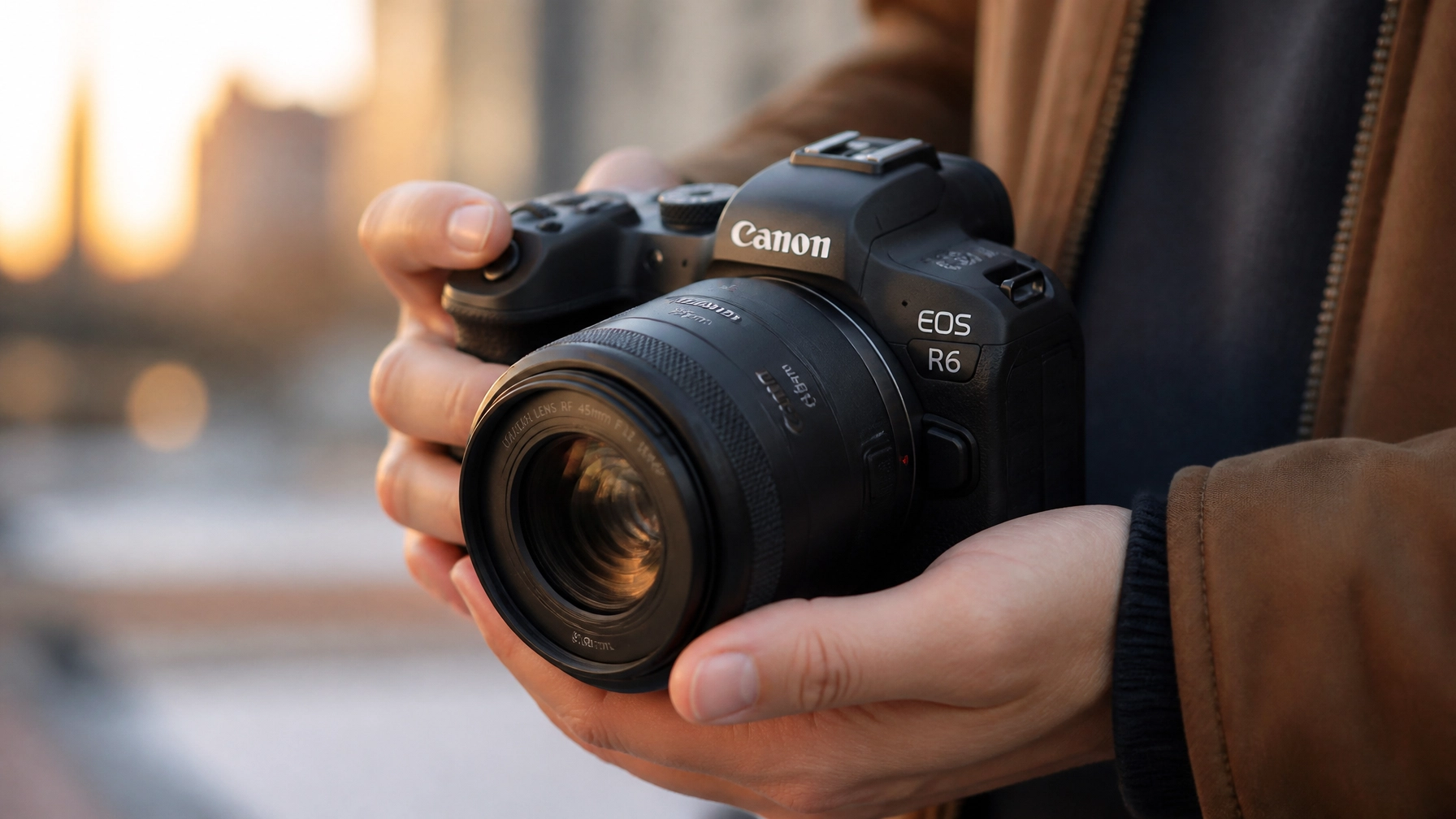
If you have been living under a rock (or just actually enjoying your life away from gear forums), you might have missed the seismic shift happening in the Canon ecosystem. The "big news" that everyone is buzzing about this morning is the staying power and market dominance of the New Canon RF 45mm f/1.2. Now, I know what you’re thinking. It’s 2026. We have AI that can practically generate a photo of a cat on a surfboard without us even picking up a camera. So, does a piece of glass and metal really matter anymore?
The short answer: Yes. The long answer? It matters more now than it ever did.
For years, the photography world was divided into two camps: the "L-series elite" who dropped three months' rent on a single lens, and the "nifty-fifty" crowd who made do with plastic mounts and slow autofocus. Canon just blew that binary wide open. The New Canon RF 45mm f/1.2 is a disruptor. It’s the lens that shouldn’t exist according to the old rules of the industry, yet here it is, sitting on almost every R6 Mark III we see in the wild.
Why 45mm? The Focal Length Nobody Knew They Needed
Let’s talk about that "weird" focal length first. Why 45mm? For decades, we’ve been told that 35mm is for stories and 50mm is for portraits. But 45mm? It’s the "Goldilocks" zone. It is wider than the standard 50mm, which can feel a bit tight in cramped indoor settings, but it doesn’t have the distortion of a 35mm when you get close for a headshot.
In 2026, the trend is moving toward "naturalism." Photographers are tired of the ultra-wide look that smartphones have popularized to the point of exhaustion. We want images that look like how we actually see the world. The 45mm focal length is remarkably close to the human eye’s field of vision. When you pair that with an f/1.2 aperture, you get a perspective that feels both intimate and cinematic. It matters because it offers a "look" that AI-generated imagery still struggles to replicate with perfect physical accuracy, that organic transition from sharp focus to buttery blur.
If you’re still trying to figure out which prime lens is right for your kit, check out our 2026 mirrorless camera comparison where we break down how these new lenses change the game for different sensor types.
The Price Tag That Shook the Industry
The real headline isn't just the glass; it’s the price. Historically, an f/1.2 lens was a badge of professional status. It meant you had "arrived" (or had a very high credit limit). Canon’s decision to release this as a non-L series STM lens for under $500 changed the math for everyone.
This isn't just a win for the hobbyist; it’s a strategic move to keep people in the RF system. By offering "halo-spec" features at enthusiast prices, Canon is fighting back against the third-party lens manufacturers who have been nipping at their heels. It turns out that when you give people professional-grade bokeh for the price of a mid-range smartphone, they buy it. A lot of it. The shipping delays we saw at the start of the year are finally clearing up, but the demand remains sky-high.

Is the "STM" Motor Good Enough for Pros?
One of the biggest gripes when the New Canon RF 45mm f/1.2 was announced was the use of an STM motor instead of the high-end USM found in L-glass. Critics said it would be too slow or too loud. In practice? Most people can’t tell the difference.
The gear-type STM motor in this lens is surprisingly snappy. It’s designed for the hybrid shooter, someone who is toggling between high-speed stills and 4K (or 8K) video. It’s silent enough for internal mics and smooth enough that focus pulls don’t look jerky. For the modern content creator, this lens is a dream. You get the depth of field that used to require a cinema lens, but in a package that weighs about as much as a cup of coffee.
If you want to master how to use this kind of glass in the field, you should really dive into our courses at Learn Shut Your Aperture. We go deep into how to nail focus at f/1.2 because, let’s be honest, at that aperture, if the subject sneezes, they’re out of focus.
Software Integration: The Secret Sauce
We can't talk about gear in 2026 without talking about software. The New Canon RF 45mm f/1.2 is great, but it becomes "magical" when you bring the files into post-processing. This lens was built with digital corrections in mind. While "purists" might whine about barrel distortion or vignetting in the raw files, the reality is that the camera and the software fix it instantly.
When you take those shots into Luminar, the results are stunning. The AI tools in Luminar recognize the depth map created by the f/1.2 glass and allow you to enhance the atmosphere, add sun rays, or refine the bokeh even further without the weird "cut-out" look you see on phone portraits. The synergy between high-quality glass and AI-powered editing is where the industry is headed.
Speaking of trends, have you noticed how AI is reshaping the news lately? We covered this in our piece on AI-powered photography news, and it’s a must-read for anyone trying to stay ahead of the curve.
The Hybrid Revolution: Video and Stills
The New Canon RF 45mm f/1.2 isn't just a "stills" lens. It’s a video lens that happens to take great photos. Canon included focus breathing correction compatibility, which is a big deal for videographers. Usually, when you pull focus with a prime lens, the frame seems to "zoom" slightly. It’s distracting and looks "amateur." By baking the correction into the lens-camera communication, Canon has made this 45mm prime act like a much more expensive cinema lens.
In 2026, everyone is a hybrid shooter. Whether you're filming a wedding, a YouTube vlog, or a high-end commercial, having one lens that can handle the "cinematic look" while being small enough to fit on a travel gimbal is a huge advantage. This lens is light (only 346g), which means your wrists won't be screaming at you after an eight-hour shoot.

How It Compares: The 50mm and 35mm Rivals
If you already own the RF 50mm f/1.8 or the RF 35mm f/1.8, you might be wondering if you should upgrade.
- Vs. the 50mm f/1.8 (The Nifty Fifty): The 45mm f/1.2 is in a different league. The f/1.8 is a great starter lens, but the 45mm offers significantly better subject isolation and "character." The bokeh on the 45mm is circular and creamy, whereas the 50mm f/1.8 can get a bit "busy" or "nervous" in the background. Plus, that extra bit of width (45mm vs 50mm) makes it much more usable for indoor lifestyle shots.
- Vs. the 35mm f/1.8: The 35mm is a classic for street photography, but it can be too wide for flattering portraits. The 45mm hits that sweet spot. If you could only carry one prime lens for an entire trip, the 45mm is the one I’d put my money on. It’s versatile enough to do it all.
- Vs. the L-Series Giants: If you are a professional wedding photographer who needs weather sealing and the absolute pinnacle of sharpness, the RF 50mm f/1.2L is still the king. But for 90% of people, including many working pros, the 45mm STM provides 95% of the performance for 25% of the price.
For more tips on choosing your glass, check out PhotoGuides.org for some excellent technical breakdowns.
The Morning News Wrap-Up: What Else is Happening?
While the Canon 45mm is stealing the headlines, there’s plenty of other gear news to wake up to this morning:
- Sony Firmware Updates: Sony just pushed a major update to the A7 IV and A7R V, improving the AI-autofocus tracking for "micro-subjects" like insects and jewelry. This is clearly a move to stay competitive with Canon's latest animal-eye AF.
- Global Shutter Expansion: Rumors are swirling that Nikon is about to drop a mid-range Z-series body with a global shutter, following in the footsteps of the A9 III but at a more accessible price point. If true, this could mean the end of rolling shutter for the masses.
- Sustainability in Gear: More manufacturers are moving toward recycled plastics in their lens barrels and eco-friendly packaging. Canon’s 45mm f/1.2 is part of this trend, using less "virgin" plastic than previous generations.
It’s an exciting time to be a photographer. We are seeing a "normalization" of high-end specs. Things that were reserved for the elite five years ago are now becoming standard. It’s not just about the gear, though; it’s about what you do with it. If you’re feeling uninspired, take a look at our 25 creative street photography ideas to get back out there.
Investing in Glass vs. Investing in Bodies
One of the biggest mistakes photographers make (even in 2026) is over-investing in the camera body and under-investing in glass. A camera body is like a computer, it’s outdated in three years. Good glass, like the New Canon RF 45mm f/1.2, will stay in your bag for a decade.
Even though this is an "enthusiast" lens, the optical quality is high enough that it will easily resolve the sensors of the future. Whether you’re shooting on 24 megapixels or 100 megapixels, this lens is going to keep up. We’ve talked about this before, does gear really matter in 2026?, and the answer is always that glass is the better investment.
If you’re looking for high-quality prints to see the true detail of your lenses, check out Edin Fine Art. Seeing an f/1.2 image printed large is the only way to truly appreciate the depth and texture that this lens can produce.

Final Thoughts on the Canon RF 45mm f/1.2
Is it a "perfect" lens? No. It’s not weather-sealed, it’s not an L-series, and it doesn't have the "prestige" of a red ring. But it’s the lens that the market actually needed. It’s fast, it’s sharp where it needs to be, and it’s affordable.
In a world where photography is becoming more accessible and more integrated with AI, the New Canon RF 45mm f/1.2 stands as a reminder that there is still something special about physical optics. It’s about the way the light hits the sensor through a specific arrangement of glass. It’s about that slight imperfection that makes a photo look "real" instead of "rendered."
Whether you’re a pro looking for a lightweight walk-around lens or a beginner looking for your first "fast" prime, the 45mm f/1.2 is a no-brainer. It matters because it levels the playing field. It takes the "pro look" out of the hands of the elite and gives it to everyone.
And that, my friends, is why it’s the biggest story in photography this morning. Now, go charge your batteries, grab your 45mm, and go shoot something beautiful. If you need some help with your technique, don’t forget to browse blog.edinchavez.com for some behind-the-scenes insights.
Common Questions About the RF 45mm f/1.2 (FAQ)
Does it come with a lens hood?
Unfortunately, no. In typical Canon fashion for non-L lenses, you’ll have to buy the hood separately. It’s a minor annoyance, but definitely worth the extra few bucks to protect that big front element.
How is the flare resistance?
Surprisingly good. Canon used some of their newer coatings on this lens. You’ll get some characterful flare if you point it directly at the sun, but it’s controlled and doesn't wash out the contrast.
Can I use it for macro?
Not really. With a minimum focus distance of 0.45m, it’s more of a portrait/lifestyle lens. If you want macro, you’re better off with the RF 35mm f/1.8 or a dedicated macro lens.
Is it worth it for APS-C users?
Absolutely. On an R7 or R50, it acts like a 72mm equivalent, which makes it a phenomenal, fast portrait lens. It’s one of the best ways to get "full-frame style" bokeh on a crop sensor.
For more deep dives into portraiture, check out our ultimate guide to portrait photography.