
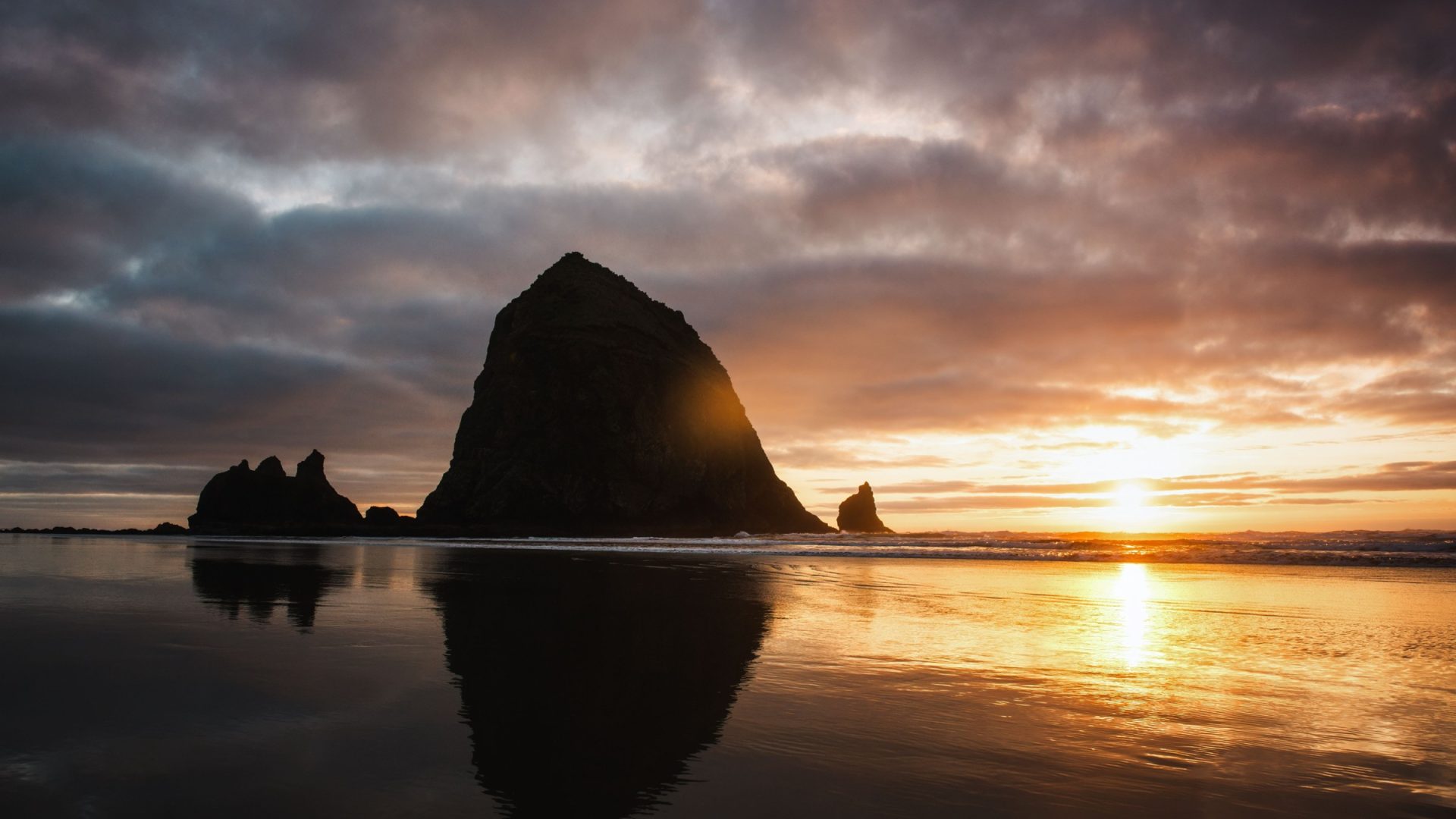
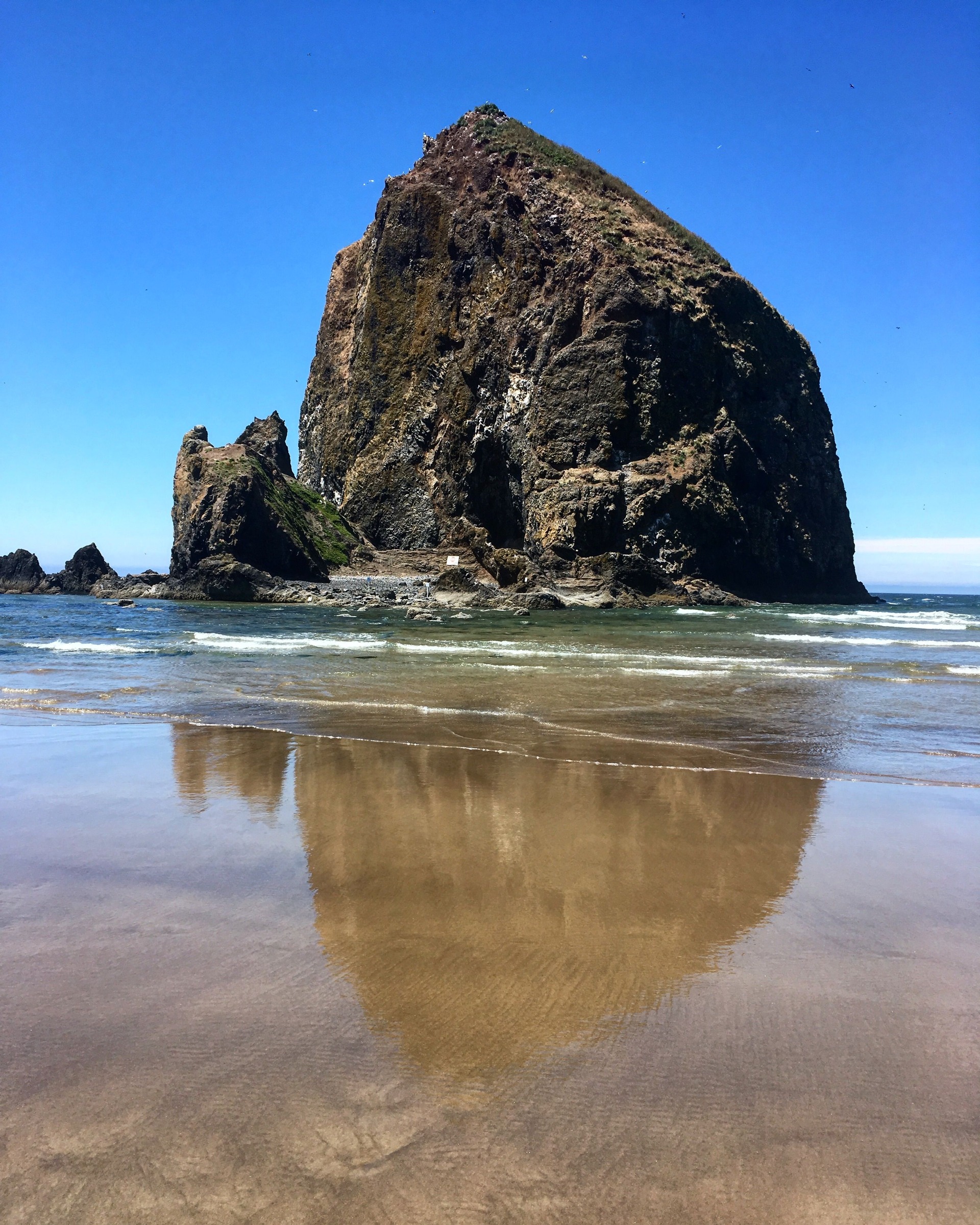
Hero: Haystack Rock and wet-sand reflection at sunset. This is an illustrative photograph, not current surf, tide or access information. Photo: Tim Mossholder. Source · Pexels License. Resized; no generative edits.
Haystack Rock gives a Cannon Beach photograph a strong shape before you add anything else: a sea stack, its smaller neighbors, and a wide stretch of water or sand. The harder part is deciding which foreground is available without putting yourself or the intertidal habitat at risk. A low tide can expose more of the shore, but it does not guarantee a reflection, a safe route around the rocks or a particular photograph.
Plan this as a beach shoot with changing conditions, not a checklist of camera positions you must reach. This guide covers tide planning, light, compositions and current access rules. The contributing photographers are credited beside their images; the photographs illustrate conditions and choices, not today’s access or a claim that Edin Chavez made every frame.
Before you take the camera onto the beach
- Start with conditions: Read the Haystack Rock Awareness Program’s beach-safety guidance, local weather and any active beach-hazard warnings. A tide prediction alone is not a safety forecast.
- Check your date’s tide: Use the HRAP schedule and tide table. HRAP says a predicted low of 1 foot or lower is needed for tidepool access, with minus tides exposing more. Do not translate that into permission to approach every rock.
- Keep a retreat route: Stay aware of the incoming water, keep clear of drift logs and do not turn your back on the ocean. Skip a composition if the route or conditions are uncertain.
- Do not climb: The refuge rocks are closed to public access. Make photographs from permitted beach areas and follow signs, ropes and staff directions.
- Leave the drone out of this plan: Current Oregon Parks rules close the ocean shore to drone operations except as authorized by permit or designated-area rules. Cannon Beach is not on the current designated list.
Getting to Haystack Rock
For a straightforward first visit, HRAP recommends the public parking at Hemlock and Gower Street beside City Hall, 163 E. Gower St. Its planning page describes proceeding west along Gower to the beach, then looking south toward the rock. It gives a walking estimate of 12 to 15 minutes from there. Allow more time if you are carrying equipment or moving slowly on sand.
The same page identifies free public parking, but read the signs where you actually stop and do not assume that every nearby curb space is unrestricted. There is no reliable promise that a parking space will remain available until a particular morning hour. Leave enough time to use another lawful space rather than rushing onto the beach for the last few minutes of light.
HRAP says there are no restroom facilities on the beach and directs visitors to the public restroom across Hemlock near the parking area. Its FAQ and planning page currently give different street numbers, so use the on-site signs rather than an exact address copied from an older guide. Take the restroom break before the walk.
Tolovana Beach State Recreation Site is a separate southern access. Oregon Parks describes Haystack Rock as less than a mile to its north. The current park listing indicates a day-use parking permit and says the park is closed from sunset to sunrise, with no overnight occupancy. That makes it a poor default parking plan for a shoot that continues into blue hour: do not plan to return through a closed park after dark.
Parking fees are not beach admission. Where an Oregon State Park parking permit is required, the current state parking-permit page lists daily permits at $10 for Oregon residents and $12 for non-residents. Check the specific park and payment signs before your trip; a permit does not override its hours. If you need a step-free route, beach wheelchair or other mobility support, confirm the current arrangement directly with the local program before choosing an access.
Read the tide table without treating it as a guarantee
HRAP uses tide estimates for North Jetty, Washington, as a reference for Haystack Rock. Use the linked local schedule for the date you will visit, and read both the time and height of the low. If you follow through to a NOAA table, confirm the station, date and time-zone setting shown there. Do not assume a screenshot from another month uses the same display settings.
A minus tide means a predicted level below the table’s zero reference, not a promise that the ocean will remain behind a particular line. Wind, waves and weather can change what you experience on shore. HRAP recommends arriving at the pools an hour to an hour and a half before the predicted low so you can explore as the water recedes. That is planning guidance, not a fixed safe window.
There is no general “45 minutes after low tide” allowance. Watch the actual water and leave before the route becomes doubtful. Do not walk between the Needles or around the rock because a photograph or tide number suggests that a channel should be dry. Incoming tides can isolate places that looked connected to shore earlier.
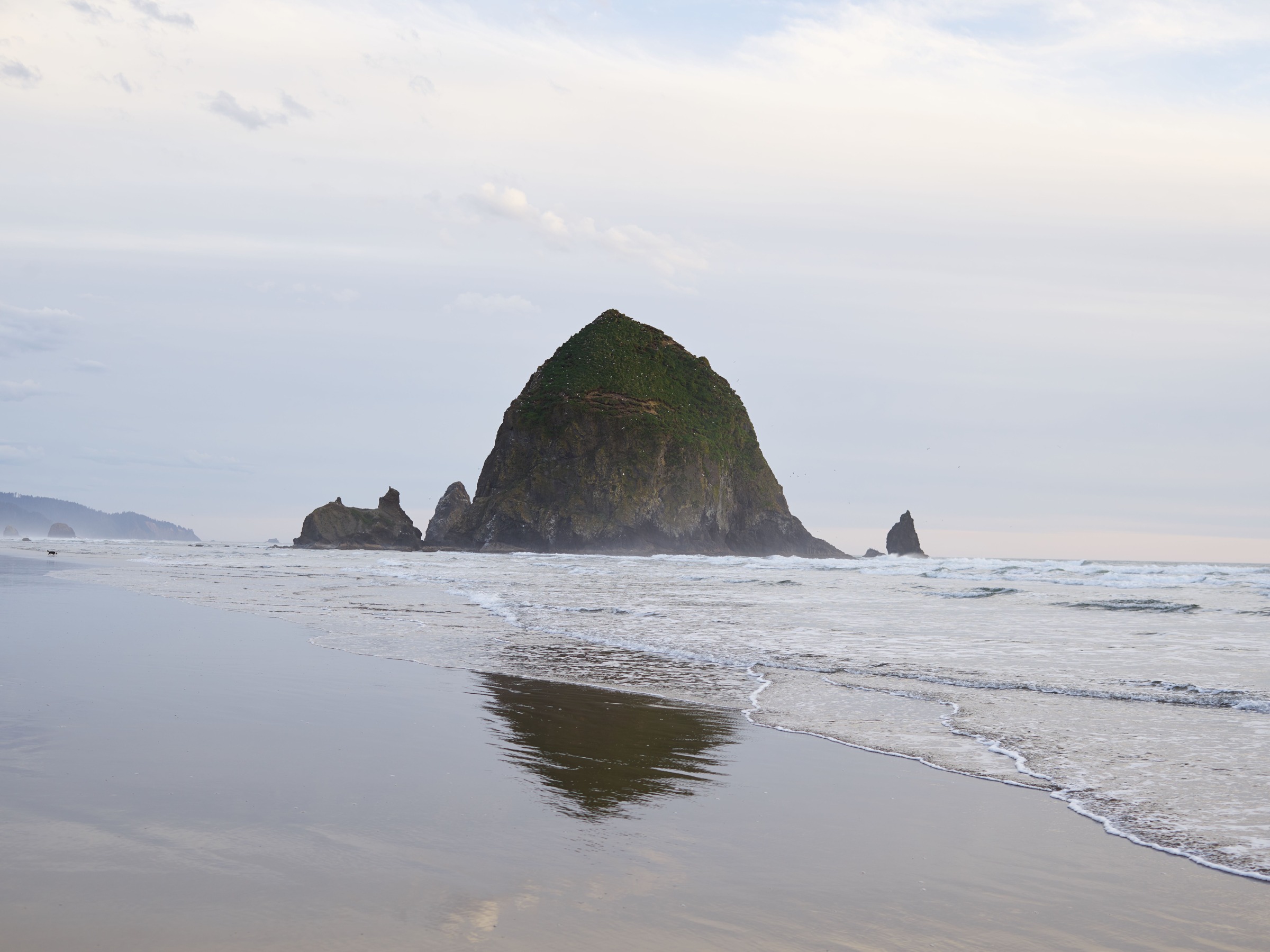
For landscape photographs, choose a safe section of open beach first. Wet sand may reflect the rock as water drains, but its appearance depends on slope, wind, waves and your viewing angle. You do not need to reach tide pools to photograph a reflection. High water may remove one foreground while leaving a distant silhouette or a wider shoreline frame available from a safe position.
 Save
Light: sunset, pale skies and changing visibility
Sunset without a promised alignment
Evening light can turn Haystack Rock into a silhouette while the wet sand holds sky color. Decide whether the picture is about the rock, the reflection or the sky. Give the most interesting element enough room and keep the others simple. A horizon placed through the middle can work for a reflection; it is not automatically a mistake or a rule to follow.
The sun’s position changes with the season and your position along the beach. Do not rely on a generic instruction to stand a fixed distance north or south of the rock to put the sun beside it. Scout from the permitted beach and check the actual alignment for your date. If the safe area does not give you the alignment you wanted, change the photograph rather than moving into surf or protected habitat.
Blue hour and a safe departure
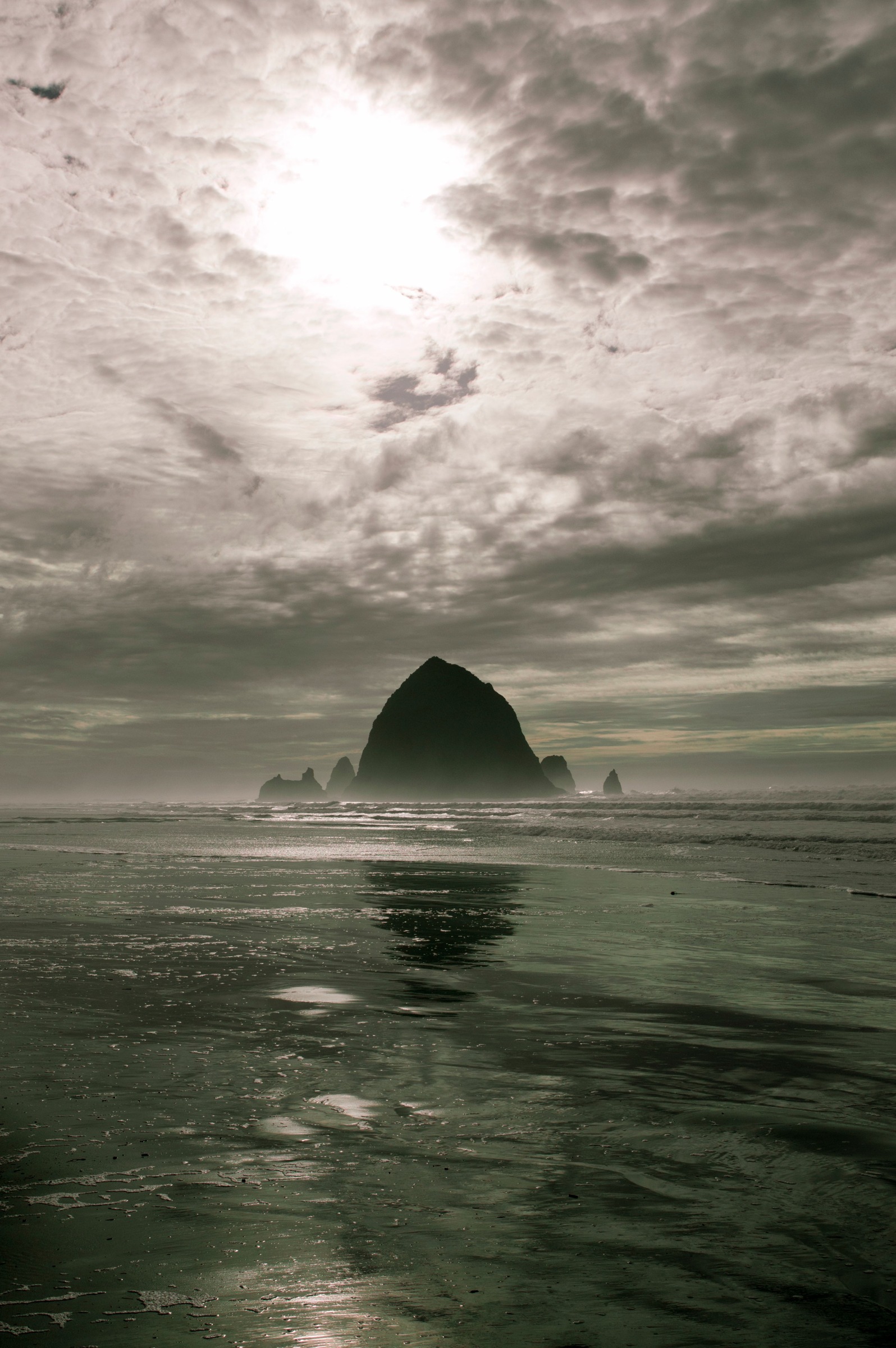
After sunset, watch the remaining color and the shape of the rock against the sky. There is no guaranteed twenty-minute period with the same exposure. Check the histogram as the light falls, and remember that a long shutter speed can make moving water look calmer than it was. A smooth-looking photograph is not proof that the conditions were safe.
Before staying late, know that your access and parking remain open, arrange your route back and carry a light. Tolovana’s sunset closure is a specific constraint, not a suggestion. Leave earlier if visibility, water or weather makes it hard to judge your surroundings.
 Save
Fog, haze and overcast light
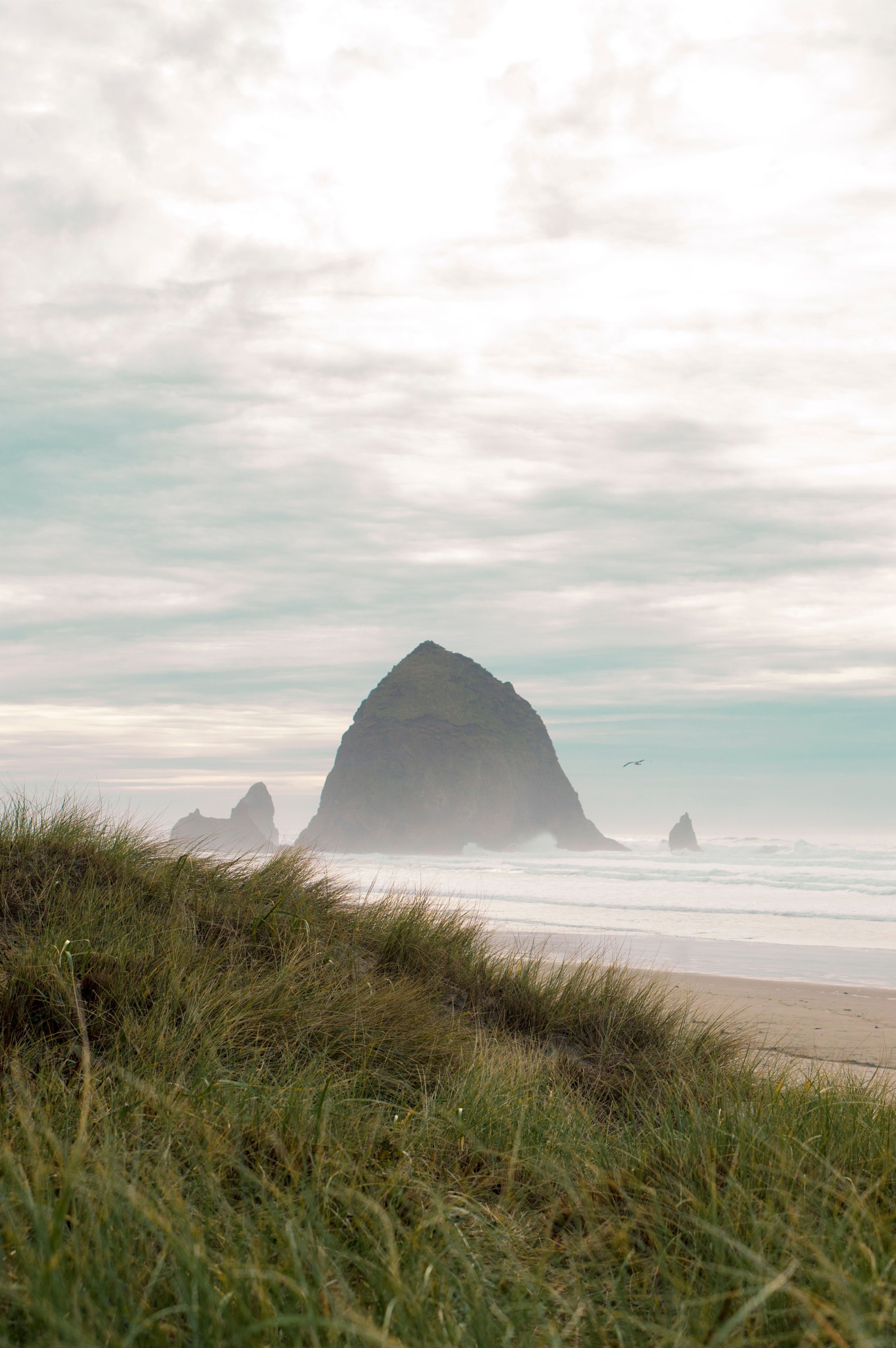
A pale sky does not require abandoning the shoot. In mist, the rock can become a simple dark form with fewer background distractions. Compare a wider frame with foreground grass or shoreline texture against a tighter frame that excludes a flat sky. Use existing public routes; a photograph with dune grass in front is not permission to walk into vegetation.
A polarizer can change reflections and glare, but it will not remove atmospheric fog. For a reflection photograph, rotate it while watching the scene because it may reduce the very reflection you want. Under soft light, a restrained edit often preserves the mood better than forcing strong contrast into every part of the file.
 Save
Build different photographs, not repeated wide shots
Rock and reflection
Start from a position where you can remain out of the advancing water. Lowering the camera can strengthen a reflection, but do not concentrate on the screen so completely that you stop watching the ocean. Work with a companion as a lookout when useful, and keep your own awareness even then.
Check the whole reflected shape and all four frame edges. A small movement can separate a neighboring stack from the main rock or change the amount of foreground. Make a vertical frame if it helps the rock and reflection read together. Do not force a full mirror when the water surface is broken or when the safe camera position does not show it.
 Save
Wave lines and scale
Use foam or a draining sheet of water as a line into the frame. Choose shutter speed for the effect: a shorter exposure retains more wave structure, while a longer one merges movement. There is no universal filter strength or shutter speed that produces the right pattern. Make a test sequence and compare the movement, not only the brightness.
The smaller stacks can help show the size of Haystack Rock. Look for separation between their outlines rather than seeking a risky close position. A normal zoom may be enough; a wide lens is useful when the foreground has a clear role. A longer focal length can simplify the scene from farther away, but it does not solve haze or unsafe access.
Intertidal detail without moving the subject
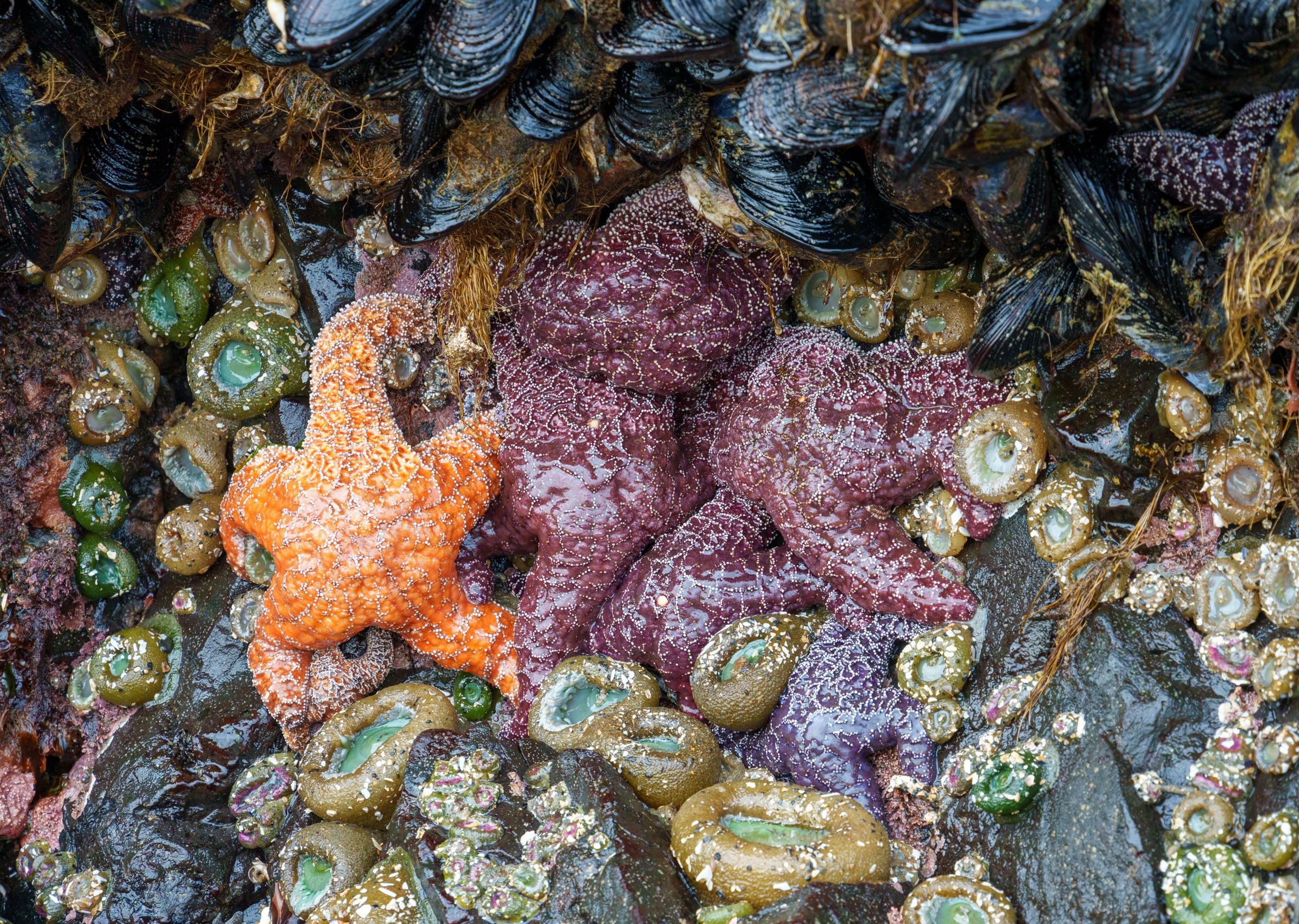
When conditions and the permitted area allow tidepool viewing, try a detail rather than another skyline-sized composition. Sea stars, anemones, mussels and water patterns can create a different scale. HRAP recommends watching your step and protecting the living habitat. Stand on sand where possible and do not tread on organisms to place the camera.
Do not lift an animal, peel anything from a rock or move a creature into better light. Wait for surface ripples to settle if they prevent a clear view, but keep watching the ocean and your exit. A macro lens is optional; a phone or a zoom that focuses close may make a useful record without leaning farther into a pool.
 Save
Camera settings and protecting equipment
For a stationary landscape, begin with an aperture that gives the depth you need, then choose shutter speed for the moving water and ISO for the remaining exposure requirement. A moderate aperture such as f/8 is a reasonable test, not a required setting. Inspect the result, especially when a close foreground and distant rock must both look sharp.
- Focus: Use a clear edge and review a magnified file. Refocus when you change focal length or include a much closer foreground.
- Exposure: Watch bright sky and reflective water. Take a darker safety frame when the contrast is high. Bracket a static scene if needed, while allowing for moving waves between frames.
- Support: Use a tripod only where it can stand securely without blocking visitors or damaging habitat. Sand can shift beneath the feet; recheck level and stability.
- Long exposures: Choose the movement first. Add a neutral-density filter only when the available light prevents the shutter speed you want. Check for color casts and dark corners.
- Wind: Use a timer or remote when it reduces camera shake. Avoid raising a center column or attaching a swinging bag as an automatic fix for instability.
- Spray: Carry a dry cloth, a protective cover and a way to keep unused equipment out of sand. Check the front element between sequences; a thin film of salt can soften the next set of photographs.
Weather sealing is not waterproofing, and a non-sealed camera does not automatically make a beach shoot impossible. Keep equipment sheltered and avoid exposing it to spray. If a wave threatens your setup, prioritize leaving safely over saving the frame or retrieving a small accessory. Follow your equipment maker’s cleaning guidance afterward.
For more on exposure choices, see our sunset photography guide. Use the photo-spots library for other researched location guides, with each place’s access rules checked separately.
Wildlife, the refuge and current drone rules
The U.S. Fish and Wildlife Service refuge rules close offshore rocks, reefs and islands to public access. Do not climb, scramble onto or land on them. HRAP identifies the land above the mean high tide or barnacle line at Haystack Rock as the protected refuge. The intertidal area is also sensitive habitat, not an unrestricted platform for photography.
Tufted puffins are a seasonal subject, not a year-round promise. HRAP’s FAQ describes nesting from April through August, while the USFWS monitoring page describes coastal viewing from May to August. Check with HRAP about current sightings rather than assuming a bird will appear at a particular hour. Binoculars or a long lens let you watch without approaching. Do not flush birds for a flight photograph, cross ropes or interfere with a resting animal.
HRAP’s rules require dogs to be leashed at and around the Marine Garden and prohibit wildlife harassment. Leave shells, plants and animals in place rather than treating a collecting exception as part of a photography visit. Ask an interpreter when you are unsure where to stand. Use the current schedule to plan an interpreter visit: the program’s pages give different broad season descriptions, so an old February-to-November claim is not a reliable attendance promise.
For drones, use the current Oregon Parks drone-operations policy and HRAP drone guidance. Oregon Parks’ rules took effect May 1, 2026, with specified designated areas opening later; Cannon Beach is not on its current designated list. The ocean shore remains closed to operations except as authorized. A recommendation to stay 500 feet from wildlife does not create flight permission. Federal refuge restrictions and wildlife protections also apply.
For commercial filming, events or a larger production, ask the relevant land manager about permits before organizing the shoot. Oregon Parks lists special-use requirements and seasonal restrictions for events at Tolovana. Do not generalize a casual beach visit into permission for every production, drone operation or exclusive setup.
Frequently asked questions
What tide is best for Haystack Rock tidepool photography?
HRAP says a predicted low tide of 1 foot or lower is needed for tidepool access, with minus tides exposing more. Use the current local tide table and conditions. No tide height guarantees safe access, a reflection or a fixed amount of time before retreating.
Where should I park for a first Haystack Rock visit?
HRAP recommends the public lot at Hemlock and Gower beside City Hall, 163 E. Gower St. Follow its beach-access directions west along Gower, then south toward the rock. Read current parking signs and allow time for the walk.
Can I use Tolovana parking for a blue-hour shoot?
Do not assume so. Oregon Parks currently lists Tolovana as closed from sunset to sunrise, with no overnight occupancy. Choose a lawful access and parking plan that remains open for your departure instead of planning to return through a closed park.
Can I climb Haystack Rock or walk between the stacks?
The refuge rocks are closed to public access and climbing. Do not plan a route between stacks from a tide number or an old photograph. Incoming water can isolate routes; follow signs and staff directions and stay in permitted areas with a clear retreat.
Can I fly a drone at Cannon Beach?
Current Oregon Parks rules close the ocean shore to drone operations except as authorized by permit or designated-area rules. Cannon Beach is not on the current designated list. Wildlife-distance recommendations do not grant flight permission, and refuge and wildlife protections also apply.
When can I photograph tufted puffins at Haystack Rock?
Puffins are a spring and summer nesting subject, not a guaranteed year-round sighting. HRAP describes April through August, while USFWS describes coastal viewing from May to August. Check current sightings with HRAP and watch from a respectful distance.
Access and policy sources checked October 30, 2026. Tide, weather, parking, program schedules and restrictions can change. Follow current official guidance and on-site signs.
What to Pack
A landscape kit built around wide views, steady support, and changing light is a useful starting point. Compare the gear and choose what fits your camera, budget, and conditions. These links lead to B&H Photo Video and Amazon.
| What & Why | B&H | Amazon |
|---|---|---|
Sony 16-35mm f/2.8 GM Check the camera mount before buying. Choose a focal length that fits the photos you plan to make. | Shop B&H → | Shop Amazon → |
Peak Design Travel Tripod Check the load rating, packed size and local tripod rules before buying. | Shop B&H → | Shop Amazon → |
Breakthrough X4 CPL Check the filter type and lens thread size before buying. Use a filter only when the effect fits your photo. | Shop B&H → | Shop Amazon → |
Breakthrough X4 10-stop ND Check the filter type and lens thread size before buying. Use a filter only when the effect fits your photo. | Shop B&H → | Shop Amazon → |
Sony NP-FZ100 battery Use the battery type specified for your camera. Bring a spare if your shooting plan calls for one. | Shop B&H → | Shop Amazon → |
SanDisk Extreme Pro 128GB Check the card format and speed requirements specified for your camera. | Shop B&H → | Shop Amazon → |
Koh microfiber cloths Compare this option with your current kit. Check compatibility and the product details before buying. | Shop B&H → | Shop Amazon → |
B&H and Amazon links are affiliate links. We earn a small commission on purchases at no extra cost to you.