Landscape Photography
Updated
Table of Contents — 15 min read
- Why Landscape Is the Hardest “Easy” Genre
- The 4 Pillars of Landscape Mastery
- Subgenres of Landscape Photography
- The Field Workflow: From Research to Backup
- Post-Processing Approach: RAW, Exposure Blending, and HDR
- 7-Day Landscape Photography Practice Plan for Beginners
- Everything Landscape on Shut Your Aperture
- Frequently Asked Questions
Landscape photography is the practice of recording a scene composed of land, water, sky, and the light that connects them — with enough control over time to decide which version of that light you capture. Strip away the gear talk and the genre definitions and you’re left with three controllable variables: land (your compositional choices), light (when and how you work with it), and time (shutter speed, season, hour of day). Every technique in this guide exists to give you better control over one of those three things.
This is the central hub for all landscape photography content on Shut Your Aperture. You’ll find definitions, frameworks, field workflows, and links to every deep-dive resource on the site. If you’re new to the genre, start here and follow the links. If you’re already shooting and looking for something specific — gear, settings, sub-genre advice — use the section headings below to jump directly to what you need.
Why Landscape Is the Hardest “Easy” Genre
Landscape photography looks approachable from the outside. No clients, no posing, no artificial light to manage. You go to a beautiful place and press a button. But that framing hides the real difficulty: the genre punishes passivity. You cannot ask the light to wait. You cannot ask the mountain to move. You cannot manufacture golden hour on a cloudy morning or coax a smooth waterfall out of a high-water torrent.
Portrait photographers work with controllable subjects. Product photographers control the entire environment. Street photographers work reactively, where timing is fast and the bar for “acceptable light” is lower. Landscape photographers work with variables that are mostly outside their control — and the gap between a mediocre landscape shot and a great one is almost entirely explained by the decisions made before the shutter was pressed: location research, arrival timing, compositional planning, and patient waiting.
That’s what this guide addresses. Not which camera to buy, but how to think about the genre — and how to build the habits that turn good scenes into strong photographs.
 Save
SaveThe 4 Pillars of Landscape Mastery
Every teachable aspect of landscape photography falls into one of four areas. Master these and the technical details take care of themselves.
1. Light Timing
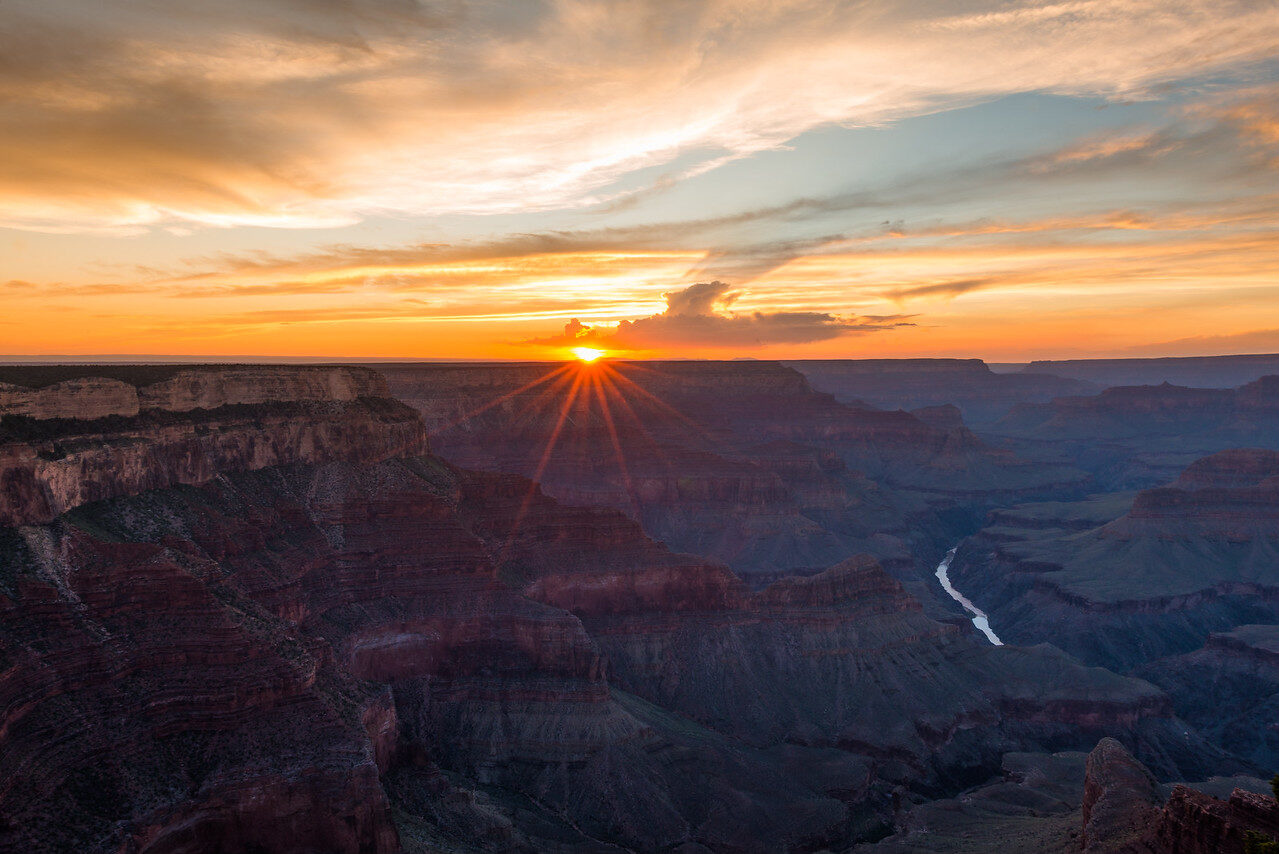
The single highest-leverage variable in landscape photography. The same scene photographed at noon and at golden hour looks like two completely different photographs. Soft, directional light reveals texture in rock faces, separates foreground from background, and adds warmth and color contrast that no amount of post-processing can fully recreate after the fact.
The key windows are golden hour (the 30–60 minutes after sunrise and before sunset), blue hour (the 20 minutes before and after those windows), and overcast midday (which works exceptionally well for forests and waterfalls where contrast reduction helps). Learn the light patterns for your target locations using apps like PhotoPills or The Photographer’s Ephemeris before you go.
For a complete breakdown of light timing, exposure settings for each window, and real field examples, read the full Landscape Photography 101: A Beginner’s Guide to Mastering Natural Light.
2. Composition Rules and When to Break Them
Composition is how you direct attention within the frame. Landscapes are compositionally tricky because the scene is large, the subject is often diffuse, and the camera has no natural bias toward what matters. A few foundational rules do most of the work:
- Rule of thirds: Place the horizon on the upper or lower third rather than center. Center horizons split attention equally between sky and land, which usually serves neither.
- Leading lines: Roads, rivers, shorelines, and fence lines pull the eye into the frame and create depth. A strong leading line is often the difference between a flat snapshot and an image with genuine three-dimensionality.
- Foreground interest: Including a sharp foreground element — rocks, wildflowers, a tide pool — creates a sense of scale and gives the eye a starting point before traveling toward the horizon.
- Natural frames: Trees, arches, canyon walls, and overhangs can frame the main subject and control where the eye goes.
Rules matter most when you’re learning. The goal is to internalize them well enough that breaking them is a deliberate choice, not an accident.
3. Gear That Earns Its Weight
Landscape photography doesn’t require expensive gear, but it does require the right gear. Three items separate serious landscape shooters from casual ones: a wide lens that resolves well at small apertures, a tripod that doesn’t wobble, and a set of filters for managing light.
For lens selection, the best wide-angle lenses for landscape photography guide covers every major format and budget. For camera-specific settings, the Sony ZV-E10 II landscape settings guide shows exactly how to configure a modern APS-C mirrorless camera for the genre. And for a broader look at lens options across focal lengths, see the top lenses for landscape photography roundup.
The gear minimum for serious landscape work:
- Wide-angle lens: The Sony FE 16-35mm f/2.8 GM is the benchmark for full-frame Sony shooters — weather-sealed, sharp corner-to-corner even at f/8, and wide enough for foreground-to-horizon compositions. APS-C shooters have strong alternatives at lower price points.
- Tripod: The Manfrotto MT055XPRO3 aluminum tripod handles up to 44 lb, extends to 67 inches, and features a horizontal center column — useful for low-angle foreground work. This is a workhorse tripod that will outlast multiple camera bodies.
- ND filter set: A variable ND gives you flexibility to slow shutter speed in bright conditions for silky water and blurred clouds. The K&F Concept Nano-D Variable ND Filter (77mm, 3–11 stop) uses 24-layer multi-coating to minimize color shift and vignetting — a common weak point on cheaper variable NDs.
- Circular polarizer: The Tiffen 77mm Circular Polarizing Filter cuts glare on water and wet rocks, deepens blue skies, and eliminates reflections in a way that no software can replicate. Made in the USA, 10-year warranty.
- Camera backpack: The Lowepro Flipside Trek BP 350 AW is built specifically for photographers who hike to their locations — body-side access, integrated rain cover, ActivZone suspension system, and attachment points for a tripod. It handles a DSLR or mirrorless body with 2–3 lenses, plus personal gear for a full day.
 Save
Save4. Exposure Stacking and Technical Control
Dynamic range is the core technical challenge in landscape photography. A scene at golden hour might span 10–14 stops of light from the shadowed foreground to the bright sky — more than most sensors can capture in a single frame. Three tools address this problem:
- ND graduated filters: A physical filter that darkens the sky half of the frame, reducing the exposure gap at capture time.
- Exposure blending: Shoot two or more frames at different exposures and blend them in post. More flexible than HDR, less obvious when done well.
- Single-shot RAW processing: Modern sensors — especially Sony and Nikon full-frame — have enough dynamic range to recover significant shadow and highlight detail from a single RAW file, reducing the need for exposure stacking in all but the most extreme situations.
The technical foundations you need to make these decisions confidently are covered in three dedicated guides: aperture in photography, shutter speed, and ISO. Understanding how these interact is more useful than memorizing settings for specific scenes.
Subgenres of Landscape Photography
Landscape photography is not one genre — it’s several, each with distinct challenges and priorities. Here’s what to know about the ones covered on this site:
Mountain Photography
Light changes fast at elevation and weather moves in unpredictably. Getting foreground and background in sharp focus simultaneously requires f/11–f/16 and careful hyperfocal distance work. Pre-dawn starts are standard. The payoff is alpine light that hits peaks before the valley floor, creating a layered depth that daytime shooting can’t replicate.
Coastal and Seascape Photography
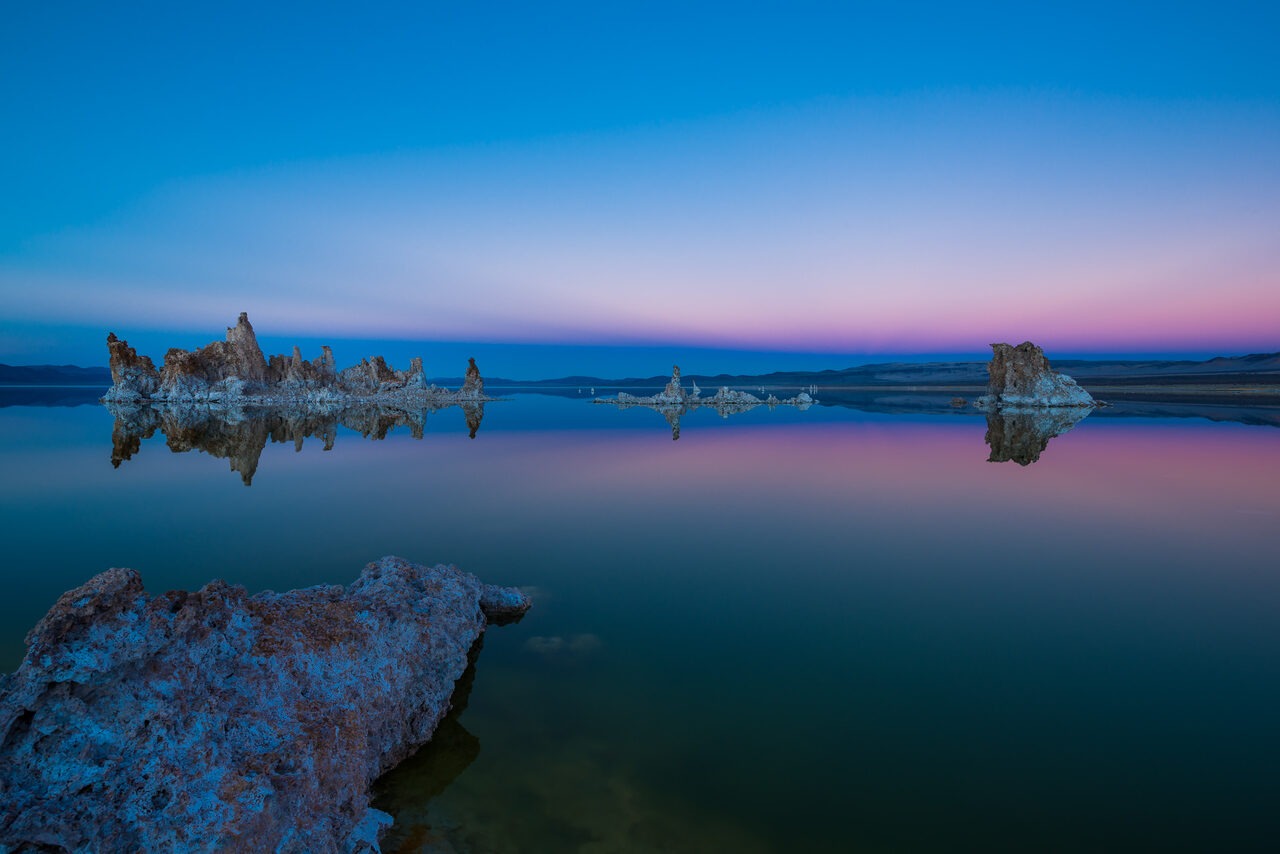
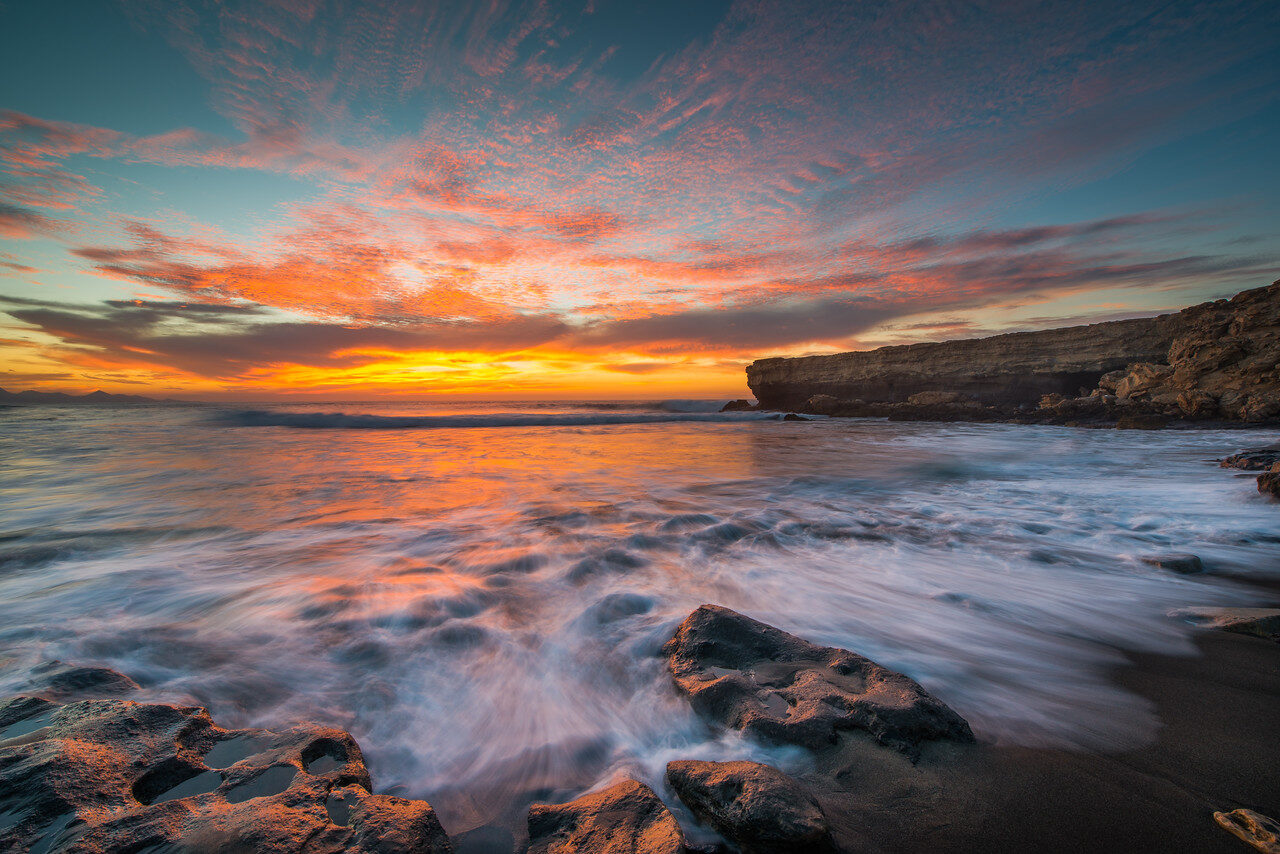
Coastal work is filter-intensive. A polarizer removes glare from wet sand and tide pools. A 3–6 stop ND turns crashing waves into smooth water at 1–4 second exposures. A 10-stop ND transforms a busy harbor into a minimal glassy composition in 30 seconds. Coastal golden hour light is among the most dramatic in the genre — salt haze, warm raking light, and wet reflective surfaces together. The window lasts 15–20 minutes. Arrive early.
Desert Photography
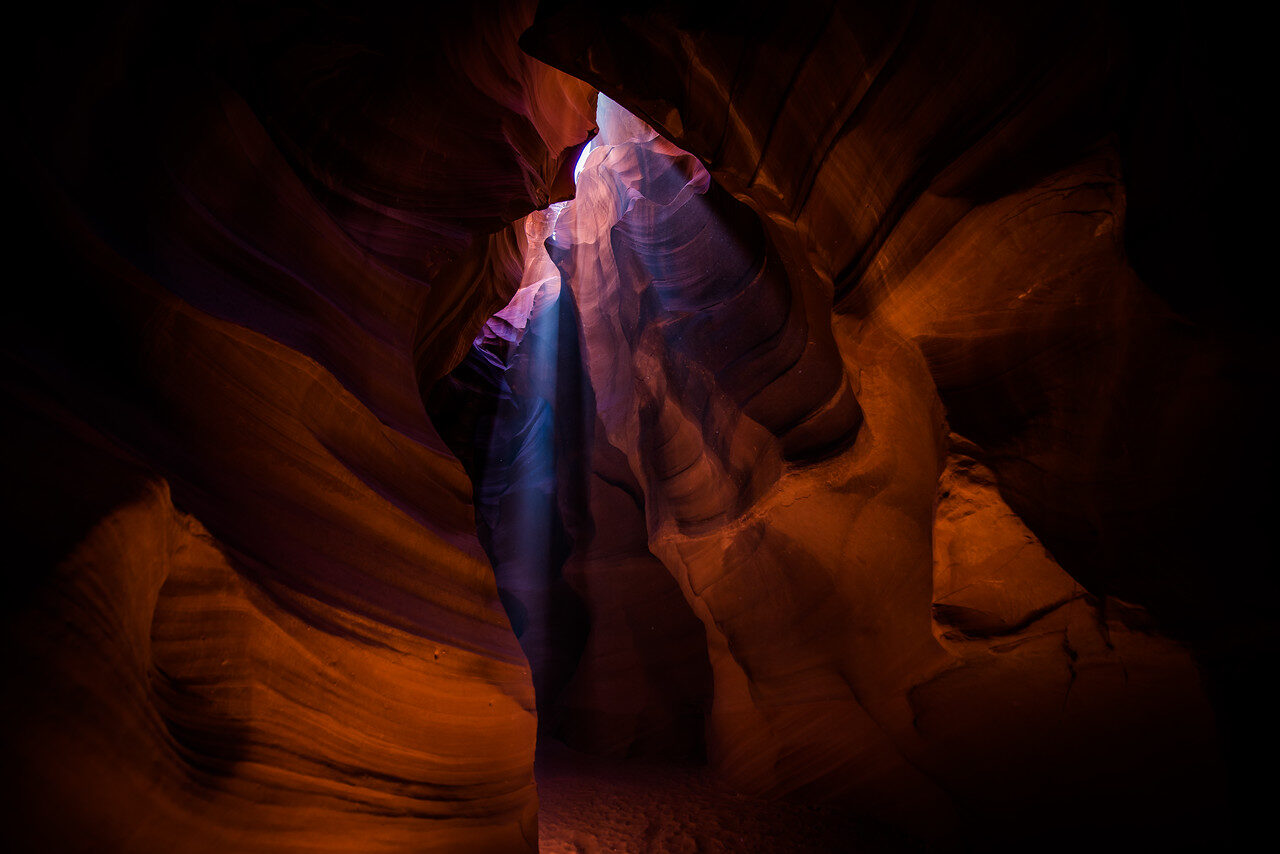
Desert scenes are high-contrast by nature: bleached sand against intense blue sky, minimal haze. The best light arrives in the 45 minutes after sunrise, when long shadows reveal texture in dunes and rock formations. Midday is usually unworkable. Dust protection for camera and lenses is non-negotiable.
Forest Photography
Forests present the opposite challenge: low contrast, low light, complex three-dimensional scenes. Find structure — strong vertical trunks, mist for atmospheric separation, a single shaft of light through the canopy. Overcast days often work better than sunny ones; diffuse light keeps contrast manageable and avoids harsh spotting from direct sun. A tripod is essential at the shutter speeds forest interiors require.
Urban Landscape and Cityscape Photography
The urban landscape genre treats cities as built environments shaped by light and time. Blue hour is the premium window: artificial building light balances against the remaining sky color, avoiding the blown-highlights problem of pure night photography. Wide lens, tripod, 2–4 second exposure, remote shutter release or self-timer.
Astrophotography Overlap
Milky Way photography shares the same gear requirements as landscape work but adds dark-sky location constraints. The rule of 500 (divide 500 by your focal length for maximum exposure time before star trails appear) governs shutter speed, pushing ISO higher than daytime work requires. Finding genuinely dark sky locations is often harder than the photography itself.
 Save
SaveThe Field Workflow: From Research to Backup
Most landscape photography failures happen in the planning phase, not at the camera. A repeatable field workflow prevents the most common mistakes:
- Research: Use Google Earth, PhotoPills, or The Photographer’s Ephemeris to identify promising locations, understand the direction and timing of sunrise/sunset at that spot, and find compositions worth making the trip for.
- Scout first: If the location is within reach, scout it before your main shoot — preferably at the same time of day you plan to shoot. What looks promising on a map or in other photographers’ images may have changed, or may work from a completely different angle than you expected.
- Arrive early: 30–45 minutes before golden hour gives you time to set up, find your composition, check focus, and be ready when the light changes fast. Rushing into position at sunrise means missing the best 10 minutes.
- Wait: The first 10 minutes of golden hour are rarely the best. The light continues to evolve. Photographers who pack up after the sun crests the horizon often leave just as the scene reaches its peak.
- Shoot multiple exposures: For any keeper composition, shoot at minimum: one exposure metered for the highlights, one for the shadows, and one as a safety. Bracket automatically if your camera supports it. Shoot in RAW.
- Backup immediately: Copy cards to a second storage medium the same day. Hard drives fail, cards fail, backpacks get stolen. The session isn’t safe until it exists in two places.
For more on the travel and planning side of landscape photography — scouting apps, permit requirements, and multi-day trip planning — see the travel photography guides.
Post-Processing Approach: RAW, Exposure Blending, and HDR
Landscape photography is a RAW-first genre. JPEG processing discards data you’ll want when working with high-contrast scenes, and the difference between a processed RAW file and a processed JPEG at the shadow recovery stage is significant enough to make JPEG unacceptable for any serious landscape work.
Three approaches to handling dynamic range in post:
- Single-shot RAW processing: Works when the scene fits within the sensor’s dynamic range (roughly 10–12 stops). Expose for highlights, recover shadows in post. Modern RAW processors can pull 3–5 stops of shadow detail with minimal noise on recent sensors.
- Exposure blending: Shoot multiple frames from the same tripod position, blend in Lightroom’s HDR Merge or manually in Photoshop with luminosity masks. The preferred method when sky/land contrast exceeds a single RAW’s range.
- Tone-mapped HDR: Largely replaced by exposure blending. Strong tone-mapping produces halos, oversaturated color, and muddy midtones. Subtle Lightroom HDR merging can be useful for extreme scenes.
For sky replacements and AI-assisted editing, tools like Luminar Neo’s Sky AI can be useful for demonstration or commercial work, but they change what the camera recorded rather than what was actually present. That distinction matters depending on how you define the purpose of your landscape photography.
 Save
Save7-Day Landscape Photography Practice Plan for Beginners
Theory absorbs slowly until it’s attached to real-world shooting. This plan forces you to engage with the fundamental variables one at a time:
- Day 1 — Golden hour at a familiar location: Go somewhere you already know. Arrive 40 minutes early and shoot the same composition throughout the light change. Review the sequence to see how fast conditions shifted.
- Day 2 — Leading lines: Build three compositions around a strong leading line (road, river, shoreline). The line must enter the lower third of the frame and move toward the horizon.
- Day 3 — Foreground focus: Practice hyperfocal focusing. Find interesting foreground (rocks, wildflowers, a tide pool) and make the near-to-far sharpness work. Start at f/11.
- Day 4 — Slow shutter: Shoot exposures of 1, 5, and 30 seconds at the same scene with your tripod and ND filter. Compare what each shutter speed does to moving water or sky.
- Day 5 — Shoot a subgenre you avoid: If you shoot mountains, go coastal. If you shoot outdoors, go urban. New environments force compositional thinking that familiar scenes can’t.
- Day 6 — Post-processing: Take your five best RAW files and process each twice — once protecting highlights, once recovering shadows. Decide which version serves each image better.
- Day 7 — Full field workflow: Execute the complete workflow: research, scout, arrive early, wait, shoot multiple exposures, back up the same day. Treat this as a rehearsal for any planned location trip.
Everything Landscape on Shut Your Aperture
This hub links to all landscape photography resources on the site. Use this section as your navigation map:
Core Technique
- Landscape Photography 101: A Beginner’s Guide to Mastering Natural Light — the comprehensive deep-dive on reading and working with natural light. Start here if you’re new to the genre.
- Aperture in Photography — how f-stop choices affect depth of field and diffraction in landscape work.
- Shutter Speed — from freezing motion to long exposure fundamentals, with landscape applications.
- ISO in Photography — when to push ISO for astrophotography and low-light coastal work, and how to manage noise.
Gear
- Best Wide-Angle Lenses for Landscape Photography — full-frame and APS-C options across every major brand and budget.
- Top Lenses for Landscape Photography — a broader roundup including mid-range and telephoto focal lengths.
- Sony ZV-E10 II Settings for Landscape Photography — specific menu settings, picture profiles, and recommended configurations for this APS-C mirrorless body.
Travel and Location Planning
- Travel Photography — All Guides — packing lists, location research workflows, permit considerations, and international shooting logistics.
Turn your next landscape trip into deliberate practice. Light. Land. Legacy. at Shut Your Aperture Academy is a 10-module landscape photography course with 40+ lessons. Build your approach to light, composition and field planning, then put those choices to work on your next shoot.
Frequently Asked Questions
What camera settings should I use for landscape photography?
Start at aperture priority, f/8 to f/11, ISO 100, with a tripod to handle whatever shutter speed the metering requires. Apertures tighter than f/16 introduce diffraction softening on most sensors — use hyperfocal distance technique or focus stacking instead of stopping down to f/22.
Do I need a full-frame camera for landscape photography?
No. APS-C sensors perform well in the conditions landscape photographers typically work in — low ISO, tripod-mounted. Full-frame offers advantages in dynamic range and high-ISO performance relevant to astrophotography, but for golden-hour and daytime shooting a modern APS-C body is fully capable.
How do I avoid overexposed skies in landscape photos?
Three options: expose for highlights and recover shadows in RAW, use a graduated ND filter to reduce sky exposure at capture, or shoot multiple exposures and blend them. For scenes where the sky-to-land contrast is extreme, exposure blending is the most reliable approach.
What is the best focal length for landscape photography?
Wide-angle primes and zooms in the 16–35mm range (full-frame equivalent) handle the majority of landscape scenarios. Ultra-wide lenses (10–14mm) work for dramatic foreground compositions but distort the horizon if it’s not kept near the center of the frame. Telephoto lenses (70–200mm) are useful for isolating distant mountains, compressing perspective to stack layers, and for detail shots within a larger landscape scene.
Is post-processing necessary for landscape photography?
For RAW files — which should be all of them — yes. A well-exposed file in good light may need only white balance, contrast, and saturation adjustments. A difficult high-contrast scene may require exposure blending, noise reduction, and targeted color grading. Shoot RAW and decide in post how much intervention the image needs.
Landscape Presets
The Landscape, Cityscape & Drone Preset Pack — 75 presets built from real landscape and aerial work, including dedicated noise-reduction variants for blue hour and astro. Works in Lightroom Classic, desktop and mobile.