By Edin Chavez | Updated October 2026
Rome’s big sights are crowded by day and the light can be flat. Around sunset and after, the same buildings often glow warm against a deepening blue sky and the fountains light up. Crowds and light vary by day and season. This is a researched guide to Rome with 13 photo-led chapters, built around that light and around the rules that decide whether you can set up a camera where you want to.
This is not a trip report. These are researched spots, based on official visitor pages, city and monument rules, and the photographs selected for each place. I am not claiming a first-hand visit to any of them. Check current hours, tickets and rules before you go, because Rome changes them often.
Start with the light, not the list
A list sorted by neighbourhood sends you across the city at the wrong hour. A plan sorted by light works better.
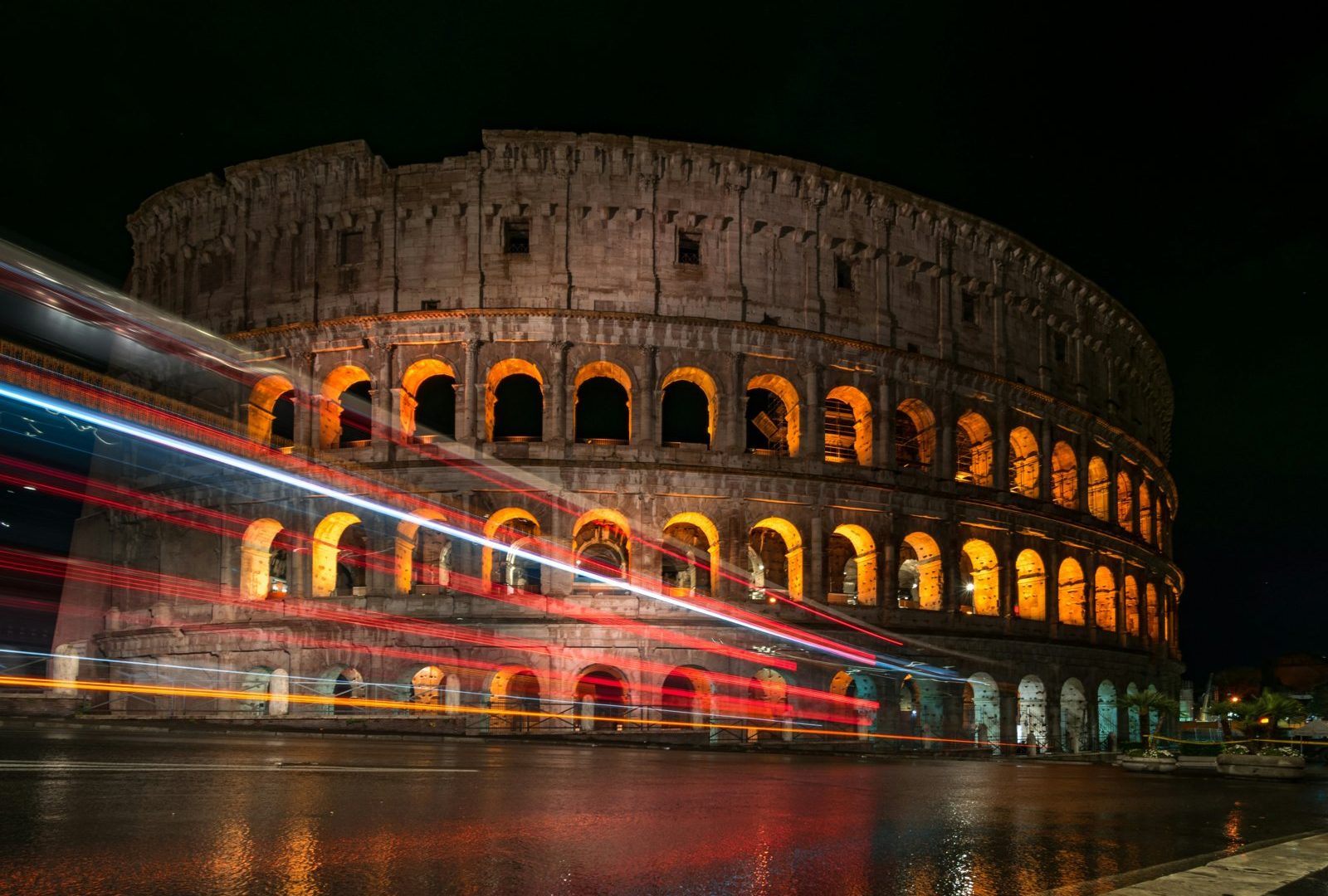
Night. The Trevi Fountain, the Pantheon portico, the Colosseum arches and the Tiber bridges all reward a night visit. Monuments are lit, so you do not need full darkness. The strongest night frames in the guide are the Colosseum with light trails, the Trevi basin and the Pantheon portico with its inscription.
Blue hour. The Roman Forum, St Peter’s, Castel Sant’Angelo and Piazza Navona look best in the 20 to 40 minutes after sunset, when the sky is deep blue and the floodlights are already on. This is the most useful window in the city. It is bright enough to hand hold at higher ISO and dark enough for the lights to read.
Sunset. The Pincio Terrace, the Vittoriano and the Forum and Colosseum skyline suit low sun. The Pincio looks out over the city with the dome of St Peter’s on the horizon. The chapter called Ancient Rome at Sunset is built around layered ruins in warm side light.
Dawn. The Spanish Steps and Piazza Navona are quietest at first light. Dawn is often quieter, though crowds vary.
Sunset runs from about 16:39 in December to about 20:46 in June, and Italy puts the clocks back on October 25, 2026, so late October sunsets move about an hour earlier. The guide has a month-by-month table. Use an ephemeris app for your exact date.
The rules that decide your tripod
Rome is stricter about equipment than most visitors expect, and the rules are different at each kind of place. Read this section before you pack.
Colosseum Archaeological Park. The Park’s visitor rules, approved April 1, 2026, ban tripods, professional optical and audio equipment and drones without authorization from the Park management. That covers the Colosseum, the Roman Forum and the Palatine. The outside of the Colosseum, seen from the paved piazza and the surrounding paths, is public space, but the Park rules apply inside the paid area.
City streets and squares. Roma Capitale’s page for photographic shoots says authorization is needed for commercial shoots and for shoots that occupy public land, and that a tripod counts as one square metre of occupied land. Casual personal photography is not on the list of shoots that need authorization. The Capitoline Hill goes through the Mayor’s Office (the Gabinetto del Sindaco). The Tiber banks and Tiber Island need a concession from the Regione Lazio, and the bridges carry an extra fee for reproduction. If you are shooting for a client or for sale, read the official page and ask first.
St Peter’s Basilica. The Basilica’s rules ask visitors not to take photographs inside, even for personal use, and they bar bulky or professional equipment without authorization. The guide treats St Peter’s as an exterior chapter: the facade, the dome and the square.
The Vittoriano terrace (VIVE). The VIVE FAQ allows amateur personal photos and video, with no flash, tripod or selfie stick. Professional photography needs authorization and a fee.
Drones. ENAC, Italy’s civil aviation authority, requires the operator to check the D-Flight maps before every flight, and the maps need a registered D-Flight account. The Colosseum Park bans drones without authorization. Do not plan on flying one. Here is the official map: D-Flight maps.
Colosseum
 Save
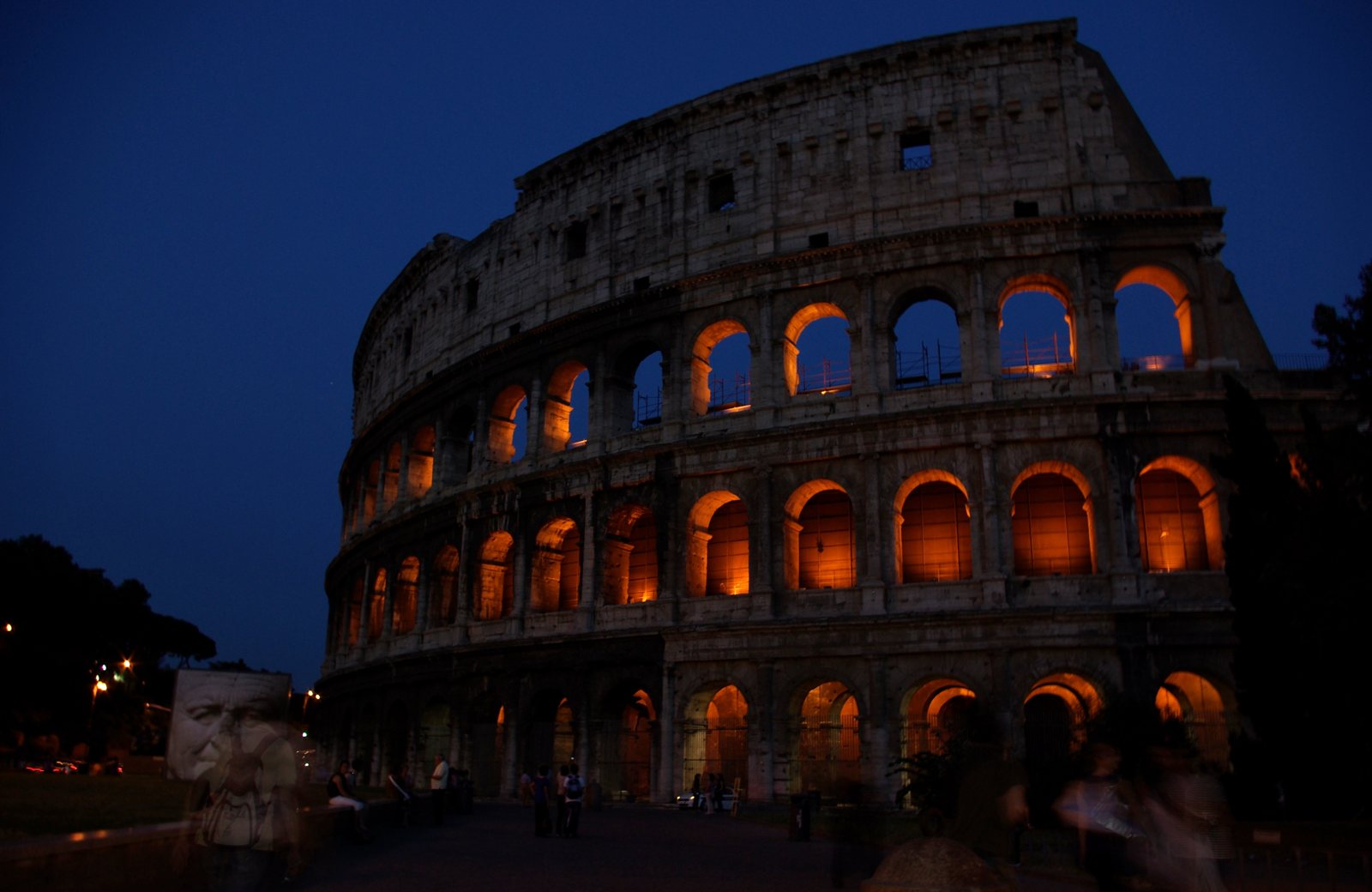
SaveThe Colosseum is the most photographed monument in Rome and it changes a lot between sunset, blue hour and night. From the paved piazza the arches glow warm against a dark blue sky in the first minutes after sunset. A slow shutter turns passing traffic into streaks, which is what the opener in the guide shows.
Entry is by timed ticket. The full ticket covers the Colosseum, the Roman Forum and the Palatine. The Forum and Palatine are one entry, valid at the time you choose within 24 hours before or after your Colosseum booking. Check the ticket page for the current price and for reduced rates. Because tripods are banned in the Park, plan to brace the camera on a wall or a bag.
There are also evening visits. Una Notte al Colosseo is listed on the Park’s events page for Tuesdays and Thursdays from 20:00 to 23:00, with last entry at 21:50, in a season running from July 7 to October 22, 2026, with listed exceptions on September 22, September 24 and October 1. Check the page for dates before you build a trip around it: Una Notte al Colosseo 2026.
Roman Forum
The Forum is the ruined heart of ancient Rome. The best frames use layers: a column or wall in the foreground, the ruins in the middle and a lit building behind. At blue hour the columns of the Temple of Saturn pick up warm light while the sky goes deep blue.
The Forum shares the Colosseum ticket. The Park also lists a Friday evening activity, Una Notte al Foro Romano, from 19:30 to 22:00 with last entry at 20:30. Dates vary, so check the official page. Free viewpoints exist outside the paid area, along Via dei Fori Imperiali and on the Capitoline Hill, and these are public pavements and traffic, so keep the tripod for somewhere it is allowed.
Ancient Rome at Sunset
Sunset gives the ruins a warm, layered look. The guide shows the Forum at sunset with the bell tower of Santa Francesca Romana and the Colosseum beyond, and the Colosseum wall with sun rays breaking through cloud. Look for layers: ruins in the foreground, the tower mid-frame and the Colosseum on the horizon. Sun rays need low sun and broken cloud, and a longer lens stacks the Colosseum behind the Forum. Bracket the bright sky.
Trevi Fountain
The Trevi Fountain fills a small square, so the main question is how to frame it among the people. Night and early morning are the quietest and best lit.
Since February 2, 2026, non-residents pay EUR 2 to enter the inner perimeter of the fountain, according to the official Trevi page. Hours are listed as Monday and Friday 11:30 to 22:00 and other days 9:00 to 22:00, with last entry at 21:00, and the fee also applies on the first Sunday of the month. Rome residents enter free. Check the official page for what applies to the wider square. Crowds are heavy at all hours, so follow staff directions at the basin and keep walkways clear. Handheld at night, ISO 800 to 3200 and the slowest shutter speed you can hold are a sensible place to begin.
Pantheon
The Pantheon portico has 16 granite columns and the inscription naming Marcus Agrippa. At blue hour the portico glows and the inscription reads cleanly. Keep the verticals straight and use the symmetry of the facade. The square in front is a good place for a handheld frame, with fewer people late in the evening.
The Pantheon is an active church, and the interior is a separate subject by day. The interior ticket is EUR 7 and the Direzione Musei Roma page lists reduced and free categories, so check it, because the rate changed during 2026. The ticket office closes at 18:00 and the last entry for individual tickets is 18:30, so after-dark frames are of the exterior from the square.
St Peter’s Basilica
St Peter’s facade and dome are best at the start of the evening, when the sky is blue and the windows glow warm. This is an exterior chapter. The Basilica’s rules ask visitors not to photograph inside, and security queues in the square can be long, so allow time. The Basilica is free to enter. The official page lists the Basilica open 7:00 to 20:00 (from June 1, 2026) with last access at 19:15, depending on security queues, and dome hours that shorten after October 25, so confirm the day you go.
Spanish Steps
The Spanish Steps climb from Piazza di Spagna to the church of Trinità dei Monti. Dawn is often a quieter time on the staircase, with the pink sky and the lit lamps of early morning. Stand low in the square to stack the Barcaccia fountain, the steps and the twin towers.
Sitting on the steps is banned under Rome’s police regulation, and press reports at the time of the 2019 rule gave fines of EUR 160 to 400. Do not set a tripod on the staircase. The steps and square are normally accessible, subject to city closures.
Castel Sant’Angelo
Castel Sant’Angelo was built as Hadrian’s mausoleum and later became a papal fortress. At dusk the stone glows warm while the sky is still deep blue, and the angel-lined bridge makes a natural lead-in.
The museum ticket is EUR 18 from July 1, 2026, with EUR 2 for EU citizens aged 18 to 25 and free entry on the first Sunday of the month. It is normally closed on Mondays, December 25 and January 1, but from August 3, 2026 the museum also opens on the first Monday of each month from 14:00 to 20:00, last admission 19:00, with a EUR 5 ticket bought on site. The exterior and the riverside are public and normally accessible, subject to closures.
Piazza Navona
Piazza Navona follows the outline of an ancient stadium and holds three fountains, including Bernini’s Fountain of the Four Rivers. Early morning and late night are often quieter. Arrive before the cafe tables are set up, and use the street lamps as part of the image.
Roma Capitale has fined cafes for occupying public space, so tables and chairs can change from week to week. Shoot handheld or brace the camera without occupying public land. Under the city’s rules a tripod counts as occupied public land, so get authorization before you set one up.
Pincio Terrace
The Pincio terrace is a classic Roman sunset view, with the dome of St Peter’s on the horizon. Turismo Roma points to the terrace for the late-afternoon view of Rome. It is part of the Villa Borghese gardens, which Roma Capitale lists as open from dawn to sunset. The pages I checked do not say the terrace stays open after sunset, so plan to leave by sunset. Arrive early to hold a spot at the railing, and bracket for the sunburst.
Vittoriano and Piazza Venezia
The Vittoriano, also called the Altare della Patria, is the white marble monument on Piazza Venezia topped by bronze quadrigae. Sunset warms the marble, and broken cloud behind the quadriga makes the best frames. The panoramic terrace at the top gives a viewpoint over the Forum, the Colosseum and the city.
The Altare della Patria is free to visit. The panoramic terrace needs a VIVE ticket, EUR 18 full and EUR 5 reduced for EU citizens aged 18 to 25, free under 18, according to the VIVE pages. Terrace hours are 9:30 to 19:30. The info page gives last entry at 19:00 while the FAQ gives 18:45, so plan for 18:45 and confirm with the operator. From late March through part of September, sunset can fall after the 19:30 closing (about 19:31 on March 29 and 19:43 on September 1, 2026), so check the exact date. Amateur photos are fine, with no flash, tripod or selfie stick.
Ponte Sant’Angelo from Ponte Umberto I
The most dramatic bridge frame in the guide looks up the Tiber from Ponte Umberto I toward Ponte Sant’Angelo and the lit dome of St Peter’s. The five arches glow gold at night and the angel statues line the bridge. Shoot from the walkway or the riverside, low and near the water for reflections, and keep the dome in the centre of the frame.
The embankments are public walkways, but water levels, closed stairs and lighting vary through the year. Shoots that occupy public land need authorization under the Roma Capitale rules, and Tiber banks and Tiber Island need a Regione Lazio concession. For ordinary handheld shooting, brace the camera against yourself or your bag rather than setting up a tripod.
Ponte Sant’Angelo and the Castle
The last chapter puts the castle and the bridge together. Still water gives a mirror, with early evening and early morning calmer. Include the bridge arches and the castle with the reflection in the lower third, and use the angel statues as foreground. The bridge is pedestrian-only and normally accessible, subject to closures, and it is crowded with sellers and visitors at midday.
Passes, tickets and timing at a glance
- Colosseum, Roman Forum and Palatine: one timed ticket, the Forum and Palatine entry is valid within 24 hours before or after the Colosseum slot.
- Pantheon interior: EUR 7, last individual entry 18:30.
- Castel Sant’Angelo: EUR 18, first Monday of the month openings from August 3, 2026.
- Vittoriano terrace: EUR 18, plan for the 18:45 last-entry time.
- St Peter’s Basilica: free, no photography inside.
- Trevi inner perimeter: EUR 2 for non-residents.
Prices, hours and rules change, so use the official page linked in each chapter of the guide.
If you want someone else to handle the walking
Rome’s sights are spread out and the night routes can be hard to link up. A guided evening walk handles the route and the crowds while you look at the city. These are third-party tours I have not taken, linked as options, not recommendations from experience:
- Rome at Night: Small Group Guided City Walking Tour on Viator: a roughly two-hour small-group walk that covers the Pantheon, the Forum and the Colosseum area by night.
- Moonlight Rome: Night Walking Tour of Roman Highlights on Viator: a roughly two-and-a-half-hour small-group night walk of the main highlights.
Neither is a photography tour and neither is timed around your light. Ask the operator about stops. Treat them as orientation, then come back on your own for a blue hour session.
Frequently asked questions
When is the best time of day to photograph Rome?
The 20 to 40 minutes after sunset. The sky is deep blue, the monuments are lit and most day visitors have left. Dawn is often quieter, though crowds vary.
Can I use a tripod in Rome?
It depends on where you are. Tripods are banned in the Colosseum Park without authorization, and the Basilica and the VIVE terrace do not allow them either. In public streets and squares, the city’s rules count a tripod as one square metre of occupied public land and say shoots that occupy public land need authorization. Casual personal photography is not on the list. Get authorization before setting one up, keep walkways clear and follow staff directions. If you are shooting commercially, check the official page and ask first.
Can I fly a drone in Rome?
Plan on no. ENAC requires you to check the D-Flight maps before every flight, the Colosseum Park bans drones without authorization, and Roma Capitale has a separate authorization route for drone filming and public use of images of municipal heritage.
Can I photograph inside St Peter’s Basilica?
The Basilica’s rules ask visitors not to take photographs, even for personal use. The guide treats the Basilica as an exterior-only chapter.
Is the Colosseum open at night?
Not as a normal visit. The Park lists evening events such as Una Notte al Colosseo, which runs on set dates. Check the event page before booking.
Is Rome safe for night photography?
The centre is busy in the evening. Keep your bag in front of you and the camera strap on, and be careful in crowds at the Trevi Fountain and the Spanish Steps. Stay on lit, busy streets late at night. I have not researched crime statistics, so use your own judgment.
Do I need a ticket for Piazza Navona or the Spanish Steps?
No. These are public squares and are normally accessible, subject to closures. The church interiors have their own hours.
What settings should I start with?
Treat them as scenarios, not promises. Handheld at blue hour, ISO 800 to 3200, f/2.8 to f/5.6, 1/30 to 1/60 s. On a steady wall or bag, ISO 200 to 800 and 1/15 s to a few seconds. For sunset, ISO 100 to 200, f/8 to f/11 and bracket for the bright sky.
How many spots are in the guide?
Thirteen photo-led chapters (some subjects, such as Castel Sant’Angelo and the Colosseum with the Forum, appear in more than one), each with a hero photo, a second photo, a shot list, access notes, map pins and links to the official pages.
Are the map pins exact camera positions?
No. They are starting references to named landmarks, not tested camera positions.
What is in the guide
The Rome guide covers 13 photo-led chapters (Colosseum, Roman Forum, Ancient Rome at Sunset, Trevi Fountain, Pantheon, St Peter’s Basilica, Spanish Steps, Castel Sant’Angelo, Piazza Navona, Pincio Terrace, Vittoriano and Piazza Venezia, Ponte Sant’Angelo from Ponte Umberto I, and Ponte Sant’Angelo and the Castle) with two photos per chapter, composition and light notes, scenario-based starting settings, current access and equipment rules from the official pages, clickable map pins and links to the pages to check. The starting settings are scenarios to begin from, not promises. Light and conditions change.
Recommended Gear for Rome Night and Low-Light Photography
A short kit for walking, blue hour and night work. Remember the tripod rules above, and pick gear that suits handheld shooting and a compact support.
Peak Design Carbon Fiber Travel Tripod: Shop B&H | Shop Amazon. Compact support for places that allow one. Check the rules for each site first.
Sony FE 24mm f/1.4 GM Lens: Shop B&H | Shop Amazon. A fast wide lens for handheld night frames of fountains and facades. Pick the equivalent for your own camera system.
Peak Design Everyday Sling 6L: Shop B&H | Shop Amazon. A small front-carry bag for crowded squares.
SanDisk Extreme PRO 128GB UHS-I SDXC Card: Shop B&H | Shop Amazon. Room for long bracketed sunset and night sequences. Check that your camera takes SD cards.
Disclosure: this post links to third-party tours and photography gear. If you book a tour or buy gear through those links, the site may earn a commission at no extra cost to you. Hours, fees and closures change; the operator and official pages take priority.