Best Photography Spots in Washington DC: 12 Locations With GPS
Updated
~14 min read
DC monuments swing fast between blown highlights and crushed shadows — our landscape photography guide walks through the field workflow that handles them cleanly.
Washington, D.C. is one of the most photogenic destinations for serious travel photographers. This field guide covers 12 GPS-tagged vantage points, camera settings optimized for each location, gear recommendations, and the logistics photographers actually need — transit, timing, permits, and seasonal light conditions. Whether you have a long weekend or a one-day layover, use this guide to come home with portfolio-quality frames.
 Save
SaveWhy Washington, D.C. rewards photographers
Washington, D.C. concentrates an exceptional range of photographic subjects within a compact, walkable geography. The combination of urban architecture, natural light patterns, and cultural street life creates a city that rewards photographers who move slowly and look carefully. The 12 vantage points in this guide represent the highest-yield locations — places where composition, light, and accessibility converge into frames worth keeping.
The photographers who produce the best work here arrive with a specific shot list (use the table below), plan around the golden and blue hours, and then walk far enough to find the second-best angle — the one without the tour bus in the frame. Bring fewer lenses than you think and walk farther than you planned.
For Washington, D.C., the editing approach that works is one that respects the city’s natural color palette. Push contrast and lift shadows — don’t crush the blacks into oblivion. Shoot RAW so you have the dynamic range to handle the bright skies and dark shadows that characterize this latitude at golden hour.
12 photography spots with GPS coordinates
The table below lists all 12 vantage points with GPS coordinates, recommended focal length, and a brief composition note. Pin these on Google Maps or import them into Gaia GPS before you leave home — cell coverage is spotty in many of the best spots.
| Vantage Point | GPS | Why Shoot Here | Focal Length |
|---|---|---|---|
| 1. Lincoln Memorial | 38.8893,-77.0502 |
Columns glow at blue hour; shoot the statue with the chamber lights behind. | 16–35mm |
| 2. Lincoln Memorial Reflecting Pool | 38.8893,-77.0447 |
The Washington Monument doubled in still water; the classic dawn reflection. | 24–70mm |
| 3. Tidal Basin | 38.8841,-77.0385 |
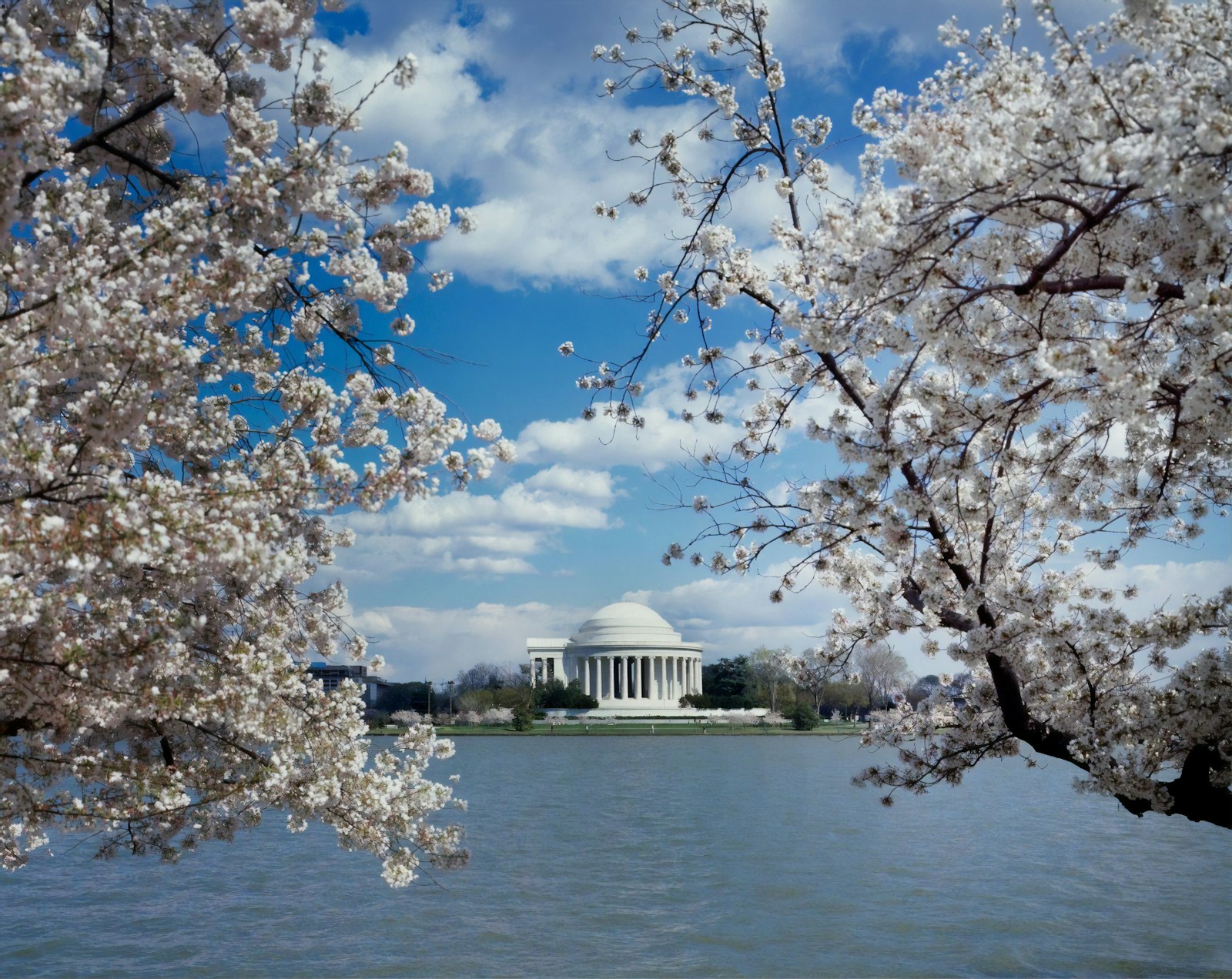
Cherry blossoms ring the water in early April; paddle boats and the Jefferson dome. | 24–70mm |
| 4. Jefferson Memorial | 38.8814,-77.0365 |
Neoclassical rotunda across the basin; sunset silhouettes and blossom-season frames. | 24–70mm |
| 5. Washington Monument | 38.8895,-77.0353 |
555-foot obelisk; go long from the Mall or shoot reflections from the WWII plaza. | 24–200mm |
| 6. US Capitol, West Front | 38.8860,-76.9995 |
The dome rising over the Mall; blue hour with the terraces lit, reflecting pool at the base. | 16–35mm |
| 7. Martin Luther King Jr. Memorial | 38.8863,-77.0443 |
Stone of Hope carved from the Mountain of Despair; morning side-light on the granite. | 24–70mm |
| 8. World War II Memorial | 38.8894,-77.0405 |
Fountains and pillars with the Monument centered behind; floodlit after dark. | 16–35mm |
| 9. Netherlands Carillon, Arlington | 38.8882,-77.0695 |
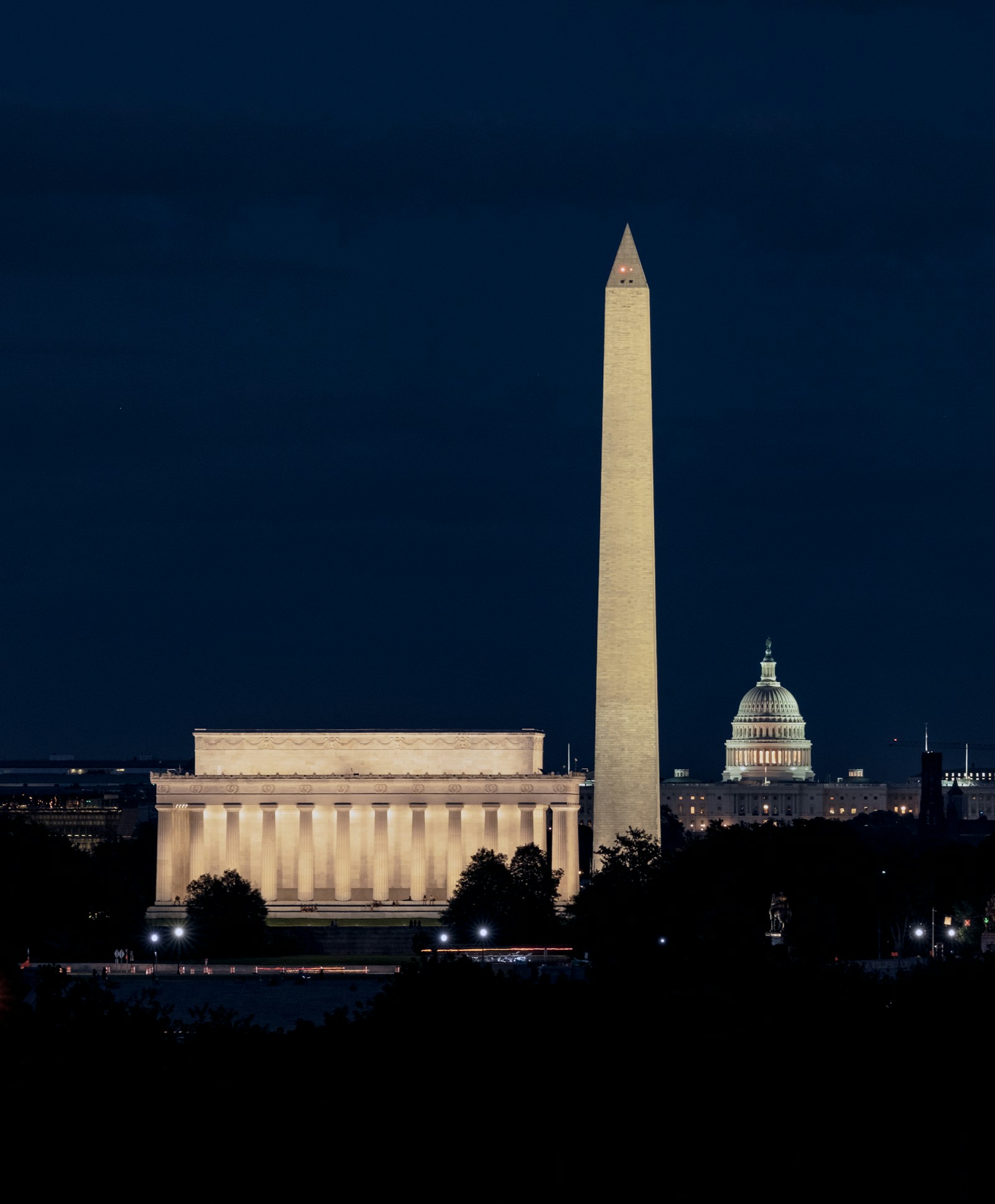
The best skyline view of DC: Lincoln, Washington, and Capitol in one dawn line. | 70–200mm |
| 10. Georgetown Waterfront Park | 38.9029,-77.0653 |
Potomac boardwalk with the Kennedy Center and Key Bridge; kayakers at golden hour. | 24–70mm |
| 11. Union Station | 38.8970,-77.0064 |
Beaux-Arts main hall with coffered gold ceiling; tripods allowed, go at quiet hours. | 16–35mm |
| 12. Vietnam Veterans Memorial | 38.8913,-77.0477 |
The black granite Wall in low morning light; reflections of names and visitors. | 24–70mm |
Detailed vantage point guide for Washington, D.C.
Each vantage point below includes a detailed composition guide, the best time of day and year, transit notes, and the specific technical challenges you will encounter at each location. Read this section before you arrive so you can solve problems before you are standing in fading light with the wrong lens mounted.
1. Lincoln Memorial
GPS: 38.8893,-77.0502, Focal Length: 16–35mm
Columns glow at blue hour; shoot the statue with the chamber lights behind.
2. Lincoln Memorial Reflecting Pool
GPS: 38.8893,-77.0447, Focal Length: 24–70mm
The Washington Monument doubled in still water; the classic dawn reflection.
3. Tidal Basin
GPS: 38.8841,-77.0385, Focal Length: 24–70mm
Cherry blossoms ring the water in early April; paddle boats and the Jefferson dome.
4. Jefferson Memorial
GPS: 38.8814,-77.0365, Focal Length: 24–70mm
Neoclassical rotunda across the basin; sunset silhouettes and blossom-season frames.
5. Washington Monument
GPS: 38.8895,-77.0353, Focal Length: 24–200mm
555-foot obelisk; go long from the Mall or shoot reflections from the WWII plaza.
6. US Capitol, West Front
GPS: 38.8860,-76.9995, Focal Length: 16–35mm
The dome rising over the Mall; blue hour with the terraces lit, reflecting pool at the base.
7. Martin Luther King Jr. Memorial
GPS: 38.8863,-77.0443, Focal Length: 24–70mm
Stone of Hope carved from the Mountain of Despair; morning side-light on the granite.
8. World War II Memorial
GPS: 38.8894,-77.0405, Focal Length: 16–35mm
Fountains and pillars with the Monument centered behind; floodlit after dark.
9. Netherlands Carillon, Arlington
GPS: 38.8882,-77.0695, Focal Length: 70–200mm
The best skyline view of DC: Lincoln, Washington, and Capitol in one dawn line.
10. Georgetown Waterfront Park
GPS: 38.9029,-77.0653, Focal Length: 24–70mm
Potomac boardwalk with the Kennedy Center and Key Bridge; kayakers at golden hour.
11. Union Station
GPS: 38.8970,-77.0064, Focal Length: 16–35mm
Beaux-Arts main hall with coffered gold ceiling; tripods allowed, go at quiet hours.
12. Vietnam Veterans Memorial
GPS: 38.8913,-77.0477, Focal Length: 24–70mm
The black granite Wall in low morning light; reflections of names and visitors.
Camera settings cheat sheet for Washington, D.C.
Settings vary by scenario. Use this as a starting point and bracket exposures in challenging light:
| Scenario | ISO | Aperture | Shutter | Notes |
|---|---|---|---|---|
| Golden hour landscape | 100–400 | f/8–f/11 | 1/125–1/500s | Expose to protect highlights; lift shadows in RAW |
| Blue hour cityscape | 400–1600 | f/8 | 2–15s (tripod) | Balance ambient and artificial light |
| Night cityscape | 800–3200 | f/5.6–f/8 | 5–30s (tripod) | Use self-timer or cable release to eliminate vibration |
| Street photography | 400–3200 | f/2.8–f/5.6 | 1/125–1/500s | Continuous AF; burst mode for candid moments |
| Interior architecture | 400–3200 | f/5.6–f/8 | 1/30–1/125s (tripod) | Check permissions; keystone correction in post |
| Waterfront long exposure | 100 | f/11 | 30–120s (ND filter) | 10-stop ND filter; remote release; mirror lock-up |
| Sunrise landscape | 100–200 | f/8–f/16 | 1/30–1/250s | Arrive 30 min before sunrise; bracket 3 frames |
Lens and gear recommendations for Washington, D.C.
The essential kit for Washington, D.C. photography covers three focal ranges: wide (16–35mm or equivalent) for architecture and sweeping landscapes, standard zoom (24–70mm f/2.8) as the workhorse for 80% of shots, and telephoto (70–200mm) for compressed skylines, wildlife, and isolating architectural details from distance.
For mirrorless shooters: a single body with a 24–70mm f/2.8 plus a 35mm or 50mm f/1.8 prime is a viable travel kit. Add a 16–35mm for the wide-angle moments and a 70–200mm for compression. Most photographers bring two bodies to avoid lens changes in challenging conditions.
Essential accessories: a sturdy travel tripod (carbon fiber under 1.5kg), a circular polarizing filter for sky contrast and water management, a 6-stop and 10-stop ND filter for long exposures, extra batteries (cold weather or long shooting days drain fast), and enough memory cards to shoot RAW all day without worrying about space.
US Cities Guide Series
This guide is part of the Shut Your Aperture US cities series: GPS-tagged vantage guides, camera settings cheat sheets, and seasonal light notes for the most-visited cities in the country.
Best months and light conditions for Washington, D.C.
Spring (March–May) and fall (September–November) offer the best combination of moderate temperatures, photogenic skies, and lower crowd density at the main vantage points. Summer delivers the longest golden hours but also peak tourist traffic and, in many cities, haze that degrades long telephoto shots. Winter can produce dramatic low-angle light and clear air — particularly valuable for skyline photography — but requires planning around shorter days and colder conditions.
Day-to-day, plan your shooting schedule around golden hour (first and last hour of daylight) and blue hour (30 minutes after sunset). Midday sun in most urban environments creates harsh, unflattering light for architecture and street photography. Use the midday hours for scouting evening compositions, eating, and transit between vantage points. The four-hour midday block is planning time, not capture time.
Check weather forecasts for partial cloud cover — a single layer of clouds at sunset can transform the sky into a canvas and multiply the quality of any exterior shot. Completely overcast days are excellent for waterfall, forest, and interior photography where diffuse light eliminates harsh contrast.
Getting around Washington, D.C. for photographers
Washington is a walking-and-Metro city: the National Mall core of this guide is a 2-mile pedestrian corridor, and Metro’s Blue, Orange, and Silver lines drop you at Smithsonian station in the middle of it. A car is a liability downtown – parking is scarce and the Mall has no street access. Take Metro or rideshare to the Mall, then walk everything.
Tripods need a reality check here: handheld photography at the memorials is fine, but tripod use on National Park Service land around the memorials can require a permit, and Capitol grounds have their own rules – a monopod draws no attention where a full tripod setup can. Sunrise at the Lincoln Memorial and the Reflecting Pool means sharing the view with almost nobody; the crowds arrive with the tour buses after 9 AM.
 Save
SaveRelated guides nearby
Other photography destinations to explore:
-
Philadelphia
199 km away, city, USA -
New York City
328 km away, city, USA -
Boston
634 km away, city, USA
Frequently asked questions
What is the best time of day to photograph in Washington, D.C.?
The golden hour (first hour after sunrise, last hour before sunset) and blue hour (30 minutes after sunset) deliver the best light in Washington, D.C.. Midday sun is harsh and produces flat, overexposed results. Plan your shooting schedule around the light, not the convenience of sleeping in.
Do I need a permit to photograph in Washington, D.C.?
Personal and editorial photography on public property in Washington, D.C. generally requires no permit. Commercial photography — where a tripod is used for commercial purposes in a public park, or photography takes place on private property — may require a permit. Check with local parks departments and venues before commercial shoots. Drone photography requires FAA Part 107 certification and may be restricted in certain zones near airports.
What gear should I bring to Washington, D.C.?
A versatile zoom lens (24–70mm f/2.8 or equivalent) covers 80% of Washington, D.C. photography. Add a wide-angle (16–35mm) for architectural and landscape work and a telephoto (70–200mm) for compressed city skylines and wildlife. A sturdy travel tripod is essential for blue-hour and night photography. Pack a polarizing filter to manage reflections and deepen sky contrast, and an ND filter (6-stop or 10-stop) for long-exposure water and crowd shots.
What camera settings work best for city photography in Washington, D.C.?
During golden hour: ISO 100–400, f/8–f/11 for sharpness, 1/125–1/500s shutter speed. At blue hour and night: ISO 800–3200, f/5.6–f/8, use a tripod and shoot 2–30 second exposures for light trails and long exposures. Shoot RAW files in all conditions — the extra dynamic range rescues highlights and shadows that JPEG cannot recover.
When is the best season to visit Washington, D.C. for photography?
Spring and fall offer the best combination of comfortable temperatures, lower tourist density, dramatic skies, and ideal light angles. Summer delivers long days with extended golden hours but peak crowds. Winter can offer dramatic weather and clear air, with lower humidity removing haze from long telephoto shots. Research any unique seasonal events – the late-March to early-April cherry blossom peak around the Tidal Basin, the July 4th fireworks over the Mall, and the quiet winter months when the memorials stand nearly empty – that create once-a-year photographic opportunities in Washington, D.C..
Plan a Washington DC outing with Klook
Check the departure point, timing and route before booking. This is a sightseeing outing, not photography instruction.
What to Pack
A landscape kit built around wide views, steady support, and changing light is a useful starting point. Compare the gear and choose what fits your camera, budget, and conditions. These links lead to B&H Photo Video and Amazon.
| What & Why | B&H | Amazon |
|---|---|---|
Sony 16-35mm f/2.8 GM Check the camera mount before buying. Choose a focal length that fits the photos you plan to make. | Shop B&H → | Shop Amazon → |
Peak Design Travel Tripod Check the load rating, packed size and local tripod rules before buying. | Shop B&H → | Shop Amazon → |
Breakthrough X4 CPL Check the filter type and lens thread size before buying. Use a filter only when the effect fits your photo. | Shop B&H → | Shop Amazon → |
Breakthrough X4 10-stop ND Check the filter type and lens thread size before buying. Use a filter only when the effect fits your photo. | Shop B&H → | Shop Amazon → |
Sony NP-FZ100 battery Use the battery type specified for your camera. Bring a spare if your shooting plan calls for one. | Shop B&H → | Shop Amazon → |
SanDisk Extreme Pro 128GB Check the card format and speed requirements specified for your camera. | Shop B&H → | Shop Amazon → |
Koh microfiber cloths Compare this option with your current kit. Check compatibility and the product details before buying. | Shop B&H → | Shop Amazon → |
B&H and Amazon links are affiliate links. We earn a small commission on purchases at no extra cost to you.