Best Photography Spots in Miami: A Local Shooter’s Guide (2026)

Location Guides  /  Florida

Miami is harsh light, hard colors, and a tight golden hour — pair this guide with our landscape photography guide for the filters, white-balance moves, and exposure habits that hold up in tropical sun.

Best Photography Spots in Miami: A Local Shooter’s Guide (2026)

Real timing, real parking headaches, real permit requirements — 14 locations worth your memory card.

By the Shut Your Aperture Team  •  Updated June 2026  •  16 min read

It’s 6:04 a.m. on a Tuesday in January. You’re standing at the 10th Street lifeguard tower on South Beach — the one painted in seafoam green and coral — and the sun hasn’t cleared the water yet but the sky behind you is already doing something ridiculous. Lavender going orange going pink, all of it reflected in the wet sand from the overnight tide. Two joggers. A guy walking a greyhound. That’s it. You fire the shutter and in the back of your head you already know this is the frame.

That’s Miami. It hands you these moments if you know where to stand and when to show up.

This guide covers 14 locations across Miami-Dade — from South Beach to the Everglades edge — with the kind of detail you only get from actually scouting the shots: which lifeguard tower number to target, where to park without losing $40, when the Wynwood security guards change shift, and which venues will ask you to buy a commercial permit before you even uncap your lens. Browse our interactive travel photography map to see them all plotted, or dig into the broader travel photography location library for more guides like this one.

Why Miami is Different from Anywhere Else for Photography

Photographers who’ve shot in Los Angeles, New York, or New Orleans often show up in Miami and immediately feel like something is off with their mental model. The light here is not like LA light. LA has haze and marine layer that softens everything. Miami’s light — especially from November through April — is punishing and direct, bouncing off white sand and glass towers with almost no diffusion. The shadows are brutal. The highlights clip fast. You’re essentially shooting on a mirror.

The color is the other thing. Art Deco architecture in candy pastels, murals that cover entire city blocks, tropical vegetation that goes deep saturated green against a sky that’s often an implausibly deep blue. Miami is one of the few cities in the world where you can max out your saturation slider and still have the image feel restrained.

Then there’s the humidity. From June through September, the air feels solid. Glass fogs. Metal corrodes faster than you’d expect. A morning session can cover your rear element in fine salt mist if you’re shooting near the water. And the afternoon thunderstorms — coming in daily from the southwest around 3 or 4 p.m. — produce the most dramatic skies you’ll find anywhere in the continental US. Shoot into them, not away from them.

The crowds are a legitimate factor too. Ocean Drive on a Saturday in February is roughly like Times Square with better lighting. Wynwood on a weekend afternoon has more photographers than models. The locals who’ve figured out Miami photography all operate on a simple principle: get up earlier than everyone else, and plan your access for the shoulder seasons. That’s the whole secret.

Understanding aperture and depth of field is foundational to making any of these shots work — the aperture guide on this site covers it properly if you need a refresher before you go.

1. South Beach / Ocean Drive — The Lifeguard Towers

The lifeguard towers are the most photographed structures in Miami, which means the worst versions of these shots are everywhere and the best versions are rare. The difference is almost entirely about timing.

AddressOcean Drive between 1st and 15th St, Miami Beach
Best TimeSunrise (6–7:30 a.m.) or last 45 min of sunset
Best SeasonNov–Apr (cleaner skies, lower humidity)
ParkingOcean Drive parking garage (13th St) or street meters — both expensive

The towers everyone wants are at 10th, 13th, and 14th Street — the pastel ones that go seafoam, coral, and that specific aquamarine that looks Photoshopped even in real life. The 10th Street tower sits in front of Lummus Park with a long clean approach from the sand. The 14th Street tower is taller and gets a better sky reflection in the wet sand at low tide. Check tide charts the night before; you want to shoot during or just after high tide as it recedes.

For the architecture-forward shot with Art Deco hotels behind the tower, face west during sunrise: the warm light hits the hotel facades directly while the tower is slightly backlit, giving you natural separation. For the pure tower-against-sky composition, face east at sunrise — but get there at least 30 minutes before the sun breaks the horizon.

Local Tip The towers are painted on a rotation by the City of Miami Beach, and the colors do change. The turquoise-and-yellow tower near 14th was repainted in late 2024. Check Miami Beach’s official social accounts or the preservation board’s newsletter if you’re planning around a specific color scheme.

Parking: The Collins Avenue / 13th Street garage runs about $3–5/hour early morning and jumps fast after 9 a.m. Street meters on Ocean Drive are 8 a.m. to midnight. Your best move is to park on the street on Collins north of 17th before the meters kick in and walk south — the 15-minute walk is worth it compared to sitting in a line of SUVs. Rideshare drop-off on Ocean Drive is unrestricted before 7 a.m.

2. South Pointe Park — Pier + Skyline at Sunrise

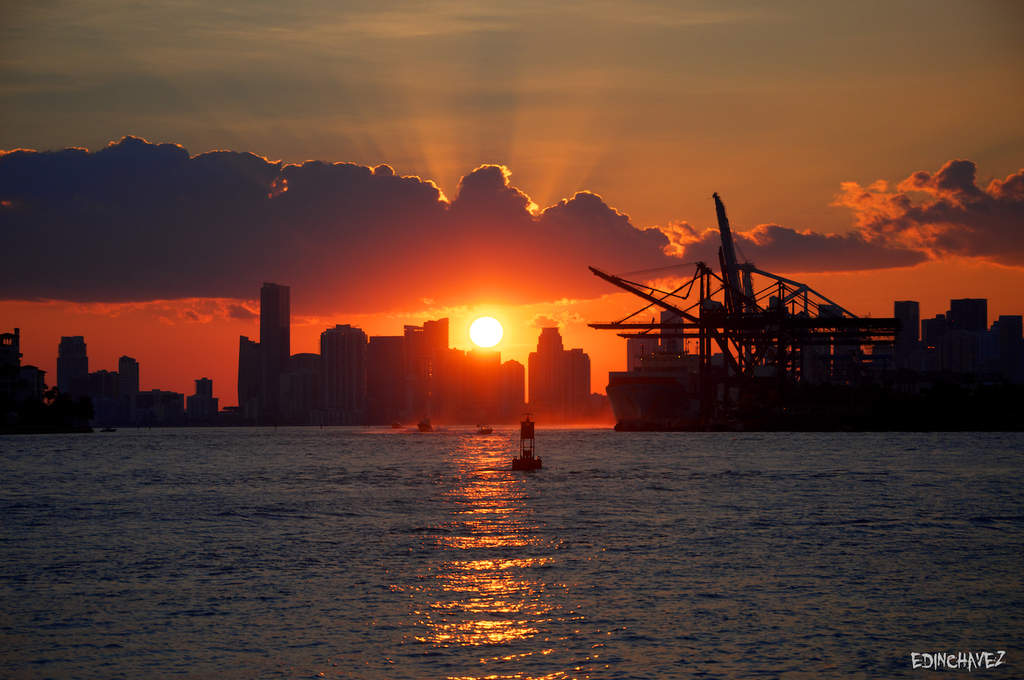
South Pointe is where you go when you’re serious. The rest of South Beach is sleeping, and you’re at the southern tip of Miami Beach at 5:45 a.m. with the entire Miami skyline across the water going from black to deep purple to gold.

Address1 Washington Ave, Miami Beach, FL 33139
Best Time30 min before sunrise through first hour of light
Best SeasonDec–Mar (clearest skies, most predictable color)
ParkingSouth Pointe Park lot on Washington Ave — free before 8 a.m., then metered

The pier extends north-northeast into the Government Cut channel. You want to shoot from the pier’s west railing, looking northwest toward downtown Miami. The Brickell skyline comes up on the horizon with cruise ships occasionally framing the background — those ships leave Government Cut between 5 and 6 a.m., so if you’re there early enough, you can catch the ship transit framed against the lit-up skyline. That’s a shot most people have never seen because most people are not at a pier at 5:30 a.m.

Use a 24–70mm zoom here. Wide gets the whole skyline but flattens the towers. Tightening to 70mm compresses the buildings beautifully and exaggerates the pink-to-blue gradient in the sky. Bring a tripod — the pier has a slight sway and anything under 1/60s will show it.

Local Tip The fishing community is out here early and they are protective of railing space. Be respectful of their lines — move to the left side of the pier (north end) and you’ll have clean water between you and the skyline with no interference. They’ve been coming here longer than Instagram has existed.

3. Wynwood Walls — Murals Without the Mob

You’ve seen a thousand Wynwood photos and they all look the same: a person posed in front of a mural, Instagram-ready outfit, ring light from somewhere. The actual photography here can be genuinely interesting if you go at the right time.

Address2520 NW 2nd Ave, Miami, FL 33127 (Wynwood Walls entrance)
Best TimeTuesday–Thursday, 7:30–9 a.m. (open at 7 a.m.)
Best SeasonYear-round; murals refresh frequently — new work goes up at Art Basel (Dec)
ParkingPaid lots on NW 24th St or NW 2nd Ave — expect $10–20 after 10 a.m. Metered street parking on NW 26th St

Wynwood Walls opens at 7 a.m. The first hour and a half on a weekday is the only time you’ll get clean shots of the major murals without people in them. By 10 a.m. on any day, the tour groups arrive and the light gets harsh overhead. Overcast mornings are actually ideal here — the murals are all vertical and in a courtyard-style space, so diffused light eliminates the shadows that a direct sun angle throws across the lower half of every panel.

The outer block murals — on NW 25th Street and NW 2nd Avenue — are accessible 24 hours. These change more frequently and some of the most interesting recent work happens on the perimeter rather than inside the main paid compound. A wide-angle lens (16–24mm) is the right call for the full panels; step back across the street for the building-scale pieces.

Local Tip The security staff at the main entrance rotates shifts around 8 a.m. In that window, they’re often more relaxed about where photographers position themselves. The murals on the east-facing NW 2nd Ave exterior catch the best direct morning light between 7:30 and 9, then go into shadow — so sequence your shots starting on that side.

Permit note: Personal and editorial photography inside Wynwood Walls does not require a permit. Commercial photography — defined loosely as anything with a model, a product, or a client — requires permission from Goldman Properties. They do enforce this.

4. Lincoln Road — Architecture, People, and the Long Perspective

AddressLincoln Road Mall, Miami Beach (between Alton Rd and Washington Ave)
Best TimeLate afternoon (3–5 p.m.) for long shadows; early morning for architecture
Best SeasonOct–Mar for manageable crowds; Art Basel week (Dec) for street energy
Parking17th St Garage ($2/hr first two hours) is the move

Lincoln Road is a pedestrian mall, which means no car traffic and long compression lines when you shoot with a telephoto. Standing at the Washington Avenue end and shooting west with a 70–200mm collapses the whole boulevard into an abstract of awnings, palms, and mid-century Modernist facades. At 4 p.m. in January, the shadows from the concrete pergolas create a repeating geometric pattern across the pavement that’s worth a dedicated half-roll on its own.

For people photography, the outdoor café seating along the center offers genuine candid material. Miami Beach has no general restriction on street photography of people in public spaces. Use a 50mm or an 85mm and shoot from the hip or from a seated position — the elevated perspective of standing draws more attention here than it does anywhere else on the beach strip.

Local Tip The farmers market runs on Sunday mornings year-round. It’s not particularly photogenic in itself, but the mix of vendors, locals, and tourists creates people-photography conditions you won’t find on a Tuesday. Set up at the east end near Washington and let the foot traffic bring the shots to you.

5. Vizcaya Museum and Gardens Permit Required

Vizcaya is the most visually layered photography location in Miami-Dade. The 1916 Italian Renaissance villa, its formal gardens, and the stone barge sitting in Biscayne Bay form a combination of architecture, water, and horticulture that genuinely has no equivalent anywhere else in the southeastern US.

Address3251 S Miami Ave, Miami, FL 33129
Best Time9–11 a.m. (gardens) / mid-morning for loggia interiors
Best SeasonNov–Apr (low humidity, better sky conditions)
ParkingFree on-site lot — arrive early on weekends; fills by 11 a.m.

The loggia — the open arched gallery on the bay-facing side of the main house — is the money shot for architectural photography. The arches frame the Biscayne Bay view in a way that feels Renaissance Italian transplanted to subtropical Florida, which is exactly what it is. Morning light hits the eastern garden face directly; by noon it’s overhead and flat. Shoot the loggia from the garden side between 9 and 11 a.m. for the best arch-and-water framing.

The stone barge sits just off the main landing on the bay. It’s accessible via the seawall walkway. Shoot from the landing looking south-southeast with the barge in foreground and the bay behind — a polarizer here is non-negotiable for cutting the water glare and bringing out the stone detail. The Breakthrough Photography X4 CPL handles the high UV index here better than cheaper glass does.

Local Tip The gardens are arranged in a formal French pattern with a central axis. The best symmetry shots are from the second-floor balcony of the east wing overlooking the south garden — it’s technically interior access, but the door is often left open on weekday mornings. If it’s closed, the upper terrace on the main building’s roof gives a comparable angle.

Permit: Personal and editorial photography is included with general admission ($22). Any commercial shoot — model, product, video — requires a separate filming/photography permit starting at $500/half-day. Vizcaya’s event coordination office manages these and they do check. Drone photography is not permitted.

6. Bayside / Bayfront Park — Miami Skyline at Blue Hour

Address301 Biscayne Blvd, Miami, FL 33132 (Bayfront Park)
Best TimeBlue hour (15–30 min before sunrise or after sunset)
Best SeasonNov–Feb for clearest skies and best color balance
ParkingBayside Marketplace garage — free first hour, then $3–4/hr

The classic Miami skyline shot — the one you’ve seen on every travel piece — comes from the north end of Bayfront Park, looking west from the seawall. At blue hour after sunset, the towers are lit from within while the sky behind them transitions through a specific shade of deep teal that Miami seems to do better than any other city. Your exposure needs to balance both the ambient sky and the interior building lights, which means bracketing or shooting at ISO 400–800 on a tripod and accepting a 4–8 second exposure.

The fountain in the south end of Bayfront Park gives a foreground element for wider shots. Shoot at f/8 to f/11 for front-to-back sharpness. Long exposures will smooth the bay surface completely, which works well with the hard geometry of the skyline above it.

Local Tip American Airlines Arena (now Kaseya Center) is directly to your north and its exterior LED array throws orange and purple spill light after 8 p.m. on event nights. Check the Heat’s schedule before you go — an event night adds chaos and crowds but occasionally produces interesting ambient light on the water.

7. Pérez Art Museum Miami / Maurice A. Ferré Park

Address1103 Biscayne Blvd, Miami, FL 33132 (PAMM); Ferré Park directly south
Best TimeEarly morning (8–10 a.m.) for museum exterior; any time for Ferré Park
Best SeasonYear-round; PAMM exterior is shaded — less time-of-day sensitive
ParkingMuseum garage off NE 13th St, or street parking on Biscayne Blvd

The Pérez Art Museum’s exterior is genuinely striking architecture — Herzog and de Meuron’s hanging gardens (vertical planters suspended from the canopy on steel cables) make for an unusual compositional element that bridges the building and the sky. The west-facing bay overlook from PAMM’s terrace is one of the cleanest skyline views in the city and it’s free to access even without museum admission.

Maurice A. Ferré Park runs south along the waterfront and connects to Museum Park. The open lawn gives you a long clean line toward both PAMM and the Frost Museum dome — a 70–200mm shot from the park’s south end compresses both buildings together into a tight architectural cluster with Biscayne Bay behind them.

Local Tip The blue vertical light installation on the museum’s bay-facing exterior illuminates after dark. Shooting from the seawall in the park at dusk gives you the lit museum against the last of the sky — underexposed by about a stop, it reads as very deliberate contemporary architecture photography.

8. Little Havana / Calle Ocho

Calle Ocho is SW 8th Street, and it runs about 20 blocks through the heart of Little Havana. It’s the most authentically Cuban neighborhood in the continental US and also the most overtly photogenic street in Miami that doesn’t require waking up before 5 a.m.

AddressSW 8th St between SW 17th and SW 27th Ave, Miami
Best TimeWeekday afternoons (2–5 p.m.) for Domino Park; mornings for cigar shops
Best SeasonYear-round; Calle Ocho Festival (March) is special but also chaotic
ParkingStreet parking is genuinely available on side streets — try SW 14th Ave or SW 15th Ave

Maximo Gomez Park — universally called Domino Park — sits at SW 8th Street and SW 15th Avenue. Old men play dominoes here every afternoon, and they’ve been doing it since before Miami was photogenic. The park is covered by a tiled roof that creates beautiful dappled light on the tables in the afternoon. Use a 50mm or 85mm with a wide aperture — f/1.8 to f/2.8 — and focus on hands and faces. Ask permission first. Most players are not bothered by photographers who ask, and will wave off photographers who don’t.

The cigar shops on Calle Ocho — El Credito, La Gloria Cubana, several others — often have rollers working in the front window. The combination of warm interior light, tobacco leaf texture, and the rollers’ focused expressions is some of the best light you’ll find indoors anywhere in the city. Ask the shop owner before pointing a camera inside.

Local Tip The Block 22 section between SW 14th and SW 16th is where the genuine local culture is concentrated. The stretch east of SW 12th is increasingly touristy and staged. Spend your time west of that point.

9. Coral Castle — Homestead’s Magnificent Oddity

Address28655 S Dixie Hwy, Homestead, FL 33033 (about 40 min south of Miami)
Best TimeWeekday mornings at opening (8 a.m.)
Best SeasonNov–Apr to avoid summer humidity and afternoon storms
ParkingFree on-site lot

Edward Leedskalnin built this 1,100-ton coral rock structure alone, at night, over 28 years, using tools he made himself. No one watched him build it. No one knows exactly how he moved stones weighing up to 30 tons. The place is surreal and strange and it photographs beautifully because of it — a completely original built environment with no architectural reference point anywhere in the world.

The rocking chairs, the stone table, the telescope, and especially the nine-ton gate that swings open with one finger are all worth individual compositions. The light is overhead and unfiltered most of the day — a polarizer helps control the sky and the buff-gray coral surface’s reflectivity. Arrive at opening on a Tuesday or Wednesday and you may have the place nearly to yourself for the first hour.

Local Tip The admission fee includes a self-guided audio tour, but the audio player is bulky and gets in the way. Skip it and do the self-guided version on your phone — the Coral Castle website has a text-based version. Your hands will thank you when you’re holding a camera.

10. Coral Gables — Venetian Pool and the Biltmore

AddressVenetian Pool: 2701 De Soto Blvd, Coral Gables, FL 33134 | Biltmore: 1200 Anastasia Ave
Best Time9 a.m. at Venetian Pool (opens at 10 a.m. — shoot exterior before opening); Biltmore at golden hour
Best SeasonYear-round; pool is closed in winter (Nov–Mar) but the exterior is still accessible
ParkingStreet parking in the De Soto Plaza area; metered, usually available

The Venetian Pool is a 1923 public swimming pool carved from a coral rock quarry and dressed up with Venetian-style architecture — loggias, towers, a waterfall, bridges. When it’s not in operation (the pool drains and refills nightly with well water), the rock walls and Mediterranean detailing photograph like a location scout’s dream. Shoot the exterior facades from across De Soto Boulevard; the towers are perfectly framed from that angle in the hour after opening.

The Biltmore Hotel one block south is one of the finest examples of Mediterranean Revival architecture in the US. The tower — modeled after the Giralda in Seville — goes orange-gold in the last 45 minutes before sunset. The hotel’s manicured grounds are accessible to walk; the pool terrace requires guest status or a restaurant reservation, but the exterior grounds are open.

Local Tip Commercial photography at Venetian Pool requires a separate permit from the City of Coral Gables ($175–350 depending on crew size). Personal photography is fine with admission. The city does have enforcement staff who check.

11. Key Biscayne / Crandon Park — Mangroves at Sunrise

AddressCrandon Park: 6747 Crandon Blvd, Key Biscayne, FL 33149
Best TimeSunrise — park opens at 8 a.m. but the northern mangrove edge is accessible via the Crandon Park Marina entrance (open earlier)
Best SeasonOct–Apr; summer brings crowds and afternoon storms
Parking$8/vehicle entry fee; marina parking separately metered

Crandon Park’s north end has a mangrove estuary that catches the sunrise light in a way the beach side doesn’t. The mangroves create a labyrinthine network of aerial root systems that reflect in the still water — at sunrise, when the light comes through horizontally from the east, the roots cast long shadows across the glassy surface. A 100–400mm or a macro lens works beautifully here. There are ibis, herons, roseate spoonbills, and the occasional manatee.

The main beach, further south, is a classic barrier island setup — long white sand, turquoise water, good for wide landscape work. Less interesting from a photographic standpoint than the mangrove edge unless the conditions (clouds, wind chop, light) are exceptional.

Local Tip A kayak rental from the marina gives you access to the inner channels of the mangrove network. From inside the forest, looking back toward the open water at sunrise, is a completely different shot than anything you’ll get from the shore. Kayak Miami rents from this location and opens early.

12. Bill Baggs Cape Florida State Park — The Lighthouse

Address1200 S Crandon Blvd, Key Biscayne, FL 33149
Best TimeSunrise (lighthouse faces east) and sunset for side light
Best SeasonNov–Apr; park is open year-round but summer humidity is severe
Parking$8/vehicle; the lot near the lighthouse fills on weekends by 9 a.m.

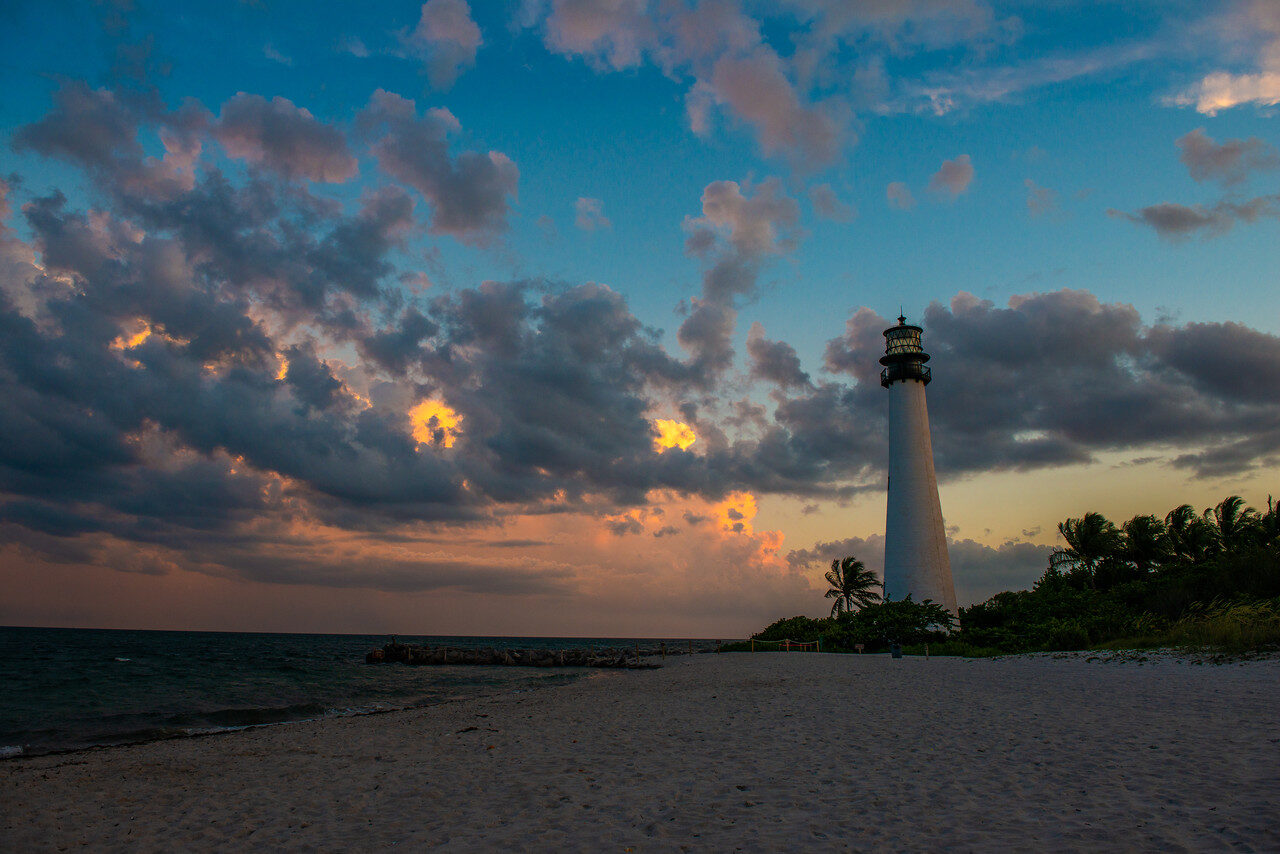
The Cape Florida Lighthouse (1825, rebuilt 1846) is the oldest standing structure in Miami-Dade County. It stands 95 feet tall at the southern tip of Key Biscayne, surrounded by the natural scrub and beach that predates every other thing in this guide. The lighthouse itself is brick-red at the base and white at the upper tower — the contrast with the blue sky and the Atlantic beyond it is genuinely dramatic.

Sunrise here is worth the 5 a.m. alarm: the lighthouse catches the first light on its east face while the western side is in cool shadow, giving you a clean split-light effect without any fill. A 24–70mm at around 35mm captures both the full tower and the beach vegetation in the foreground. If you can get there on a morning with high-altitude clouds, the crepuscular rays through those clouds and behind the lighthouse are extraordinary.

Local Tip The lighthouse offers guided climbs on Thursday through Monday at 10 a.m. and 1 p.m. — reservations required through the Florida State Parks system. The view from the top is a 360-degree shot of the Atlantic, the bay, downtown Miami, and the Keys to the south. The steps are narrow and your gear bag will need to be slim.

13. Brickell + Metromover — The Architecture Loop

AddressStart at Brickell City Centre, 701 S Miami Ave — ride the Metromover from Brickell Station
Best TimeMid-morning for Brickell; golden hour for glassy tower reflections
Best SeasonYear-round
ParkingUse the Metromover — it’s free and runs every 3 minutes

The Metromover is an automated elevated rail loop that runs through downtown and Brickell, and it’s free. From the elevated stations and cars, you get eye-level and above views of Miami’s glass towers that are impossible from street level. The Brickell loop passes through a section of the financial district where the towers are so close together that from inside the Metromover car you’re looking directly into upper floors — reflections, geometry, light patterns. This is genuinely unique to Miami; no other US city has a free transit system that doubles as an elevated photography platform.

Shoot through the windows with your lens pressed against the glass (use your jacket as a buffer to prevent reflections). A fast shutter — 1/500s or faster — freezes the motion. Shoot in burst mode and edit down. The Brickell station at ground level, looking north toward the Brickell City Centre’s glass atrium facade, is worth 30 minutes of its own.

Local Tip The Metromover runs until midnight and the city lights from the inner loop at night are a genuinely different shot — blue-lit financial towers, traffic light trails below, the bay visible between buildings. Evening on a Tuesday or Wednesday is the lowest-traffic window.

14. Design District — Architecture and Sculpture

AddressNW 2nd Ave between NE 38th and NE 42nd St, Miami
Best TimeEarly morning (8–10 a.m.) before retail opens; or late afternoon for sculptures in golden light
Best SeasonYear-round; Art Basel week (Dec) brings temporary installations
ParkingPaid lots on NE 39th St — arrive before 9 a.m. for reasonable rates

The Design District is Miami’s luxury retail and gallery quarter, but its architecture and permanent public art installations make it genuinely interesting for photography beyond the obvious fashion-blogger-in-front-of-Louis-Vuitton content. The Institute of Contemporary Art is free and its interior has excellent natural light through skylights. The street-level facades — particularly the perforated metal screens and the custom tile work on several boutiques — give you detailed abstract compositions at any time of day.

The permanent sculpture installations scattered through the district include work by Ugo Rondinone, Elmgreen and Dragset, and others — check the current installation list on the Design Miami website before going. The Rondinone piece at NE 40th Street catches the low western sun perfectly in the last hour before it drops behind the buildings.

Local Tip The district’s upper-level walkways (the second-floor retail passage above NW 39th Street) are usually empty in the early morning. From up there, looking down at the courtyard space and the street-level architecture, you get a perspective most people never see because most people don’t bother going upstairs before the stores open.

Bonus: Stiltsville — Requires a Boat

AccessBoat only — 1 mile offshore in Biscayne Bay, within Biscayne National Park
Best TimeGolden hour — sunrise (east-facing) or sunset (west-facing)
Best SeasonApr–Oct (calmer bay conditions)
AccessCharter from Coconut Grove or Bayside marina; kayak from the Bill Baggs shoreline (advanced, not recommended without experience)

Seven weathered wooden houses on stilts in the middle of Biscayne Bay, remnants of what was once a larger community of 27 structures. They’ve survived hurricanes, federal attempts at demolition, and nearly a century of salt air. From a boat at golden hour, with the stilted houses in silhouette against a Miami sunset and the city skyline visible in the far distance, this is unlike anything else in American photography. It’s genuinely otherworldly.

You cannot land on the structures. Photography from the water is unrestricted. A guided photography tour from one of the outfitters operating in Coconut Grove is worth considering — they know the position in the bay where the houses, the bay, and the city skyline align for the best composition. Consider a guided photography tour of the bay for this shot; the logistics alone are worth having local support for the first visit.

Local Tip The houses face different directions. The cluster that faces roughly west gives you the best sunset silhouette. Bring a 200–400mm if you can — shooting tight on individual structures from a rocking boat requires as much focal length as you have.

Bonus: Everglades / Anhinga Trail — For Nature Shooters

AddressAnhinga Trail, Royal Palm area, Everglades National Park, FL 33034 (about 60 min SW of Miami)
Best TimeSunrise or first two hours of morning light
Best SeasonNov–Apr (dry season — wildlife concentrates near water)
ParkingFree at Royal Palm trailhead; park entrance fee $35/vehicle

The Anhinga Trail is a half-mile boardwalk loop over Taylor Slough where the wildlife is so accustomed to humans that you can get within 6 feet of anhingas, herons, cormorants, alligators, and purple gallinules without a hide. In the dry season, when the slough levels drop, all of these animals concentrate along the trail edges in extraordinary density. A 100–400mm or a 500mm f/5.6 is ideal; you can also make extraordinary close-up shots with a 70–200mm because the wildlife will come to you.

The anhinga itself — a black waterbird that spreads its wings to dry after diving — is one of the most cooperative portrait subjects in North American wildlife photography. They sit still for extended periods on branches over the water. In December and January, the light at sunrise through the cypress and saw grass creates a warm haze that’s uniquely Everglades.

Local Tip Get there as close to sunrise as possible. By 10 a.m. the light is harsh, the tourists arrive in force, and the wildlife retreats to the shade. The first two hours after opening are the entire reason to make this drive.

Gear Setup for Shooting Miami

Miami presents three specific problems that most other US cities don’t: extreme UV, salt air, and humidity. None of them are insurmountable, but all three will damage unprotected gear over time and ruin individual shots if you don’t account for them.

Body: Weather Sealing

If you’re shooting near the beach or in the Everglades in summer, weather sealing matters. Salt spray from ocean-facing positions will find its way into any gap. A body rated for weather resistance handles both the marine environment and the afternoon rain squalls.

Sony α7 IV at B&H →

Filter: Circular Polarizer

Non-negotiable in Miami. The water, the white sand, and the glass towers all produce glare that a polarizer cuts without affecting colors the way post-processing adjustments do. Use it at Vizcaya’s barge and anywhere on the water.

Breakthrough X4 CPL at B&H →

Microfiber Cloths

Bring more than you think you need. Salt mist deposits on your rear element between shots and it happens faster than you’ll expect. Wipe your glass before every new setup.

Microfiber cloth multi-pack on Amazon →

Lenses

A 24–70mm f/2.8 (or f/4 for lighter weight) handles 80% of Miami’s locations. Add a 70–200mm for Brickell compression, wildlife at the Everglades, and the Domino Park portraits. A wide prime (16–24mm) for Wynwood Walls.

Keep your gear bag out of direct sun when not shooting. The interior of a car parked in Miami sun hits 140°F+ within 20 minutes. Heat warps lens elements, drains batteries faster, and degrades the lubricants in zoom rings over time. Carry your bag into wherever you go, or use an insulated bag with a mylar liner.

For tripods: carbon fiber over aluminum at the beach. The aluminum joints on cheap tripods corrode within a season of salt air exposure. Wash your tripod legs with fresh water after every beach shoot.

Best Months and Golden-Hour Times

Miami sits at 25.8° north latitude, which means the sun moves differently here than in Chicago or New York. The summer sun is nearly overhead at midday; the winter sun stays lower in the sky and golden hour lasts longer.

Seasonal Breakdown

  • November–January: The best photography months. Sunrise around 6:45–7:10 a.m., sunset around 5:30–5:45 p.m. Clear skies, manageable humidity, dramatic light angles. Tourist season starts picking up in December.
  • February–April: Still excellent. Sunrise creeps earlier (6:30 a.m. by April), humidity starts rising but remains workable. Spring break crowds hit South Beach mid-March through early April.
  • May–June: Transition period. Humidity up, afternoon thunderstorms begin. But the thunderstorm skies in June — before the official summer pattern locks in — can be spectacular. Good for dramatic weather photography.
  • July–September: Full summer. Humidity is oppressive, afternoon storms are daily and intense. Not ideal for most photography, but the post-storm light (when the storm breaks quickly and the sky goes dramatic orange) is unlike anything else. Hurricane season — check forecasts and be prepared to reschedule.
  • October: The sweet spot that not enough photographers know about. Crowds thin dramatically after Labor Day, humidity starts dropping, and the October light has a quality that January doesn’t — longer golden hours, slightly more atmospheric haze that adds depth to skyline shots.

Permits You Actually Need

Permit Quick Reference

  • South Beach / Ocean Drive (public beach): No permit for personal or editorial photography. Commercial shoots with crew of 5+ require a City of Miami Beach film permit ($150–750/day).
  • Vizcaya Museum: Personal photography included with admission ($22). Commercial shoots start at $500/half-day through Vizcaya’s events office. Drone photography: not permitted.
  • Wynwood Walls (interior compound): Personal photography with admission. Commercial/model shoots require Goldman Properties approval.
  • Venetian Pool (Coral Gables): Personal photography with admission. Commercial photography permit from City of Coral Gables ($175–350).
  • Biltmore Hotel: Exterior grounds (public access): no permit. Interior/pool: hotel permission required, negotiated directly.
  • Bill Baggs / Crandon Park (State Parks): Personal photography: no permit. Commercial photography: Florida State Parks commercial use permit required ($150–500/day depending on crew).
  • Everglades National Park: Still photography: no permit for personal use. Commercial photography: NPS commercial use authorization required ($50 application fee + day-use fee). Drone photography: prohibited.
  • Stiltsville: Photography from water within Biscayne National Park: no permit required. Landing on structures: not permitted.

Want a local-led shoot? Browse Miami photography tours and walks on Viator. (Affiliate link — supports SYA at no cost to you.)

FAQ

What’s the single best photography spot in Miami for a first-time visitor with limited time?

South Pointe Park at sunrise. It’s accessible, uncrowded at 5:45 a.m., requires no permit, has free early parking, and delivers the Miami skyline shot in conditions that are hard to replicate anywhere else. If you can only be at one place at golden hour, that’s the one.

Is street photography legal in Miami?

Yes. Florida has no state-level restriction on photography of people in public places. Miami Beach, Coral Gables, and the City of Miami all follow the general First Amendment standard — anything visible from a public place can be photographed. Private property (hotel lobbies, the interior of Wynwood Walls, shopping malls) is another matter and the management’s rules govern there.

How bad is the parking situation, really?

Bad enough to plan around. On South Beach in season (December–April), garages on Collins and Ocean Drive fill by 9 a.m. on weekends and rates double after 10 a.m. The practical solution for most locations is rideshare drop-off for sunrise shoots, or parking north of 17th Street and walking south. For Wynwood and the Design District, paid lots exist but the rates are reasonable before 9 a.m. Little Havana and Coral Gables have the most available free or metered street parking of anywhere on this list.

Can I fly a drone over South Beach or Biscayne Bay?

This is complicated. South Beach falls under Class B airspace for Miami International Airport and the Miami Executive Airport area. Most of the coastal areas require FAA Part 107 authorization via the LAANC system before any drone flight. Biscayne National Park prohibits drones entirely. Vizcaya and the state parks prohibit them. The Wynwood neighborhood has no specific ban but you’re still in controlled airspace. Check the B4UFLY app and get your LAANC authorization well before the trip.

What time does it get light enough to shoot without a tripod in Miami in January?

In January, civil twilight starts around 6:20 a.m. and the sun clears the horizon around 7:05–7:10 a.m. Shooting handheld without a tripod at a usable ISO (1600 or below) on a full-frame body becomes practical around 6:45–6:50 a.m. — about 15 minutes before sunrise. If you’re shooting with a weather-sealed body and a reasonably fast lens, that window is enough for most beach locations. For the Everglades and Key Biscayne, the tree cover delays usable light by another 10–15 minutes.

© 2026 Shut Your Aperture. All rights reserved.

Affiliate disclosure: Some links on this page are affiliate links. We earn a small commission if you purchase through them, at no additional cost to you.

The Working Photographer's Kit

What to Pack

Urban photography rewards a small, fast, flexible kit. Here is what travels well to Miami — links go to B&H Photo Video (our primary supplier) and Amazon for accessories.

What & WhyB&HAmazon
Standard zoom (24-70mm)
The single best urban walkaround lens. Wide enough for streets, tight enough for portraits and details.
Shop B&H →Shop Amazon →
Fast prime (35mm or 50mm)
For low-light blue-hour streetwork and cafe interiors where a tripod is not welcome.
Shop B&H →Shop Amazon →
Compact travel tripod
For blue-hour skylines and long exposures from bridges and rooftops.
Shop B&H →Shop Amazon →
Variable ND filter
Cuts daytime light for slow-shutter motion in busy urban scenes.
Shop B&H →Shop Amazon →
Extra batteries (3 minimum)
A full day of street shooting drains two batteries minimum. Carry three.
Shop B&H →Shop Amazon →
Lens cleaning kit
Fingerprints and urban grime appear fast. Clean between every coffee stop.
Shop B&H →Shop Amazon →
Anti-theft camera strap
Quick-release plus security cable. Worth the investment in any major city.
Shop B&H →Shop Amazon →

B&H and Amazon links are affiliate links. We earn a small commission on purchases at no extra cost to you. We only recommend gear we use or would buy ourselves.