

Updated October 2026.
Smooth footage starts before you press record. Pick a subject, decide where the shot begins and ends, and walk the route without a camera first. A motorized gimbal can keep the horizon steady. It cannot decide what belongs in your frame or stop your footsteps from lifting the camera.
This guide covers the original DJI Osmo with the Zenmuse X3 camera, introduced in 2015. It is not the Osmo Pocket, Osmo Mobile, Osmo Action or Osmo+. The goal is a dependable shooting setup and a sensible used-kit check, based on DJI’s original-model documentation. This is not a hands-on review. The city and landscape photographs illustrate composition and are not presented as Osmo samples.
Know which Osmo you have
The original system combines a detachable X3 camera and three-axis gimbal with a handle, removable battery and phone holder. Unlike a phone gimbal, it has its own camera. The phone supplies a live view and settings through a Wi-Fi connection and the legacy DJI GO app. The handle has a joystick, record button, shutter button and trigger.
DJI identifies the camera as X3/FC350H, with a 1/2.3-inch CMOS sensor and approximately 12.4 million effective pixels. Still images reach 4000 x 3000 pixels, and JPEG and DNG RAW are listed. Those specifications belong to this original camera, not to the larger sensors or newer processing found in other products sharing the Osmo name.
The lens is a fixed f/2.8 wide-angle design, listed at a 20mm full-frame-equivalent view and 94-degree field of view. It is not an interchangeable zoom. DJI lists focus at 3.5m with a suitable range of 1.5m to infinity. Keep close subjects outside that limit unless you have tested the actual result. Do not assume face tracking or close autofocus from a newer camera applies here.
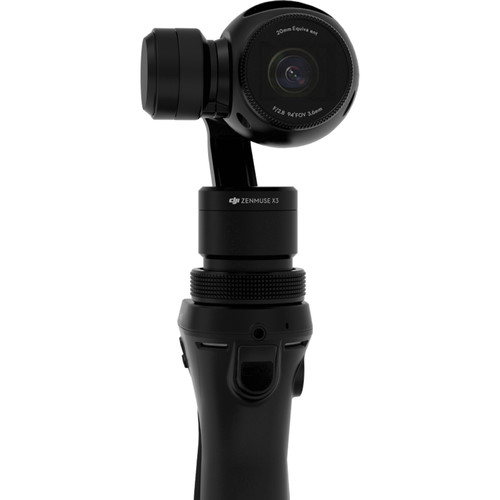
Unlock the gimbal before shooting
The transport locks protect the three motor axes. Follow the original manual’s unlocking order rather than pulling the camera head against resistance. DJI specifically warns to unlock the tilt motor before the roll motor. Check the pan-axis lock too. For ordinary startup, the manual recommends unlocking before powering on.
Inspect the securing ring and camera connection before use. A detachable assembly should be seated and secured correctly, not supported by a loose connection. Do not force it into position or hold the camera head still while the motors fight your hand. If it beeps or behaves strangely, stop and check the locks and setup.
After recording, power down and use the documented transport-lock procedure. Carry the unit in a protective case instead of letting the camera head swing against other gear. This matters on an older kit: bent parts, damaged stops or a loose mount may affect operation even when the camera still turns on.
Learn the trigger before the fancy modes
In the original manual, holding the trigger enables Lock Mode. The camera holds its current direction while you move the handle; releasing the trigger returns to SmoothTrack. Double-tapping centers the camera. A triple tap enters Selfie Mode in the upright and underslung modes described by DJI. Practice those controls somewhere safe before walking through a busy scene.
Lock Mode is useful when you want to keep a subject framed while moving your hand. SmoothTrack is useful when the shot should follow a deliberate change in handle direction. Neither setting makes every movement look intentional. Choose one behavior, rehearse it and review the saved clip before adding a second movement.
Use the joystick for a controlled adjustment rather than a nervous search for the subject. Leave room before and after the main action so the clip has an edit point. A short, well-planned movement is easier to use than a long take that wanders between unrelated details.
Connect and test the actual phone
The original Osmo uses its own Wi-Fi network and DJI GO, not DJI Mimo or a Bluetooth-only phone-gimbal workflow. Follow the original Osmo support instructions for connection and activation. An archived list of supported phones does not prove that your current phone and operating system work today.
Before buying a used unit, test the app installation, connection, live view, settings and playback on the phone you intend to use. If activation is required, confirm that the official process works. Do not accept a seller’s old screenshot as proof. Ask DJI about the exact model and software path if a step is unavailable.
Check whether the phone fits securely in the original holder with its case attached. Keep cables clear of the moving head. The phone screen is a monitoring tool; inspect the actual recording from the microSD card as well. A successful live preview does not prove that the card received a clean full-resolution file.
Build one reliable video setup
DJI lists 4096 x 2160 at 24 or 25p and 3840 x 2160 at 24, 25 or 30p. The first is the wider cinema-style 4K frame; the second is UHD. Choose the resolution and frame rate for your project, then keep them consistent where practical. Do not promise 4K60 by confusing this camera with a later Osmo.
The original model records MP4 or MOV using H.264/MPEG-4 AVC, with a maximum listed bitrate of 60Mbps. A container choice is not a different sensor or an automatic quality upgrade. Record a normal test clip, open it in your editing software and make an export before depending on the workflow.
Slow motion needs extra care because DJI’s own documents differ. The March 2016 v1.2 manual lists 1080p120; the March 2017 v1.4 specification table and current original-model support table list 1080p100. The support page also identifies a narrower 47-degree slow-motion view. Check the installed firmware, menu and exported file rather than treating an old 120fps line as a universal promise.
Choose exposure deliberately. For motion, shutter speed affects how movement looks; it does not stabilize the camera. Bright sunlight may require a compatible neutral-density filter for your preferred exposure. Check the exact X3 filter fit and clearance. Keep a normal reference clip so you can judge whether a change actually helped.
Walk for the shot, not for the specification
A three-axis gimbal corrects rotational movement. It does not cancel every vertical rise and fall from walking. Bend your knees slightly, take measured steps and keep your upper body calm. Watch the path rather than staring only at the phone. If the route is unsafe, change the route or make a stationary shot.
Start with a straight move toward a distant subject. Keep foreground objects out of the path, and avoid sudden turns. Review the horizon and the beginning and end of the movement. Once that works, try a slow side move with a clear foreground and background. Change one variable at a time.
For a city shot, choose the building or bridge that anchors the frame. Bright windows and reflections can pull attention away from it. Let the movement reveal something useful instead of moving simply because you own a gimbal. A locked-off view may tell the story better.
Record sound you can actually use
The handle has a built-in microphone and a 3.5mm external microphone input. DJI’s manual says an external microphone overrides the built-in microphone, and notes that the internal microphone can pick up gimbal-motor noise. Smooth video does not mean quiet audio.
Make a spoken test with the microphone, cable and mounting position you intend to use. Play the recorded file back on a separate device. Listen for motor noise, wind, handling noise, distortion and missing channels. Do not assume any microphone with a 3.5mm plug is electrically or physically suitable. Check the exact compatibility guidance.
Keep the microphone and cable away from the moving axes. For important speech, plan a separate recording option and a clear sync cue if needed. Test the whole process before the event. An attractive moving shot is not much help when the words are unusable.
Stills, panoramas and long exposures
The original X3 can make JPEG and DNG stills. Use DNG when you want a RAW editing workflow, but verify that your software reads the files. Keep the lens clean, check the horizon and protect important bright areas. A larger file is not a substitute for thoughtful light and framing.
Automatic panorama modes rotate the camera and capture a sequence. Choose a scene with enough consistent detail for the sequence, and avoid expecting moving people or very close objects to stitch perfectly. Inspect the joins and the final crop. A panorama still needs a strong subject, not simply a wider sweep.
The old launch copy made handheld long exposures sound certain. They are not a guarantee. The manual’s long-exposure guidance still tells you to hold the camera still for the entire shutter duration. Use suitable support when the scene permits and inspect fine detail. The gimbal cannot freeze moving water, leaves or people during a long exposure.
Time-lapse needs a stable plan
Choose a scene that changes: clouds crossing a landscape, shadows moving across a wall or people passing through a fixed composition. Decide how much change you need before selecting the interval and duration. Make a short test first so you can check exposure consistency and the resulting sequence.
Use a stable, compatible support where permitted. The old promise of automatic tripod-free time-lapse ignores changes in position, wind and accidental bumps. Keep the setup secure and supervised. If you move the camera for a hyperlapse, plan the path and framing carefully rather than assuming stabilization repairs every step.
Check battery and card capacity before starting. Avoid placing the camera where it blocks a walkway or exposes the kit to spray. A landscape composition that works as one photograph may need different framing when the sky or light changes over a longer sequence.

Cards, power and weather
DJI’s original documentation specifies microSD cards up to 64GB, Class 10 or UHS-I. Follow that model-specific guidance rather than assuming a much larger modern card is supported. Use a known-good card, record a sustained test and verify the files. Back them up before formatting anything.
The original battery is identified as HB01-522365, a removable 980mAh pack. Actual useful runtime depends on condition and operation; an old battery is not restored by repeating a launch-era runtime claim. Inspect it for swelling or damage and use the appropriate compatible charger. Follow DJI’s battery safety instructions and temperature limits.
The manual explicitly says the Osmo is not water resistant and should be kept away from sand and dust. Treat rain, surf and blowing sand as reasons to protect the kit or stop. Wipe it with a soft dry cloth after use; do not spray cleaning liquid into the assembly. A used unit’s clean exterior does not rule out internal moisture damage.
Check the complete used kit
Ask for the exact camera, handle, battery, charger, phone holder and case included in the sale. Test every button, the joystick, trigger, gimbal movement, Wi-Fi, card recording, stills and audio. Check the saved files on a computer. Include a realistic return window so you can inspect more than the power light.
Do not assume every Zenmuse camera swaps straight onto the handle. The original manual describes compatibility with an Inspire 1 X3 under a specific firmware condition. That does not establish that the Osmo X3 works on an aircraft, or that an X5 requires no additional parts. Verify the exact camera, adapter, firmware and intended direction of use with DJI.
Use the original Osmo download area and v1.4 manual for model-specific instructions. Read firmware precautions before updating, and keep power stable. This guide makes no current stock, repair-service or price promise. Buy only after the entire kit and software path meet your needs.
Frequently asked questions
Which DJI Osmo does this guide cover?
The original 2015 Osmo with the Zenmuse X3 camera, not Osmo Pocket, Mobile, Action or Osmo+.
Does it use my phone as the camera?
No. The X3 is the camera. The phone provides monitoring and settings through Wi-Fi and the legacy DJI GO app.
Does a gimbal remove walking bounce?
It controls rotational movement, but does not cancel every vertical movement from footsteps. Rehearse the route and inspect the recording.
Is the original Osmo water resistant?
No. The original manual says it is not water resistant and should be kept away from sand and dust.
Does it record 4K at 60fps?
The original documentation lists 4096 x 2160 at 24/25p and 3840 x 2160 at 24/25/30p, not 4K60.
Will the old DJI GO app work on my current phone?
Verify the actual installation, connection, activation and recording workflow with DJI and your phone before buying. An old compatibility list is not a current guarantee.
Gear to check for an original Osmo kit
Verify exact model, condition and compatibility before buying. These are shopping starting points, not promises of stock or price.
Original X3 kit: Browse Amazon or B&H. Check the actual item against your setup.
Compatible power: Browse Amazon or B&H. Check the actual item against your setup.
External microphone: Browse Amazon or B&H. Check the actual item against your setup.
Recording card: Browse Amazon or B&H. Check the actual item against your setup.
Affiliate disclosure: This article contains affiliate links. If you buy through them, we may earn a commission at no extra cost to you. As an Amazon Associate, we earn from qualifying purchases.
For practical photography tips, visit the Shut Your Aperture Academy. Build your understanding of light and composition alongside your camera setup.


