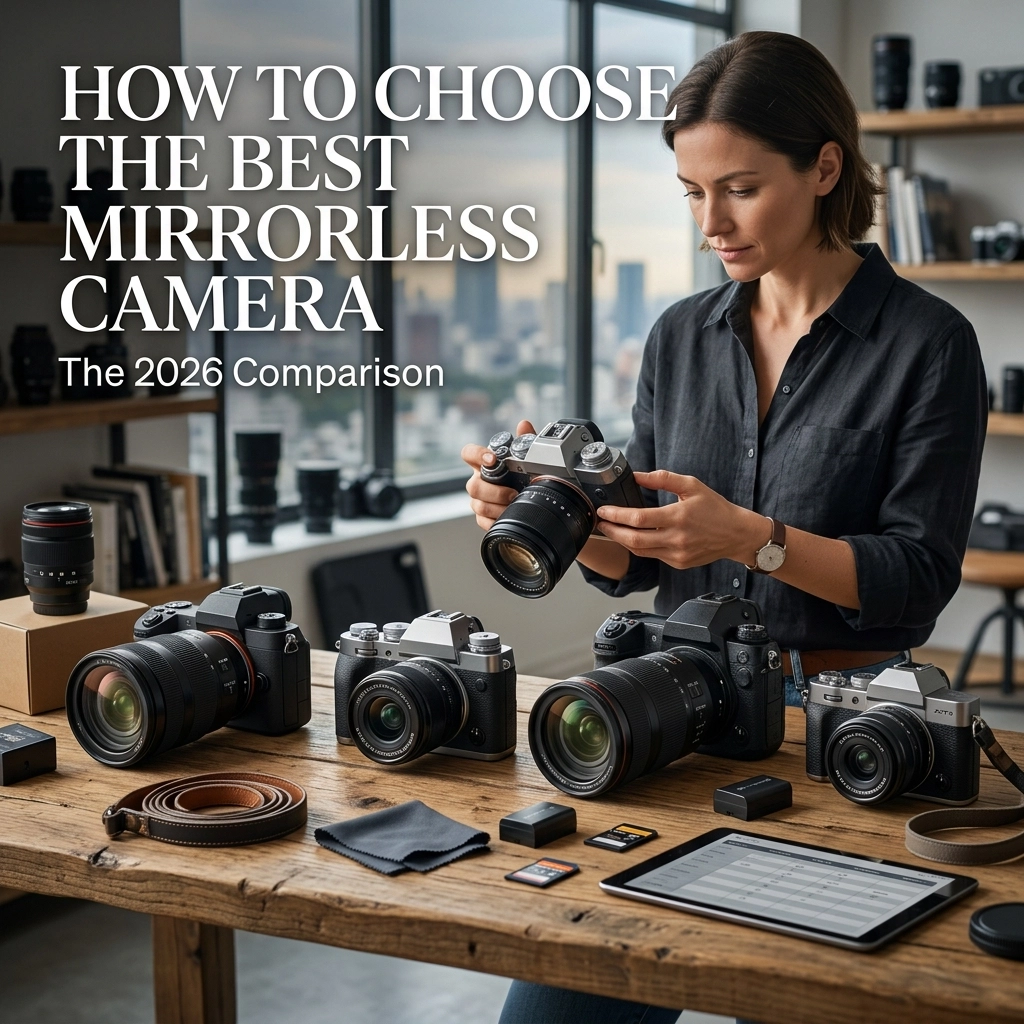
How to Choose a Mirrorless Camera in 2026: The Real Comparison
She’d been standing in front of the mirrorless wall at B&H for twenty minutes. A Sony rep in a blue shirt had already walked past twice, doing that careful thing where they try to make eye contact without seeming pushy. She had her phone out, comparing spec sheets side by side, and she was no closer to knowing what to buy than she’d been on the subway down to 34th Street. Her budget was real. Her shooting situation was specific. But every review she’d read had told her everything except the thing she actually needed to know.
That scenario happens constantly. On photography forums, in gear groups, in the DMs of every photographer who posts anything about their kit. The mirrorless market in 2026 is genuinely excellent and genuinely overwhelming. More good options does not mean easier decisions.
This is not a ranked list. It is a decision framework. Four questions that actually separate the right camera from the wrong one for your situation, plain talk on sensor sizes and mount ecosystems, and concrete picks by use case. If you want a spec-by-spec chart that ends with “the Sony won,” this isn’t that. If you want to understand what you’re buying, keep reading.
The Four Questions That Actually Matter
Most people start with the wrong question. They start with brand loyalty, or with whatever camera their favorite YouTuber is holding, or with “what has the best image quality” — which is a question with a thousand correct answers depending on what “best” means for your work. Here’s a better sequence.
What are you shooting?
This is not a generic opener. It’s the actual filter that eliminates 70% of the options immediately. Wedding and event photographers need dual card slots, reliable autofocus in mixed light, and a body that won’t die halfway through a reception. Landscape shooters need resolution and dynamic range, not 30fps burst shooting. Street photographers need something that doesn’t look like a threat. Video-first operators need codecs, not still-image scores. Before you even look at a camera body, write down the three situations you’ll be shooting most often in the next two years. That list is your spec sheet.
Full frame or APS-C?
The gap between a good APS-C sensor and a full-frame sensor has closed dramatically. In 2026, cameras like the Fujifilm X-T5 and Sony A6700 produce images that would have looked like medium-format output five years ago. That said, the gap is not zero, and it matters in specific situations: very high ISO shooting in the dark, very large prints where the extra resolution headroom is real, and the lens availability math that comes with a bigger system. APS-C cameras are also physically smaller, meaningfully cheaper, and optically different — a 50mm lens behaves like a 75mm equivalent on a crop sensor, which is worth knowing before you show up to a tight indoor venue. Neither choice is wrong. But they are different, and you should pick based on your actual work, not on the idea that full frame is “more serious.”
Hybrid or stills-first?
The word “hybrid” has been diluted into meaninglessness by marketing. Every mirrorless camera shoots video now. But there is a real difference between a camera designed around the still-image workflow that can also shoot decent video, and a camera built from the ground up to do both without compromising either. If 40% or more of your paid work is video — social content, events, documentary, commercial — you want a camera that handles heat properly, gives you proper log profiles out of the box, and ideally has a fan or an open-gate sensor mode. If you mostly shoot stills and occasionally throw up a reel, any of the main bodies will handle that without you ever thinking about it. The distinction matters because cameras that try to be true video workhorses often make ergonomic and menu-system tradeoffs that stills photographers find annoying, and vice versa.
What mount can you afford to commit to?
This is the question people skip, and it is the one that will cost them the most money over time. Camera bodies change every few years. Lenses last decades. The mount you choose today is the ecosystem you’re locking yourself into, and switching systems later means either selling everything or absorbing the cost of adapting lenses that don’t perform as well as native glass. Sony E-mount has the deepest third-party ecosystem. Canon RF is tightly locked down but Canon’s own glass is exceptional. Nikon Z is genuinely excellent and more open than RF. Fuji X is beloved but smaller. L-mount (Panasonic and Sigma share it) gives you access to some of the most optically pure primes available. Micro Four Thirds has the widest lens library of any mirrorless system, period. None of these are bad. But they are different bets, and you’re making one either way, so make it consciously. We break this down further below.
Body Type and Handling: The Stuff Reviews Gloss Over
Ergonomics are almost impossible to communicate through a review, yet they determine how much you actually enjoy using a camera. A photographer with medium hands who shoots street will find a deep-grip camera like the Nikon Z8 exhausting to carry all day. A photographer who shoots wildlife with a 400mm f/2.8 will find a compact body like the Sony A7C II borderline unusable — the balance is just wrong.
There’s no objective right answer here, but there are a few useful checkpoints. If you plan to use longer telephoto glass, you need a proper grip depth — the kind that lets all four fingers wrap the camera without your palm grazing the lens mount. If you’re building a compact kit for travel or street work, look at bodies with retractable grips or rangefinder-style layouts. You’ll lose some handling confidence, but you gain a system that actually goes with you.
Electronic viewfinders are another area where spec sheets mislead. A 5.76 million dot EVF sounds impressive, but what you actually care about is refresh rate and blackout time during burst shooting. Shooting action with an EVF that blackouts on every frame is a miserable experience, regardless of the dot count. Look for cameras with at least 120fps EVF refresh if sports or moving subjects are part of your work. You can learn more about how aperture affects depth of field and how that interacts with EVF display rendering in our foundational guide.
EVF Specs That Actually Matter
Resolution: 3.68M dots is the sweet spot for accuracy. Above that is diminishing returns for most shooters.
Refresh rate: 60fps is fine for stills. 120fps is important if you track action or fast movement.
Magnification: 0.78x and above gives you room to see the full frame clearly. Below 0.70x feels cramped for extended shoots.
Blackout-free: Only matters if you’re shooting bursts above 15fps. Sony, Nikon Z8/Z9, and Canon R3/R5 II have this. Most other bodies don’t.
Sensor Sizes, Explained Without the Condescension
Three sensor sizes show up in mirrorless cameras most photographers will actually consider buying. Here’s the plain version:
Micro Four Thirds (MFT): A sensor roughly 17.3 x 13mm. Smaller, lighter bodies and lenses, and the OM System OM-1 II and Panasonic GH7 prove you can do serious professional work here. The tradeoff is high-ISO noise, which is meaningfully worse than larger sensors. Shooting dark receptions at ISO 6400 regularly? It’s a fight. Shooting in good light or building a compact weather-sealed kit? Entirely legitimate.
APS-C: The “crop sensor.” Roughly 23.5 x 15.6mm. Fuji’s X-Trans sensors have their own color rendering that many photographers genuinely prefer over full frame, and Sony’s 26MP A6700 is excellent. This is where most of the best value in cameras currently lives, and the lens ecosystems — especially Fuji X — are mature enough that you’re not making real compromises.
Full Frame: 36 x 24mm. The “standard” professional format. Better dynamic range, better high-ISO performance, more background separation at equivalent focal lengths. Also heavier and more expensive everywhere — body, lenses, storage. It’s not inherently better than APS-C; it’s better in specific use cases like dark venues, large-format printing, and demanding commercial work.
Medium Format: The Fujifilm GFX 100S II delivers 102MP at a price that reflects it. A real tool for architectural, large-format commercial, and landscape photography where prints exceed 40 inches. For most photographers, it’s beyond their ceiling. If your work is asking the question, it probably already knows the answer.
Mount Commitment and Lens Ecosystem Real-Talk
This is the section most buying guides soften because they don’t want to alienate any brand’s fans. We’re going to be more direct.
| Mount | Best for | Third-party glass | Watch out for |
|---|---|---|---|
| Sony E-mount | General professional work, hybrid, documentary | Excellent — Sigma, Tamron, Viltrox all support it natively | Sony’s own primes can be very expensive; the lens lineup is massive, which can make decisions harder, not easier |
| Canon RF | Stills professionals, wedding, wildlife | Limited — Canon has kept third parties out of full AF support. This will cost you over time. | You are locked into Canon glass prices unless you adapt EF lenses (which works well but adds weight and length) |
| Nikon Z | All-around professionals, landscape, sport | Good and growing — Sigma Z and Tamron Z have arrived, Viltrox has solid options | The system is younger than Sony E, so some specialty focal lengths are still missing |
| Fujifilm X | Street, travel, portrait, documentary | Reasonable — Viltrox covers most of the critical focal lengths | APS-C only. If you ever want full frame, you’re switching systems entirely. |
| L-mount | Video, landscape, commercial stills | Excellent — Sigma Art and DN lenses are the strongest argument for L-mount | The body options are fewer; Panasonic AF has improved but is still behind Sony and Canon |
| Micro Four Thirds | Wildlife, travel, video, compact documentary | Exceptional — largest mirrorless lens library by volume | High-ISO limitations are real. If low light is your main environment, factor that in. |
If you’re coming from a DSLR with Canon EF or Nikon F glass, you don’t necessarily need to replace everything. Both Canon’s RF adapter and Nikon’s FTZ II adapter work very well. Many photographers run adapted DSLR lenses on mirrorless bodies for years. Just know that some older lenses won’t take full advantage of the newer AF systems. Read our complete camera buyer’s guide for more on building a full-system lens kit without starting from scratch.
The Best Mirrorless Camera for Your Actual Situation
These picks are not about which camera “won” in a lab. They’re about which cameras consistently perform for the kind of work in question, based on autofocus reliability, file quality, ergonomics, dual card slots where it matters, and real-world heat and buffer management. Prices shift, so check current pricing at the links below.
Sony A7 IV — The workhorse. Dual card slots, 33MP full frame, excellent AF in any light, real 4K video when you need it. The color science won’t wow you, but the reliability record will. This is what a working wedding photographer actually runs.
Canon R6 Mark II — If you’re already in the RF ecosystem, this is the answer. Canon’s Dual Pixel AF II is still the smoothest autofocus experience in the business for fast-moving subjects in variable light. The 40fps burst at 24MP is useful. Battery life is strong.
Sony A7R V — 61MP with genuinely excellent skin-tone rendering when shot in the right color profile. The AI autofocus subject recognition locks onto eyes even through hair and off-axis subjects. Large files, but that’s the point. You can crop hard and still have a printable image.
Nikon Z8 — 45.7MP, blackout-free shooting, built-in ND filter simulation. Nikon’s color rendering out of camera is warmer and more flattering for skin than Sony’s default. If you shoot a lot of natural light portraits and do minimal post-processing, the Z8 will save you time.
Canon R5 — Still a legitimate portrait tool even with a newer R5 Mark II on market. The 45MP sensor and Canon color science combination is very forgiving, and the price has dropped enough to make it an excellent value if you’re in the RF system.
Nikon Z8 — The best blend of resolution, dynamic range, and field reliability in the full-frame landscape bracket. Weather-sealed, fast for its resolution class, and the Nikon Z lens lineup (especially the 14-24mm f/2.8 S and 24-120mm f/4 S) is optically stellar for wide-angle landscape work.
Sony A7R V — If you need to print very large, 61MP gives you options that 45MP doesn’t. The pixel-shift high resolution mode is remarkable in static scenes. Pair it with a good wide prime and you’re making images that could go on a billboard.
The Fujifilm GFX 100S II lives above both of these if you’re doing professional large-format landscape and commercial work where the budget permits. It’s a different conversation entirely.
Fuji X100VI — A fixed-lens camera that shouldn’t be the answer but keeps being the answer. The 40MP X-Trans sensor, built-in ND filter, IBIS, and the way this camera simply disappears into a crowd make it one of the best street photography tools ever made. The catch: it’s still hard to find in stock at retail price.
Sony A7C II — Full frame in a body small enough to not announce itself. The 33MP sensor, IBIS, and Sony’s subject recognition AF work together in a package that travels genuinely well. Pair it with the 35mm or 50mm f/1.8 and you have a surprisingly compact full-frame kit.
OM System OM-1 II — If weather sealing and weight matter more than sensor size, nothing in this price range touches it. IP53 rated, exceptionally light, and the computational photography features (handheld high-res shot, live ND) are genuinely useful for outdoor travel.
Sony FX3 — The definitive answer for dedicated video work. Fanless but thermally stable, full-frame 4K 120fps, clean HDMI out, excellent color science for S-Log3. It’s a cinema camera wearing a mirrorless body’s clothes. Sony E-mount means native Sigma and Tamron cine-style glass is available and affordable.
Panasonic GH7 — The best value in serious video on a micro four thirds sensor. Internal ProRes, 5.7K anamorphic mode, unlimited recording time, and the V-Log L color science that professional colorists actually like working with. If you’re shooting documentary, social, or event video and want a lightweight rig, the GH7 is a proper professional tool.
Canon R5 C — For photographers who need genuine cinema output without going full dedicated cinema camera. 8K RAW, 12-bit color, but with the same Canon color rendering and Dual Pixel AF that portrait and wedding photographers already trust.
Sony ZV-E10 II — APS-C, Sony E-mount, solid video specs for content creation. The mount matters here: you get access to the entire Sony E third-party ecosystem, which means a 16mm Sigma f/2.8 DN costs about the price of a dinner out. A genuine entry-level camera that doesn’t dead-end your options.
Canon R50 — Canon’s color science and Dual Pixel AF at the lowest rung of the RF ecosystem. The RF mount limitation (no cheap third-party glass yet) is real, but if you’re committed to eventually moving up to R6 II or R5 territory, starting here makes the system logic work.
Nikon Zf — Not actually a budget camera by price, but worth mentioning because of what it is: a full-frame body with a retro aesthetic, excellent sensor, and great ergonomics for photographers coming from a film background. If the look of the camera matters to you — and for some shooters, it genuinely does — the Zf is a credible reason to enter the Z ecosystem.
Understanding how shutter speed interacts with your subject will help you get the most out of whichever body you land on — especially if you’re transitioning from a slower DSLR workflow to the high-speed electronic shutter options that most of these cameras offer.
The Myths to Stop Believing
“More megapixels means better photos.”
Resolution is one variable. A 24MP camera with excellent color science, a sharp lens, and proper exposure will produce images that embarrass a 61MP camera shot through a mediocre lens wide open. Megapixels give you cropping headroom and large-print capability. They do not give you better images automatically. Most photographers sharing online or printing at standard sizes never use the extra pixels meaningfully.
“Full frame is always better.”
Full frame is better at specific things: high-ISO noise, dynamic range, background separation at equivalent field of view. It is not better at: weight, cost, tight indoor spaces, or compact travel kits. A Fujifilm X-T5 with a 23mm f/1.4 Fujinon is more capable for its intended use than a Sony A7 IV with a mediocre kit zoom. System thinking beats sensor-size thinking almost every time.
“Sony’s autofocus is automatically the best for every situation.”
Sony’s AI autofocus is excellent. Canon’s Dual Pixel AF II is, for many shooters doing fast-moving subjects in social and wedding environments, smoother and more predictable. Nikon’s Z8/Z9 AF at high speed is genuinely class-leading. The “Sony always wins AF” narrative was more true in 2020. In 2026, the gap between the top three is narrow enough that most photographers will never feel it.
“Mirrorless is always smaller than DSLR.”
The body can be. The lens often isn’t. Large-aperture mirrorless lenses are physically big because physics hasn’t changed. A Canon R5 with the RF 85mm f/1.2 L is not a small kit. If size and weight are the priority, the camera body is the wrong place to start. Begin with the lens system, then work backward to a body that balances it.
“You need to buy new.”
A used Sony A7 III, Canon R6 first gen, or Nikon Z6 II costs half what it did at launch and is still a capable professional camera. The sensor hasn’t aged. The autofocus is still very good. If your budget is real and having the newest body isn’t a client-facing requirement, buying used is one of the most rational decisions in photography right now.
Frequently Asked Questions
Is the Sony A7 IV still worth buying in 2026?
Yes. The A7 IV has been price-adjusted since its launch and remains one of the most balanced all-around full-frame mirrorless cameras available. 33MP is enough resolution for most professional work, the dual card slots handle professional reliability requirements, and Sony E-mount gives you access to the widest third-party lens ecosystem in full-frame mirrorless. A newer A7 V will arrive eventually, but the IV is not obsolete.
Should I switch from Canon DSLR to Canon mirrorless?
If you have Canon EF glass, the transition to RF mirrorless is the most rational upgrade path available. The EF-RF adapter works well. You’ll gain IBIS on the R6 II and R5, dramatically better autofocus, and video capabilities that Canon’s DSLRs couldn’t touch. The main caution is that native RF glass is expensive, and third-party options at full AF capability are limited. Budget to grow your RF lens library slowly, or plan to use adapted EF glass long-term.
What’s the best mirrorless camera for someone starting out?
The honest answer is: the one in the ecosystem you’ll realistically invest in. If you plan to grow into Sony, start with the ZV-E10 II or the A6700. If you’re drawn to Canon’s color and autofocus, the R50 or R8 makes the system logic work. If you want to understand the craft of photography first and worry about the system later, the Nikon Zf gives you a full-frame sensor and a shooting experience that rewards deliberate technique. Reading up on portrait photography basics before spending money on gear will also save you from buying the wrong focal lengths.
Is Micro Four Thirds dying?
No. The OM System OM-1 Mark II and Panasonic GH7 are both current, competitive, actively-supported professional tools. The MFT lens ecosystem has more total options than any other mirrorless mount, and OM System and Panasonic are releasing new lenses regularly. The format has a real use case: weather-sealed, lightweight, fast-burst shooting in demanding conditions. Wildlife and sports photographers who don’t need extreme low-light performance use MFT professionally, full stop.
How important is in-body image stabilization (IBIS)?
Very, in specific situations — and nearly irrelevant in others. If you shoot handheld video, IBIS makes a significant difference in footage smoothness. If you shoot handheld stills in lower light with slower shutter speeds, IBIS gives you extra stops of shake compensation that can mean the difference between a sharp image and a blurry one. If you’re primarily on a tripod for landscape work, or shooting at fast shutter speeds where shake isn’t an issue, you’ll barely notice whether it’s there. Almost every current full-frame mirrorless camera has IBIS. The notable exception in the budget range is the Canon R8, which skips it to hit its price point.