Best Camera for Newborn Photography in 2026
–
 Save
SaveMore About Cameras For Newborn And Baby Photography
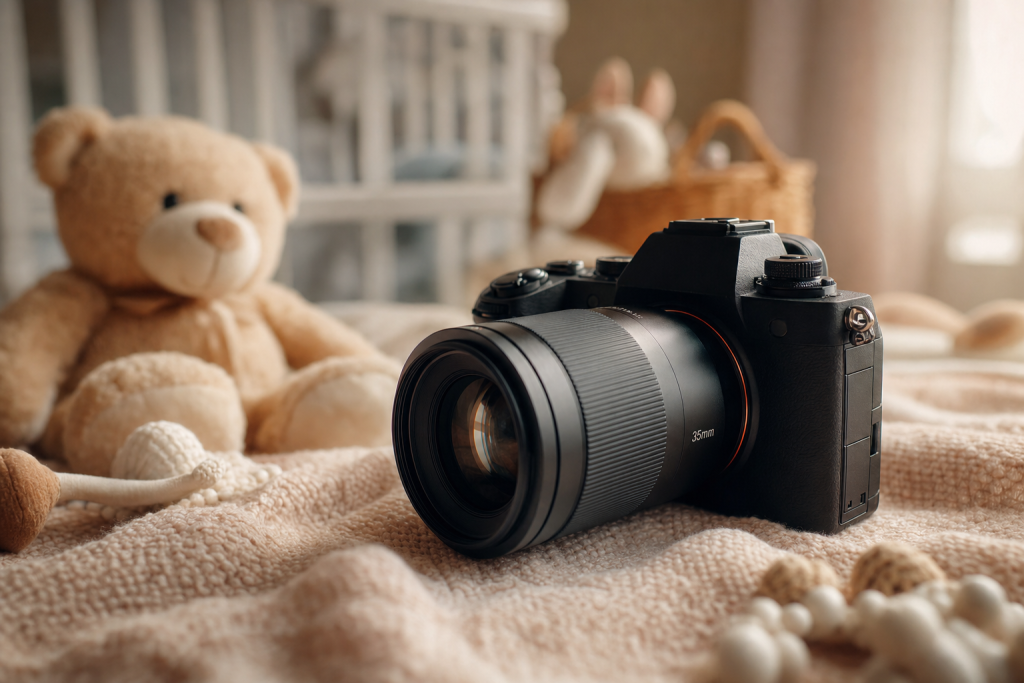
Newborn photography has unique demands: very low light (controlled studio lighting or window light), extreme close-up compositions, and the need to capture fleeting expressions quickly and quietly. The ideal camera is fast, silent, and capable of beautiful depth of field at close distances.
Top Picks: Detailed Breakdown
Here is a closer look at each recommended option, with pros, cons, best use cases, and purchasing information for each pick.
Sony A7 IV — ~$2,499
33MP full-frame, real-time Eye AF with newborn-scale precision, 5.5-stop IBIS, silent electronic shutter (does not disturb sleeping babies), 4K 60fps.
Best for: Professional newborn photographers who need the combination of silent shutter, full-frame sensor, and reliable eye-tracking AF for a sleeping baby’s expression.
Pros:
- Silent electronic shutter — no mechanical noise during sleeping poses
- Real-time Eye AF at extremely close focus distances
- 33MP allows significant crop without resolution loss for tight face compositions
Cons:
- $2,499 body price
- Heavy system when paired with macro/portrait glass
- Menu complexity requires learning investment
Buy the Sony A7 IV at B&H Photo
Canon EOS R6 Mark II — ~$2,499
24MP full-frame, Canon’s industry-leading skin tone accuracy, RF 85mm f/2 Macro IS STM lens pairing, 12fps mechanical / 40fps electronic.
Best for: Newborn and family photographers who value color accuracy and Canon’s ergonomics. The R6 II + RF 85mm f/2 Macro pairing is the most recommended newborn kit by professional photographers.
Pros:
- Best-in-class out-of-camera skin tones — critical for newborn skin rendering
- 8-stop IBIS with RF IS lenses — sharp at low shutter for soft window light sessions
- Canon RF 85mm f/2 Macro IS STM ($599) is the ideal newborn portrait lens
Cons:
- 24MP is lower resolution than Sony A7 IV for aggressive cropping
- RF mount third-party limitations
- 40fps electronic shutter requires fast CFexpress for long bursts
Buy the Canon EOS R6 Mark II at B&H Photo
Fujifilm X-T5 — ~$1,699
40MP APS-C, physical aperture and shutter dials, 7-stop IBIS, Fuji Classic Chrome for skin tone rendering, compact for studio flexibility.
Best for: Newborn photographers who prefer the Fuji color rendering, the control of physical dials, and the 40MP resolution for fine art printing without Sony/Canon price premiums.
Pros:
- 40MP APS-C — highest resolution at this price tier
- Physical dials make exposure changes without looking away from the viewfinder
- Classic Chrome Film Simulation renders warm, creamy newborn skin tones
Cons:
- APS-C sensor — 1.5 stops behind full-frame for dark studio setups
- Tilt-only screen limits low-angle floor compositions
- Face AF slightly behind Canon and Sony in very low light
Buy the Fujifilm X-T5 at B&H Photo
 Save
SaveBuying Guide: How to Choose the Right Option for You
Before purchasing, work through these key decision questions:
What lens is most important for newborn photography?
An 85mm macro (full-frame) or 50-60mm macro (APS-C) is the essential first lens. The Canon RF 85mm f/2 Macro IS STM ($599) is the best single purchase for Canon R-series newborn work. Sony users: the FE 90mm f/2.8 G Macro OSS ($1,100) is the professional choice; the Sigma 65mm f/2 ($499) is excellent value.
Do you shoot in a dedicated studio or in-home?
In-home session photographers need more IBIS to handle window-lit shoots in cramped spaces. The Canon R6 II with RF IS lenses (8-stop IBIS) or the Fuji X-T5 (7-stop body-only IBIS) are the most forgiving for hand-held in-home newborn work.
How important is the silent shutter?
Critical — a sleeping newborn woken by a mechanical shutter click can cost you 45 minutes of re-settling. All three cameras above offer silent electronic shutter modes. Enable it as your default mode for all posed/sleeping work.
Do you print large for clients?
If you offer 20×30″ or larger canvas prints, the Fuji X-T5 (40MP) or Sony A7 IV (33MP) provide the most pixel density for large-format newborn portraits. Canon R6 II’s 24MP is adequate to 30×40″ with clean ISO performance.
What color workflow do you use?
If you deliver warm, creamy newborn skin tones with minimal editing: Canon R6 II out-of-camera color is the most natural. If you use Lightroom presets (Mastin Labs, VSCO) and edit extensively: sensor brand matters less than resolution.
 Save
SaveFrequently Asked Questions
What is the safest way to photograph a newborn?
Always work with a trained newborn posing assistant. Never leave a baby unattended in a prop or elevated position. Composite posing (two separately safe shots merged in Photoshop) is the professional standard for poses that appear risky. No photography is worth a baby’s safety.
What aperture do professional newborn photographers use?
f/2.8–f/4 for most posed shots — sharp on the face with soft background. f/5.6–f/8 for full-body flat-lay shots where the entire pose must be sharp. Avoid f/1.4–f/1.8 for newborns — the depth of field at close focus distance is too narrow to keep the full face sharp.
Do I need a macro lens for newborn photography?
A macro lens (1:1 reproduction ratio) is not strictly required for newborn photography, but the 85mm f/2 Macro’s close-focus distance allows the tighter compositions (hands, feet, face details) that define fine art newborn photography.