Best Camera Settings for Newborn Photography: The Complete Cheat Sheet
~8 min read · Updated 2026-05-10
shutyouraperture-20). Buying through these links costs you nothing extra and helps fund our free guides.
This is the camera settings cheat sheet for Newborn Photography: the mode, aperture, shutter speed, ISO, and focus combination that works — explained, then broken down into three real scenarios you will actually face. No filler. Pin the cheat sheet, read the scenarios, and shoot.
Table of contents
 Save
Save1-minute cheat sheet: Newborn Photography
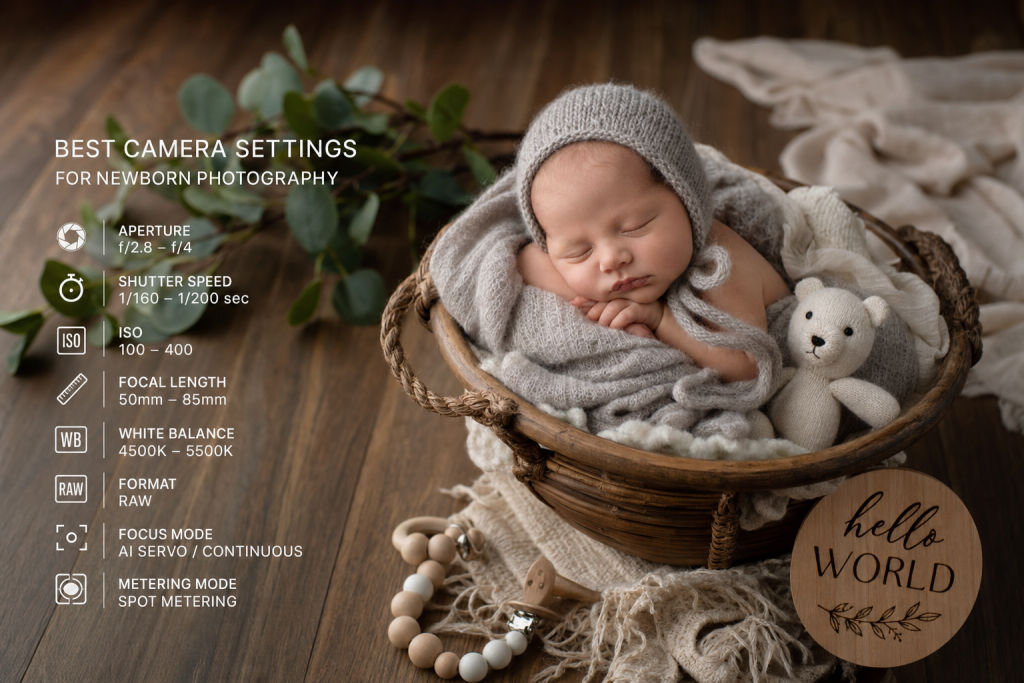
- Mode: Manual (M)
- Aperture: f/2.0-f/2.8 (softer background separation without losing face sharpness)
- Shutter Speed: 1/200 sec minimum (newborns move subtly even while sleeping)
- ISO: 400-800 (maximize ambient light first; avoid ISO 1600+ if possible)
- Focus: Single AF on the nearest eye (or eyes if face is fully visible)
Pin this. Come back to it before every newborn photography session.
Get the complete Newborn Photography settings guide (PDF, $47): The ShutYourAperture Newborn Photography PDF guide: 44 pages covering light setup diagrams, safe posing guidelines, skin tone editing, and client delivery workflows.
Preset pack ($19): ShutYourAperture Newborn preset pack: 5 tones from warm-neutral skin to airy-white haze — all calibrated for pale newborn skin without color-washing.
Bundle both for $54 — save $12. Browse the ShutYourAperture Shop.
Why these settings work
Newborn photography is technically soft, color-sensitive portrait work done in a warm, comfortable environment. The camera settings are straightforward — aperture f/2.0-f/2.8, shutter 1/200 sec minimum to freeze tiny breathing movements, ISO as low as usable ambient light allows. The real challenge is light quality and baby safety. A large softbox or a north-facing window with a white reflector is the ideal light source. Never use direct flash on newborns. Shoot in RAW — skin tone accuracy requires post-processing latitude.
3 scenarios with full settings tables
Three situations you will encounter, with the exact settings for each:
Scenario 1: Window light in-home session
| Mode | Manual |
|---|---|
| Aperture | f/2.0 |
| Shutter Speed | 1/250 sec |
| ISO | 400-800 |
| Focus Mode | Single AF, eye detection |
| White Balance | 5500-6000K (daylight window) |
| Exposure Compensation | N/A (Manual) |
A north-facing window provides the softest, most consistent natural light for newborn photography. Position the baby within 3-5 feet of the window with a reflector or white foam board opposite to fill shadows. Meter off the baby's cheek. At f/2.0, the depth of field is shallow enough that if the baby is angled slightly, only one eye will be sharp — ensure focus lands on the closest eye to camera for a natural result.
Scenario 2: Studio softbox setup
| Mode | Manual |
|---|---|
| Aperture | f/2.8 |
| Shutter Speed | 1/200 sec |
| ISO | 200-400 |
| Focus Mode | Single AF, eye/face detection |
| White Balance | 5600K (standard strobe color temperature) |
| Exposure Compensation | N/A (Manual) |
A large octabox (4-5 feet) at camera-left and 1-2 stops brighter than any fill gives clean, controllable studio newborn light. Position it high (45 degrees) and slightly to the side to create Rembrandt or loop lighting on tiny features. Use a modeling light (not strobe flash) while setting up poses — strobe firing repeatedly near a newborn's face is not necessary; set the shot then fire once.
Scenario 3: Posed macro detail shots (hands, feet, lips)
| Mode | Manual |
|---|---|
| Aperture | f/2.8-f/4.0 |
| Shutter Speed | 1/250 sec |
| ISO | 400 |
| Focus Mode | Single AF, manual position refinement |
| White Balance | Match main session WB |
| Exposure Compensation | N/A (Manual) |
Detail shots of hands, feet, and lips are the signature elements of newborn sessions. Use a 100mm macro or 85mm prime and focus stack 2-3 frames if the depth of field at f/2.8 is too shallow for the whole hand. Stop to f/4.0 for hand shots — you want fingernails visible. Bump ISO if needed; at this focal length, clean files matter more than a thin depth-of-field style look.
Subscribe to the ShutYourAperture Aperture Academy for weekly photography tutorials, or browse the Shop for location PDF guides and Lightroom preset packs.
Gear that helps
You do not need to spend more than your subject demands, but the right gear eliminates the technical obstacles so you can focus on the image. These are the tools the settings above were designed around:
- Canon RF 85mm f/1.2L — the highest-resolution portrait lens for newborn close-up work
- Sony FE 85mm f/1.8 — the best budget-to-quality option for newborn and portrait photographers
- Nikon Z 85mm f/1.8 S — sharpest 85mm prime at f/2.0 on any mirrorless system at its price
- Godox SL150W LED panel — continuous LED light safe for newborns, no flicker at shutter speeds above 1/200
- Westcott 43-inch white umbrella — the cheapest, lightest, and most portable newborn studio light modifier
ShutYourAperture is a B&H Photo affiliate. Links marked with affiliate notation may earn a commission at no extra cost to you.
Lighting and conditions
Newborn babies are extremely light-sensitive and should never be subjected to direct flash positioned near the face. Use continuous LED light (which allows baby to adjust eyes naturally) or strobes positioned at minimum 4 feet from the baby. Keep the room warm — 75-78F is the standard for newborn studio sessions so the baby remains calm undressed. Natural window light on an overcast day is the safest and most beautiful option for in-home sessions.
 Save
Save5 common mistakes
These are the five errors that ruin otherwise well-composed images of newborn photography. Read them before the shoot, not after:
- Shutter speed below 1/200 sec — even "sleeping" newborns breathe and twitch, causing subtle motion blur
- Focus on the blanket or swaddle instead of the face — always ensure eye detection AF has locked on the face before firing
- Working in a cold room — cold babies cry, making posing impossible and client experience poor
- Using apertures wider than f/2.0 for wide face shots — at f/1.4, depth of field is so shallow that one eye is sharp and one is soft
- Using Auto White Balance — AWB drifts between frames and makes batch editing inconsistent; lock WB manually to match your light source
Sample workflow
Here is the shoot checklist condensed into a repeatable sequence:
- Set camera to the recommended mode and aperture before you arrive at the location.
- Dial in the base ISO and shutter speed from the cheat sheet above.
- Take one test frame, check the histogram, and adjust exposure if needed.
- Confirm focus method (AF mode and point, or manual zone) is set correctly.
- Shoot a small burst, chimp once, then commit to the settings and concentrate on the subject.
- At each major lighting change (cloud, shade, new location), repeat the exposure check.
- Back home: import RAW files and apply your base preset before any individual edits.
Post-processing
Newborn skin tones are the most technically challenging to edit correctly. Start with White Balance at 5600-6000K (cooler than portraits of adults). In HSL, desaturate Reds -10 and Oranges -10 slightly to reduce the redness typical of newborn skin without making it gray. Lift Shadows +20 to open deep shadows in skin folds. Apply gentle Skin Softening (Lightroom's masking tools > Person > Skin) at low strength (30-40). Export full resolution with no compression for client delivery — newborn images are frequently printed large.
Preset shortcut: ShutYourAperture Newborn preset pack: 5 tones from warm-neutral skin to airy-white haze — all calibrated for pale newborn skin without color-washing. Available in the ShutYourAperture Shop.
Quick Amazon shortcuts to the gear most useful for this kind of shot. Use them if Prime shipping or Amazon credit makes more sense than B&H. As an Amazon Associate ShutYourAperture earns from qualifying purchases.
Frequently asked questions
What aperture should I use for newborn photography?
f/2.0-f/2.8 for most newborn shots. f/1.4 is only safe for profile shots or when the entire face is parallel to the camera sensor plane. At f/1.4 aimed at a newborn face at a slight angle, one eye will be sharp and one will be out of focus — usually unacceptable to clients. f/2.0 gives you the background separation and the depth-of-field safety margin.
Can I use flash for newborn photography?
Strobes positioned 4+ feet from the baby are safe; direct on-camera flash pointed at the baby's face is not recommended. Most professional newborn photographers use large softboxes 4-6 feet from the subject at low power. If you are doing in-home sessions without studio gear, window light or an LED panel is the safest and most flattering option.
What is the best focal length for newborn photography?
An 85mm or 100mm prime is the standard for portraiture and detail shots — it gives natural perspective without distorting the baby's features. Some photographers use a 50mm for environmental shots showing the baby in context (crib, nursery). Avoid focal lengths shorter than 50mm for close-up face shots — the distortion makes features appear unnatural.
When is the best age to photograph a newborn?
The first 5-14 days after birth. At this age, babies sleep deeply and can be positioned in curled poses typical of newborn photography. After 2-3 weeks, the startle reflex becomes stronger and deep sleep windows shorten, making posed shots more difficult. Schedule sessions in advance and be flexible on timing based on when the baby arrives.
 Save
SaveKeep shooting
More settings cheat sheets from the same cluster:
- Best Camera Settings for Northern Lights
- Best Camera Settings for Milky Way
- Best Camera Settings for Indoor Sports
More at Shut Your Aperture
Browse the Camera Settings Cheat Sheets hub for every genre, or visit the Shop for PDF guides and Lightroom preset packs.
ShutYourAperture participates in affiliate programs. We earn a commission on qualifying purchases at no extra cost to you.
All links go to B&H Photo Video, the trusted pro source. Tagged as affiliate per FTC.