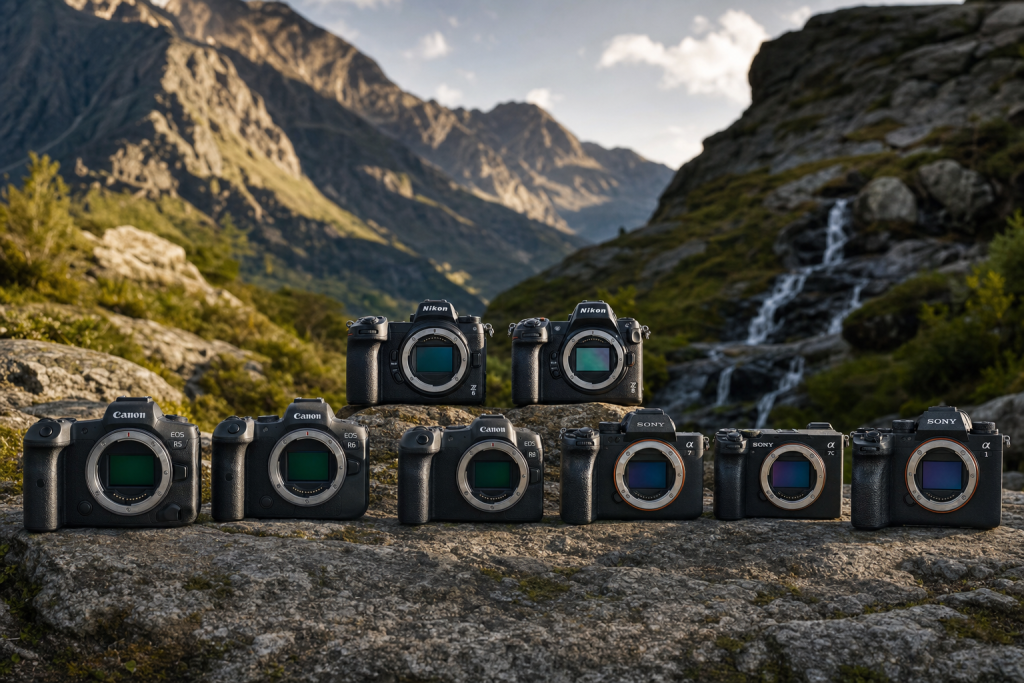
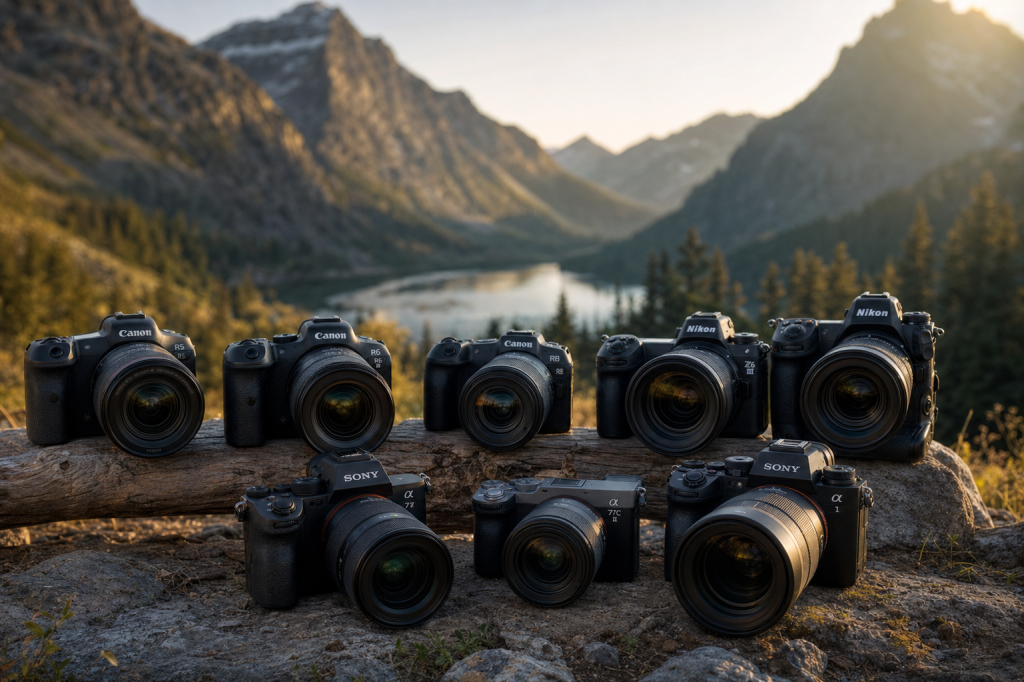
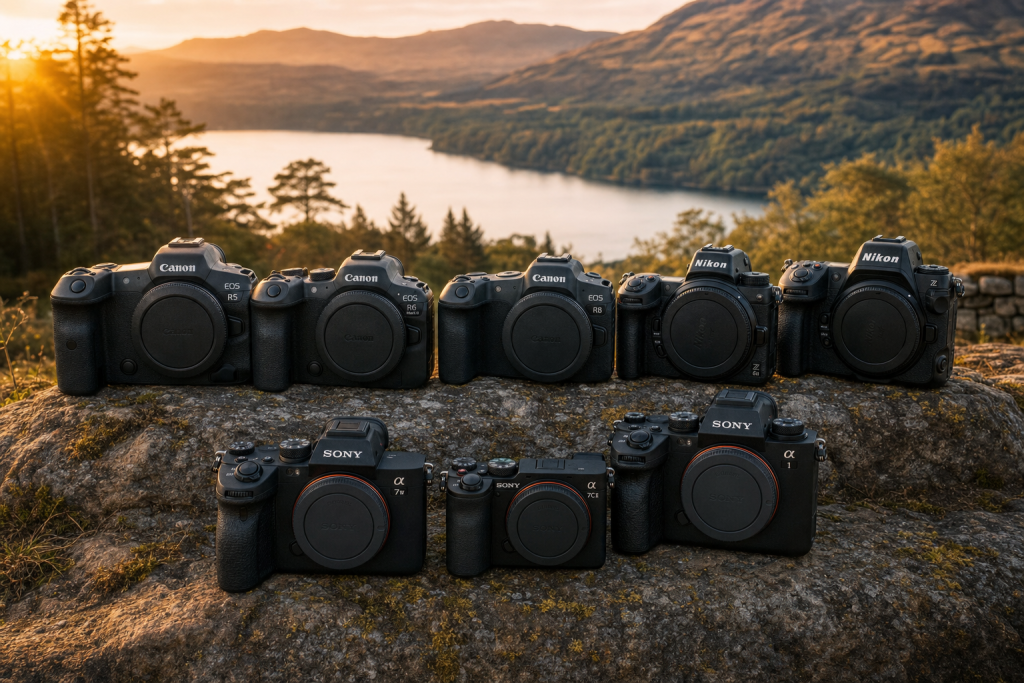
Canon (R5, R6 II, R8) vs Nikon (Z6 III, Z8) vs Sony (A7 IV, A7C II, A1): Honest Comparison and a Clear Winner
–
 Save
SaveSide-by-Side Spec Comparison
Before diving into use cases and recommendations, here is a direct specification comparison. Use this table as a quick reference when you need to compare a specific attribute.
| Specification | Canon (EOS R System) | Nikon (Z System) | Sony (Alpha / E-mount) |
|---|---|---|---|
| Current mirrorless mount | Canon RF | Nikon Z | Sony E (FE for full-frame) |
| Sensor resolution range (2026) | 24MP (R8) → 45MP (R5 Mark II) | 24MP (Z5 II) → 61MP (Z9) | 24MP (A7C) → 61MP (A7R V) |
| Best travel body weight | Canon EOS R8: 461g | Nikon Z6 III: 760g | Sony A7C II: 514g |
| Lens ecosystem size | ~90 RF lenses (restricted third-party) | ~80 Z lenses + 60+ adapted F | ~180+ FE lenses (open third-party) |
| Third-party lens support | Restricted — RF mount protocols limit third-party AF | Open Z mount — Sigma, Tamron, Viltrox all AF-compatible | Fully open — Sigma, Tamron, Tokina, Viltrox all AF-compatible |
| AF subject recognition | Excellent — eye, animal, vehicle, motorsport tracking | Excellent — 3D tracking, bird, animal, vehicle | Best — most AF subject types, industry-leading eye AF depth of field |
| Out-of-camera color (JPEG/HEIF) | Best — Canon color science is the easiest to deliver | Excellent — natural, accurate rendition | Good — requires more post for warm skin tones |
| Video (flagship models) | Canon R5C / R5 II: 8K RAW internal, Cinema EOS pedigree | Nikon Z8/Z9: 8.3K N-RAW, ProRes RAW | Sony A7S III / FX3: A-mount video legacy, 4K 120p |
| Battery life (flagship travel body) | Canon R6 II: ~450 shots CIPA | Nikon Z6 III: ~370 shots CIPA (mechanical)) | Sony A7C II: ~800 shots CIPA |
Real-World Use Cases: Which Option Wins for Your Situation?
Specifications only tell part of the story. Here is how each option stacks up for specific photography scenarios:
| Your Situation | Best Choice | Why |
|---|---|---|
| Travel photographer buying their first mirrorless kit | Sony | The largest lens ecosystem, the most third-party lens options (Tamron, Sigma), and the best second-hand market make Sony the lowest total-cost-of-entry for a complete system. |
| Switching from Canon DSLR to mirrorless | Canon EOS R | Canon RF uses the same menus, color science, and ergonomics as Canon DSLRs. The EF-to-RF adapter ($200) makes your entire existing lens collection immediately usable. |
| Landscape and architecture (resolution priority) | Nikon Z7 II or Sony A7R V | Both offer 45-61MP sensors with exceptional dynamic range. The Nikon Z system’s on-sensor PDAF and open mount make it more accessible for telephoto landscape lenses from Sigma and Tamron. |
| Wildlife and action photographer | Sony A1 or A9 III | Sony’s global shutter (A9 III) and 120fps blackout-free electronic shutter (A1) are ahead of Canon and Nikon equivalents in 2026 for high-speed subject tracking. |
| Wedding and portrait photographer | Canon EOS R6 Mark II | Canon’s color science produces the best straight-from-camera skin tones. Combined with the most intuitive menu system, it requires less post-processing per event than Sony or Nikon equivalents. |
Pricing Breakdown
Entry-level mirrorless: Canon EOS R50 ($679), Nikon Z30 ($699), Sony ZV-E10 II ($750). Travel mid-range: Canon EOS R8 ($1,299), Nikon Z5 II ($1,299), Sony A7C ($1,799). Professional: Canon R6 Mark II ($2,499), Nikon Z6 III ($1,999), Sony A7 IV ($2,499). Sony’s higher entry price is partially offset by the deeper second-hand market and more competitive third-party lens pricing.
 Save
SaveAlternatives Worth Considering
Before you commit to either option, these alternatives may better suit your specific needs:
- Fujifilm X System: APS-C sensor, outstanding Film Simulations, physical dials, and a loyal travel photography community. The X-T5 (40MP APS-C) is a serious tool at $1,699.
- OM System (Olympus): Micro Four Thirds: small, weather-sealed, and feature-rich at lower prices. The OM-5 is the ultimate adventure/travel body for extreme conditions.
- Leica M11: For photojournalistic purists: rangefinder, manual focus, 60MP BSI CMOS. At $9,995, it’s a prestige investment — but the workflow it imposes makes you a better photographer.
Frequently Asked Questions
Which brand has the best autofocus for travel photography?
Sony leads for subject tracking across the broadest range of subject types (people, animals, birds, insects, vehicles). Canon and Nikon have closed the gap significantly in 2025-2026 firmware updates, but Sony’s AF depth remains the market reference.
Is Canon’s RF mount restriction a problem for travel photographers?
For travel photography on standard zooms and primes, Canon makes excellent RF-mount lenses at competitive prices. The restriction only matters if you specifically want Sigma Art or Tamron RF-mount third-party lenses.
Which system has the most travel-friendly lightweight kit?
Sony FE: the A7C II + Tamron 28-200mm FE weighs under 1,100g for a full-range travel kit. Canon’s R8 + RF 24-105mm f/4-7.1 IS STM weighs about 950g — slightly lighter but with a consumer-grade lens.
Should I switch brands if I already have one system?
Only if a specific feature you need is unavailable in your current system. Switching systems costs $3,000-8,000 in new lenses. The best camera is the one with the lenses you already own.
 Save
SaveThe Bottom Line
Our recommendation: Sony for ecosystem depth and AF; Canon for color and ergonomics; Nikon for resolution and dynamic range. The best choice ultimately depends on your specific shooting style, budget, and existing kit. Use the use-case table above as your primary decision framework — find your most common scenario and choose the option that wins there. Both options in this comparison are used by working professional photographers; you cannot make a wrong choice if it aligns with your actual workflow.