Best Photography Spots in Goa: 8 GPS-Tagged Locations
~12 min read · 2026-05-24 For practitioners, see our breakdown of public-transit photo etiquette.
Goa is a former Portuguese colony on India’s Konkan coast — beaches, Catholic baroque churches, and a hybrid culture you find nowhere else in India. This is the working photographer’s field guide: when to be there for the light, what gear actually fits the trip, the 8 highest-yield vantage points with GPS coordinates, and the cultural and legal context that separates respectful documentary photography from the cliché tourist frame. Plan with the same rigor you bring to a paid commercial assignment and your portfolio comes home better.
 Save
SaveWhy Goa is a photographer's dream
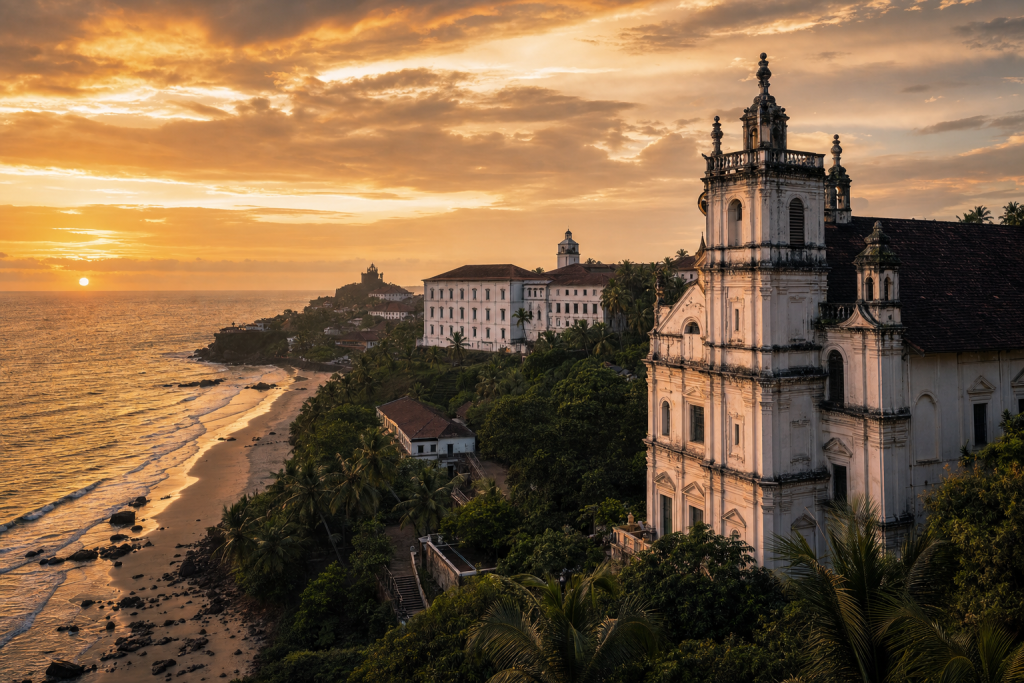
Goa was Portuguese for 451 years (1510-1961), and the architectural and culinary residue is the photographer’s prize. The capital Old Goa is a UNESCO site of 16th-17th century Catholic basilicas (Bom Jesus holds the relics of Saint Francis Xavier) standing on a tropical riverbank. North Goa is the famous beach belt — Anjuna, Vagator, Arambol — known for sunset cliffs and the Saturday night markets. South Goa is quieter, with palm-back beaches like Palolem and the historic spice plantations inland. Photographers come for one of three things: Catholic baroque architecture, beach landscapes, or Goa’s peculiar cultural sweetness. Most stay for all three.
For photographers, Goa rewards a particular working method: arrive at sunrise, walk between the high-yield sites, eat in the middle of the day, scout for evening compositions, and return to the river or the main square for the last hour of light. The cities of India concentrate visual density into a small geographic area — every block has a frame in it if you slow down enough to see it. Bring fewer lenses than you think and walk farther than you planned.
The frames that come out of Goa reward an editing approach that respects the city’s natural color palette instead of pushing every shot into a uniform Instagram preset. Photographers who study one good photographic monograph of the destination before they fly consistently produce richer trip portfolios than photographers who arrive cold with only a shot list.
When to go: best months and light in Goa
November through March. December-February peak season has perfect weather but crowded beaches. October and March are shoulder months with empty beaches and 90% of the weather. Avoid June-September off-season unless you want torrential photography.
Light quality changes dramatically across the year. The cool, dry months deliver the most reliable golden hour and the cleanest blue skies. Shoulder-season photography is a different aesthetic entirely: lower contrast, saturated greens, dramatic clouds, and the genuine atmospheric mood that earns a photographer’s portfolio its variety. If you are choosing a single trip, prioritize the dry, clear months for predictable light. If you have shot the destination before, a wetter or off-season trip rewards the patient.
Day-by-day, plan around the morning and evening blue and golden hours. Midday is harsh and unflattering at every site listed below — skip it, eat lunch, scout your evening compositions in the shade, and return when the light returns. Photographers who insist on shooting through midday sun in India produce washed-out files they end up culling in the edit. Treat the four-hour midday block as scouting time, not capture time.
8 photography spots with GPS coordinates
The vantage points below are organized roughly in the order a photographer working a half-day in Goa would shoot them — establishing wide on the iconic landmarks first, then mid-distance compositions, then street-level documentary detail. Each entry includes the GPS coordinates so you can pin it on Google Maps before you arrive, plus a brief composition note and recommended focal length. Use this as a shot list, not a script: the best frame is often something you notice once you are standing there. The list keeps you from missing the obvious ones.
| Vantage point | GPS | Notes |
|---|---|---|
| Basilica of Bom Jesus interior | 15.5009, 73.9119 |
14-24mm wide. The 1605 baroque interior with the silver casket of Saint Francis Xavier. Tripod permission required (₹300). Best at 9am when sidelight from the south clerestory cuts the nave. |
| Se Cathedral exterior | 15.5018, 73.9121 |
24-35mm. The largest church in Asia, built 1640. Whitewashed bell tower against blue sky. Late afternoon for warm side light. |
| Chapora Fort sunset | 15.6042, 73.7333 |
Wide 16-35mm. The 1717 Portuguese fort ruins above Vagator beach. The famous "Dil Chahta Hai" viewpoint. Arrive 30 min before sunset for the best light over the Arabian Sea. |
| Anjuna flea market Saturday | 15.5773, 73.7455 |
35mm or 50mm prime. Saturday only, 6pm-late. Color, bohemian portraits, smoke, sunset over the cliff stalls. Watch your gear in crowds. |
| Dudhsagar Falls (off-season access) | 15.3144, 74.3144 |
Wide 16-35mm. India's 5th-tallest waterfall, 310m. Best in off-season but jeep tours run year-round from Mollem. Slow shutter 1/8s for the silk effect. |
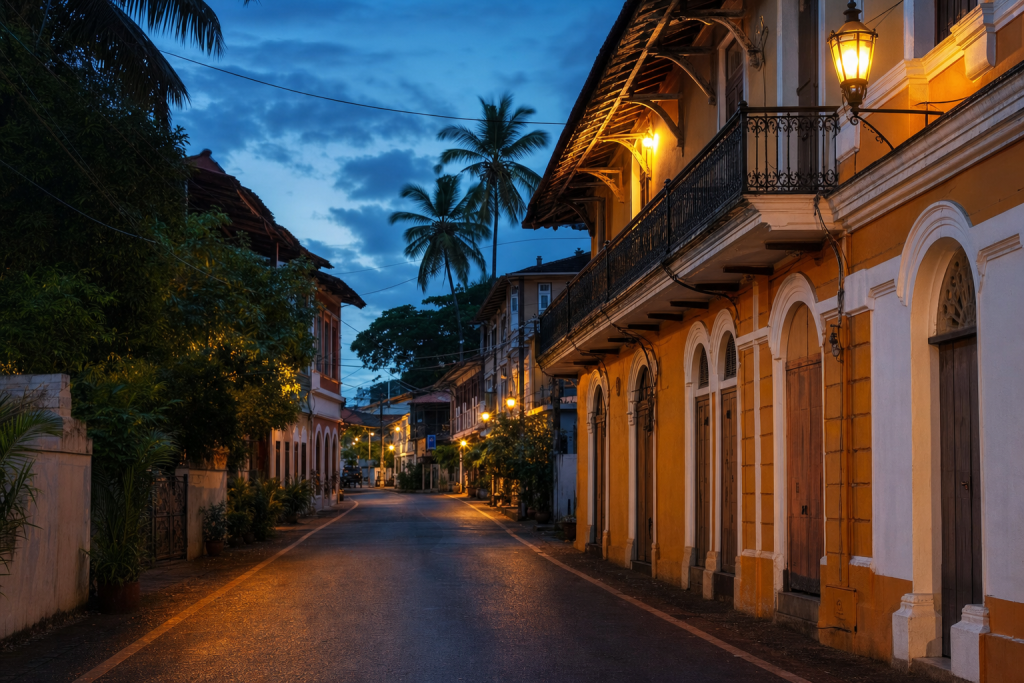
| Fontainhas Latin Quarter Panaji | 15.4988, 73.8336 |
35mm prime. Yellow, blue, and green Portuguese row houses on narrow lanes. Late afternoon for warm side light. The Capela de São Sebastião at the end of the lane is the prize composition. |
| Palolem Beach at dawn | 15.0099, 74.0237 |
24-70mm. The crescent-shaped southern beach. 6am winter for low pink light on fishing boats and palm-fringed rocks. Empty in the morning, packed by 10am. |
| Spice Plantation Sahakari (Ponda) | 15.4145, 73.9760 |
35mm or 50mm prime. Pepper vines, betel nut palms, cardamom plants. 90-minute guided tour with elephant interaction (skip the elephant — ethical concerns). Lush green color, dappled forest light. |
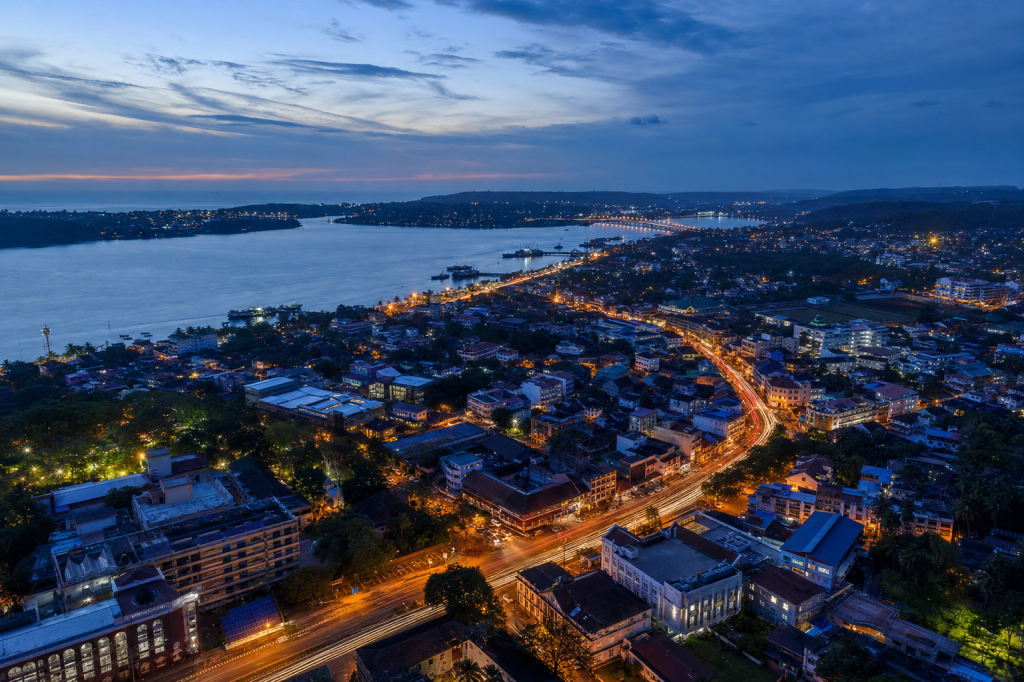
If you have additional time on site, work each vantage point twice — once at golden hour for warm tones, once at blue hour for cooler atmospheric mood. The same composition photographed 90 minutes apart looks like two different locations. That is the city photographer’s edit advantage: light variety from a single trip.
Camera settings cheat sheet
Goa photography lives across a wide exposure range. Bright midday architectural detail, dim interiors, golden-hour streetscapes, blue-hour skylines — each scenario has its own settings sweet spot. The cheat sheet below covers the most common scenarios in Goa. Use auto-ISO with a maximum cap (3200 on most modern bodies, 6400 if you trust your sensor) so you can stop worrying about ISO and concentrate on aperture and shutter:
| Scenario | Aperture | Shutter | ISO |
|---|---|---|---|
| Sunrise / golden hour landscape | f/8 – f/11 | 1/125 – 1/500 | 200 – 400 |
| Architectural detail (sidelight) | f/8 | 1/250 | 100 – 200 |
| Street / market documentary | f/2.8 – f/4 | 1/250 – 1/500 | 400 – 1600 |
| Temple / church interior | f/2.8 – f/4 | 1/60 – 1/125 (tripod) | 800 – 3200 |
| Night cityscape / festival | f/4 – f/8 | 1s – 8s (tripod) | 200 – 800 |
Bracketing is your friend. A three-frame bracket at +/- 1 stop captures the full dynamic range of most Goa scenes and gives you HDR options in post without committing to the look at capture time. Modern sensors recover shadows beautifully — expose to the right, protect highlights, and lift the shadows in Lightroom rather than blowing the sky. Indian and tropical light is contrasty: spending three minutes on a single bracketed exposure beats running-and-gunning ten frames you cannot rescue.
 Save
SaveLens recommendations
24-70mm versatile zoom is the right Goa lens. 16-35mm for church interiors and beach landscapes. 35mm or 50mm prime for Fontainhas and the markets. A 70-200mm for compressed beach-to-coconut-tree shots and distant Chapora ruins.
For mirrorless shooters: a single body with a 24-70mm f/2.8 plus a 35mm or 50mm f/1.8 prime is a viable lighter kit. The compromise is the long end — a 70-200mm becomes useful when you need to compress distant landmarks against a closer foreground. Most Goa photographers travel with two bodies (one zoom, one prime) and accept the weight for the speed of swapping focal lengths without changing lenses in dusty street conditions.
A polarizing filter changes the look of Goa’s skies, deepens the color of stone facades, and cuts reflection on water and glass. Carry one. For long-exposure work — night cityscapes, river silk, fountain motion blur — a 6-stop or 10-stop ND filter and a sturdy travel tripod are non-negotiable. Carbon fiber under 1.5kg is the right tradeoff between weight and stability for long-distance travel.
Cultural rules and photo etiquette
Cover shoulders inside churches. Most beaches are public, but private beach restaurants control deck-chair access. Drone use over beaches is restricted near military and naval zones (especially South Goa near Karwar). Festival photography (Carnival in February, Christmas) is welcomed but ask before close portraits.
Beyond the location-specific rules, the universal photographer’s code applies: ask before close portraits, do not photograph children without parental consent, do not photograph religious rituals if asked to stop, and never tip with your camera (offering money for a photograph quickly creates a transactional dynamic that degrades the work). The best Goa portraits come from photographers who spent twenty minutes drinking chai with the subject before the camera came up. Slow is the only honest speed for documentary work.
Do not photograph security personnel, military zones, or strategic infrastructure (railway switching yards, government buildings, bridges marked as restricted). Photography of these subjects can result in police questioning even if you were standing on a public street. The price of a frame is never worth a problem with the local authorities. Read the room.
Getting around Goa
A hired scooter (₹300-500/day) is the standard photographer’s vehicle in Goa. Taxis are expensive and uberized GoaMiles is unreliable. Train (Konkan Railway) connects Madgaon and Thivim stations. North Goa beaches are 90 minutes from South Goa beaches by road.
Plan your photography day around the geography of the high-yield vantage points. Cluster the morning shots within a 2km radius if possible — you lose more time fighting traffic in India than walking, even in the heat. Hire a half-day driver if you are visiting non-adjacent zones (a temples-and-old-town day in Goa, or a coastal-and-historic-quarter day where applicable). The cost is modest and the time saved is meaningful for serious shooting.
Carry a portable phone charger, a printed map (cell signal is unreliable in the older parts of many historic city centers), small denominations of local currency for entry fees and tips, and a water bottle. Photographers who bring all the gear but forget the boring practicalities lose half their day to friction.
Post-processing the Goa look
The dominant aesthetic for India photography is restrained warmth — earth tones, lifted shadows, careful highlight retention, and a clear refusal to push HDR-style local contrast that flattens the natural mood of the scene. The destination’s natural palette already does most of the saturation work for you — over-processing pushes it into kitsch. Lightroom’s HSL panel with reduced saturation on greens and neutrals, combined with a slight warm split-tone, produces a cinematic travel look without crossing into postcard territory.
A practical post-processing sequence that works on most Goa RAW files: (1) lens correction and chromatic aberration first; (2) basic exposure with shadows pushed and highlights pulled; (3) HSL desaturation on green and orange (counterintuitive but it lets the warm tones speak), slight saturation boost on blue; (4) split toning warm orange in highlights and a hint of teal in shadows at low intensity; (5) clarity at +10 maximum on a frame, never higher; (6) a subtle vignette to draw the eye in. Save the result as a preset and use it as a starting point for the rest of the trip’s frames.
 Save
SaveFrequently asked questions
What is the best time of year to photograph Goa?
November through March. December-February peak season has perfect weather but crowded beaches. October and March are shoulder months with empty beaches and 90% of the weather. Avoid June-September off-season unless you want torrential photography. Plan around the dry, cool season for the most reliable light and lowest crowds at the most photographed sites.
Do I need a permit to photograph at the major sites in Goa?
Most public exterior photography is permit-free. Many palaces, churches, and museums charge a separate camera fee on top of the entry ticket — check the day’s posted policy at each site. Tripods and drones often require additional written permission and are commonly refused at heritage sites. Always check the day's posted policy at each site.
What lens kit should I bring to Goa?
24-70mm versatile zoom is the right Goa lens. 16-35mm for church interiors and beach landscapes. 35mm or 50mm prime for Fontainhas and the markets. A 70-200mm for compressed beach-to-coconut-tree shots and distant Chapora ruins.
Is Goa safe for solo photographers?
Yes, with normal traveler precautions. Watch your gear in markets and crowds, do not flash an expensive camera in low-light alleys, and use registered transport. Female photographers should be especially mindful of conservative dress at religious sites.
Can I fly a drone in Goa?
Generally no without explicit written permission from the site manager and the local civil aviation authority. Most heritage sites and active religious sites prohibit drones outright. Assume drones are not legal unless you have written confirmation from the site manager.
All links go to Viator (a TripAdvisor company), the world’s largest marketplace for guided experiences. Tagged as affiliate per FTC.
What to Pack
A focused landscape kit handles every shot at Goa without breaking your back. Here is the working photographer's pack list — every link goes to B&H Photo Video (our primary supplier) or Amazon (for accessories and same-day delivery in the US).
| What & Why | B&H | Amazon |
|---|---|---|
Wide-angle zoom (14-35mm range) The single most important lens for sweeping vistas. Pair with a circular polarizer for skies and water. | Shop B&H → | Shop Amazon → |
Sturdy travel tripod Carbon fiber, packs to 15 inches, holds steady in wind off the coast. Essential for blue-hour and long-exposure work. | Shop B&H → | Shop Amazon → |
Circular polarizer (77mm or 82mm) Cuts haze, deepens sky, reveals texture in water. Non-negotiable for landscape work. | Shop B&H → | Shop Amazon → |
10-stop ND filter For 30-second exposures that turn moving water and clouds into silk. | Shop B&H → | Shop Amazon → |
Extra batteries (3 minimum) Cold weather and long exposures eat batteries. Carry triple what you think you need. | Shop B&H → | Shop Amazon → |
Fast SD/CFexpress cards V90 or CFexpress depending on your body. Two cards minimum so a failure mid-trip is recoverable. | Shop B&H → | Shop Amazon → |
Microfiber lens cloths Salt spray, mist, and dust will ruin every shot if you don't carry a cloth. | Shop B&H → | Shop Amazon → |
B&H and Amazon links are affiliate links. We earn a small commission on purchases at no extra cost to you. We only recommend gear we use or would buy ourselves.