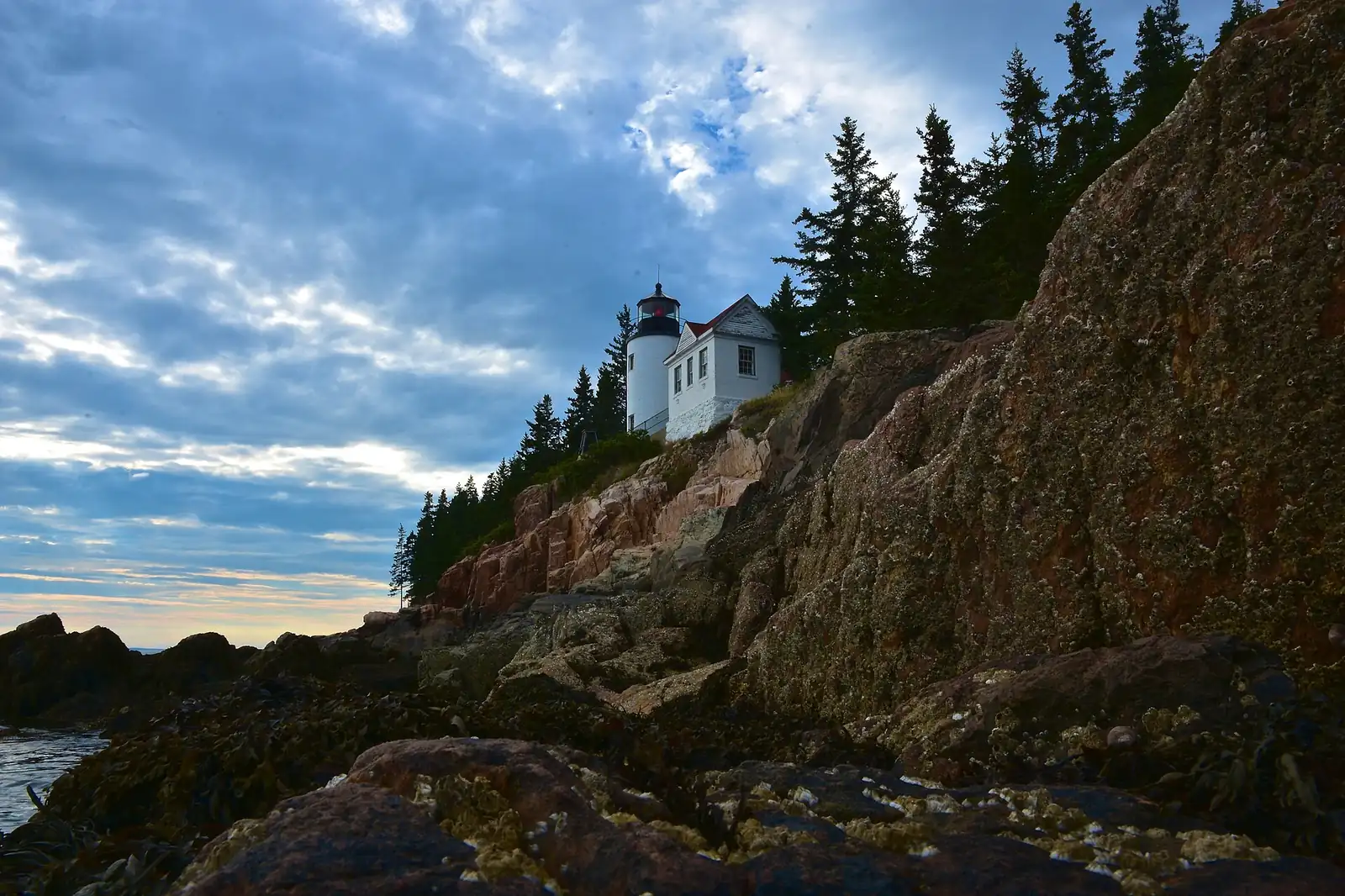
Bass Harbor Head Lighthouse perches on granite ledges at the southwestern tip of Mount Desert Island in Acadia. It is a small lighthouse — built in 1858, 26 feet tall — but its position directly on the wave-washed rocks, with the Atlantic behind it and no other buildings in view, makes it one of the most striking lighthouse compositions on the East Coast. The rocks below are accessible at lower tide levels and give water-level perspectives the parking lot above cannot.
Best Time to Shoot
Sunset: the lighthouse faces roughly southwest and the setting sun illuminates the structure and surrounding granite in direct warm light. Low to mid tide (check a Maine tide chart for the specific date) for access to the lower rocks. Fall foliage on the surrounding spruce adds context. The full sunset sequence runs about 30-45 minutes. For practitioners, see our breakdown of 30-second blue-hour exposure. For practitioners, see our breakdown of travel photography composition. For practitioners, see our breakdown of narrow aperture for sunstars.
How to Get There
Bass Harbor Head Light is at the end of Lighthouse Road off Route 102A on the southwestern end of Mount Desert Island. Free parking at the lot above the lighthouse. The upper walkway overlooks are immediately accessible; the lower rock scramble requires descending a steep wooden staircase and navigating wet granite — wear boots with grip.
Camera Settings
From the lower rocks: 16-24mm at water level with the lighthouse on the left, Atlantic on the right. f/11-f/16, ISO 100, long exposure (5-20 seconds) to smooth the ocean into mist. Graduated ND to balance the bright sky against the darker foreground rocks. From the upper walkway: 35-70mm for a tighter composition of the lighthouse against the ocean.
Recommended Gear for This Spot
Common Mistakes
- Visiting at high tide: the lower rocks are inaccessible and wet with spray.
- Setting up only at the upper walkway: the water-level shots from below are far more dynamic.
- Arriving exactly at sunset: you need 20-30 minutes on the rocks to find the best position before the light arrives.
- Forgetting a flashlight: the walk back to the parking lot after sunset is on unlit terrain.
An Acadia lighthouse photography tour covers Bass Harbor Head and the nearby Southwest Harbor waterfront in one sunset session timed to the tide. Browse Bass Harbor Head Lighthouse photography tours to find options that fit your schedule.
For more location guides like this, see the Landscape Photography Guide on Shut Your Aperture. Browse all spots on the USA ME photo spots hub.
What to Pack
A focused landscape kit handles every shot at Bass Harbor Lighthouse without breaking your back. Here is the working photographer's pack list — every link goes to B&H Photo Video (our primary supplier) or Amazon (for accessories and same-day delivery in the US).
| What & Why | B&H | Amazon |
|---|---|---|
Wide-angle zoom (14-35mm range) The single most important lens for sweeping vistas. Pair with a circular polarizer for skies and water. | Shop B&H → | Shop Amazon → |
Sturdy travel tripod Carbon fiber, packs to 15 inches, holds steady in wind off the coast. Essential for blue-hour and long-exposure work. | Shop B&H → | Shop Amazon → |
Circular polarizer (77mm or 82mm) Cuts haze, deepens sky, reveals texture in water. Non-negotiable for landscape work. | Shop B&H → | Shop Amazon → |
10-stop ND filter For 30-second exposures that turn moving water and clouds into silk. | Shop B&H → | Shop Amazon → |
Extra batteries (3 minimum) Cold weather and long exposures eat batteries. Carry triple what you think you need. | Shop B&H → | Shop Amazon → |
Fast SD/CFexpress cards V90 or CFexpress depending on your body. Two cards minimum so a failure mid-trip is recoverable. | Shop B&H → | Shop Amazon → |
Microfiber lens cloths Salt spray, mist, and dust will ruin every shot if you don't carry a cloth. | Shop B&H → | Shop Amazon → |
B&H and Amazon links are affiliate links. We earn a small commission on purchases at no extra cost to you. We only recommend gear we use or would buy ourselves.