Best Mirrorless Camera for Beginners in 2026
–
 Save
SaveMore About Mirrorless Cameras For Beginners 2026
The best beginner mirrorless camera in 2026 is whichever one you’ll actually carry every day. Image quality differences between entry-level mirrorless cameras at this tier are imperceptible in real-world use — the decision should be based on ergonomics, ecosystem cost, and the type of photography you want to do most.
Top Picks: Detailed Breakdown
Here is a closer look at each recommended option, with pros, cons, best use cases, and purchasing information for each pick.
Sony ZV-E10 II — ~$750
26MP APS-C, 4K 60fps 10-bit, real-time Eye AF, fully articulating screen. Best beginner camera for video creators and YouTubers.
Best for: Beginners whose primary goal is YouTube, social media video, and travel vlogging. The combination of reliable face AF and 4K 60fps at $750 is unmatched in the beginner segment.
Pros:
- 4K 60fps with 10-bit log at $750 — exceptional for vloggers
- Best autofocus tracking in the class for talking-head self-filming
- Full Sony E-mount ecosystem — over 180 lenses available, huge second-hand market
Cons:
- No EVF (electronic viewfinder)
- No IBIS — electronic stabilization crops the image
- Small body with limited physical control points
Buy the Sony ZV-E10 II at B&H Photo
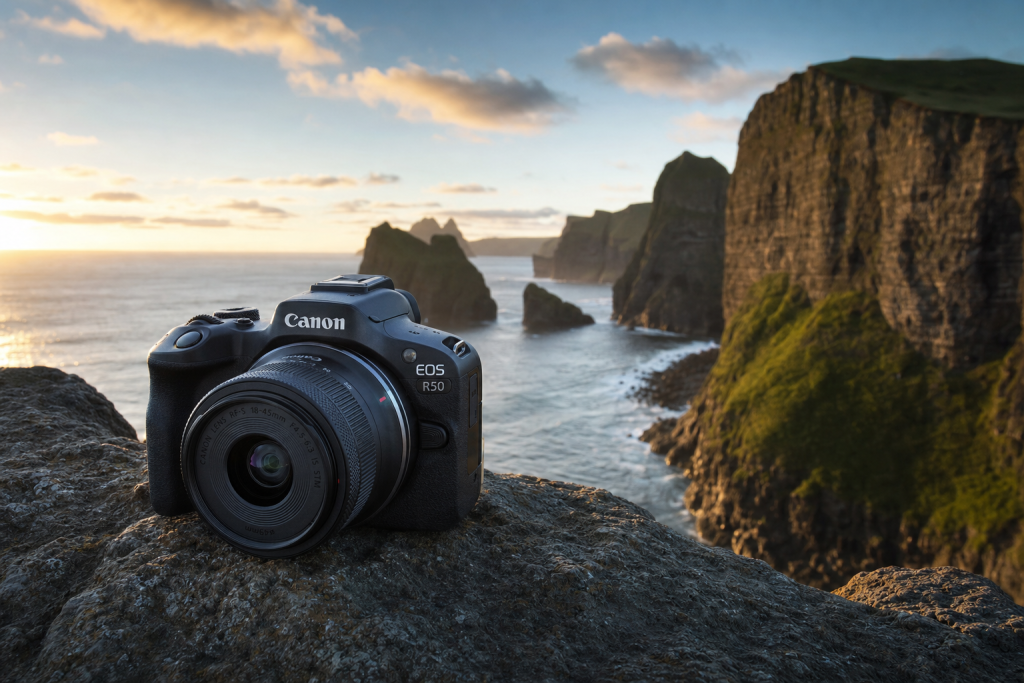
Canon EOS R50 — ~$679
24.2MP APS-C, Dual Pixel CMOS AF II, 4K 30fps, 375g, Guide UI mode for learning photography fundamentals.
Best for: Absolute beginners who want the most approachable camera for learning photography fundamentals. The Guide UI mode is uniquely valuable for beginners — Canon explains settings in context without requiring manual reading.
Pros:
- Cheapest mirrorless in this group with the best ease-of-use features
- Canon Guide UI explains what each setting does in plain language — the best beginner education mode
- Dual Pixel CMOS AF II (same algorithm as the $2,499 R6 Mark II)
Cons:
- No IBIS
- 4K 30fps only (no 60p)
- RF-S lens ecosystem smaller than Sony E
Buy the Canon EOS R50 at B&H Photo
Nikon Z50 II — ~$749
21MP APS-C, 4K 30fps, fully articulating screen, 14fps burst, 310g — Nikon’s lightest mirrorless camera.
Best for: Beginners who want the lightest possible mirrorless body for travel and street photography. Nikon DSLR families who want to share lenses via the FTZ II adapter.
Pros:
- 310g body — lightest mirrorless in this comparison by a significant margin
- Nikon Z interface is clean and logical — fast learning curve
- Good natural color rendering — Nikon DSLR photographers’ natural upgrade path
Cons:
- No IBIS
- 4K 30fps with moderate crop
- Z DX lens ecosystem is the smallest of the three systems in this comparison
Buy the Nikon Z50 II at B&H Photo
Fujifilm X-S20 — ~$1,299
26.1MP APS-C, 7-stop IBIS, 4K 60fps 10-bit, Film Simulations, 800-shot battery, dedicated exposure dial. Best beginner camera for photographers who want to grow into it.
Best for: Beginners with a higher budget who want a camera they’ll still be using 5 years into their photography journey without growing out of it. The IBIS, battery life, and Film Simulations are features that reward experienced photographers — invest in the X-S20 only if you’re committed to learning and growing.
Pros:
- 7-stop IBIS — best stabilization in the beginner category
- 800 CIPA shots — all-day travel shooting without battery anxiety
- Film Simulations eliminate the need for color grading — fastest social-media-ready workflow
Cons:
- $1,299 — significantly more expensive than the other three
- More complex for absolute beginners than Canon R50
- Heavier than Sony ZV-E10 II and Nikon Z50 II at 491g
Buy the Fujifilm X-S20 at B&H Photo
 Save
SaveBuying Guide: How to Choose the Right Option for You
Before purchasing, work through these key decision questions:
What do you primarily want to photograph?
People, events, and vlogging: Sony ZV-E10 II for the best video AF. Landscape and travel stills: Fujifilm X-S20 for IBIS and Film Simulations. General family/daily photography: Canon R50 for ease of use. Any photography, lightest option: Nikon Z50 II.
Do you care about video?
If video is important: Sony ZV-E10 II (4K 60fps, 10-bit) or Fujifilm X-S20 (6.2K, IBIS). If video is secondary to stills: Canon R50 or Nikon Z50 II are better stills-focused beginner cameras.
Will you want to upgrade in 2-3 years?
Sony E-mount: your Sony lenses (especially Sigma and Tamron) will work on any future Sony body. Canon RF: Canon RF and RF-S lenses work across the Canon R-series family. Nikon Z: your Z DX lenses adapt to full-frame Z bodies with FTZ. Fuji X: Fujinon XF lenses are compatible across all Fuji X-series bodies indefinitely.
What is your budget for the first lens?
The kit lens (18-55mm or 15-45mm) is good to start. Your first upgrade should be a 35mm f/1.8 prime ($300-400 depending on system) — the single most impactful learning tool for a beginning photographer. Low light, background blur, and compositional decision-making all improve with a fast prime.
 Save
SaveFrequently Asked Questions
Is mirrorless better than DSLR for beginners?
Yes in 2026 — the major manufacturers have discontinued DSLR development. Mirrorless cameras have real-time preview in the electronic viewfinder, better video AF, and equivalent or better battery life on current generations. New beginners should start with mirrorless.
Do I need to buy a lens kit or body only?
Kit lens (body + 18-45mm or 18-55mm) is the right first purchase — it covers the full learning range from wide street photography to portrait compression. Body-only is only for photographers who already own compatible lenses from a different body.
How do I pick a beginner camera brand?
If friends or family have cameras you can borrow and learn with: match their brand (share lenses and advice). If starting fresh: Sony E-mount has the deepest second-hand lens market and the most third-party lens options at every price point — the practical advantages are significant for a growing kit over 3-5 years.
Will a beginner camera take better photos than my phone?
In good light with a quality lens: yes noticeably for portrait blur, detail resolution, and zoom quality. In low light: yes significantly — APS-C sensors collect more light than phone sensors. For wide-angle casual snapshots in daylight: modern smartphone computational photography can match or exceed basic mirrorless output. The mirrorless advantage is primarily creative control and low-light/telephoto performance.