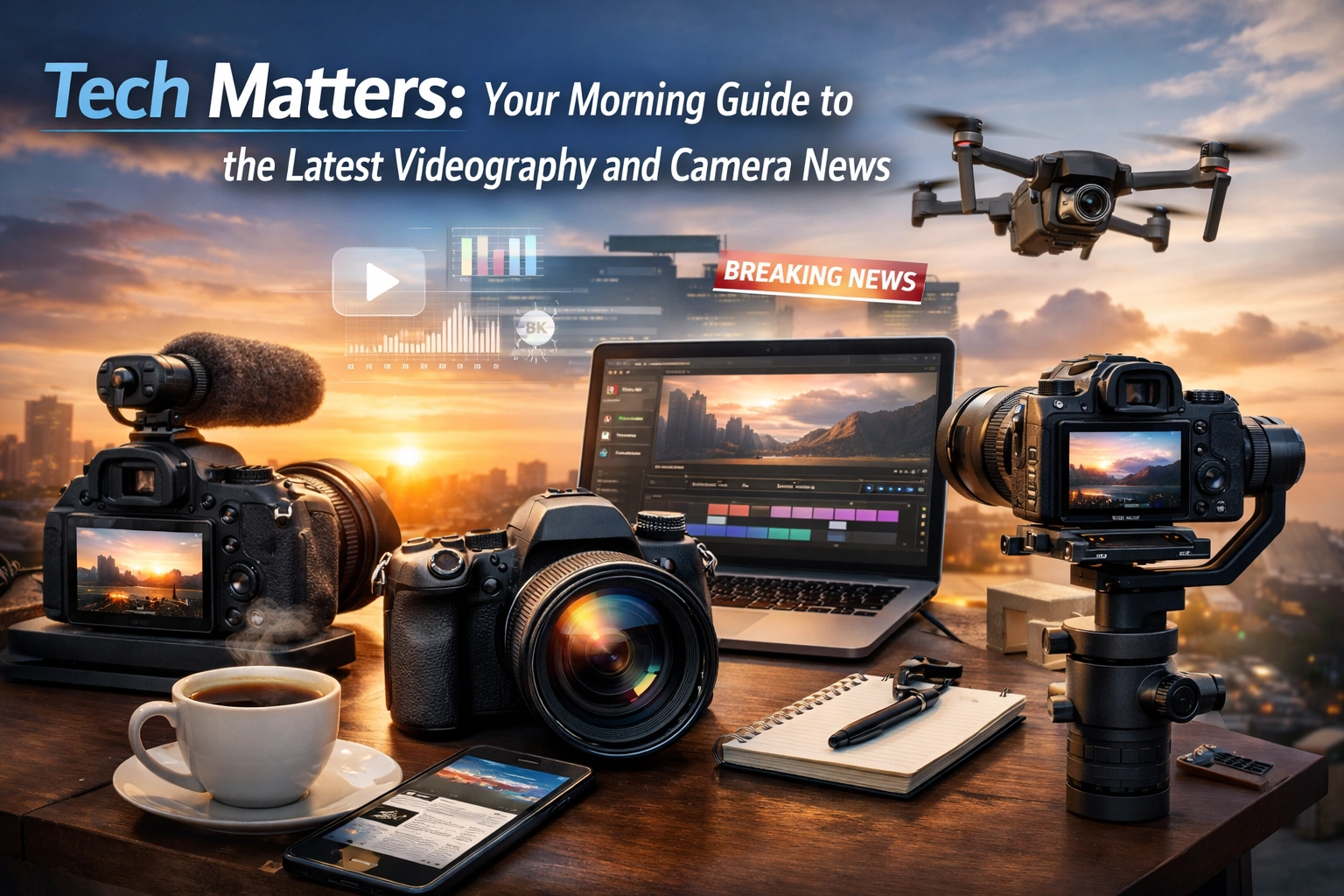
Good morning, creators. It is Friday, March 20, 2026, and if you haven’t had your caffeine fix yet, let this news cycle be your shot of espresso. The industry is moving faster than a stacked sensor on burst mode, and today’s updates are particularly juicy for those of us who live somewhere between high-end cinema and "I just want to look good on a vlog."
At Shut Your Aperture, we’ve been tracking the shift toward total hybrid dominance for a while now. Remember when you had to choose between a "video camera" and a "photo camera"? Those days are officially in the rearview mirror. Whether you’re shooting secluded paradises to enhance your photography portfolio or filming high-octane commercial work, the gear coming out this year is blurring every line in the sand.
Let’s dive into what’s happening in the world of glass, sensors, and software.
The DJI Osmo Pocket 4: A Vlogging Revolution or a Regulatory Headache?
The rumor mill is spinning so fast it’s basically a centrifuge. The DJI Osmo Pocket 4 is no longer just a whisper; it’s a roar. Leaks suggest this tiny beast is about to redefine what we expect from a gimbal camera. We’re looking at a dual-screen setup that makes framing yourself, and your surroundings, effortless.
But the real kicker? The specs. We are hearing reports of 4K recording at 240fps. Think about that for a second. The ability to pull buttery-smooth, ultra-slow motion out of your pocket while walking through picturesque coastal escapes is a game-changer for travel creators. Some sources are even pointing toward 6K recording with 10-bit color depth, which would effectively put this in the same league as professional mirrorless bodies.
However, it’s not all sunshine and rainbows. For our US-based readers, the government's stance on DJI products continues to be a cloud over these releases. While the tech is ready, the market availability remains a "wait and see" situation. If you can get your hands on one, though, it might just be the best vlogging camera for YouTube in 2026.
SEO Alt Text: High-tech handheld gimbal camera with dual screens and a large lens being used in a vibrant urban environment.
Canon’s Video-First Pivot: The EOS R8 V and R7 Mark II
Canon has spent decades being the king of "skin tones," but in 2026, they are fighting for the crown of "video specs." The Canon EOS R8 V is the one everyone is talking about. It’s being positioned as a full-frame flagship for the vlogging segment.
Here’s why you should care:
- Uncropped 4K 60p (oversampled from 6K).
- 4K 120p with a minor 1.2x crop.
- Internal CLog 3 and 10-bit 4:2:2 recording.
This makes it a direct competitor to the Sony ZV series, but with that legendary Canon ergonomics. If you’re looking for a professional videography gear guide, the R8 V is going to be near the top of that list for anyone needing a lightweight B-cam or a primary vlogging tool.
And don't forget the EOS R7 Mark II. Expected to drop around the next CP+ show, this APS-C powerhouse is rumored to focus heavily on speed. If you’re into birding or sports, this might be your new best friend. For those of us who love water photography: capturing beauty in motion, the R7 II's high frame rates and improved weather sealing will be vital.
The Hybrid Standard: Sony a7 V and the New 24MP Stacked Sensor
Sony isn't sitting still. They’ve recently rolled out a new 24MP stacked sensor that is finding its way into multiple camera lines. This sensor features a triple base ISO, which is fancy talk for "it sees in the dark better than you do."
The upcoming Sony a7 V is expected to utilize this tech to offer 6K video up to 120fps. We’ve reached a point where the artificial divide between photo and video cameras has basically evaporated. Every major mirrorless body is now a cinema-capable machine.

SEO Alt Text: Minimalistic retro digital camera in hand showing essential settings on a monochrome screen.
When you're out there unlocking secrets to enchanting urban photography, having a camera that can switch from a high-res street snap to a 10-bit cinematic sequence with one flick of a switch is what 2026 is all about.
Nikon’s Cinematic Evolution: The RED Influence
If you missed the news in 2024, Nikon bought RED. Yes, that RED. In 2026, we are finally seeing the fruit of that marriage. The Nikon ZR cinema camera has officially landed, and it’s a lightweight beast. It’s modular, it has proper professional connectivity (goodbye, micro-HDMI), and it brings the RED color science to a form factor that doesn't require a gym membership to carry.
Nikon is no longer the "underdog" in video. They are a legitimate powerhouse. If you are a professional videographer looking to build a kit that can handle anything from weddings to indie films, check out the resources at www.proshoot.io for the latest on cinema rigging.
Budget Wins: The Sony ZV-E10 II
You don’t need to spend $5,000 to get great results. The Sony ZV-E10 II is proof. At under $1,000, it fixes the dreaded rolling shutter issues of the original and adds 10-bit SLOG3 and LUT loading.
This is huge. It means beginners can now practice professional color grading workflows without the "professional" price tag. Whether you're documenting hidden gem locations for travel photography or just filming your cat, the ZV-E10 II is the most "bang for your buck" camera on the market right now.
SEO Alt Text: Beginner-friendly film-style digital camera unboxed on a desk with accessories.
Software and Post-Processing: The AI Horizon
Hardware is only half the battle. The software side of the industry is leaning heavily into AI, and not just for "generating" images. We’re talking about AI-assisted autofocus that recognizes subjects by their gait, and noise reduction that makes ISO 12,800 look like ISO 100.
If you’re looking to take your shots to the next level, Luminar continues to be at the forefront of AI editing. Their latest updates make sky replacement and skin retouching so fast it feels like cheating. But hey, if it gives you more time to go out and shoot, who’s complaining?
I’ve been chatting with Sonny, our Social Media Manager, about how these AI tools are changing the way we deliver content for Instagram and TikTok. He’ll be sharing some specific workflows on our socials soon, so keep an eye out for those links back to our deep-dive guides.
Mastering Your Environment
With all this new tech, it’s easy to get overwhelmed. But remember, the best gear in the world won’t save a bad composition. If you’re testing out the high dynamic range of these new sensors, there’s no better place to start than with water.
Between the essential water photography gear guide and our tips on mastering light and water for perfect shots, we’ve got you covered. The new high-speed frame rates on the DJI and Canon cameras mean you can capture splashes and ripples with detail that was once reserved for $50,000 Phantom cameras.
SEO Alt Text: Professional photographer using a high-end mirrorless camera on a tripod to capture a stunning waterfall at sunset.
What’s Next for 2026?
As we move through the rest of the year, expect to see more integration between your camera and the cloud. The "Camera to Cloud" (C2C) workflow is no longer just for big-budget sets. With 5G (and early 6G) speeds, your camera will soon be uploading your proxies as you shoot.
We’re also keeping a close eye on Shut Your Aperture for their upcoming deep dives into sensor technology and how to maximize your dynamic range in harsh lighting.
Quick Tips for Your Morning Shoot:
- Check your firmware. With all these new releases, manufacturers are pushing updates weekly. Don't get caught with a bug in the field.
- Experiment with Vertical Video. Even if you hate it, the sensors in cameras like the DJI Pocket 4 and Sony ZV-E10 II are designed for it. Try a vertical cinematic sequence; you might be surprised.
- Back up your data. 6K and 4K 240fps files are massive. If you haven't upgraded your storage lately, now is the time.
Photography and videography in 2026 aren't just about capturing what you see; they're about how you use the incredible tools at your disposal to tell a story. Whether you’re finding lesser-known vistas for enigmatic photos or filming a high-end commercial, the gear is finally catching up to our imaginations.
Stay tuned to Shut Your Aperture for the latest updates. We’ll be here every morning to make sure you’re ready to hit the shutter button: or the record button: with confidence. Now get out there and shoot something amazing.