
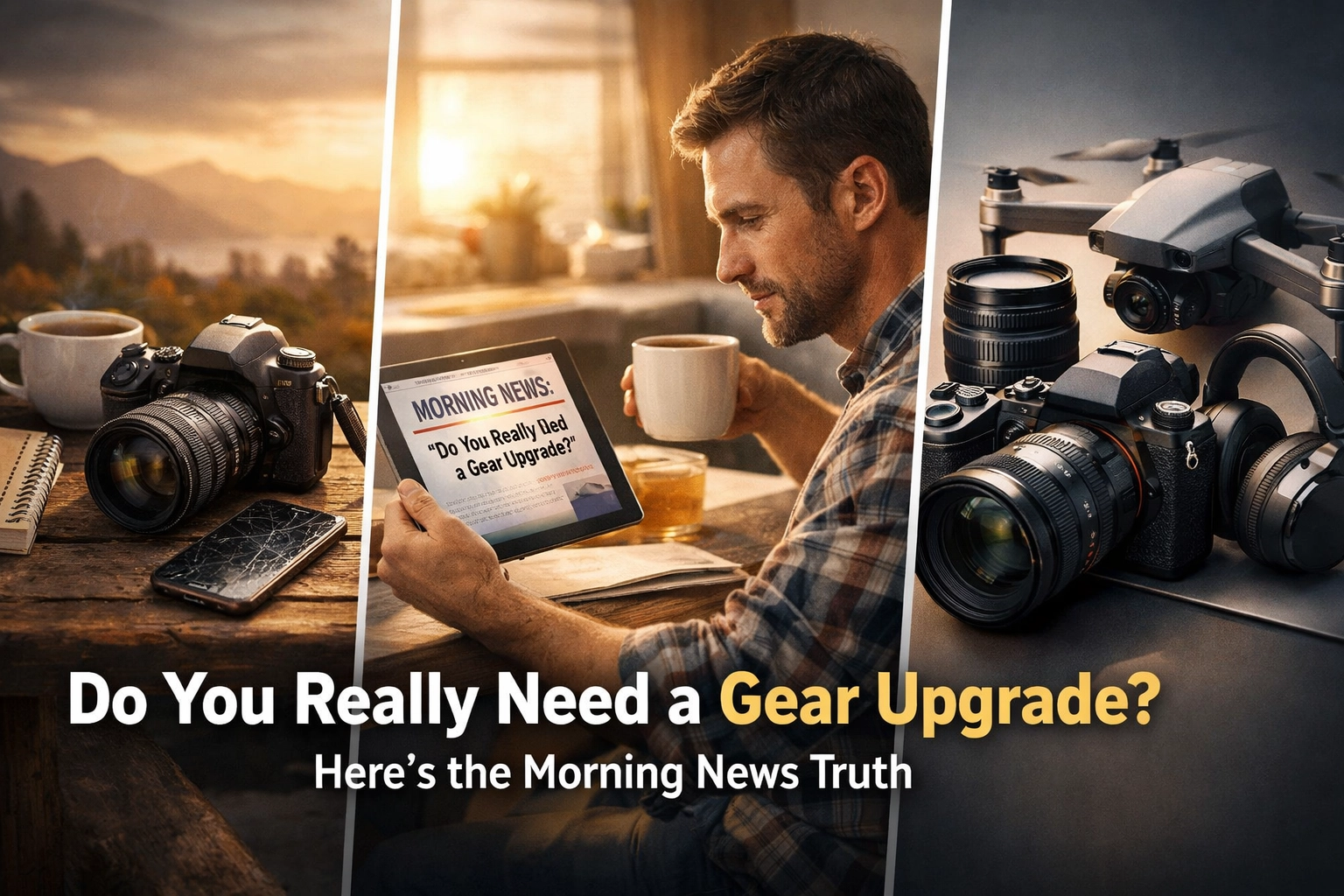
It is Sunday morning, March 15, 2026. You’re sitting there with your coffee, scrolling through the latest photography headlines, and it happens again. A notification pops up: the new flagship mirrorless camera has just been announced. It has more megapixels than your brain can process, AI-driven autofocus that can track a hummingbird’s heartbeat from a mile away, and a price tag that makes your bank account weep.
Welcome to the daily struggle of the modern creator. We live in an era where the "latest and greatest" becomes "old news" in about six months. But here at Shut Your Aperture, we like to take a breath and look at the reality behind the hype. Do you actually need that gear upgrade, or are you just falling for the morning news cycle’s masterclass in marketing?
Today, we’re breaking down the hard truths about gear acquisition syndrome (GAS), the latest industry trends for 2026, and how to decide if your current setup is actually holding you back or if you just need to spend more time shooting.
The 2026 State of the Industry: What’s Actually New?
As we look at the current landscape, the photography and videography world has shifted significantly. We’ve moved past the "megapixel wars" of the early 2020s. Today’s industry trends are focused on two major things: AI integration and computational photography.
The latest releases from the big players, Sony, Canon, and Nikon, are no longer just about hardware. They are about the silicon inside. We’re seeing cameras that can automatically cull your bad shots in real-time or suggest lighting adjustments based on the scene's dynamic range. While these features are incredible, they raise a fundamental question: does a "smarter" camera make you a better photographer?
If you look at the latest mirrorless camera reviews, you’ll see that the gap between "entry-level" and "professional" gear is smaller than ever. Even a mid-range body from 2024 is still a powerhouse today.
 Save
Save
SEO Alt Text: A photographer comparing two mirrorless cameras in a modern studio setting, showing the sleek design of 2026 camera technology.
The Gear Reviewer Trap
Let’s be real for a second. Most of the gear reviews you watch on YouTube or read on tech blogs are designed to make you want to buy things. Reviewers often have financial incentives, affiliate links, or a need to keep manufacturers happy to stay on the "early access" list.
According to recent industry analysis, a significant portion of gear purchases are driven by trend-following rather than functional necessity. You see a pro using a specific 85mm f/1.2 lens, and suddenly your perfectly sharp f/1.8 feels like a piece of plastic junk. It’s not.
The morning news truth is that most reviewers are testing gear in a vacuum. They aren't shooting your clients, your landscapes, or your family vacations. They are testing lab charts and bokeh balls. Before you hit "add to cart," check out Shut Your Aperture for a more grounded perspective on what gear actually matters for different niches.
The Four-Point Upgrade Test
Before you drop several thousand dollars on a new body or lens, run your decision through this four-point checklist. If you can’t say "yes" to at least two of these, you probably don’t need the upgrade.
1. Does it add a specific capability you lack?
This is the big one. If you’re a wildlife photographer and your current camera’s autofocus can’t keep up with a bird in flight, then a camera with better tracking is a capability upgrade. If you’re a wedding videographer and you need internal 10-bit color to match your B-cam, that’s a functional necessity.
However, if you’re buying a new camera just because it has a flip-out screen and your current one only tilts, is that really worth $2,000? Probably not. You can learn more about mastering what you already have in our manual mode 101 guide.
2. Does it improve your speed and workflow?
Time is money. If a new camera body has dual card slots that prevent you from losing data, or a faster processor that means you aren’t waiting for the buffer to clear, it’s a valid investment. This is especially true for professionals who use sites like www.proshoot.io to manage their business. Efficiency is a legitimate reason to upgrade.
3. Is there a significant weight or size reduction?
As we get older, or as our backs get more tired, weight matters. The shift to mirrorless was largely driven by this. if moving from a heavy DSLR setup to a compact mirrorless system means you’ll actually take your camera out more often, then the upgrade is justified. The best camera is the one you actually carry.
4. Does it solve a "comfort" issue?
Don't underestimate ergonomics. If your current camera gives you hand cramps after an hour of shooting, or the menu system is so confusing that it makes you want to throw it into a lake, changing systems might save your sanity.
 Save
Save
SEO Alt Text: Close up of a photographer's hands adjusting the tactile dials on a premium magnesium alloy camera body.
Software Over Hardware: The Secret of 2026
Before you replace your sensor, have you looked at your software lately? In 2026, software updates are doing more for image quality than new sensors are.
If your images feel "dull" or you’re struggling with noise in low-light situations, you might not need a new camera. You might just need better post-processing tools. We highly recommend checking out Luminar. Their AI-driven enhancements can breathe new life into files from older cameras, making them look like they were shot on the latest flagship models.
Instead of spending $3,000 on a body, spend $100 on a powerful editor like Luminar and see if that fixes your "quality" problem. You’d be surprised how much life is left in a 5-year-old sensor when you use modern de-noising and sharpening algorithms.
Maintenance vs. Replacement
Sometimes the urge to upgrade comes from the fact that our current gear is just… dirty. A sticky shutter button, a dusty sensor, or a loose lens mount can make a camera feel "old."
Before you give up on your faithful companion, go through our camera maintenance guide. A professional cleaning and a firmware update can often make a camera feel brand new. Check for the latest firmware on the manufacturer's site; in 2026, companies are increasingly releasing "feature drops" via software to extend the life of their hardware.
 Save
Save
SEO Alt Text: A clean workspace with camera cleaning tools, a sensor loupe, and a mirrorless camera being carefully maintained.
What the Pros Are Doing
If you look at the portfolios on www.edinfineart.com, you’ll notice something interesting. The stunning, high-resolution prints aren't always shot on the most expensive gear of the current week. They are shot by someone who knows their equipment inside and out.
Professionalism isn't about having the most expensive bag; it’s about reliability and vision. Many of the top creators featured on blog.edinchavez.com use gear that is two or three generations old because they’ve mastered the quirks of those specific tools.
The Financial Reality of Upgrading
Let’s talk numbers. Photography gear depreciates faster than a new car. The second you take that camera out of the box, it loses 20-30% of its value. If you upgrade every year, you are essentially paying a massive "subscription fee" to the manufacturers.
If you’re running a business, you need to calculate the Return on Investment (ROI). Will this new camera allow you to charge more? Will it attract a higher tier of client at www.edinstudios.com? If the answer is no, then that money is better spent on marketing, education, or even a trip to a new location to expand your TRAVEL portfolio.
Trends to Watch: When You SHOULD Upgrade
While I’ve been advocating for caution, there are times when the industry makes a leap that is impossible to ignore. Here are a few 2026 trends that might actually warrant a gear swap:
- Global Shutters: If your work involves high-speed flash sync or fast-moving subjects (like sports or wheels), the move to global shutters is a game-changer. No more rolling shutter distortion.
- Unified Mounts: If you are still holding onto legacy glass with clunky adapters, moving to a native mirrorless lens system will significantly improve your autofocus speed and reliability.
- Environmental Sealing: As weather patterns become more unpredictable, the high-end weather sealing in modern "pro" bodies is becoming a necessity for outdoor photographers.
 Save
Save
SEO Alt Text: A mirrorless camera being used in a heavy rainstorm, demonstrating modern professional-grade weather sealing.
Focus on the Craft, Not the Chrome
At the end of the day, the morning news truth is simple: the industry wants you to be a consumer, but you want to be a creator.
Don't let the shiny new specs distract you from the fundamentals of composition, lighting, and storytelling. If you’re feeling uninspired, a new camera will only give you a temporary "dopamine hit" of inspiration that lasts about two weeks. After that, you’re back to being the same photographer, just with a lighter wallet.
Instead of browsing the sitemap for new gear reviews, try browsing it for new techniques. Mastering a new lighting setup or a new editing style will do more for your photos than any sensor upgrade ever could.
Conclusion: Making the Call
So, do you really need that upgrade?
If your current gear is broken, limiting your ability to take a specific type of shot, or causing you to lose money due to inefficiency: buy the gear.
If your current gear is working fine but you’re just bored or feeling the pressure of "keeping up with the Joneses" on social media: keep your money.
Invest in your skills, maintain your current equipment, and remember that the best gear in the world is useless if you don't know how to use it. Now, put down the news feed, grab your "old" camera, and go shoot something amazing.
Categories: News, TUTORIALS
Tags: News, TUTORIALS, PHOTO SERIES, TRAVEL