How to Photograph Forsyth Park: Vantage Points, GPS & Best Times
~13 min read · 2026-05-23 For practitioners, see our breakdown of tone curve for film looks. For practitioners, see our breakdown of panning at 1/30s.
shutyouraperture-20). Buying through these links costs you nothing extra and helps fund our free guides.
Forsyth Park is Savannah’s iconic 19th-century park, where the fountain, live oaks, and Spanish moss create a classic Lowcountry frame.. This is the working photographer’s field guide: when to be there for the light, what gear actually fits the site, the 6 highest-yield vantage points with GPS coordinates, the access reality (tripod policy, drone policy, permit policy), and the cultural and crowd-management context that separates a respectful documentary frame from the cliché tourist photograph. The genre rewards photographers who plan with the same rigor they bring to wedding work or commercial assignments.
Get the Forsyth Park Ultimate Photographer’s Guide
Every location below — pre-mapped with GPS, golden-hour timing, gear recommendations, cultural rules, and a 14-day itinerary. Downloaded by 200+ working photographers.
 Save
SaveWhy Forsyth Park is worth photographing
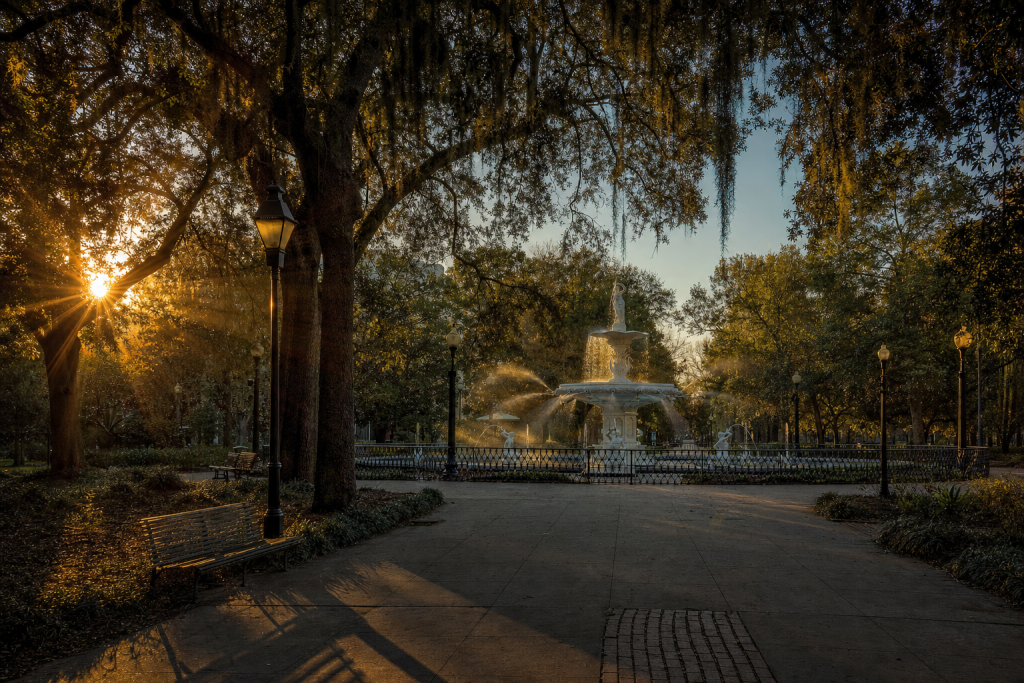
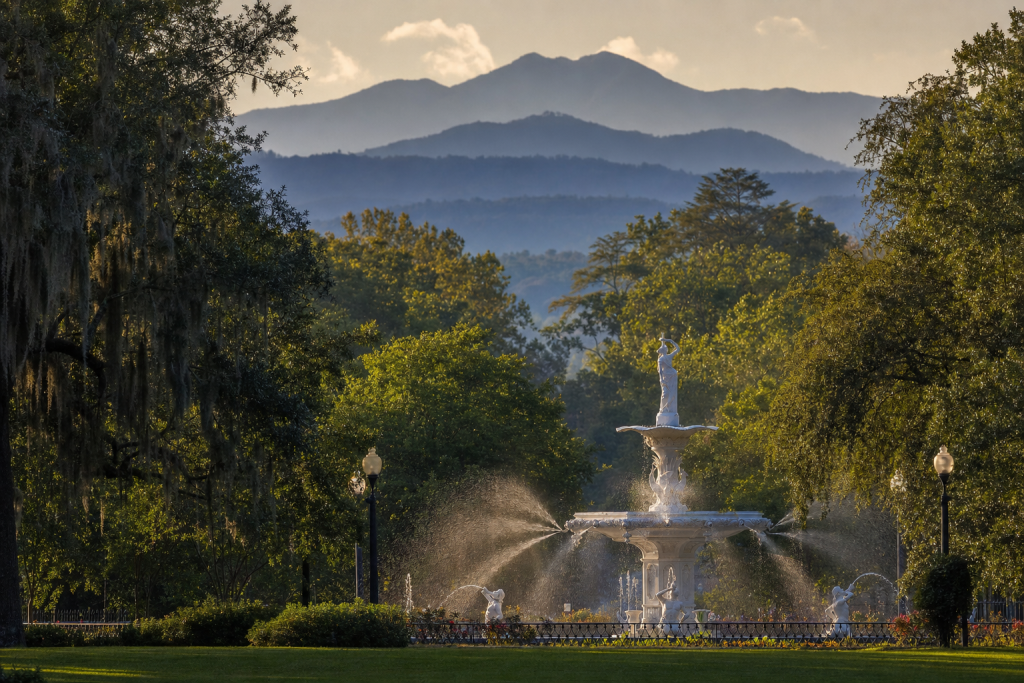
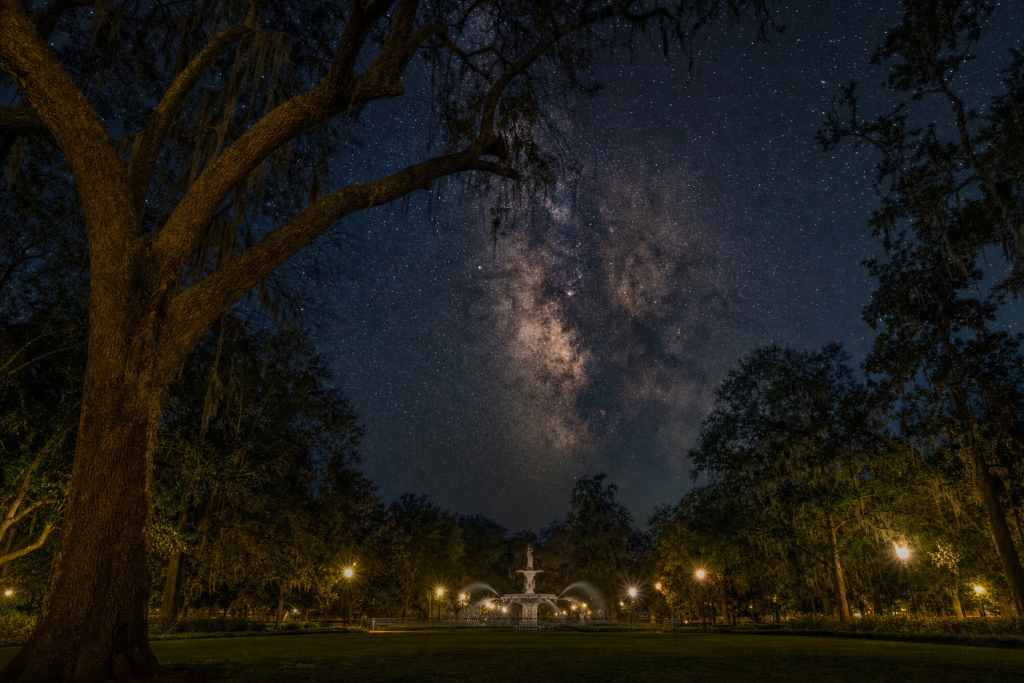
Forsyth Park is Savannah’s signature public landscape: a broad, photogenic green space anchored by the restored 1858 fountain and lined with elegant walkways, monuments, and live oaks. It delivers an easy-to-shoot mix of wide establishing views, intimate details, and strong seasonal atmosphere in the heart of the Historic District.
For photographers, Forsyth Park concentrates a particular set of demands: managing crowds, working a small physical space, balancing extreme dynamic range, and producing frames that stand apart from the millions of similar exposures already on the internet. Photographers who study the iconic frames in advance – and decide deliberately what to do differently – consistently produce richer trip portfolios than photographers who arrive and shoot reflexively from the spot where everyone else is standing. Look for the second-best angle. It is usually empty.
The frames that come out of Forsyth Park reward an editing approach that respects the site’s natural color palette instead of pushing every shot into a uniform Instagram preset. Read at least one substantial historical or architectural source before you go – the working photographer who knows the building dates, the architect, and the cultural context produces frames that read as informed rather than touristy. Bring questions, not just gear.
When to photograph Forsyth Park: best times and light
March–May and October–November for the best balance of comfortable weather, softer light, and lighter humidity; spring brings fresh green canopy and flowers, while fall offers pleasant temperatures and fewer summer crowds.
Day-by-day, plan around the morning and evening blue and golden hours. Sunrise to about 9 AM for the cleanest fountain light and fewest people; late golden hour before sunset for warm fountain and oak-tree glow. Midday at most landmarks is harsh and unflattering – skip it, eat lunch, scout your evening compositions in the shade, and return when the light returns. Photographers who insist on shooting through midday sun produce washed-out files they cull in the edit.
Arrive at sunrise or before 9 AM to avoid tour groups, weddings, and day-tripper traffic. If you want people in the frame, late afternoon and golden hour are busiest; for cleaner compositions, shoot on weekdays and avoid Saturday morning farmers-market spillover. Weather is your collaborator, not your obstacle. Light overcast is a gift for architectural detail work – diffuse light suits stone, weathered surfaces, and fountain water far better than direct sun. Light rain darkens surfaces and saturates color. Fog reduces a chaotic scene to clean compositional silhouettes. Photographers who only shoot the site in clear weather are leaving most of their best frames on the table.
6+ vantage points with GPS coordinates
The vantage points below are organized roughly in the order a photographer working a half-day would shoot them – establishing wide first, then mid-distance compositions, then detail. Each entry includes the GPS coordinates so you can pin them on Google Maps before you arrive, plus a recommended focal length and brief composition note. Use this as a shot list, not a script: the best frame is often something you notice once you are standing there. The list keeps you from missing the obvious ones.
| Vantage point | GPS | Notes |
|---|---|---|
| Forsyth Fountain | 32.0742, -81.0936 | 24-70mm. The classic hero angle on the north-end fountain. Use a mid-wide composition for the full basin and surrounding palms, or tighten in to isolate the statue and water texture. |
| Moss Archway | 32.0737, -81.0943 | 35mm. Photograph the fountain and pathway through the oak canopy for a natural frame. This works especially well in low, directional light when the moss picks up texture and depth. |
| Centerline Rail | 32.0739, -81.0939 | 24-35mm. Shoot straight down the park’s central walkway to emphasize leading lines toward the fountain. A low camera position gives the strongest symmetry and sense of depth. |
| Reflection Pool | 32.0743, -81.0936 | 50-85mm. Use the fountain basin for reflective compositions and detail shots of the spray and stonework. Early morning gives the calmest water surface and the cleanest mirror effect. |
| Park Panorama | 32.0734, -81.0932 | 16-24mm. A wider contextual view that shows the fountain within the park’s open lawns and canopy. Best for establishing shots, especially when you want the scale of the park to read clearly. |
| Drayton Street Edge | 32.0747, -81.0937 | 70-200mm. From the street-facing edge, compress the fountain against the surrounding trees and architecture for a layered city-park scene. Telephoto framing also works well for crowd-free details and portrait-style compositions. |
If you have additional time
The complete Forsyth Park guide is $47
All vantage points above + 5 bonus secret spots, printable map, gear pack list, and editing recipes. One-time payment, instant download, lifetime updates.
Camera settings cheat sheet
Forsyth Park photography lives across a wide exposure range – bright midday architectural detail, dim interior space, golden-hour exteriors, blue-hour spotlit night frames. The cheat sheet below covers the most common scenarios. Use auto-ISO with a maximum cap (3200 on most modern bodies, 6400 if you trust your sensor) so you can stop worrying about ISO and concentrate on aperture and shutter:
| Scenario | Aperture | Shutter | ISO |
|---|---|---|---|
| Golden hour exterior | f/8 – f/11 | 1/125 – 1/500 | 200 – 400 |
| Architectural detail (sidelight) | f/8 | 1/250 | 100 – 200 |
| Interior (no flash) | f/2.8 – f/4 | 1/60 – 1/125 | 1600 – 6400 |
| Long exposure water silk | f/11 – f/16 | 1s – 8s (tripod, ND filter) | 100 |
| Blue hour cityscape | f/8 | 2s – 8s (tripod) | 200 – 800 |
Bracketing is your friend. A three-frame bracket at +/- 1 stop captures the full dynamic range of most scenes and gives you HDR options in post without committing to the look at capture time. Modern sensors recover shadows beautifully – expose to the right, protect highlights, and lift the shadows in Lightroom rather than blowing the sky. Landmarks especially benefit from blue-hour blending – the architecture wants the warm tungsten light of the golden hour, but the sky wants the deep blue of 20 minutes after sunset. Two exposures, blended in post.
 Save
SaveLens recommendations
16-24mm for park panoramas, 24-35mm for the fountain and leading lines, 50-85mm for details and reflections, 70-200mm for compressed street-side or portrait-style frames
For mirrorless shooters: a single body with a 24-70mm f/2.8 plus a 35mm or 50mm f/1.8 prime is a viable lighter kit. The compromise is the long end – a 70-200mm becomes useful when you need to compress distant landmarks against a closer foreground or isolate sculptural detail. Most landmark photographers travel with two bodies (one zoom, one prime) and accept the weight for the speed of swapping focal lengths without changing lenses in dusty or crowded conditions.
A polarizing filter changes the look of stone facades, deepens sky color, and cuts reflection on water and glass. Carry one. For long-exposure work – fountain silk, blue-hour cityscapes, light-trail traffic – a 6-stop or 10-stop ND filter and a sturdy travel tripod are non-negotiable where allowed. Carbon fiber under 1.5kg is the right tradeoff between weight and stability for long-distance travel. Always check tripod policy before you arrive.
Crowds, restrictions, and on-site etiquette
Official city page information is limited; no specific park-wide photo restrictions were stated. The City of Savannah confirms Forsyth Park is a public park, and a city news post notes the historic fountain has been restored; for current rules on tripods, drones, special events, or commercial photography, check the City of Savannah Parks & Tree Department / Special Event Calendar. As with most urban parks, stay on paths and off planted areas, and avoid interfering with weddings or permitted events.
Beyond the location-specific rules, the universal photographer’s code applies: ask before close portraits, do not photograph children without parental consent, do not photograph religious rituals if asked to stop, and never tip with your camera. The best landmark portraits come from photographers who blend in, work quietly, and respect the sense of place. Use the walkways, keep off lawns and flower beds, and give space to couples and wedding parties. Be respectful of a shared civic park: avoid blocking paths, and keep sound and gear footprint low around the fountain and monument areas. A camera in a religious site – Catholic, Hindu, Buddhist, Muslim – is a guest at someone’s home. Behave accordingly.
Drone rules deserve special caution. Default assumption for any major landmark: drones are not allowed. Most heritage sites ban them outright. Even where they are technically legal, flying a drone over a tour group or above protected architecture is a fast way to get your gear seized and your name on a list. If you must fly, do it before the site opens, with permission, and far from any other visitors.
How to get there
Nearest airport is Savannah/Hilton Head International Airport (about 20-25 minutes by car in normal traffic). Forsyth Park is in Savannah’s Historic District, so downtown parking is typically easiest along perimeter streets or nearby garages; CAT bus service operates in Savannah, and the park is walkable from many Historic District hotels.
Plan your photography day around the geography of the high-yield vantage points. Cluster the morning shots within a short walking radius if possible – you lose more time fighting traffic and crowds than walking. Hire a half-day driver if you are visiting non-adjacent zones. The cost is modest and the time saved is meaningful for serious shooting. Carry a portable phone charger, a printed map (cell signal is unreliable in many old cities), small denominations of local currency for entry fees and tips, and a water bottle. Photographers who bring all the gear but forget the boring practicalities lose half their day to friction.
Post-processing approach
Aim for warm, luminous Lowcountry color: soft greens, creamy whites, and gentle fountain blues with moderate contrast. Keep skies natural, preserve the historic stone tones, and let the moss and canopy feel rich without going overly saturated.
A practical post-processing sequence that works on most landmark RAW files: (1) lens correction and chromatic aberration first; (2) basic exposure with shadows pushed and highlights pulled; (3) HSL desaturation on greens and oranges (counterintuitive but it lets the architectural tones speak), slight saturation boost on blue; (4) split toning warm orange in highlights and a hint of teal in shadows at low intensity; (5) clarity at +10 maximum on a frame, never higher; (6) a subtle vignette to draw the eye in. Save the result as a preset and use it as a starting point for the rest of the trip’s frames. The 20 presets in the matched Lightroom pack do this work for you with adjustments calibrated specifically for Forsyth Park’s color palette.
Quick Amazon shortcuts to the gear most useful for this kind of shot. Use them if Prime shipping or Amazon credit makes more sense than B&H. As an Amazon Associate ShutYourAperture earns from qualifying purchases.
 Save
SaveFrequently asked questions
What is the best time of day to photograph Forsyth Park?
Sunrise to about 9 AM for the cleanest fountain light and fewest people; late golden hour before sunset for warm fountain and oak-tree glow. Arrive at sunrise or before 9 AM to avoid tour groups, weddings, and day-tripper traffic. If you want people in the frame, late afternoon and golden hour are busiest; for cleaner compositions, shoot on weekdays and avoid Saturday morning farmers-market spillover.
Do I need a permit to photograph at Forsyth Park?
Use the walkways, keep off lawns and flower beds, and give space to couples and wedding parties. Be respectful of a shared civic park: avoid blocking paths, and keep sound and gear footprint low around the fountain and monument areas.
What lens should I bring to Forsyth Park?
16-24mm for park panoramas, 24-35mm for the fountain and leading lines, 50-85mm for details and reflections, 70-200mm for compressed street-side or portrait-style frames
What are the opening hours and entry fees for Forsyth Park?
Open daily as a public park; no official hours were clearly listed on the city page. Check the City of Savannah site for current access or event-related closures.
Can I bring a tripod to Forsyth Park?
Official city page information is limited; no specific park-wide photo restrictions were stated. The City of Savannah confirms Forsyth Park is a public park, and a city news post notes the historic fountain has been restored; for current rules on tripods, drones, special events, or commercial photography, check the City of Savannah Parks & Tree Department / Special Event Calendar. As with most urban parks, stay on paths and off planted areas, and avoid interfering with weddings or permitted events.
More landmark photography guides: browse the complete landmarks photography hub → for sibling guides on the world’s most photographed sites.
All links go to Viator (a TripAdvisor company), the world’s largest marketplace for guided experiences. Tagged as affiliate per FTC.
All links go to B&H Photo Video, the trusted pro source. Tagged as affiliate per FTC.
Common questions about the Forsyth Park guide
Is the Forsyth Park photography guide worth $47?
For most photographers, yes. The guide saves 8-12 hours of trip-planning research and prevents the most common mistake of Forsyth Park photography: shooting at the wrong time of day. If a single better frame is worth $47 to you, the guide pays for itself on day one. Buyers get every GPS coordinate, every golden-hour window, every cultural rule, and a printable shot list.
Does the Forsyth Park guide include GPS coordinates?
Yes — every vantage point in the guide has Google Maps-ready GPS coordinates so you can pin them before you fly. The guide also includes a printable map showing all locations clustered by walking distance, so you can build efficient half-day routes.
What's in the Forsyth Park PDF that isn't in this article?
The article shows the highlights. The PDF includes: 5 additional secret spots not published online, a 14-day itinerary with daily routes, the full camera-settings cheat sheet for every scenario in Forsyth Park, a printable gear packing list, post-processing recipes with screenshot examples, and a list of local guides we trust for portrait commissions.
Do I get the Lightroom presets too?
The $47 guide is the PDF only. The matching Forsyth Park preset pack is a separate $19 download — most buyers grab both as a bundle and save the editing time. Both are instant download, both work on Lightroom Classic and Lightroom Mobile.
Will the guide work for a Forsyth Park trip in 2026?
Yes. The guide is updated annually as fees, restrictions, and new vantage points change. All buyers get free lifetime updates. The 2026 edition includes the latest drone rules, museum photography policies, and seasonal light data for the year.
Visiting more than Forsyth Park?
Bundle multiple destination guides and save planning time across the trip:
- Philadelphia Photographer’s Guide ($47)
- Houston Photographer’s Guide ($47)
- San Antonio Photographer’s Guide ($47)
- Dallas Photographer’s Guide ($47)
Or get all 60+ destinations in one bundle: Photo Atlas — every guide, every map, $97.
What to Pack
Urban photography rewards a small, fast, flexible kit. Here is what travels well to Forsyth Park — links go to B&H Photo Video (our primary supplier) and Amazon for accessories.
| What & Why | B&H | Amazon |
|---|---|---|
Standard zoom (24-70mm) The single best urban walkaround lens. Wide enough for streets, tight enough for portraits and details. | Shop B&H → | Shop Amazon → |
Fast prime (35mm or 50mm) For low-light blue-hour streetwork and cafe interiors where a tripod is not welcome. | Shop B&H → | Shop Amazon → |
Compact travel tripod For blue-hour skylines and long exposures from bridges and rooftops. | Shop B&H → | Shop Amazon → |
Variable ND filter Cuts daytime light for slow-shutter motion in busy urban scenes. | Shop B&H → | Shop Amazon → |
Extra batteries (3 minimum) A full day of street shooting drains two batteries minimum. Carry three. | Shop B&H → | Shop Amazon → |
Lens cleaning kit Fingerprints and urban grime appear fast. Clean between every coffee stop. | Shop B&H → | Shop Amazon → |
Anti-theft camera strap Quick-release plus security cable. Worth the investment in any major city. | Shop B&H → | Shop Amazon → |
B&H and Amazon links are affiliate links. We earn a small commission on purchases at no extra cost to you. We only recommend gear we use or would buy ourselves.