Griffith Observatory is the highest-yield single location in Los Angeles for photographers — three world-class subjects (the Hollywood Sign, the downtown LA skyline, and the Art Deco observatory building itself) all visible from one paved terrace, free to access, and open until 10 p.m. Most photographers blow it by arriving at sunset on a Saturday and fighting 4,000 other people for the same shot. The notes below are how to actually walk away with a portfolio image.
Hours, access, and the day-of-week that quietly matters
The Observatory opens 12:00 noon to 10:00 p.m. Tuesday through Friday and 10:00 a.m. to 10:00 p.m. on weekends. It is closed all day Monday — the building, not the grounds. This matters because the exterior terraces, walkways, and the Hollywood Sign sightline remain fully accessible on Mondays, and the parking lot is free when the building is closed. A Monday at 4:30 p.m. in winter is the single best window most photographers never use: free parking, no crowds, golden hour light on the south face of the building, and the Hollywood Sign clean against late-afternoon haze.
Griffith Park’s inbound gates close at 10:00 p.m. and the park itself closes at 10:30 p.m. If you are shooting blue hour into night, your car must be moving down the hill by 10:15 at the latest. Rangers and Observatory security actively sweep the property — this is not enforced loosely.
Parking — the part that ruins most shoots
Three options, ranked by what actually works for a photographer hauling a tripod and a body bag:
- Main Observatory lot (2800 East Observatory Road) — paid, credit card only at the pay stations, and the only lot without an uphill walk. Stay in the LEFT lane on West Observatory Road or you will be locked out and forced into the through-traffic right lane with no way to turn around for half a mile. Free when the building is closed (Mondays, and after 10 p.m. — but see the gate-close rule above).
- Greek Theatre lot and roadside (about a mile downhill) — free, but unavailable after 1:00 p.m. on Greek Theatre concert evenings. Check the Greek schedule before planning a sunset shoot here. This is a real, sustained climb with gear; budget 20 minutes uphill.
- DASH Observatory shuttle — the fallback when both lots are full on a weekend. You park legally somewhere downhill, then ride up. Slow, but it eliminates the tow-away gamble.
Do not improvise a spot on the roadside without reading every sign on the same pole. Red curbs, tow-away windows, residential permit zones, and street sweeping signs are all actively enforced in this area, and a hire-car ticket arriving at your home address two months later is the standard tourist experience.
The light: when each subject actually works
The three subjects have three completely different best-light windows. Trying to shoot all three in one visit is the mistake most people make.
Hollywood Sign — morning, not evening
 Save
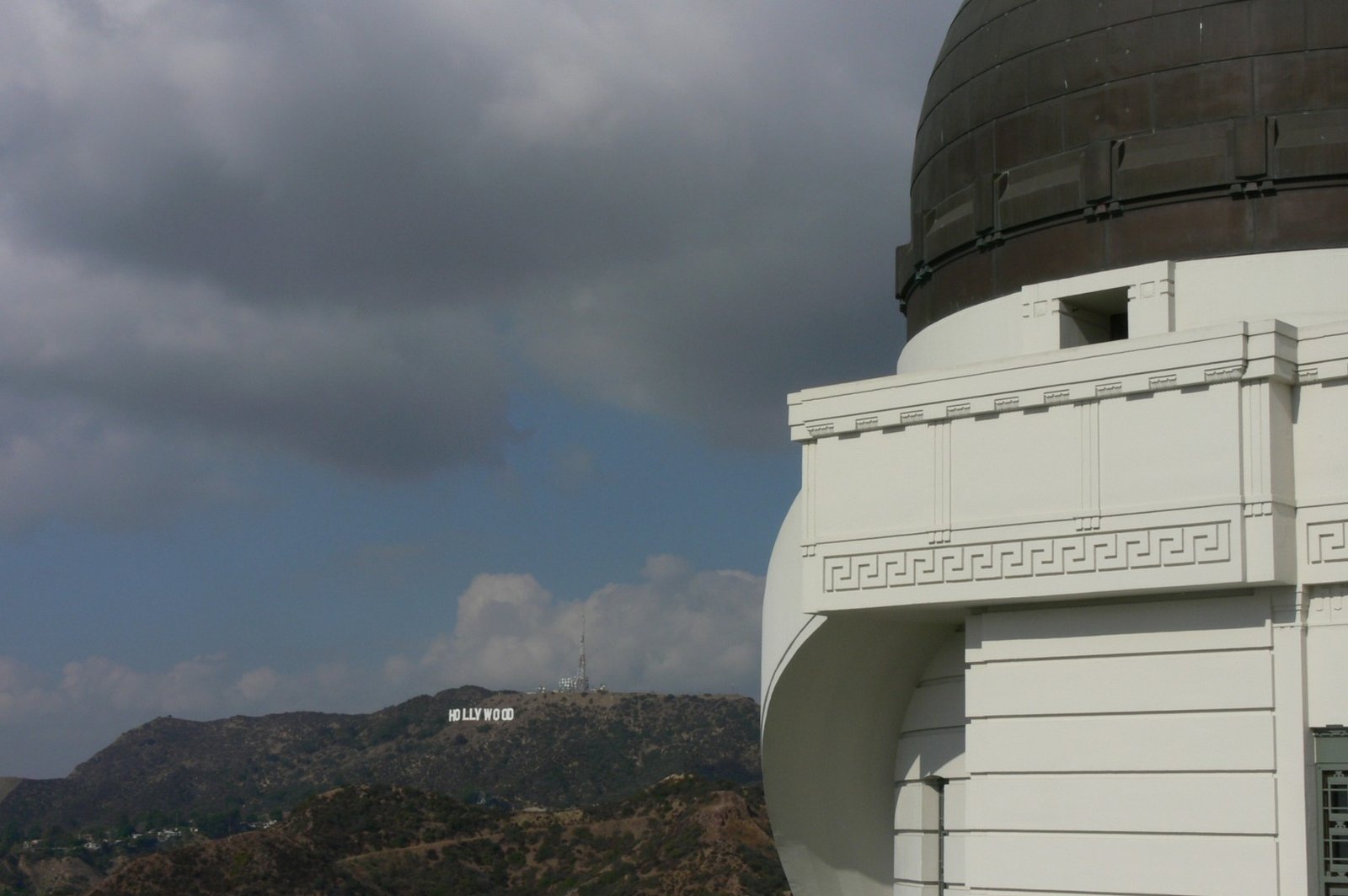
SaveThe Hollywood Sign sits roughly northwest of the Observatory, so it is side-lit in the morning and back-lit in the evening. At sunset the sign goes flat and hazy against the western sky — exactly when 90% of the crowd is photographing it. Sunrise to about 9:30 a.m. is when the sign has directional light raking across its face. Winter mornings after a Santa Ana wind event give the cleanest air. Use the western side of the Observatory grounds, near the Tower Viewer overlooks. A 70-200mm at 135-180mm compresses the sign nicely against Mount Lee.
Downtown LA skyline — blue hour, looking southeast
 Save
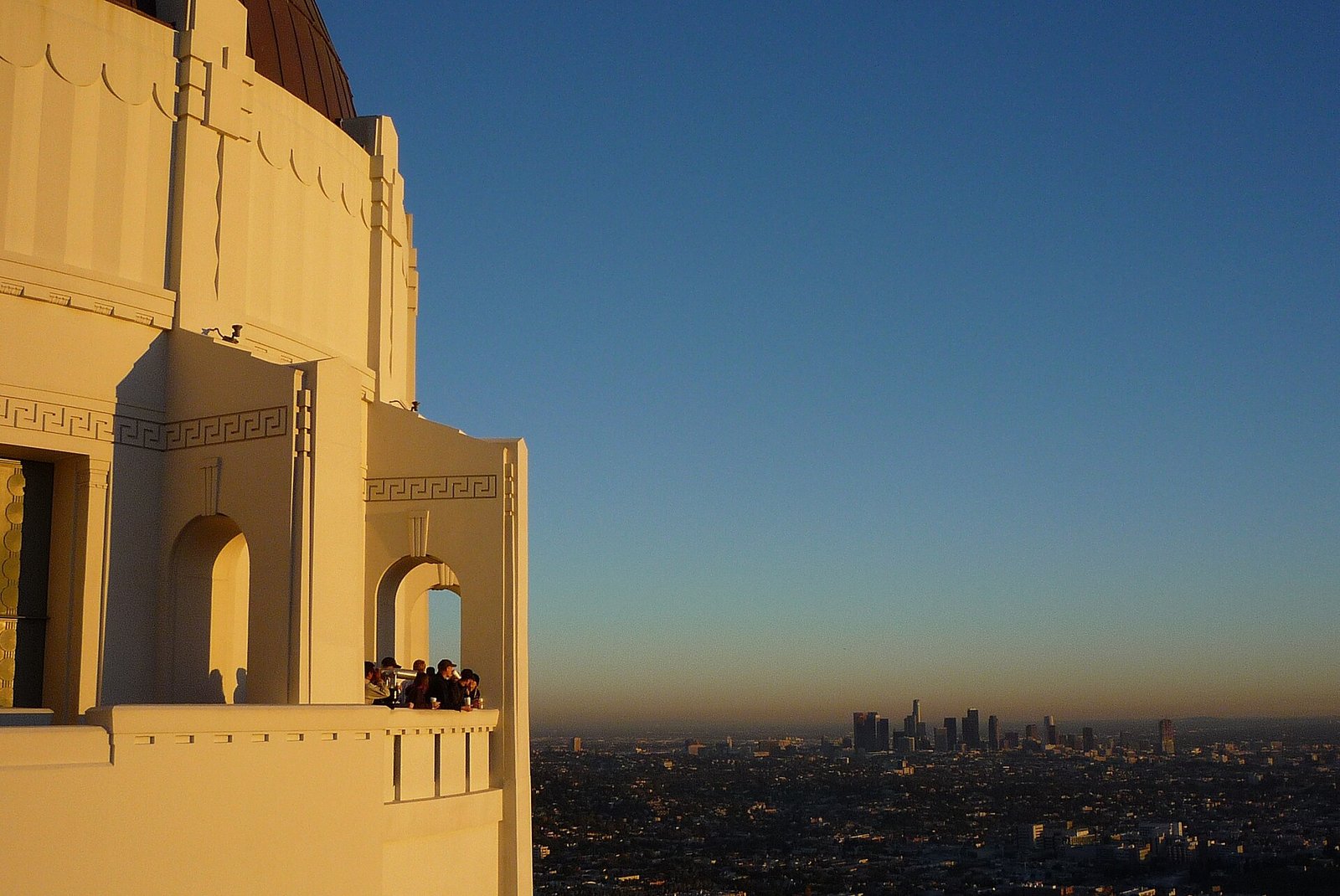
SaveThe downtown skyline shot is the one worth staying for. Best window is the 25 minutes between official sunset (around 7:58 p.m. in late May, 4:50 p.m. in mid-December) and full dark, when city lights have come on but there is still color in the sky. Shoot from the southern edge of the front lawn or the eastern terrace. A 24-70mm at 50-70mm gives the classic frame; a 70-200mm tighter shot isolates the US Bank Tower cluster. Tripod essential — exposures land in the 1-4 second range at ISO 200, f/8.
The Observatory building itself — last hour of golden light
 Save
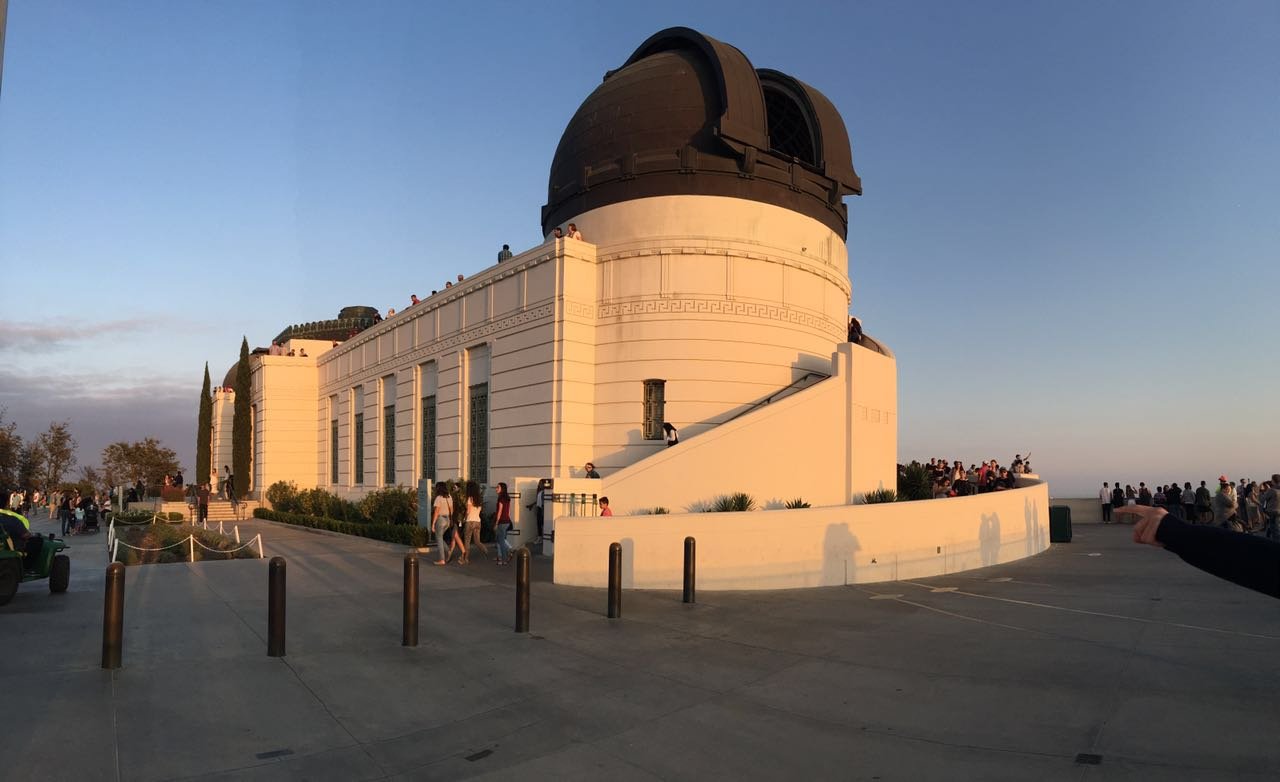
SaveThe south face of the building gets warm direct light in the final hour before sunset. The three copper-domed rotundas pick up the color beautifully. Walk to the front lawn, stand about 40 feet back from the central rotunda, and shoot at 24-35mm. Sun position from late September through March puts the light directly on the facade; in summer it skims it from the side, which also works but produces longer shadows from the railings.
Tripods, permits, and the rule that catches commercial shooters
Per the Observatory’s published guidelines: tripods are permitted on the exterior only, for personal use, as long as you do not block walkways or sight lines. Lighting kits, reflectors, modifiers, and any “unattached equipment” beyond the camera and tripod are not allowed. Drones are flatly prohibited everywhere in Griffith Park.
The line that catches working photographers: “staged” photography — engagement shoots, wedding portraits, branded content — is prohibited on the roof, in the telescope dome, in the Gottlieb Transit Corridor, and on the Sunset Terrace outside the café. A wedding photographer working a couple’s personal shoot is treated as personal use and is fine on the front lawn and main terrace, but the moment it reads as a “session” blocking foot traffic, security will end it. Anything commercial — branded content, magazine shoot, video work — requires a FilmLA permit coordinated through the Park Film Office at (323) 644-6220, and exterior-only commercial fees start at $15,000.
Gear recommendations
- Body: Anything with good high-ISO recovery. Blue-hour skyline lands you in the ISO 400-1600 range depending on your shutter speed tolerance. See our ISO guide for the noise/grain tradeoffs.
- Lenses: A 24-70mm f/2.8 covers the building and skyline framing. A 70-200mm f/2.8 or f/4 is non-negotiable for the Hollywood Sign — anything wider and the sign becomes a postage stamp.
- Tripod: Carbon-fiber travel tripod is fine; the surfaces are paved and stable. Avoid setting up on the curved marble paths near the bronze sundial — security will move you off it.
- Filters: A circular polarizer cuts haze on the Hollywood Sign and downtown views. A 3-stop ND helps extend exposures on the building exterior in late afternoon. Aperture choices matter more here than they will on most landscape locations — depth-of-field on the foreground statuary against the city behind it is the signature compositional move.
What not to shoot
- The Foucault pendulum and any interior exhibit at flash power. Personal photos are fine; flash and tripods are prohibited inside the building.
- The Zeiss telescope dome and the planetarium theater — photography prohibited entirely.
- The sunset terrace outside the café for any staged or session-style work. Personal candids are fine.
- The same Hollywood Sign frame every other photographer takes from the railing on the west walkway. Move 30 feet. The composition with the green Art Deco door and the sign together is far less photographed and immediately recognizable as Griffith.
Logistics
- Restrooms: Public restrooms next to the main parking lot; additional restrooms inside the building during open hours.
- Food/water: The Café at the End of the Universe is on the lower level of the building (open during building hours only). Bring water on Monday visits — there is nothing on the grounds.
- Cell service: Strong on Verizon and T-Mobile; weaker on AT&T behind the building.
- Accessibility: The grounds, terraces, and main building floors are wheelchair-accessible. The roof and dome levels are reached only by stairs.
- Weather: Marine layer can sit on the city until 11 a.m.-noon, particularly May through July (locally “June Gloom”). Check a webcam before driving up for a morning Hollywood Sign shoot.
Address: 2800 East Observatory Road, Los Angeles, CA 90027. Phone: (213) 473-0800. Coordinates: 34.1184° N, 118.3004° W.
More photography spots in this area
Gear Blueprint: What to Pack for This Shoot
Griffith Observatory gives you three different shots from one location: LA skyline at sunset to the south, Hollywood Sign to the west, and the observatory itself at night. Each needs a different focal length — pack for all three.
- Telephoto zoom (70-200mm) — For the compressed Hollywood Sign shot from the east terrace.
- Mid zoom (24-70mm) — For LA skyline at golden hour.
- Wide prime or zoom (16-35mm) — For the observatory building lit up against the sky at blue hour.
- Sturdy tripod — Mandatory for skyline-to-blue-hour exposures. Hilltop wind picks up after sunset.
- Lens hood (all lenses) — You’re shooting toward the setting sun and toward bright observatory lights.
- Headlamp (red mode) — For the walk back down after dark.
- ND filter (6-stop) — For long-exposure car-light trails on the road below.
- Light jacket / windbreaker — It gets 15°F colder at the observatory than downtown LA, especially after sunset.
Affiliate disclosure: links above go to Amazon. We may earn a small commission at no extra cost to you. We only recommend gear we’d take ourselves to this specific location.