
Haystack Rock is the third-tallest coastal monolith in the contiguous United States — a 235-foot basalt column that sits at the waterline at Cannon Beach, Oregon, so close to shore that at minus tide you can walk to within a few feet of it in bare sand. That proximity, combined with a federal wildlife refuge overhead, a state-protected marine garden below, one of the most accessible tufted puffin colonies on the Pacific Coast, and a beach that runs arrow-straight for miles, makes this the single highest-yield location on the Oregon coast for photographers. Most people arrive at midday on a sunny July weekend, snap a wide shot in flat light, and go home vaguely disappointed. The notes below explain how to actually come home with a portfolio image. For practitioners, see our breakdown of keyword shortcuts. For practitioners, see our breakdown of editing on a tablet. For practitioners, see our breakdown of shutter sync with strobes.
Access — three entry points, one clear winner
All Oregon ocean beaches are public by law under the 1967 Beach Bill, managed by Oregon Parks and Recreation Department. Haystack Rock itself — everything above the mean high tide line (the barnacle line) — is federally protected as part of the Oregon Islands National Wildlife Refuge and is closed to public access at all times. The surrounding beach and intertidal zone below the barnacle line are free and open, with no entry fee, no permit, and no reservation required.
There are three practical access points for photographers, ranked by how close they put you to the rock:
1. Hemlock Street / Viewpoint Terrace stairway — closest approach
The tightest parking area in Cannon Beach sits on the east side of South Hemlock Street near Viewpoint Terrace. A wooden stairway directly across the street drops you onto the sand directly in front of Haystack Rock — the shortest walk of any access point, under two minutes. The lot is small (fewer than a dozen spaces) and fills before 8 a.m. on summer weekends. If it is full, street parking on Hemlock south of Viewpoint Terrace sometimes opens up on the curves. Walk north on Hemlock from wherever you park; the stairway is on the left (west) side.
2. Gower Street / City Hall lot — best reliable option
The primary public parking lot sits at the corner of South Hemlock Street and Gower Avenue, adjacent to Cannon Beach City Hall (163 E. Gower St.). This is the lot the Haystack Rock Awareness Program officially recommends. Walk west on Gower, cross the small footbridge, and crest the sand dune — Haystack Rock is immediately visible to the south. HRAP puts the walk at 12 to 15 minutes; in practice it is closer to 10 minutes if you move at a photographer’s pace. The lot includes three RV-length spaces. The nearest public restroom is at 1216 S. Hemlock St. (next to the American Legion), directly across from the parking lot. Arrive by 7 a.m. during summer low tides or you will be circling. There is no parking fee at this city lot.
3. Tolovana Beach State Recreation Site — best for southern-angle shots
Located at 3288 Pacific Avenue at the south end of Cannon Beach, Tolovana Beach State Recreation Site is a day-use Oregon State Parks property (open dawn to dusk; no overnight parking). Tolovana has a large lot, a restroom building, a playground, and a wheelchair-accessible beach ramp — the easiest access for photographers carrying heavy tripods and gear bags. Haystack Rock is roughly a 15-to-20-minute walk north along the beach from the Tolovana access. The southern angle looking north puts the rock against open sky without the town behind it, which is a compositional advantage for long-exposure work at low tide. A day-use parking permit is required; purchase it on-site at the fee station. A small grocery (Fresh Foods) is directly across the street.
A fourth option, Ecola Court (midtown beach access), is a useful backup when the Gower lot is full. Take Ecola Court west off Hemlock; beach access is at the end. It puts you on the sand roughly between the Gower and Viewpoint Terrace access points, about 10 minutes from the rock. For the Ecola State Park overlook — the elevated Haystack Rock angle seen in countless wide landscape shots — Ecola State Park requires a day-use parking permit and sits north of town off Ecola Park Road. Do not confuse it with Ecola Court.
Tide planning — the only variable that actually matters
At high tide, the intertidal zone is submerged and the rock sits in water that can reach the base of the barnacle line. The reflections and tide-pool compositions that make Haystack Rock photographs interesting are simply not available. Everything in this guide about low-angle mirror shots, The Needles foregrounds, and marine garden access depends on the tide level — so plan before you book travel.
How to read the NOAA tide tables for Cannon Beach
The official Cannon Beach tide chart page links to NOAA Tides and Currents and recommends the North Jetty, WA station as the closest reference point for Cannon Beach predictions. You can access it directly at tidesandcurrents.noaa.gov. Search for “North Jetty” in the station finder. All times display in Pacific time. Pull up the monthly table view, not the hourly chart, so you can see every low-tide value across 30 days in one screen — this is the fastest way to identify shooting windows.
The threshold that matters: HRAP states you need a low tide of 1.0 foot or lower to access the tide pools. For photography — where you want standing water, mirror reflections, and exposed intertidal rock formations — target minus tides (0.0 feet and below). At a −1.5 ft tide, a sheet of water a centimeter deep stretches across the sand flat south of the rock; that is the mirror-reflection foreground. At −2.0 ft, the tidal channels between The Needles drain enough to let you move between them carefully on sand.
Best time of year for the lowest tides
On the Oregon coast, the deepest minus tides align with summer. The lowest predicted tides of the year — frequently reaching −1.5 to −2.0 ft — occur in June and July, driven by the combination of lunar perigee cycles and the seasonal tidal pattern. A secondary run of good minus tides appears in late May and again in late August. The critical practical constraint is timing: summer minus tides on the Oregon coast frequently fall in the morning hours (roughly 7 a.m. to 11 a.m.), which puts them squarely inside the golden-hour and mid-morning window. This is unusual good luck — your best tide and your best light overlap. In winter, minus tides tend to fall at night, making them useless for photography and dangerous for solo beach work. Spring and fall can produce minus tides in the late afternoon, occasionally aligned with sunset.
Plan to arrive at the rock 60 to 90 minutes before the predicted low-tide time. The water recedes gradually as it approaches minimum, giving you the best combination of exposed sand flat and active wave motion. After the low, you have roughly 45 minutes before the incoming tide starts to cover the mirror flats again.
The light: when each shot works by season
Summer sunset — the money shot, positioned correctly
 Save
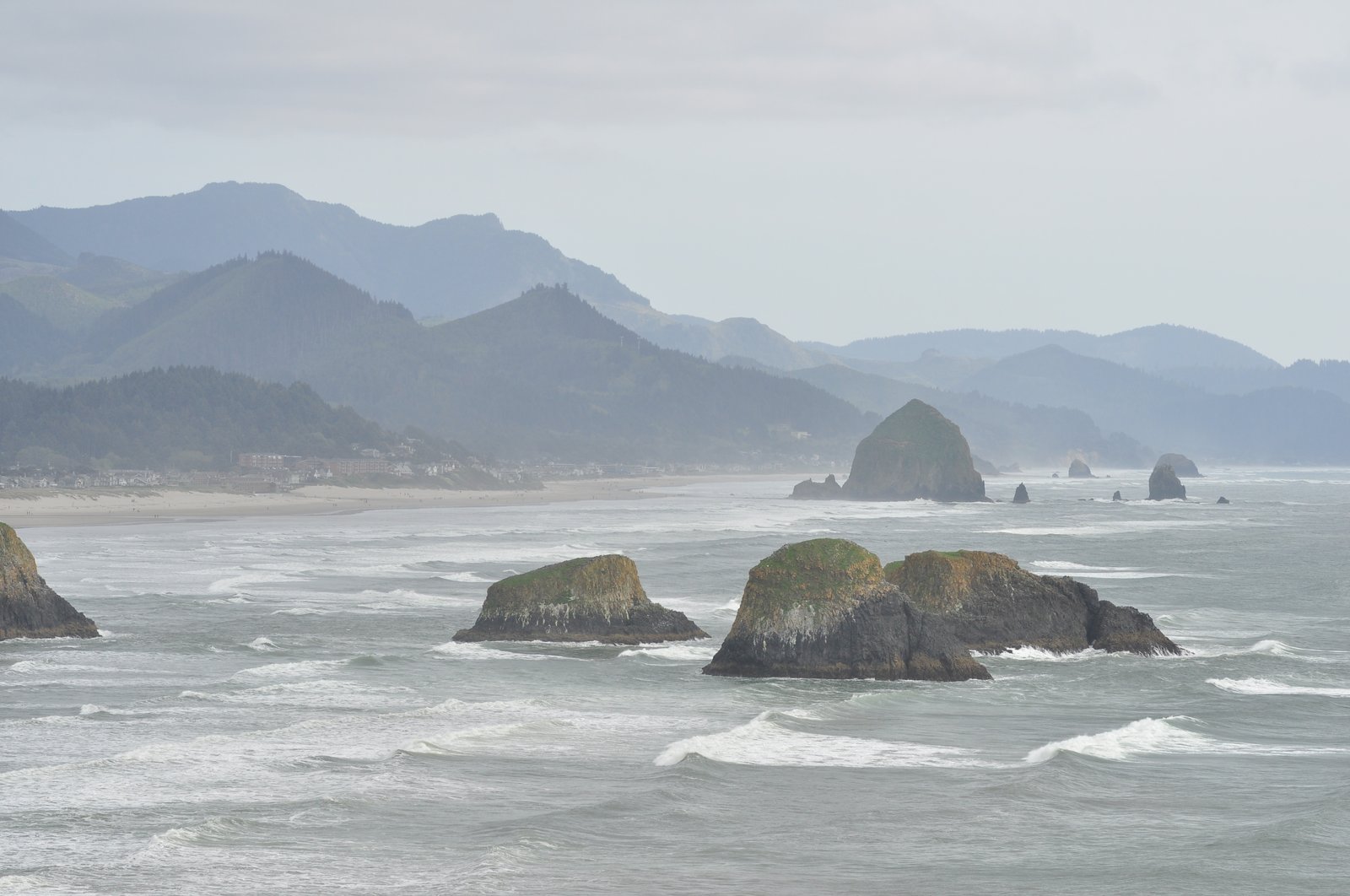
SaveIn summer (June through August), the sun sets well north of due west — roughly northwest — and because Haystack Rock sits at the waterline facing west-southwest, the summer sunset disk drops behind or very near the rock’s profile when viewed from a position south of the rock. This is the classic silhouette shot: rock and The Needles rendered black against an orange-to-magenta sky, wave foam glowing in the foreground. Set up 200 to 400 feet south of the rock and dial in your composition before golden hour starts. The sun moves faster near the horizon than photographers expect; have your tripod locked and your exposure bracketed before color peaks.
In winter, the sunset azimuth shifts south of west, and the sun sets east of the rock’s position — to put the setting sun in your frame with the rock, you need to position yourself north of the rock and shoot south-southwest. This produces a different composition: the rock in profile against a lit sky, rather than the full silhouette. Fewer people attempt it, and the result is less clichéd.
Blue hour — the shot most photographers leave before
The 20 to 30 minutes after sunset, when the sky transitions from pink to deep indigo, is consistently the most underrated shooting window at Haystack Rock. The rock goes to pure black silhouette against a gradient sky, the tide pools fill with blue-hour reflection, and the crowds thin out because most casual visitors leave at sunset. For blue-hour work, a 3-stop ND filter is useful for smoothing out residual wave action; at ISO 100 and f/11 you will be in the 15-to-45-second exposure range. A remote shutter release is essential. The Needles, visible to the south, turn into graphic negative shapes against the sky at this hour and make a strong alternative foreground to the rock itself.
Foggy mornings and marine layer — a different kind of image
Cannon Beach sits on a coast that generates significant marine layer — low fog that rolls in overnight and can persist until late morning. This is most common in summer, when warm inland air meets cold Pacific water. A foggy morning at Haystack Rock produces a completely different image vocabulary: the rock emerges from white obscurity, the horizon disappears, and the tonal range collapses to soft grays with only the foreground tide pools in sharp focus. This mood is notoriously difficult to plan for — check the NWS Point Forecast for Cannon Beach the evening before — but when the marine layer is present, treat it as a gift rather than a frustration. A polarizing filter cuts through the haze slightly and restores saturation to wet rocks and anemones in the pools.
Compositions and what makes them work
The low-tide mirror reflection
 Save
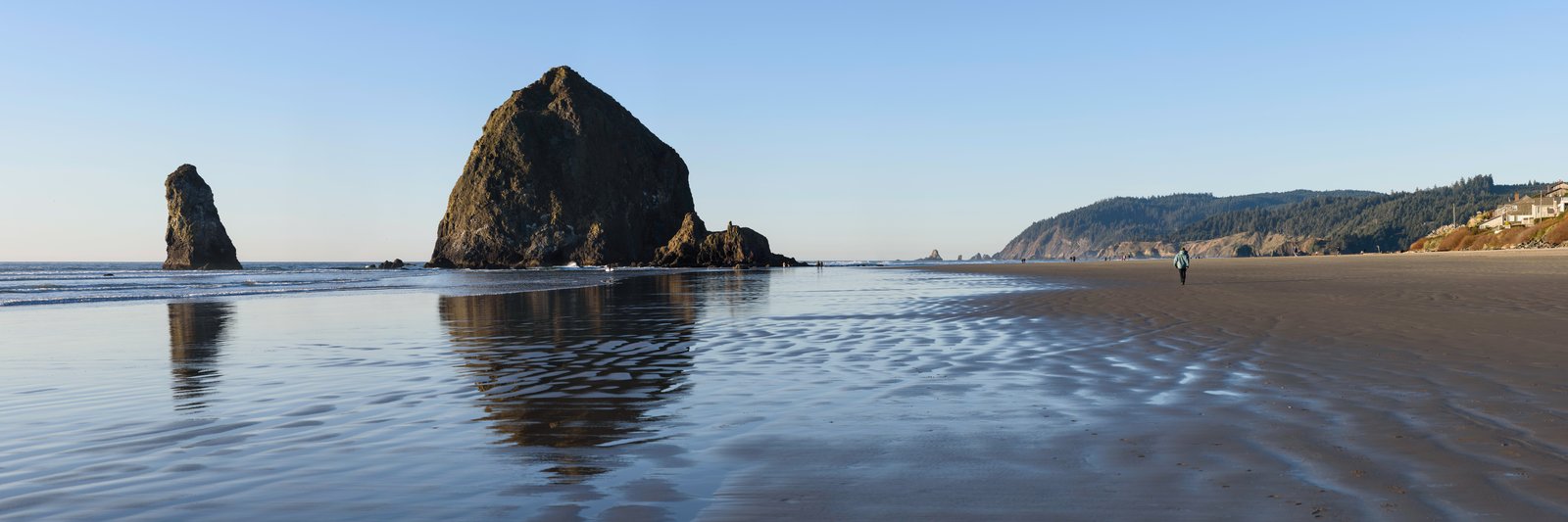
SaveAt minus tides, a thin sheet of water remains on the sand flat south and southwest of Haystack Rock as the tide retreats. This is the mirror-reflection foreground. Get your tripod legs as low as possible — center column fully down, legs splayed — and shoot with a wide-angle lens (16–24mm full frame) to include both the reflected sky and the rock simultaneously. A level bubble or electronic horizon helps; even a one-degree tilt breaks the mirror symmetry. The reflection is most vivid in the 10 to 20 minutes after a wave has washed across and then retreated, leaving an undisturbed surface. Patience over anticipation: don’t trip the shutter until a wave has fully drained off and the surface settles. A 3-stop ND filter at 1/4 to 2 seconds smooths the remaining ripple without requiring an exposure long enough to blow the highlights in a bright sky.
Wave smoothing with ND filters
For silky wave-motion images — white foam trails radiating away from the base of the rock — use a 6-stop ND filter at base ISO. At f/11 in late afternoon light, this typically yields a 15-to-30-second exposure that turns active surf into a white mist while keeping the rock, The Needles, and the sky sharp. Stack the 3-stop and 6-stop for full daylight if you need exposures over 30 seconds. Autofocus before mounting the ND; most cameras cannot find contrast through a dark filter. Check your filter edges for vignetting at focal lengths below 20mm on a full-frame body. For more on how aperture controls depth of field in these long-exposure scenarios, see our aperture photography guide.
The Needles sea stacks
 Save
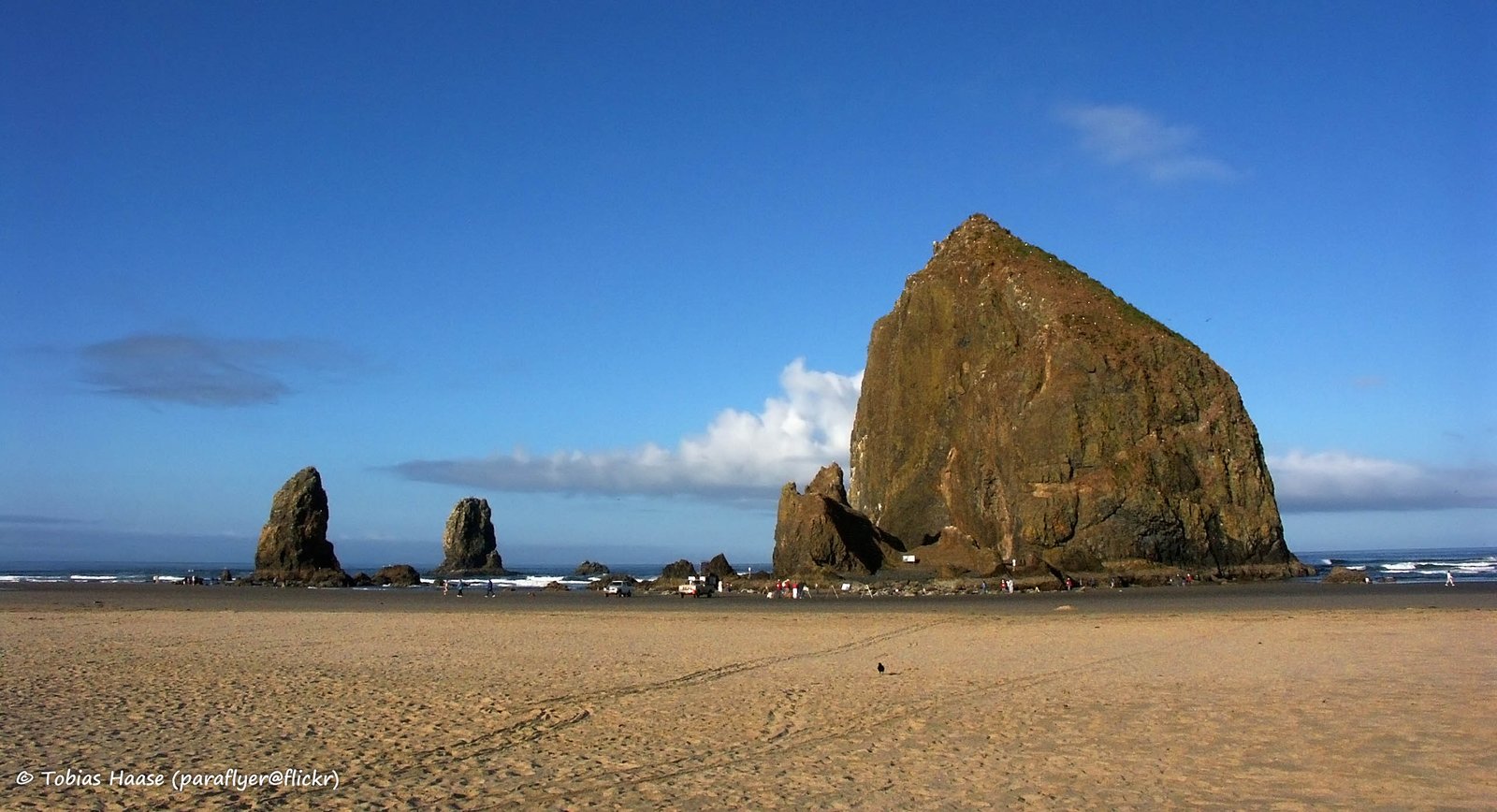
SaveThe Needles — a cluster of narrow basalt sea stacks roughly 500 feet south of Haystack Rock — are visible from almost every position on the beach and provide a natural secondary subject for wide compositions. At high tide they sit in breaking surf; at minus tide the connecting sand channels drain and you can frame Haystack Rock with The Needles in the foreground. At the 16–20mm range, this gives you a layered composition: tide-pool foreground, Needles mid-ground, Haystack Rock and sky behind. Shooting from just north of The Needles looking north also gives you a slightly elevated angle on the sand flat that shows the mirror reflection geometry more dramatically.
Puffin colony — long glass, still position, federal law
Tufted puffins nest on the grassy north slope of Haystack Rock from approximately April through early August, with peak activity and visibility in June and July according to the Cannon Beach visitor guide. By late August the adults and fledglings return to the open ocean. The birds are most active — flying in and out with fish for chicks — during the first two hours of daylight and the last two hours before dark. From a photography standpoint: you cannot get close. The rock above the barnacle line is federal wilderness; any approach, landing by drone, or action that disturbs a nesting bird is a federal offense under the Migratory Bird Treaty Act. The practical shooting distance is 200 to 300 feet from the base of the rock, which means a minimum of 400–500mm equivalent reach for a frame-filling puffin shot. The HRAP team sometimes sets up a spotting scope during daytime low tides (February through November) for public viewing — ask them to help you locate active nest entrances on the north face before you burn your memory card on an empty ledge. Shoot in burst mode as birds approach the nest burrows; the landing approach is unpredictable. Do not flush birds deliberately. Do not approach the roped-off areas around the base of the rock.
Other nesting seabirds at Haystack Rock include Pelagic Cormorants (south-facing cliffs), Western Gulls, Pigeon Guillemots, and Black Oystercatchers. The same 300-yard no-collecting / no-disturbing radius from Cannon Beach’s official Haystack Rock page applies to all of them.
Wildlife rules — what the law actually says
Haystack Rock operates under a layered legal framework. Photographers need to know all three levels:
Federal — Oregon Islands National Wildlife Refuge: All land above the mean high tide line (the barnacle line visible as a band of encrusting barnacles on the lower rock face) is federally designated Wilderness Sanctuary under the jurisdiction of the U.S. Fish and Wildlife Service. Per USFWS Oregon Islands NWR, this land “is closed to the public at all times.” Climbing, landing on, or setting foot above the barnacle line is prohibited regardless of reason. Harassing or disturbing nesting seabirds — including by drone — is a federal offense under the Migratory Bird Treaty Act. For drones, HRAP recommends keeping at least 500 feet (roughly two Haystack Rock heights) away to avoid unintentional disturbance to the nesting sanctuary, especially April through September. Drones may not take off or land from the rock itself under any circumstances.
State — Marine Garden designation: The intertidal zone below the barnacle line is one of seven designated Marine Gardens on the Oregon coast under the Oregon Territorial Sea Plan, administered by the Oregon Department of Fish and Wildlife. Collecting or harvesting invertebrates and marine aquatic vegetation is strictly prohibited. No shells, no sea stars, no anemones, no animals. A single mussel may be taken for bait. Walking on bare rock is permitted; walking on rock covered with barnacles, mussels, or anemones is prohibited and damages living habitat. Walk only on sand or bare, clearly lifeless rock.
City — HRAP rules and dog regulations: Under Oregon Administrative Rule 736 (OAR 736-021-0090), dogs must be kept on leash at and around the Haystack Rock Marine Garden at all times — even if your dog is normally reliable under voice command off-leash elsewhere on Oregon beaches. The leash rule is in effect year-round, not only during nesting season. The Haystack Rock Awareness Program (HRAP) — a City of Cannon Beach program operating since 1985 — staffs beach interpreters during every daytime low tide from February through November. Their presence is educational, not enforcement. They can be genuinely useful for locating puffins on the north face and identifying marine species in the pools.
Gear for Cannon Beach
The Oregon coast is hostile to camera equipment in ways that desert and mountain locations are not. Salt spray travels farther than you expect — a wave breaking 30 feet away can mist your front element. On a calm-seeming day you may not notice the accumulation until you review images with hazing across the frame.
- Body: Weather-sealed is not optional here — it is the minimum. On a foggy morning or in active surf spray, an unprotected body can be damaged. If you are shooting a non-sealed mirrorless or DSLR, keep it in a dry bag when moving between locations and shelter it under your jacket when not actively shooting.
- Lenses: Two covers most scenarios. A wide zoom (16–35mm or equivalent) handles the mirror reflection, The Needles foregrounds, and blue-hour silhouettes. A telephoto (300–500mm or equivalent) is necessary for puffin and cormorant details; you cannot get close enough for a usable bird frame at anything shorter. Bring lens cloths — multiple — in an accessible pocket, not the bottom of your bag.
- Tripod: Mandatory. Low-angle mirror shots require legs in the wet sand, which means a tripod designed to get dirty. Carbon fiber legs are lighter on a long beach walk. Bring a tripod with independently adjustable legs so you can go completely flat on uneven wet sand. Set the legs before the tide flats drain to avoid disturbing the mirror surface when you reposition.
- Filters: A 3-stop ND and a 6-stop ND cover the full range of conditions you will encounter — wave smoothing in early morning light (3-stop), full-daylight long exposures (6-stop stacked). A circular polarizer cuts glare off wet rocks and saturates tide-pool colors. Step-up rings allow a single filter set to work across multiple lens diameters. For the theory behind how filters interact with your exposure triangle, see our landscape photography guide.
- Footwear: Gum boots (rubber wellies) are the single most underrated piece of photo gear on the Oregon coast. They let you walk into 6 to 8 inches of retreating wave wash to position your tripod in the wet mirror flat without soaking your feet. Neoprene socks inside the boots add warmth — water temperature averages around 50–55°F year-round. Sandals and trail runners are insufficient when wave action increases.
- Extras: A dry bag or waterproof camera insert for your pack; lens cloths in a ziplock; a small headlamp for pre-dawn setup even in summer (first light can be 5:15 a.m. in June); a tide chart printout as backup when cell service is patchy.
Hazards — the ones that catch photographers specifically
Photographers at Haystack Rock are statistically higher risk than casual beachgoers for one reason: we stare into viewfinders or at screens with our backs to the ocean. The Oregon coast produces sneaker waves — sudden surges that travel significantly farther up the beach than preceding waves, with no reliable warning. Per the Cannon Beach beach safety guidelines: “Sneaker waves are unpredictable and appear suddenly. They can rush up high on the shore with enough force to knock you down and drag you out to sea.” The practical rule for photographers: set your shot, take it, and look seaward before you review it. Never review images on a screen with your back to the ocean. Set up your tripod on ground you can retreat from quickly — avoid low depressions in the sand flat where a surge can pool around you faster than you can react.
Additional hazards specific to this location:
- Cold water and hypothermia: Pacific water at Cannon Beach averages 50–55°F. If you are knocked down in surf, hypothermia sets in within 30 minutes. Do not wade deeper than ankle-height without a wetsuit.
- Fog reducing sightline: Marine layer can roll in quickly, reducing visibility to a few hundred feet. This affects your ability to see incoming sets. If the horizon disappears in fog, increase your vigilance and consider moving higher on the beach.
- Slippery rock surfaces: The barnacle-covered lower face of Haystack Rock and the exposed intertidal boulders around it are wet and slippery. Stay on sand. If you must cross bare rock to position a shot, test each step. A fall onto barnacle-covered rock causes significant cuts.
- The rock cannot be climbed: This bears repeating because some photographers attempt it for an elevated angle. Every surface above the barnacle line is federal wilderness and physically dangerous — the rock is wet, steep, and crumbling in places. HRAP intercepted over 1,200 would-be climbers in a single season. The legal, physical, and ethical case for staying off is airtight. Shoot the elevated angle from Ecola State Park instead.
- Drift logs: Wet sand and surf-zone logs can be rolled by waves without warning. Never sit on or lean against a log that is on wet sand or near the water’s edge.
Logistics
Coordinates: 45.8845° N, 123.9678° W. The rock is visible from essentially any point on the beach between downtown Cannon Beach and Tolovana.
Dogs: Allowed on the beach but must be on leash at all times in the Marine Garden area around Haystack Rock (per HRAP rules and Oregon Administrative Rule OAR 736-021-0090). Keep dogs away from roped wildlife protection areas and from the tide-pool zone. Dog waste bags are required; no facilities to dispose of waste on the beach — pack it out.
Restrooms: Nearest to the Gower Street lot is at 1216 S. Hemlock St. (next to the American Legion). Tolovana Beach State Recreation Site has a restroom building in the parking area. There are no restroom facilities on the beach itself.
Food: Cannon Beach is a well-developed small resort town. The Wayfarer Restaurant on Hemlock Street is a local institution for dinner after a shoot. Pizza a’fetta, Morris’ Fireside Restaurant, and numerous cafes are walkable from any of the main parking areas. For pre-dawn shoots, Tolovana’s Fresh Foods grocery across the street from the state park is a practical food stop. The town is small enough that you will never be more than 10 minutes’ drive from a coffee option.
Accommodation: The Surfsand Resort and The Hallmark Resort sit in midtown Cannon Beach adjacent to the Gower Street beach access — the closest lodging to Haystack Rock. Both are walking distance from the primary parking lot and eliminate the car entirely for early-morning minus-tide shoots. Book well ahead for summer weekends; rooms often sell out months in advance for June and July.
Cell service: Generally adequate throughout the town and beach area (Verizon and T-Mobile perform best on the Oregon coast). Do not rely on cell service for tide lookups — download or print your tide table before you go.
Drones: Drones may be flown on the beach at Cannon Beach subject to FAA Part 107 rules, but may not take off or land from Haystack Rock. HRAP recommends a minimum 500-foot standoff from the rock during nesting season (April–September) to avoid federal Migratory Bird Treaty Act liability. Tolovana Beach State Recreation Site has posted signage prohibiting drone use to protect nesting shorebirds.
Sources: Haystack Rock Awareness Program — Rules and Regulations; HRAP — Planning Your Visit; U.S. Fish & Wildlife Service — Oregon Islands NWR Species; Oregon State Parks — Tolovana Beach State Recreation Site; Cannon Beach — Haystack Rock; Cannon Beach — Tufted Puffins; Cannon Beach Beach Safety Tips; Cannon Beach Tide Charts / NOAA; NOAA Tides and Currents.
Gear Blueprint: What to Pack for This Shoot
Haystack Rock is a 235-foot sea stack you shoot from low tide pools. The challenges are salt spray on your gear, fast-moving water at your feet, and bracketing for a bright sky against dark wet sand.
- Wide zoom (16-35mm) — You want to include the foreground tide pools and the full rock — 16-24mm on full frame is the working range.
- Aluminum tripod (NOT carbon) — Saltwater corrodes carbon fiber sleeves over time. Aluminum is cheaper to rinse and replace.
- 10-stop ND filter — For long-exposure water smoothing at sunset blue hour.
- Polarizer (CPL) — Cuts surface glare off the tide pools so you can see the reflection of the rock.
- Waterproof boots (knee-high) — You will be standing in 4-8 inches of water. Hiking boots fail here.
- Rain cover for camera body — Salt mist gets everywhere, even on dry days.
- Lens cleaning kit (with distilled water) — Salt spray dries on the front element in minutes.
- Tide chart app on phone (free) —
Affiliate disclosure: links above go to Amazon. We may earn a small commission at no extra cost to you. We only recommend gear we’d take ourselves to this specific location.