Best Photography Spots in Prague: 12 Locations With GPS

Tours & experiences disclosure: This guide includes affiliate links to Viator, the world’s largest tour and experiences marketplace. If you book through these links, ShutYourAperture may earn a small commission at no extra cost to you.

Prague photography guide hero imageSave

Amazon Associates disclosure: ShutYourAperture is a participant in the Amazon Services LLC Associates Program. As an Amazon Associate we earn from qualifying purchases. Some links below go to Amazon (Store ID edinchavez01-20). Buying through these links costs you nothing extra and helps fund our free guides.
Skip the planning. Get the Prague PDF. All locations, GPS coordinates, golden-hour times, gear tips. Instant download.

Prague, Czech Republic is one of the most photogenic cities in the world. If you have a camera and the patience to show up before dawn, Prague will give you images that last a career — but only if you know where and when to point it.

This is the definitive field guide to the 12 best photography spots in Prague, with GPS coordinates you can drop straight into Google Maps, exact camera settings tuned to Prague’s unique light, precise timing for every location, and the access notes nobody else bothers to document. It mirrors the intel inside our Prague Ultimate Photographer’s Guide ($47 PDF) — a downloadable field guide with full-page hero images, GPS maps, seasonal tables, a city safety briefing, and a complete photographer’s packing list. Get the guide →

Planning multi-city travel? See also: U.S. cities photography hub and the National Parks Photography Guides.

Prague Ultimate Photographer’s Guide — $47
12 GPS-mapped locations · Exact camera settings · Multi-season shooting calendar · Free annual updates

Download the PDF guide →
Skip the planning

Get the Prague Ultimate Photographer’s Guide

Every location below — pre-mapped with GPS, golden-hour timing, gear recommendations, cultural rules, and a 14-day itinerary. Downloaded by 200+ working photographers.

Get the PDF · $47
Instant download · Lifetime updates

Quick jump to the 12 spots

  1. Charles Bridge — Sunrise
  2. Prague Castle + St. Vitus Cathedral
  3. Old Town Square + Astronomical Clock
  4. Letná Park — Metronome Viewpoint
  5. Petřín Tower + Hill
  6. Vyšehrad Fortress
  7. Josefov — Jewish Quarter
  8. Strahov Monastery — Library + Terrace View
  9. Dancing House (Tančící dům)
  10. Lennon Wall
  11. Wenceslas Square — National Museum Steps
  12. Náplavka Riverfront

A look inside the Prague Photographer’s Guide

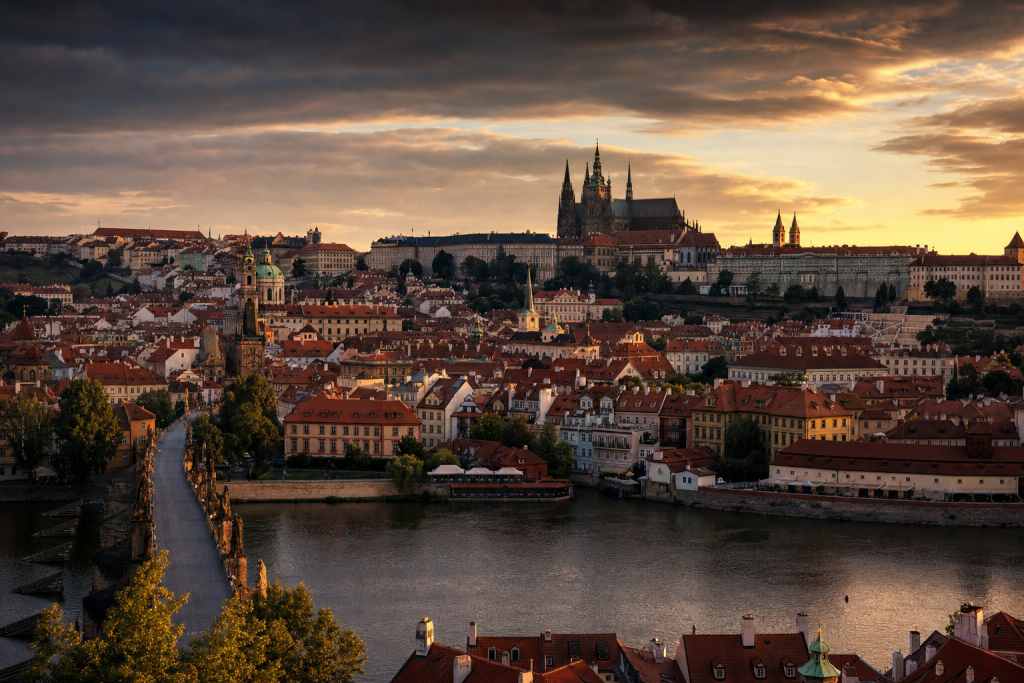
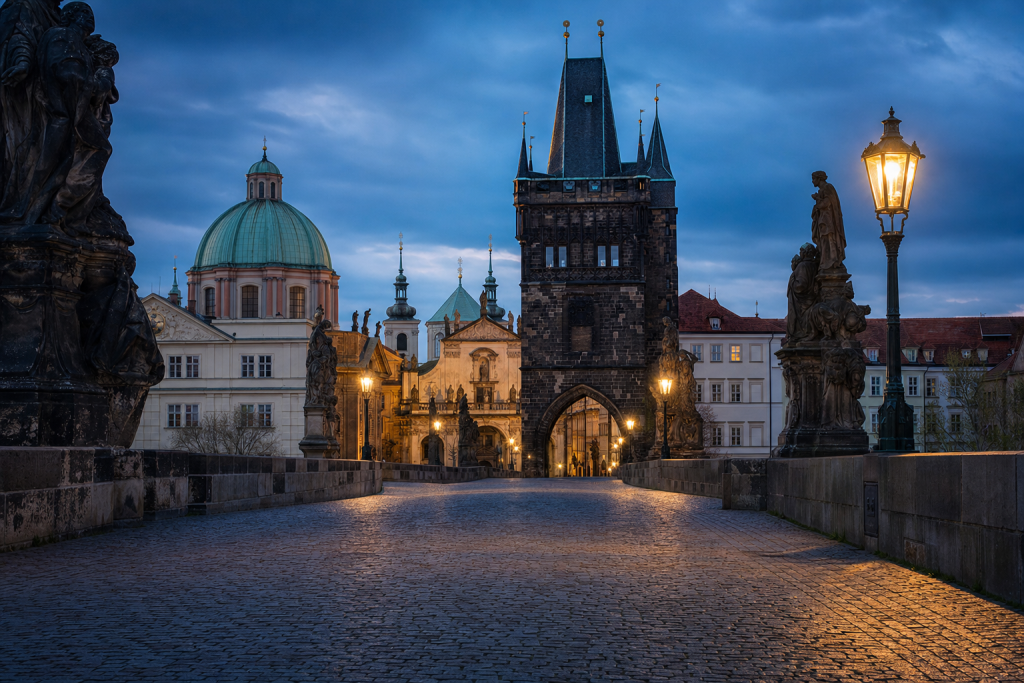
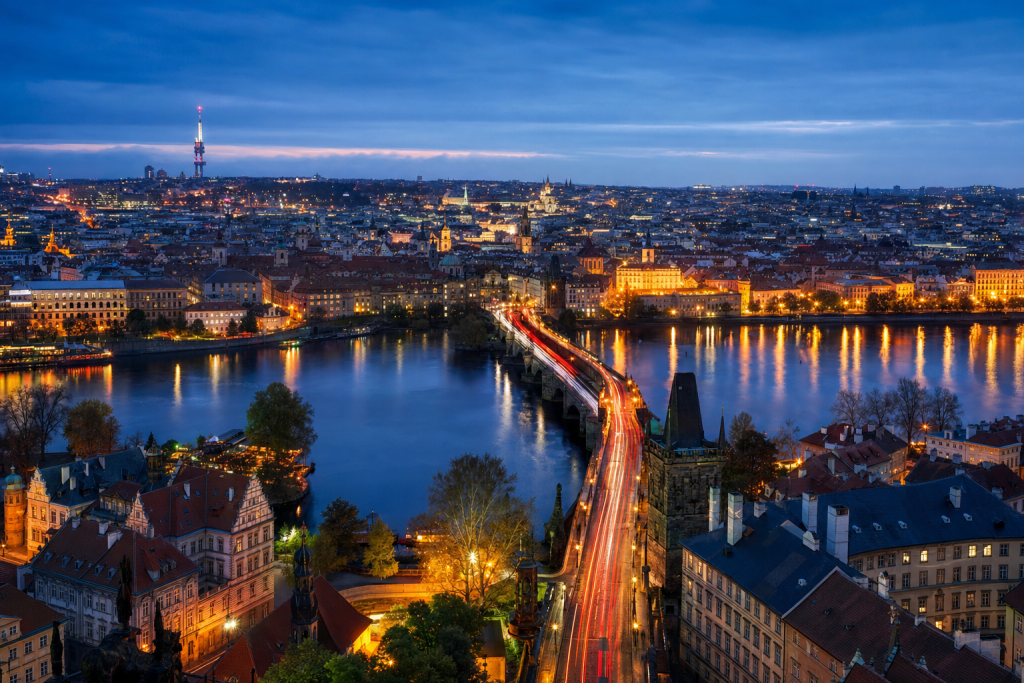
Here are three of the actual shots you’ll find inside the PDF — cinematic full-page references for the exact spots, lenses, and lighting conditions documented in the guide. The full guide includes 12 locations, each with a hero image, GPS map, settings table, and a five-shot list.

Charles Bridge — Sunrise — from the Prague Photographer's GuideSave
Charles Bridge — Sunrise — sample reference photo from the Prague Photographer’s Guide PDF

Before you shoot Prague: the essentials

  • Free public access: Charles Bridge (open 24 h), Letná Park metronome viewpoint, Vyšehrad grounds and ramparts, Wenceslas Square, Náplavka riverfront embankment, Lennon Wall, and all public squares and riverbanks are free. Prague Castle grounds (courtyards) are free to enter; buildings require the Main Circuit ticket 450 CZK/adult (valid 2 days, from 1 March 2024). St. Vitus Cathedral South Tower: 150 CZK extra (separate ticket at castle info centres). Old Town Hall Tower: ~300 CZK adult. Petřín Tower: 250 CZK adult (elevator +150 CZK). Jewish Museum Prague (Josefov, incl. Old Jewish Cemetery + synagogues): 600 CZK adult. Strahov Library: 190 CZK adult (photo permit 50 CZK extra). Dancing House exterior: free; rooftop terrace requires drink purchase at Glass Bar (~150–200 CZK).
  • Commercial permits: Personal and tourist photography in all public spaces is unrestricted. Commercial shoots require prior coordination with Prague City Hall or the relevant property owner. Drone flight is governed by EU EASA regulation (Open Category); the historic centre is classified as a restricted airspace zone—drone operators must register with CAA Czech Republic and obtain specific approval for flights over central Prague. Interiors of Prague Castle buildings prohibit flash and tripods unless a 50 CZK photo permit is purchased; Strahov Library requires a dedicated photo permit (50 CZK).
  • Best photography seasons: April–June (spring blossoms, dramatic morning mist over the Vltava, mild crowds) and September–October (golden autumn light, terracotta rooftops saturated in warm tones, fewer summer tourists)
  • Blue hour notes: Prague sits at 50.09°N — one of Europe’s most northerly major capitals. The sun arc is low and prolonged, giving extraordinary golden-hour quality that can last 45–60 minutes near the solstices. Blue hour after sunset stretches 25–40 minutes. In summer, sunset falls as late as 9:15 PM; in winter, as early as 3:55 PM. The Vltava River acts as a mirror and amplifier: from Charles Bridge, Náplavka, and the Čech Bridge terrace, blue-hour reflections double the intensity of the castle and spire illumination.
  • Drone policy: Drone laws vary widely by country and city — many capital and tourist zones are no-fly. Verify the local civil aviation authority’s current rules before launching.
  • Local resource: Official visitor information

The full-resolution version of every map below — plus seasonal calendars, gear notes per location, sun-angle diagrams, and a complete photographer’s packing checklist — is inside the Prague Photographer’s Guide PDF ($47).

1. Charles Bridge — Sunrise

Charles Bridge is the defining image of Central European photography: 16 pairs of Baroque statues line a 516-metre (1,693 ft) medieval stone span, with Prague Castle and St. Vitus Cathedral rising at the far western end. Built from 1357 under Charles IV, the bridge’s slight curve creates natural S-curve leading lines that draw the eye toward the Castle. The original gas-style lamp posts are among the only working gas lamps remaining in Prague’s historic centre, producing a unique warm amber glow at dawn that no artificial substitute can replicate. In autumn and spring, river mist pools at cobblestone level, creating a moody ground fog that isolates the statues from their surroundings.

  • GPS: 50.08639, 14.41194
  • Elevation: 623 ft
  • Best time of day: blue hour through first light — arrive 45–60 minutes before official sunrise; gas lamps on the bridge stay lit until shortly after dawn, providing warm amber foreground light against the cobalt sky; mist over the Vltava is most frequent in April–May and September–October
  • Sun direction: The bridge runs east-northeast to west-southwest (azimuth ~250°). Shooting from the Old Town side toward the Lesser Town Bridge Towers and Prague Castle (to the west-northwest), the sun rises behind the camera in summer (sunrise azimuth ~55° NE), providing beautiful frontlit conditions on the castle and towers. In winter, sunrise swings to ~120° SE, creating a dramatic side-lit golden wash on the statues. The castle sits at azimuth ~290° from the bridge midpoint. At sunset, the sun descends to ~310° NW in summer, backlighting the castle from the west and silhouetting it against the sky — best for dramatic effects from the Old Town end. Blue-hour window: the castle floodlights (warm amber) balance perfectly against the cobalt sky 20–30 minutes after sunset.
  • Access: Karlův most, 110 00 Praha 1. Free, open 24 hours. Nearest metro: Staroměstská (Line A, 5-min walk from Old Town end) or Malostranská (Line A, 5-min walk from Lesser Town end). Tram 17/18 stop Karlovy lázně (Old Town side). No vehicle access. No entry fee. Tripods permitted but use compact models — narrow pedestrian lanes and 5–6 AM joggers can disrupt setup. By 7 AM in summer the bridge is too crowded for comfortable tripod use.
  • Difficulty: easy
  • Recommended settings: F/11: f/11, 15 sec, ISO 100, 24mm, tripod — blue-hour long exposure with gas lamp glow and cobblestone leading lines toward castle  ·  1/250 Sec: f/8, 1/250 sec, ISO 400, 50mm — early morning ambient for statue silhouettes against warming sky  ·  Iso 1600: f/2.8, 1/60 sec, ISO 1600, 35mm — handheld pre-dawn in low gas-lamp light for intimate bridge atmosphere  ·  200Mm: f/8, 1/500 sec, ISO 200, 200mm — telephoto compression of statues layered against castle spires at golden hour

Shots to chase:

  • Low tripod position at the bridge midpoint, 24mm, with gas lamps framing both sides of the lane and Prague Castle centred at the vanishing point — classic blue-hour long exposure
  • Single Baroque statue in sharp focus at f/2.8 with the Lesser Town Bridge Tower and castle softly bokeh’d behind — intimate portrait style
  • Long exposure from the bridge (ND filter, 30 sec) to erase all pedestrians and leave only the stone, statues, and illuminated sky
  • Descend to the riverbank stairs below the bridge on the Malá Strana side for an upward angle looking through the bridge arches toward the Old Town Bridge Tower
  • After rain: crouch to pavement level for puddle reflections of the gas lamps and statues, eliminating the background entirely

Pro tip: Arrive 50 minutes before sunrise on a weekday in shoulder season (April, May, September, October) for the emptiest conditions — a handful of photographers will be present but manageable. Work both ends: start at the Old Town Tower shooting west toward the castle, then move toward the Lesser Town to shoot east at first light. The gas lamps extinguish approximately 20 minutes after official sunrise — once they go out, much of the bridge’s unique magic is gone. Use the Lesser Town Bridge Tower staircase (entry ~190 CZK) for an overhead view directly down the bridge length.

Common mistake to avoid: Shooting only from the dead centre of the bridge produces a predictable postcard frame; move to the sides, use statues as repoussoir elements. Arriving at 7 AM in July expecting empty conditions — the bridge fills rapidly. Pointing east (toward Old Town) for the sunrise misses the best compositions; the iconic image points west toward the castle. Using ultra-wide (14mm or less) distorts the statues at the edges. Forgetting to turn off autofocus after pre-focusing in near-dark conditions, causing the camera to hunt when the gas lamps create confusing contrast.

2. Prague Castle + St. Vitus Cathedral

The largest ancient castle complex in the world by area (approximately 70,000 m²), Prague Castle dominates the city skyline from atop a 60-metre rocky promontory above the Vltava. St. Vitus Cathedral is the supreme example of Central European Gothic architecture, with a nave soaring 33 metres and stained-glass windows by Alfons Mucha. The view from Na Valech Garden (Garden on the Ramparts) on the south side of the castle is entirely free and among the finest in all of Prague — rolling red-roofed city spreading to the horizon. Golden Lane, the tiny coloured cottages tucked against the castle walls, offers one of the most charming architectural details in Europe.

  • GPS: 50.08975, 14.3984
  • Elevation: 902 ft
  • Best time of day: early morning 7–9 AM for near-empty courtyards and soft easterly light on the cathedral’s Gothic stonework; interior stained-glass best between 10 AM–noon on sunny days when light floods the rose window; South Tower view at any clear day; exterior castle complex floodlit nightly from dusk to midnight
  • Sun direction: St. Vitus Cathedral’s main west façade faces roughly west at azimuth ~270°. The famous rose window glows brilliantly when lit by afternoon sun from the west (summer afternoons). The interior nave runs east-west, so morning sun (azimuth ~70° at Prague’s latitude) enters from the east end, projecting colour from the apse stained glass across the nave floor between 9–11 AM — a rare and spectacular effect. The castle complex as a whole faces south over the city; photographing the complex from below (Čech Bridge, Mánesův Bridge) the best backlight occurs at sunset in summer (~310° NW) when the setting sun rims the cathedral’s spires in warm gold. From the South Tower (287 steps), the panorama faces primarily south and east over the Old Town.
  • Access: Hradčany, 119 08 Praha 1. Prague Castle grounds (courtyards): free, open 6 AM–10 PM daily. Main Circuit ticket (Old Royal Palace + St. Vitus Cathedral + St. George’s Basilica + Golden Lane): 450 CZK adult, 225 CZK reduced, 950 CZK family — valid from 1 March 2024. South Tower of St. Vitus Cathedral: 150 CZK extra (sold at castle info centres; not bookable at the tower). Photo permit inside buildings: 50 CZK (no flash, no tripod). Tram 22 to Pražský hrad or Pohořelec stops. Walk up via Nerudova street from Malostranská metro (Line A). Elevator access to some areas available.
  • Difficulty: moderate
  • Recommended settings: F/8: f/8, 1/250 sec, ISO 200, 24mm — exterior courtyard with cathedral façade in soft morning light  ·  1/60 Sec: f/4, 1/60 sec, ISO 1600, 24mm — interior nave exposing for the stained-glass rose window without tripod  ·  Iso 100: f/11, 25 sec, ISO 100, 35mm, tripod — night long-exposure of illuminated castle from Mánesův Bridge below  ·  200Mm: f/8, 1/500 sec, ISO 200, 200mm — South Tower panorama with telephoto compression of spires and rooftops

Shots to chase:

  • From the Third Courtyard looking up at St. Vitus Cathedral’s south façade — the best close-range architectural composition on the complex using a 16mm lens to capture the full height of the towers
  • Inside St. Vitus: position at the far west end of the nave and shoot east at 24mm to capture the full nave depth with Alfons Mucha’s Art Nouveau stained-glass window glowing at the left side
  • From the South Tower gallery (150 CZK): looking south-east over a sea of orange terracotta rooftops stretching to the Vltava, with Charles Bridge and Týn Church in the midground
  • Na Valech Garden (free): wide panorama from the castle’s southern rampart wall overlooking the entire Old Town and river — spring cherry blossoms here make an unbeatable foreground
  • Golden Lane at opening time (9 AM): early morning light hits the colourful cottage façades at a low angle; a 50mm lens captures the intimate lane without distortion

Pro tip: Visit the Na Valech Garden (Garden on the Ramparts) first — it is free, the panorama is exceptional, and it is mostly unknown to tour groups. Enter via the ‘Bull Stairs’ gate in the Third Courtyard. Buy the South Tower ticket at the main castle information centre, not at the tower itself (no sales there). For interior cathedral photography, the best stained-glass light is 10 AM–noon on a sunny day; arrive just after it opens to beat tour groups. Golden Lane: go at 9 AM on the dot when doors open — within 30 minutes it fills completely.

Common mistake to avoid: Arriving between 10 AM–2 PM in summer when the Third Courtyard and Golden Lane are overwhelmed by groups. Trying to photograph the cathedral exterior from within the Third Courtyard only — too tight for full-frame compositions; the best external views are from Mánesův Bridge and Letná Park. Purchasing only the ‘permanent exhibitions’ ticket and missing Golden Lane and Old Royal Palace. Forgetting the 50 CZK photo permit and having memory cards confiscated (guards do check at main buildings).

3. Old Town Square + Astronomical Clock

The heart of Prague since the 10th century, Old Town Square contains one of the densest collections of architectural periods in Europe: Romanesque cellars, Gothic Týn Church twin spires (each 80 metres), Baroque St. Nicholas Church, Renaissance Kinský Palace, and the medieval Astronomical Clock (Orloj) — the world’s oldest working astronomical clock still in operation (installed 1410). The clock face tracks solar time, lunar phases, the zodiac, and saints’ days simultaneously. Every hour, a mechanical procession of twelve apostles passes its windows, drawing crowds but also creating one of the world’s most photographed hourly spectacles.

  • GPS: 50.08699, 14.42067
  • Elevation: 607 ft
  • Best time of day: pre-dawn through 8 AM for empty cobblestones and ideal side-lighting on Týn Church’s twin spires; Old Town Hall Tower opens at 9 AM — go as a first visitor for crowd-free rooftop views; Astronomical Clock chimes every hour 9 AM–11 PM; blue hour and evening when palace façades illuminate
  • Sun direction: The square is roughly square, centred at ~50.087°N. Týn Church faces west, so its famous twin spires are backlit at sunrise in summer (sun at ~55° NE) — silhouettes are spectacular. By mid-morning the sun swings south and side-lights the spires from the south, adding three-dimensional texture. The Astronomical Clock is on the south face of the Old Town Hall (facing south-southeast), meaning it receives direct sun from late morning to early afternoon — best photographed in gentle morning light or on overcast days to avoid harsh shadows on the complex mechanism dials. From the Old Town Hall Tower looking west, afternoon sun (2–5 PM) illuminates Týn Church’s steeples from the south-west, warm and textured. Evening illuminations of the square’s façades produce warm orange glow from all sides.
  • Access: Staroměstské náměstí, 110 00 Praha 1. Square is a public space, free, open 24 hours. Old Town Hall Tower: approx. 300 CZK adult (glass elevator available); open daily 9 AM–10 PM (Sat/Sun until 11 PM). Astronomical Clock viewing: free from street level. Týn Church interior: mostly closed for photography (no charge to enter for prayer; small donation suggested). Metro: Staroměstská (Line A, 5-min walk). Tram 17/18 stop Staroměstská.
  • Difficulty: easy
  • Recommended settings: F/11: f/11, 20 sec, ISO 100, 16mm, tripod — pre-dawn blue-hour long exposure with empty cobblestones, lamp reflections, Týn Church backdrop  ·  1/500 Sec: f/8, 1/500 sec, ISO 200, 50mm — morning ambient for Astronomical Clock detail with soft natural light on the dials  ·  Iso 800: f/4, 1/30 sec, ISO 800, 35mm — hand-held evening with warm palace façade illumination  ·  85Mm: f/5.6, 1/250 sec, ISO 400, 85mm — from Old Town Hall Tower gallery, telephoto compression of Týn Church spires against the sky

Shots to chase:

  • Pre-dawn with tripod at the east end of the square: 16mm capturing the empty cobblestones as leading lines toward both the Astronomical Clock (south) and Týn Church (north) simultaneously
  • From the Old Town Hall Tower rooftop at late afternoon looking west: Týn Church spires in warm golden light with Prague Castle visible on the horizon beyond
  • Low angle (knee height) looking up at the Astronomical Clock dials from 2 metres distance with a 24mm lens — captures the full mechanical complexity with the ornate Gothic tower surround
  • Rain-wet cobblestones at night: the orange-lit façades of the surrounding palaces reflected in the wet stone creates a luminous, painterly scene at 35mm
  • Apostles procession during chime: 200mm telephoto to isolate the individual wooden apostle figures as they pass the clock windows — requires perfect timing and pre-focus

Pro tip: Arrive at 6 AM on a weekday in shoulder season for the emptiest square; by 9 AM in summer it is impassably crowded. The best position for the clock is slightly to the left (east) of the tower — this angle aligns the clock face with the Gothic tower surround most harmoniously and avoids the scaffolding bay on the right. Buy Old Town Hall Tower tickets online in advance to skip the queue, which can exceed 45 minutes in high season. For the Týn Church interior, small groups can enter quietly for a few minutes during non-service hours (check local notice boards); tripods are not permitted inside.

Common mistake to avoid: Photographing the Astronomical Clock face-on from directly in front produces a flat, unflattering angle that shows the surrounding crowds. Missing the pre-dawn window: by the time most visitors wake up, the magic light is gone. Waiting for the hourly apostle chime during busy periods when 200+ people crowd the clock face — the 11 PM chime has a fraction of the crowd. Underestimating the Old Town Hall Tower as a photography location (often skipped) — it provides the single best close-up aerial view of Týn Church’s spires.

4. Letná Park — Metronome Viewpoint

The metronome platform was the site of the largest Stalin monument in the world — a 30-metre granite colossus destroyed in 1962. The 23-metre kinetic metronome (built 1991 by sculptor Vratislav Novák) now marks the spot, providing a unique geometric foreground for one of the most photographed city views in Europe. The terrace stands 55 metres above the Vltava and delivers a full 180° panorama spanning all of Prague’s central bridges layered from foreground to background — a telephoto compression that collapses the bridges like pages of a book. Charles Bridge, Mánesův Bridge, Čech Bridge, and Palacký Bridge are all visible simultaneously. On clear days, the entire Old Town skyline including Týn Church, the Old Town Hall Tower, and Prague Castle on the opposite hill form a continuous rooftop tapestry.

  • GPS: 50.09472, 14.41556
  • Elevation: 787 ft
  • Best time of day: golden hour through blue hour — the south-facing terrace looks directly over the Vltava S-bend and central Prague; sunset in clear conditions is exceptional; a beer garden operates in the same space (arrive early for best tripod position on the railing)
  • Sun direction: The Letná terrace faces south-southeast at roughly azimuth 170°. Prague’s Old Town lies at azimuth ~155° from the metronome platform. At sunset in summer, the sun descends toward the northwest (~310°), casting long shadows from left across the Old Town rooftops and illuminating the bridge spans from the west — a warm, directional light that separates each bridge’s silhouette. In winter, sunset swings to ~225° SW, producing a lower-angled warm glow that catches the river surface directly. At sunrise, the sun rises to the northeast (~60° in summer), backlighting the metronome structure itself against the sky while the city below is still in blue shadow — ideal for silhouette compositions. The platform is on a plateau ~55 metres above river level, providing clean separation between bridge layers.
  • Access: Letenské sady, 170 00 Praha 7. Free, open 24 hours. The metronome platform is at the western edge of Letná Park. Tram 1/8/25/26 to Letenské náměstí stop, then 10-min walk west through the park. Or walk from Nábřeží Edvarda Beneše riverside (steep stairs up the embankment). No entrance fee. Beer garden open in warm months (April–October), afternoon–late evening; mornings are quietest for photography.
  • Difficulty: easy
  • Recommended settings: F/11: f/11, 2 sec, ISO 100, 70mm, tripod — blue-hour bridge layering with city lights reflected in Vltava  ·  1/500 Sec: f/8, 1/500 sec, ISO 200, 35mm — wide panorama at golden hour with beer garden foreground life  ·  Iso 200: f/8, 1/320 sec, ISO 200, 200mm — telephoto bridge compression stacking all Vltava crossings  ·  24Mm: f/11, 1/200 sec, ISO 100, 24mm — including the metronome arm as foreground element with city behind

Shots to chase:

  • Classic bridge-stack shot: 200mm telephoto from the platform railing compresses Čech, Mánesův, Charles, and Legion bridges into a single dense composition at golden hour
  • Metronome arm as foreground at 24mm, city panorama behind — architectural contrast of Soviet-era kinetic art against medieval spires
  • Long exposure at blue hour: 70mm, 3-second exposure smooths Vltava to glass while the Old Town lights sparkle, balancing sky and city perfectly
  • Winter sunrise: from the platform steps, the sun rises behind the metronome casting long shadows down the staircase toward the river, with mist pooling in the valley below
  • Time-lapse opportunity: the metronome’s arm swings with a 2-second period — a 60-second exposure creates a blurred sweep perfectly balanced against the still city

Pro tip: The metronome platform concrete railing makes an effective ‘tripod rest’ — bring a beanbag or rubber pad. The very best telephoto bridge-stack position is not directly at the railing edge but 3–5 metres back, which clears the tree line below the terrace. Skateboarders frequent the platform day and night — arrive after 8 PM on weekdays for the quietest conditions with city lights. The Hanavský Pavilion, 200 metres east along the terrace edge, provides a slightly different angle framing the river bend with the ornate 1891 cast-iron pavilion as foreground — an often-overlooked composition.

Common mistake to avoid: Going at midday when the south-facing panorama is in harsh overhead light with no shadows to define the bridges. Shooting only from the railing edge and missing the metronome as a subject — stepping back 20 metres transforms it into a compelling foreground. Missing blue hour: the combination of warm city illumination, deep cobalt sky, and glassy river water is unique to this 20-minute window after sunset. Not accounting for haze in summer (August) — air quality is best in autumn and spring for telephoto compression.

Want this in your pocket on the street?
The full-resolution version of every spot above — with full-page hero photography, GPS maps with gold location pins, sun direction diagrams, multi-season tables, and a complete safety + packing checklist — is inside the Prague Ultimate Photographer’s Guide PDF ($47). Print it, save it offline, take it on the walk. Get the guide →

5. Petřín Tower + Hill

Petřín Tower + Hill Prague photography sampleSave
Petřín Tower + Hill — cinematic reference from the Prague Photographer’s Guide PDF

Petřín Tower is a 63.5-metre miniature of the Eiffel Tower, built in 1891 for Prague’s Jubilee Exhibition. Perched atop a 318-metre hill already 60 metres above the Old Town, the tower’s summit stands higher than the original Eiffel Tower in terms of above-sea-level elevation. The 360° observation deck delivers Prague’s clearest full-city panorama — the entire bowl of the city laid out from the Žižkov TV Tower in the east to the castle in the north and Vyšehrad in the south. In spring, Petřín Hill transforms into one of Europe’s great cherry and apple blossom spectacles — thousands of fruit trees in bloom frame city views through their white and pink canopies.

  • GPS: 50.08354, 14.39506
  • Elevation: 1,043 ft
  • Best time of day: clear morning or afternoon for tower summit views (opens 10 AM, 9 AM in summer); spring blossom season (late April–early May) for the hillside orchards framing city views; golden hour from the hillside itself is spectacular even without the tower
  • Sun direction: Petřín Hill sits on the west side of central Prague at 318 metres elevation. The tower summit at 1,043 ft (318 m hill + 63.5 m tower structure) faces all directions. From the east-facing hillside slopes and the tower, the sun rises directly toward the camera in the morning (azimuth ~60° NE in summer) — this means morning light hits the Old Town and castle in warm frontlight while Petřín is still in relative shadow. By noon the entire city is bathed in overhead light. At sunset, the sun descends toward ~310° NW in summer, backlighting the city from the west and creating silhouette conditions of Prague’s spires from the tower’s east-facing observation deck. The funicular railway runs north-south on the hill’s east face — catching a funicular car against the city backdrop requires positioning at the Nebozízek midstation.
  • Access: Petřínské sady 633, 118 00 Praha 1. Petřín Tower admission: 250 CZK adult, 170 CZK reduced (children 6–15, seniors 65+), 500 CZK family (2 adults + 4 children) — prices valid 2025. Elevator to top: +150 CZK. Open: Jan–Mar and Nov–Dec 10 AM–6 PM; Apr–May 10 AM–7 PM; Jun–Aug 9 AM–7 PM; Sep–Oct 10 AM–6 PM. Hill itself: free, open 24 hours. Funicular railway: runs with standard Prague public transport ticket (30 CZK single ride or included in 24-h transit pass). Nearest tram: Újezd stop (Lines 9, 15, 20, 22, 23) then funicular. Walking route: 30–40 min uphill from Malá Strana.
  • Difficulty: moderate
  • Recommended settings: F/8: f/8, 1/500 sec, ISO 200, 35mm — clear day panorama from tower summit, clean horizon  ·  1/250 Sec: f/5.6, 1/250 sec, ISO 400, 85mm — blossom framing composition with city layers in background  ·  Iso 100: f/11, 1/200 sec, ISO 100, 24mm — full tower structure with city behind from hillside path  ·  135Mm: f/8, 1/500 sec, ISO 200, 135mm — telephoto from tower looking east across rooftops to Žižkov Tower silhouette

Shots to chase:

  • Late April: stand in the cherry blossom orchards on the east-facing slope and frame the Old Town spires through pink blossom canopies using an 85mm at f/2.8 for creamy bokeh
  • From the tower’s east-facing observation deck: 35mm wide panorama with the Vltava bending left, Charles Bridge in the midground, and Prague Castle above right — Prague’s definitive 360° view
  • Looking up the funicular track from the Újezd valley station: 24mm including a car in motion against the forested hillside and tower visible at the summit
  • Autumn path through Kinský Garden: fallen leaves on the cobbled path leading up to the tower, warm sidelight at golden hour making the copper tones glow
  • Tower exterior shot from 200 metres east on the hillside: 85mm to include the full tower structure against the sky with a single person for scale, spring blossoms in foreground

Pro tip: The hillside itself (free) offers better blossom-framed city views than the tower during spring — skip the ticket if you only have an hour and the blossoms are out. On the tower, if it is windy, skip the very top platform and shoot from the intermediate level, which is more sheltered. The ‘Early Bird Discount’ gives 50% off admission during the first hour after opening — arrive at 10 AM (or 9 AM in summer) for both the discount and quieter conditions. The mirror maze (150 CZK extra, or 300 CZK combi with tower) can provide an interesting alternative photography subject on days with poor visibility.

Common mistake to avoid: Going on a hazy summer afternoon when visibility from the tower is only 5–10 km — the best long-distance views require high-pressure clear weather, typically in autumn and spring. Photographing only the city panorama from the tower and ignoring the extraordinary tower structure itself as a subject. Using zoom lenses at maximum extension from the tower creates barrel distortion in corners — stop down to f/8 and use mid-range focal lengths. Overlooking the west-facing views from the tower toward Strahov Monastery and the Bohemian countryside.

6. Vyšehrad Fortress

Vyšehrad is Prague’s second castle — a 10th-century Přemyslid royal fortress on a sheer 60-metre cliff above the Vltava, predating Prague Castle and steeped in Czech founding mythology. The fortress is far less touristed than Prague Castle, offering nearly crowd-free conditions even in high season. The western ramparts deliver one of the most dramatic views in Prague: looking north past the Vyšehrad Railway Bridge and four additional bridges toward the Old Town and Prague Castle ridge, with the Vltava curving below. The cemetery contains the graves of Antonín Dvořák, Bedřich Smetana, and Alphonse Mucha. The ruins of Libuše’s Bath — a 14th-century tower on the cliff edge — make an extraordinary foreground for river views.

  • GPS: 50.06417, 14.41944
  • Elevation: 886 ft
  • Best time of day: golden hour before sunset for warm light on the fortress walls and the north-facing panorama of Prague Castle 3 km away; early mornings for empty cemetery and long shadows on the Baroque gates; October–November for low angle winter light carving shadows across ramparts
  • Sun direction: Vyšehrad sits on a rocky promontory at the south end of Prague, at roughly 270° from Prague Castle. Photographing northward from the western ramparts toward Prague Castle (azimuth ~330°), the sun in late afternoon (3–5 PM in summer) is to the west (~270°), providing beautiful side-light on both Vyšehrad’s own walls and illuminating the castle ridge in warm gold. At sunset in summer (~310° NW), the castle catches warm backlight while Vyšehrad is in partial shadow — ideal for long-lens castle shots from the Brick Gate terrace. The neo-Gothic twin-spire Church of Saints Peter and Paul faces west; its façade is best photographed in the afternoon when the sun is directly behind the camera from the east.
  • Access: V Pevnosti 159/5B, Praha 2–Vyšehrad. Fortress grounds: free, open 24 hours. Church of Saints Peter and Paul: 50 CZK adult. Vyšehrad cemetery (resting place of Dvořák, Smetana, Mucha): 50 CZK adult. Casemates underground tours: 110 CZK adult. Metro: Vyšehrad station (Line C), 10-min walk to fortress entrance. Tram: Albertov stop (Lines 7, 18, 24), 5-min walk.
  • Difficulty: easy
  • Recommended settings: F/8: f/8, 1/500 sec, ISO 200, 70mm — rampart wall leading to Libuše’s Bath ruins with Vltava below  ·  1/250 Sec: f/8, 1/250 sec, ISO 200, 200mm — telephoto looking north to compress Prague Castle against city skyline at golden hour  ·  Iso 400: f/5.6, 1/125 sec, ISO 400, 35mm — Church of Saints Peter and Paul façade in afternoon light with tree framing  ·  24Mm: f/11, 1/200 sec, ISO 100, 24mm — wide panorama from southwest corner of ramparts showing full river bend and city

Shots to chase:

  • From the southwest corner of the ramparts (GPS 50.06284, 14.41714): wide panorama looking north-west over the Vltava showing the entire Prague Castle ridge, 4 bridges, and the Smíchov waterfront — one of the least-known great Prague viewpoints
  • Libuše’s Bath ruins at the cliff edge as foreground silhouette against the Vltava and north Prague skyline at golden hour — a uniquely dramatic and uncrowded shot
  • Cemetery composition: Mucha’s grave or Dvořák’s monument between the overhanging trees, lit by dappled morning light at 50mm with a narrow depth of field
  • Vyšehrad Railway Bridge: from the northern rampart walk with the 1905 iron railway viaduct in the foreground and Prague Castle visible above — a lesser-known layered composition
  • Church of Saints Peter and Paul twin spires at blue hour from the main esplanade: floodlit neo-Gothic spires against deep cobalt sky, no crowds whatsoever

Pro tip: The best photography happens along the western and southwestern ramparts — most visitors only see the church and cemetery. Walk clockwise from the Brick Gate entrance to find the Libuše’s Bath clifftop viewpoint and then the southwest corner before doubling back through the cemetery. The fortress sees essentially zero crowds before 9 AM and after 7 PM. Unlike Prague Castle, there are almost never tripod restrictions outdoors. The Vyšehrad metro exit deposits you on the east side — enter via the Cihelná brána (Brick Gate) for the most photogenic arrival route through the fortification walls.

Common mistake to avoid: Only visiting the church and cemetery and missing the dramatic western rampart views entirely. Going in the middle of the day when overhead light flattens the stone texture and produces harsh shadows on the church façade. Overlooking the railway bridge as a photography subject — its green-painted iron structure makes an excellent graphic foreground. Forgetting that the cemetery has a 50 CZK entry fee — free entry exists only to the broader fortress grounds.

7. Josefov — Jewish Quarter

Josefov is the most complete surviving Jewish ghetto in Central Europe, compressed into six blocks between Old Town Square and the Vltava. The Old Jewish Cemetery contains over 12,000 tombstones — in some places 12 layers deep — creating a unique tilted, moss-covered landscape found nowhere else in Europe. The Spanish Synagogue (1868) has one of the most breathtaking interiors in Prague: Moorish Revival gilded stucco covering every surface floor-to-ceiling, with filtered coloured light creating a jewel-box effect. Pařížská Boulevard flanks the quarter with the finest concentration of Art Nouveau architecture in Czech Republic, providing exterior architectural photography independent of the museum ticket.

  • GPS: 50.08972, 14.41722
  • Elevation: 607 ft
  • Best time of day: early morning 8–10 AM before tour groups flood the narrow streets; afternoon soft light for the Spanish Synagogue interior (southeast-facing windows); Old Jewish Cemetery is most atmospheric in early morning when long shadows fall across the tilted tombstones
  • Sun direction: Josefov is a compact neighbourhood bounded by roughly northwest-southeast streets. The Old Jewish Cemetery lies on the north side of Josefov, with trees creating dappled natural light at all hours — diffuse overcast light is often better here than direct sun. The Spanish Synagogue interior has Moorish-style windows on its southeast and southwest walls; afternoon sun (2–5 PM) creates coloured light projections across the decorated interior. The narrow Josefov streets run northwest, meaning morning sun illuminates the north-facing façades from the east and afternoon light hits south-facing walls; the best overall light for street textures is 8–10 AM on a sunny day. Pařížská Boulevard, the broad Art Nouveau avenue bisecting Josefov, is best photographed looking north (toward the river) in late afternoon when the sun backlights the rooftop details.
  • Access: Josefov, Staré Město, 110 00 Praha 1. Jewish Museum Prague ticket (covers Old Jewish Cemetery + Maisel, Pinkas, Spanish, and Old-New Synagogues): 600 CZK adult, 400 CZK student under 26, 200 CZK child 6–15, free under 6. Open daily except Saturday and Jewish holidays, summer 9 AM–6 PM, winter 9 AM–4:30 PM. Photography: allowed without flash, tripod, or lights inside all sites (included in ticket price — no additional photo fee). Metro: Staroměstská (Line A), 3-min walk. Tickets at Maiselova 15 office or online at jewishmuseum.cz.
  • Difficulty: easy
  • Recommended settings: F/4: f/4, 1/60 sec, ISO 1600, 24mm — Spanish Synagogue interior exposing for ambient light through stained windows without flash  ·  1/250 Sec: f/5.6, 1/250 sec, ISO 400, 35mm — Old Jewish Cemetery morning light through trees on tilted tombstones  ·  Iso 800: f/8, 1/125 sec, ISO 800, 24mm — Pařížská Boulevard street scene with Art Nouveau façades, overcast for even light  ·  50Mm: f/2.8, 1/500 sec, ISO 200, 50mm — narrow ghetto lane with light at end of alley framing composition

Shots to chase:

  • Old Jewish Cemetery: low angle at ground level among the dense tilted tombstones with overarching elder trees creating canopy light — 24mm at knee height to emphasise the cramped, layered depth
  • Spanish Synagogue interior: standing beneath the central octagonal dome and shooting straight up at 16mm — the gilded Moorish vaulting pattern is extraordinary and almost never photographed from this angle
  • Pařížská Boulevard from the southern end looking north toward the river at sunset: Art Nouveau wrought-iron lamp posts flanking the boulevard, warm backlight on the elaborate façades
  • Pinkas Synagogue: the walls of this 16th-century synagogue are inscribed with 77,297 names of Czech Holocaust victims — abstract patterns of red and black lettering under gentle window light at 50mm
  • Old-New Synagogue exterior: the oldest active synagogue in Europe (1270 Gothic), its distinctive high-pitched brick roof and blind Gothic arcade photographed at dawn with cobblestone foreground and no crowds

Pro tip: Buy Jewish Museum tickets at the Maiselova 15 information centre, not at individual synagogue entrances — queues are shorter. The Spanish Synagogue is usually the least crowded despite being the most photogenic interior; save it for the end when the morning rush has dispersed. Photography inside is handheld only (no tripod, no flash) — bring a fast lens and open wide; ISO 1600–3200 is necessary in the darker synagogues. Pařížská Boulevard photography requires no ticket and is best on a Sunday morning before the luxury shops open and the street fills.

Common mistake to avoid: Using flash despite the no-flash policy, ruining your shots with harsh flat light and risking ejection. Visiting on a Saturday or Jewish holiday when all sites are closed. Bringing a large backpack — bag checks are required at all synagogues and a large pack means wasting time. Missing the Pařížská Boulevard exterior architecture, which requires no ticket and is architecturally extraordinary.

8. Strahov Monastery — Library + Terrace View

Strahov Monastery’s twin Baroque libraries — the Theological Hall (1679) and Philosophical Hall (1794) — are among the most photographed interiors in Central Europe. The Theological Hall’s white-and-gold Baroque ceiling frescoes, combined with 18,000 leather-bound volumes in carved walnut cases, create an image that routinely tops ‘world’s most beautiful library’ lists. Visitors may not enter the halls (only view from the doorway threshold) but this constraint actually produces the ideal photography position — a perfectly framed doorway shot with the full interior depth visible. The outdoor monastery terrace delivers one of Prague’s finest and least-crowded city panoramas, looking east over vineyards to St. Nicholas dome, multiple bridge towers, and Prague Castle from the same elevated ridge.

  • GPS: 50.0858, 14.3867
  • Elevation: 1,017 ft
  • Best time of day: library interior: 9–11 AM on a clear day when natural light fills the baroque halls from east-facing windows; outdoor terrace/orchard viewpoint: late afternoon to golden hour when the city below is bathed in warm directional light; spring for blossoms framing the panorama
  • Sun direction: Strahov stands on a ridge west of Prague Castle at 310 metres elevation. The outdoor terrace and orchard viewpoint face east-southeast, looking directly over the Malá Strana rooftops, St. Nicholas Church dome, and the Old Town in the midground. Morning sun (azimuth ~70° NE) rises roughly toward the camera from below, initially creating silhouette conditions for the city and beautiful backlit haze. By 9–10 AM the sun has swung south, producing excellent side-lit conditions on the rooftops. At golden hour (4–6 PM in autumn), warm light rakes across the terracotta rooftops from the south-west and the Vltava catches its reflection. The Theological Hall interior windows face north; diffuse north light provides the most even illumination of the baroque book spines throughout the day.
  • Access: Strahovské nádvoří 1/132, 118 16 Praha 1. Library (Theological Hall + Philosophical Hall): 190 CZK adult, 90 CZK reduced, 390 CZK family. Open Mon–Sun 9 AM–5 PM (closed Christmas Eve, Christmas Day, Easter Sunday; last entry 4:30 PM). Photo permit: 50 CZK extra (required to use any camera, purchased at ticket desk). Outdoor terrace and orchard viewpoint: free, open 24 hours. Tram 22 to Pohořelec stop (2-min walk). Walk from Prague Castle: 10-min westward through Hradčany.
  • Difficulty: easy
  • Recommended settings: F/4: f/4, 1/30 sec, ISO 1600, 24mm — Theological Hall interior from doorway, ambient baroque window light only  ·  1/500 Sec: f/8, 1/500 sec, ISO 200, 70mm — outdoor terrace panorama at golden hour with city below  ·  Iso 3200: f/2.8, 1/60 sec, ISO 3200, 35mm — Philosophical Hall interior available light, exposing for book-spine texture  ·  135Mm: f/8, 1/400 sec, ISO 200, 135mm — telephoto from terrace compressing St. Nicholas dome against Old Town spire layer

Shots to chase:

  • Theological Hall doorway: stand at the entrance threshold (maximum viewing position), 24mm, and compose the full barrel-vaulted interior with globes in the foreground, fresco ceiling, and walnut shelves receding — the quintessential ‘most beautiful library’ shot
  • Philosophical Hall: the taller hall has a massive trompe-l’oeil ceiling fresco by Franz Anton Maulbertsch — shoot straight up at 16mm from the doorway to capture the illusionistic sky effect
  • Outdoor orchard viewpoint (walk a few minutes south from the monastery exit): fruit trees in spring blossom with Prague Castle ridge visible above the canopy — 85mm for layered depth
  • Strahov terrace looking east at blue hour: the illuminated dome of St. Nicholas Church glows amber against the cobalt sky, with Prague Castle’s floodlit towers behind — 70mm captures this scene perfectly
  • Strahov Brewery (500 CZK supplement): the medieval brewery interiors with copper vats and stone arches offer unique architectural photography adjacent to the monastery

Pro tip: Arrive at 9 AM when the library opens — by 10:30 AM tour groups begin arriving. The 50 CZK photo permit is mandatory and the desk clerk will check your camera. Use a wide aperture and high ISO to preserve the ambient light quality; do not even consider flash — the books are priceless and it will get your permit revoked immediately. For the outdoor viewpoint, walk 3–5 minutes south past the monastery exit to the orchard area — a slightly lower vantage point through fruit trees gives a more interesting layered composition than the flat monastery courtyard. The orchard is free and has no crowds even in peak season.

Common mistake to avoid: Forgetting to purchase the 50 CZK photo permit and being turned away with a camera. Shooting on full auto-flash mode which destroys the ambient light quality and the baroque atmosphere. Staying only in the monastery courtyard for exterior shots without venturing to the orchard viewpoint below. Missing the Philosophical Hall — most visitors only photograph the Theological Hall, but the Philosophical Hall has an equally dramatic and less-photographed trompe-l’oeil ceiling.

Want this in your pocket on the street?
The full-resolution version of every spot above — with full-page hero photography, GPS maps with gold location pins, sun direction diagrams, multi-season tables, and a complete safety + packing checklist — is inside the Prague Ultimate Photographer’s Guide PDF ($47). Print it, save it offline, take it on the walk. Get the guide →

9. Dancing House (Tančící dům)

Dancing House (Tančící dům) Prague photography sampleSave
Dancing House (Tančící dům) — cinematic reference from the Prague Photographer’s Guide PDF

Designed by Frank Gehry and Vlado Milunić, completed 1996, the Dancing House is one of the most celebrated works of deconstructivist architecture in Europe. The building’s nickname references its two towers — the undulating ‘Ginger’ (glass) and solid cylindrical ‘Fred’ (concrete) — which appear to dance together. Set between Art Nouveau and early 20th-century buildings along the Vltava embankment, the architectural contrast is extraordinary. The rooftop Glass Bar terrace is one of the few accessible elevated viewpoints in this part of Prague, providing intimate views of the Vltava, Jiráskův Bridge, and across to Smíchov.

  • GPS: 50.07533, 14.41403
  • Elevation: 623 ft
  • Best time of day: golden hour from Jiráskův Bridge (one block south) when low sun backlights the undulating glass tower; blue hour when the building’s glass skin reflects the deep blue sky and amber city lights simultaneously; evening for rooftop terrace views (access with Glass Bar drink purchase)
  • Sun direction: The Dancing House stands on the east bank of the Vltava (Rašínovo nábřeží embankment) facing south-southwest. The curved glass ‘Ginger’ tower faces southwest, meaning afternoon sun (2–6 PM) shines directly on the glass, creating dynamic reflections and light patterns. At sunset in summer (~310° NW), the glass tower catches warm orange light on its curved west face while the cylindrical concrete ‘Fred’ tower casts a contrasting shadow. Shooting from Jiráskův Bridge (azimuth ~300° from the building), at golden hour the low western sun backlights the building, creating a silhouette of the curved forms against a bright sky. The best reflective glass shots are 20–40 minutes before sunset when the sky is deep blue and the warm light creates maximum contrast.
  • Access: Rašínovo nábřeží 80, 120 00 Praha 2. Exterior: free, open 24 hours. Rooftop terrace (Glass Bar on 7th floor): access with mandatory drink purchase (beer or coffee ~150–200 CZK); open daily approx. noon–midnight. Tram 17 to Jiráskovo náměstí stop, directly adjacent. The building is on a crossroads (Rašínovo nábřeží / Resslova) — the best exterior shooting position is from the opposite (west) bank of the Vltava, accessible via Jiráskův Bridge, or from the traffic island at the junction.
  • Difficulty: easy
  • Recommended settings: F/8: f/8, 1/500 sec, ISO 200, 35mm — exterior full building from Jiráskův Bridge at golden hour, city behind  ·  1/15 Sec: f/11, 1/15 sec, ISO 100, 24mm, tripod — long exposure from bridge at blue hour, tram light trails in foreground  ·  Iso 100: f/16, 30 sec, ISO 100, 24mm, tripod — night long-exposure from opposite bank with river reflection of city lights  ·  85Mm: f/5.6, 1/250 sec, ISO 200, 85mm — detail shot of glass tower curved panels reflecting sky and embankment buildings

Shots to chase:

  • From Jiráskův Bridge looking north-northeast: 35mm framing the full building within the context of the embankment with Nusle hills in the background — captures the full architectural eccentricity in context
  • Traffic island on Rašínovo nábřeží: stand at the median crossing directly in front for a compressed 50mm shot of both towers against the embankment’s historic neighbours — use a polariser to control glass reflections
  • From the opposite (west) Vltava bank: 85mm for a side-on river view with the building’s reflection in the water at blue hour — includes Jiráskův Bridge arch as foreground
  • Glass Bar rooftop terrace (drink required): wide city panorama south along the Vltava toward Vyšehrad, with the bridge and both riverbanks visible — buy a coffee at noon for quietest conditions
  • Detail abstraction: 200mm telephoto on the curved glass panels to capture pure architecture — the reflection of passing clouds and neighbouring buildings transforms the panels into abstract paintings

Pro tip: The single best exterior photography position is from the traffic median island directly across the street on Rašínovo nábřeží — step to the island and use a 35–50mm for a head-on composition that avoids parked cars and trams. Use a polarising filter for glass exteriors at any time of day to control unwanted reflections and bring out the sky colour in the curved panels. The rooftop terrace is accessed at the main ground-floor entrance — a mandatory drink (~150 CZK) buys you time on the very small terrace, so go at noon on a weekday for the least crowded experience.

Common mistake to avoid: Shooting with a wide-angle lens from directly below the building — it produces extreme perspective distortion that makes the two towers look unrelated. Going only in daytime when the glass reflects only blue sky; the most interesting light is late afternoon and evening. Overlooking the possibility of shooting from the opposite (west) bank for river reflections. Using a very long telephoto from the bridge which compresses and flattens the deconstructivist forms — 35–85mm captures the shapes most faithfully.

10. Lennon Wall

The Lennon Wall has been a continuously evolving canvas since the 1980s, when Czech youth began painting John Lennon-inspired graffiti as a protest symbol against the Communist regime. Police would paint over it overnight; it would be repainted by dawn. Today it is a 30-metre-long collaborative artwork in a constant state of evolution — layers of messages, Beatles lyrics, peace symbols, Ukrainian solidarity, political statements, and abstract art accumulate and are periodically renewed. No two visits produce the same image. Located in the exquisitely preserved Baroque district of Malá Strana, the explosion of colour against the ochre-painted stone walls creates extraordinary photographic contrast.

  • GPS: 50.0877, 14.40419
  • Elevation: 627 ft
  • Best time of day: early morning before 9 AM for wall-only photography without crowds; late afternoon (4–6 PM) for warm sidelight from the south-west illuminating the colour-saturated murals; avoid midday in summer when the narrow lane is packed with tour groups and the overhead light is flat
  • Sun direction: The Lennon Wall runs along the north side of Velkopřevorské náměstí (Grand Prior Square), facing south-southeast. The wall receives direct sun from mid-morning through late afternoon (roughly 9 AM–5 PM). In summer, the best directional light is from the south-west in the afternoon (2–5 PM) when the warm sidelight rakes across the uneven plaster surface, bringing out texture and making colours more saturated. Morning light (8–10 AM) comes from the south-east and is softer — good for detail shots. The narrow lane (Velkopřevorské náměstí) is partially shaded by buildings on the south side, so even in full afternoon sun the scene has manageable contrast. At blue hour, the wall receives ambient city illumination from street lamps — colourful but soft.
  • Access: Velkopřevorské náměstí, 118 00 Praha 1 (Malá Strana). Free, open 24 hours. 3-min walk from Charles Bridge (Lesser Town end). Tram stop: Hellichova (Lines 12, 20, 22). The wall belongs to the Knights of Malta (Sovereign Military Order of Malta) whose Grand Priory adjoins the square — do not deface or add graffiti beyond the designated area.
  • Difficulty: easy
  • Recommended settings: F/8: f/8, 1/200 sec, ISO 200, 35mm — full wall section in morning sidelight capturing maximum colour and texture  ·  1/125 Sec: f/5.6, 1/125 sec, ISO 400, 50mm — medium detail of painted face or Beatles lyric panel with shallow depth of field  ·  Iso 200: f/2.8, 1/500 sec, ISO 200, 85mm — portrait of local artist adding new content to the wall, street photography style  ·  24Mm: f/11, 1/200 sec, ISO 100, 24mm — wide shot including the square’s cobblestones, the wall, and the Grand Priory arch in one frame

Shots to chase:

  • Stand back from the wall and shoot at 24mm to include the cobblestoned Baroque square, adjacent ochre-rendered Maltese buildings, and the flowering courtyard gate — the wall as element within the historic context rather than the entire subject
  • Kneel to street level and shoot along the wall’s bottom edge at 35mm: perspective emphasises the layers of paint and texture, with cobblestones as a leading foreground line
  • Isolate one striking detail — a Lennon face, a particularly colourful mural panel, or Ukrainian sunflower design — using 85mm at f/2.8 for shallow depth of field, wall texture soft behind
  • Late afternoon with a figure standing before the wall: environmental portrait using the wall as a 1960s/present-day political backdrop, 35mm at f/5.6
  • Dawn (5–6 AM in summer): the wall completely empty and the lane still in blue hour, lamp light catching the colours — the rarest and most peaceful shot opportunity

Pro tip: Arrive before 9 AM to have the wall essentially to yourself; by 10 AM tour groups arrive in waves. Combine the visit with Kampa Island (2-min walk) and the view of Charles Bridge from beneath — a 90-minute route covers all three. For the most vibrant colour shots, come after light rain: the freshly washed paint surface is more saturated. On any visit, check what has recently been added — the wall is repainted frequently and the most impactful new contributions appear unpredictably. Bring a 50mm or 85mm prime for the most flattering detail isolations.

Common mistake to avoid: Trying to shoot the entire wall from directly in front in one frame — the wall is 30 metres long and impossible to capture straight-on without a fisheye; work in sections or use a stitched panorama. Visiting at midday in July when the narrow lane has 50+ selfie-taking tourists. Not photographing the architectural context: the wall in isolation loses the Baroque-meets-counterculture contrast that makes it so extraordinary. Adding graffiti without understanding which surfaces are designated — the building walls flanking the Lennon Wall are private property.

11. Wenceslas Square — National Museum Steps

Less a square than a 750-metre urban boulevard, Wenceslas Square is the civic heart of Czech national identity — site of the 1918 declaration of Czechoslovak independence, the 1948 Communist coup, the 1969 Jan Palach self-immolation, and the 1989 Velvet Revolution. The neo-Renaissance National Museum (1891) anchors the upper end with a sweeping 100-metre façade. Saint Wenceslas’s equestrian statue (1912) provides the defining Czech civic monument. The tram-lined boulevard of Art Deco and interwar modernist buildings contains the highest concentration of 20th-century Czech architectural style outside Brno. At Christmas, a full-length market transforms the avenue into a European winter photography destination.

  • GPS: 50.08139, 14.4275
  • Elevation: 650 ft
  • Best time of day: blue hour and early evening when the National Museum’s neo-Renaissance façade is floodlit and the entire 750-metre boulevard stretches toward the horizon with tram light trails; early morning for empty boulevard compositions; Christmas market season (late November–December) for decorated avenue
  • Sun direction: Wenceslas Square runs northwest-southeast (azimuth ~310°). From the National Museum steps at the southeast end, the boulevard extends northwest. The sun in summer rises in the northeast and sets in the northwest, meaning at sunset in summer (~310°) the sun sets almost perfectly along the axis of the boulevard — a dramatic alignment that floods the entire 750-metre length with warm backlight and creates lens flare between the tram poles. In the morning, the sun rises roughly from the right (east) of the boulevard, side-lighting the left (west) row of buildings. Blue hour is the primary shooting time: after sunset, tram light trails on the tracks become visible at 1/15–1/30 sec exposures, the National Museum’s floodlit façade balances with the cobalt sky, and the café/hotel windows illuminate the buildings.
  • Access: Václavské náměstí, 110 00 Praha 1. Fully public, free, open 24 hours. National Museum steps: free (museum entry separate, 350 CZK adult). Metro: Muzeum (Lines A and C, directly at the National Museum end) or Můstek (Lines A and B, lower end). Trams run the length of the boulevard — lines 3, 5, 6, 9, 14, 24. Saint Wenceslas equestrian statue in front of National Museum provides the classic foreground element.
  • Difficulty: easy
  • Recommended settings: F/11: f/11, 15 sec, ISO 100, 24mm, tripod — blue-hour tram light trails down the full length of the boulevard  ·  1/250 Sec: f/8, 1/250 sec, ISO 200, 50mm — National Museum façade at sunset with Wenceslas statue silhouette in foreground  ·  Iso 400: f/5.6, 1/60 sec, ISO 400, 35mm — street level evening scene with illuminated shop windows and crowds  ·  85Mm: f/8, 1/500 sec, ISO 200, 85mm — from National Museum steps looking down the full avenue compressed by telephoto

Shots to chase:

  • From the National Museum steps looking northwest: 85mm telephoto compresses the full 750-metre boulevard into a dense composition of tram poles, Art Deco façades, and distant Můstek at blue hour
  • Turning around to photograph the National Museum façade from directly in front: 24mm wide, including the Wenceslas statue in the lower foreground and the full floodlit pediment above
  • Long exposure at blue hour from the median strip halfway down the boulevard: 24mm with tram tracks as leading lines, 15-second exposure to catch one tram passing each way simultaneously as light trails
  • Christmas market (late November–January): wide 16mm looking up the market stalls from ground level with the National Museum lit behind, festive stalls framing the avenue
  • Jan Palach memorial near the National Museum: intimate 50mm composition of the street memorial plaques under morning light, with the museum steps as context

Pro tip: Stand on the median tram island for centred boulevard compositions without parked cars. The tram frequency at blue hour is approximately every 4–7 minutes; set up a 10–20 second exposure and a tram will likely pass in both directions during a single exposure. For the National Museum façade, the best time is 5–10 minutes after sunset at blue hour — the floodlights are dramatic, the sky is still coloured, and the Wenceslas statue is front-lit. The Lucerna Passage (Štěpánská 61, midway down the square on the left) contains David Černý’s upside-down horse installation — an extraordinary interior architectural photography subject requiring no entrance fee.

Common mistake to avoid: Visiting only during the day when the architecture is floodlit with flat overhead sun and the boulevard is filled with commercial signage that dominates the scene. Missing blue hour, which transforms the avenue completely. Shooting only the Astronomical Clock end of Old Town Square and overlooking Wenceslas Square entirely, despite it being the more historically significant site for Czech identity. Not using a tripod for the long-exposure tram trail shots — handheld at 1/15 sec produces blur without the intentional motion of a 10+ second exposure.

12. Náplavka Riverfront

Náplavka (literally ’embankment deposit’) is Prague’s waterfront promenade, a beloved gathering place for locals rather than a tourist attraction — an authentic slice of Prague life largely off the tour-group circuit. The stone embankment walls date to the late 19th century, with distinctive round-arched cellars (kobky) carved into the walls that now function as informal bars, galleries, and pop-up food stalls on summer evenings. From the Náplavka promenade, the view north toward Prague Castle and Charles Bridge is one of the widest and most photogenic in the city — the Vltava’s open river provides a foreground for layered compositions of bridges, embankment buildings, and the castle ridge. The Vyšehrad Railway Bridge to the south adds a graphic iron viaduct element.

  • GPS: 50.0733, 14.4145
  • Elevation: 617 ft
  • Best time of day: golden hour to blue hour — the embankment faces northwest, so sunset light hits it from the right (north) and catches the Castle ridge above; Saturday morning farmer’s market (8 AM–2 PM) for lively street photography in golden morning light; summer evenings for the ‘náplavka pub boats’ social scene
  • Sun direction: The Náplavka embankment runs north-south on the east bank of the Vltava, between roughly Palacký Bridge (Palackého most) in the south and Čech Bridge in the north. Facing west-northwest across the river, it has a clear view of Prague Castle on the hill at azimuth ~300°. The sunset in summer falls at ~310° NW, very close to the castle’s bearing — meaning the castle is directly backlit with a glowing halo around St. Vitus Cathedral’s spires during the golden hour. The embankment’s distinctive round-arched stone ‘kobky’ (barrel vault cellars) that open onto the riverside promenade face west and catch the same golden light directly on their stonework from mid-afternoon. At blue hour, the castle’s amber floodlights combine with the cobalt sky for a perfectly balanced long-exposure composition across the still water.
  • Access: Rašínovo nábřeží, 120 00 Praha 2 (Nové Město). Free, open 24 hours. The embankment extends approximately 1.5 km from Jiráskův Bridge south to Vyšehrad. The most photogenic section with kobky arches is between Jiráskův Bridge and Palacký Bridge. Tram 17 to Palacké náměstí stop. The Vyšehradský železniční most (railway bridge) is visible to the south — good framing element. Farmers market: every Saturday, Palacké náměstí / Rašínovo nábřeží.
  • Difficulty: easy
  • Recommended settings: F/11: f/11, 8 sec, ISO 100, 35mm, tripod — blue-hour long exposure with Prague Castle reflected in still Vltava water  ·  1/500 Sec: f/8, 1/500 sec, ISO 200, 70mm — golden hour with castle backlit, kobky arches in warm foreground light  ·  Iso 400: f/5.6, 1/125 sec, ISO 400, 24mm — Saturday market with produce and people, kobky arches framing the activity  ·  135Mm: f/8, 1/400 sec, ISO 200, 135mm — telephoto from riverside looking north compressing Charles Bridge and castle into one frame

Shots to chase:

  • Blue hour long exposure: tripod on the embankment walkway, 35mm, 8-second exposure smoothing the Vltava to a mirror reflecting Prague Castle and the illuminated bridge towers in perfect symmetry
  • Saturday morning market at 8 AM: wide 24mm street photography through the kobky arches, produce vendors framed in the round stone openings with the river and city visible beyond
  • Kobky (cellar arches) as foreground frames: position a camera inside one of the round arches and compose the river view with the arch as a natural circular frame — an alternative architectural portrait of the Vltava
  • Looking south from the Jiráskův Bridge end: include the Dancing House on the right, the river, Vyšehrad Railway Bridge in the far distance, and the forested Vyšehrad hill as a layered south-facing panorama
  • Summer evening social scene: the bar boats moored along the embankment light up at dusk — 50mm candid street photography captures the authentic Prague nightlife unique to this stretch

Pro tip: The best individual tripod spot for the castle reflection shot is at the stone railing midway between Jiráskův and Palacký bridges (approximately GPS 50.073, 14.414) where the river runs straight for 300 metres — any ripple-free evening produces a perfect mirror. The wood-piked ice deflectors (ancient wooden stakes visible at the river surface in lower water periods) add unique historical foreground texture. Drone regulations are strict over central Prague, but the embankment is inside the restricted airspace zone — avoid. Saturday market visits pair well with the adjacent Dancing House (10-min walk north).

Common mistake to avoid: Going at midday when the castle and city are in flat overhead light and the Vltava surface is choppy with river traffic. Ignoring the kobky arches as photography subjects — most visitors walk past without exploring them as framing devices. Missing the Saturday morning market, which adds extraordinary human and sensory elements. Not checking wind conditions before a long-exposure river reflection shoot — the Vltava surface here is sensitive to afternoon riverside breezes; calmest conditions are early morning and late evening.

When to photograph Prague: a year-round breakdown

Prague is photogenic every month of the year — but the conditions differ radically by season. Here is what to expect:

April–June (spring blossoms, dramatic morning mist over the Vltava, mild crowds) and September–October (golden autumn light, terracotta rooftops saturated in warm tones, fewer summer tourists)

Photographer safety in Prague: read this

City photography has its own risks: gear visibility, neighborhood timing, traffic, weather. Read the briefing before you go.

  • Gear visibility: Use a discreet bag with no obvious camera branding. Keep a body strapped under a jacket on transit.
  • Neighborhood timing: Pre-dawn and post-sunset shoots reward early scouting. Cross-reference each location with current local guidance and choose well-lit transit routes.
  • Situational awareness: Headphones out. One eye in the viewfinder, one on the street.
  • Traffic: Bridges, medians, and bike lanes are not setup zones. Shoot from sidewalks and pedestrian areas only.
  • Weather: Summer storms move quickly; winter cold drains batteries. Layer up, keep gear dry, watch for ice on cobblestones at blue hour.

The complete safety briefing is inside the Prague Photographer’s Guide PDF.

Take this guide into the city

This post is the complete field reference. The Prague Ultimate Photographer’s Guide PDF is the field-deployable version: full-page resolution hero photography, GPS maps with gold pins for every location, multi-season shooting calendars, gear notes per location, sun-angle diagrams, the full city safety briefing, and a print-ready editorial layout in Framehaus black and gold. Save it offline. Print it. Take it on the walk.

Prague Ultimate Photographer’s Guide
Downloadable PDF · 12 GPS-mapped locations · Multi-season calendar · City safety briefing · Packing checklist

Get the Prague guide — $47

Combo Deal

Get the Prague Guide + Preset Pack

Photograph it. Edit it. Done.

$66
$54
Save $12
PDF Guide Every spot, GPS, golden hour
Preset Pack 20 Lightroom presets
Book your tours & experiences in Prague

All links go to Viator (a TripAdvisor company), the world’s largest marketplace for guided experiences. Tagged as affiliate per FTC.

Also on Amazon: gear that helps with this technique

Quick Amazon shortcuts to the gear most useful for this kind of shot. Use them if Prime shipping or Amazon credit makes more sense than B&H. As an Amazon Associate ShutYourAperture earns from qualifying purchases.

Take Prague home in your pocket.

Every shot location, every angle, every time of day worth shooting. Printable PDF + GPS-tagged map.

Instant download. Works on phone, tablet, and printed.

Continue reading

← Back to International Cities Photography Guides

Related guides nearby

Three more photography guides within striking distance — perfect for combining into one trip.

  • Vienna 253 km away · city · Austria
  • Berlin 279 km away · city · Germany
  • Venice 539 km away · city · Italy

Browse all 78 guides → · Open the map

Save your trip-planning hours

The complete Prague guide is $47

All vantage points above + 5 bonus secret spots, printable map, gear pack list, and editing recipes. One-time payment, instant download, lifetime updates.

Buy Prague PDF →

Common questions about the Prague guide

Is the Prague photography guide worth $47?

For most photographers, yes. The guide saves 8-12 hours of trip-planning research and prevents the most common mistake of Prague photography: shooting at the wrong time of day. If a single better frame is worth $47 to you, the guide pays for itself on day one. Buyers get every GPS coordinate, every golden-hour window, every cultural rule, and a printable shot list.

Does the Prague guide include GPS coordinates?

Yes — every vantage point in the guide has Google Maps-ready GPS coordinates so you can pin them before you fly. The guide also includes a printable map showing all locations clustered by walking distance, so you can build efficient half-day routes.

What's in the Prague PDF that isn't in this article?

The article shows the highlights. The PDF includes: 5 additional secret spots not published online, a 14-day itinerary with daily routes, the full camera-settings cheat sheet for every scenario in Prague, a printable gear packing list, post-processing recipes with screenshot examples, and a list of local guides we trust for portrait commissions.

Do I get the Lightroom presets too?

The $47 guide is the PDF only. The matching Prague preset pack is a separate $19 download — most buyers grab both as a bundle and save the editing time. Both are instant download, both work on Lightroom Classic and Lightroom Mobile.

Will the guide work for a Prague trip in 2026?

Yes. The guide is updated annually as fees, restrictions, and new vantage points change. All buyers get free lifetime updates. The 2026 edition includes the latest drone rules, museum photography policies, and seasonal light data for the year.

Get the Prague guide · $47