
The Lincoln Memorial Reflecting Pool is the most photographed body of water in the United States — a 2,030-foot-long mirror that doubles the Washington Monument into one of the most symmetrical compositions in American landscape photography. Most photographers who attempt it walk away with something generic: the wrong light, the wrong end, or an afternoon frame that looks identical to what ten million phone cameras produced before theirs. The notes below are how to actually use this location, including a critical heads-up about the pool’s 2026 drainage and renovation status before you plan your visit around a reflection that isn’t there. For practitioners, see our breakdown of ISO for sports under stadium lights.
Pool status: what you need to know before you go
As of spring 2026, the Lincoln Memorial Reflecting Pool is drained and under active renovation. The National Park Service began draining the 6.75-million-gallon basin in early April 2026 for deep cleaning, structural sealing, leak repair, and application of a new industrial-grade interior coating. The Department of the Interior has targeted early July 2026 as the reopening date, with the stated goal of having water back in the pool before the America 250 celebrations on July 4, 2026. An Instagram post from the Lincoln Memorial’s account on May 22, 2026 cited a projected reopening of June 10, 2026 — though that date remains subject to weather, curing times, and final inspection. Check the NPS website for current status before scheduling any shoot around the reflection.
This is not the pool’s first drainage. A major two-year reconstruction from 2010 to 2012 replaced the original concrete basin, added an underground filtration system, and installed a recirculating pump infrastructure. The 2026 work is a maintenance renovation, not a full rebuild, and the NPS has confirmed the surrounding walkways and paths remain open throughout. If you’re visiting while it’s drained, the emptied basin does offer a genuinely unusual compositional angle — but for the mirror reflection shots this guide is about, you’ll need to wait until refill.
Access, hours, and the free 24/7 factor
The Reflecting Pool sits within National Mall and Memorial Parks, managed by the National Park Service. There is no entry fee, no gate, no timed ticket — the site is open around the clock, every day of the year. That 24/7 access is the single most important logistical fact for photographers: pre-dawn arrival is not only possible but standard practice, and the absence of a closing time means you can stay through the last light of blue hour without racing a gate.
Coordinates: 38.8893° N, 77.0501° W. The pool runs east-west between the Lincoln Memorial to the west and the World War II Memorial to the east, with the Washington Monument visible on the axis beyond. Address for navigation: 2 Lincoln Memorial Circle NW, Washington, DC 20024.
Getting there: Metro and parking
Metro
The two most practical Metro stations for the west end of the National Mall — where the Reflecting Pool sits — are Foggy Bottom-GWU (Orange, Silver, Blue Lines, 23rd and I Streets NW) and Smithsonian (Orange, Silver, Blue Lines, 12th Street SW). Per NPS’s own guidance, both stations are approximately one mile from the Lincoln Memorial. That’s roughly a 20-minute walk along Constitution Avenue or the Mall paths — not a short stroll with a full pack of gear, but manageable. The Circulator bus ($1, every 10 minutes) also connects many of the monument stops and can save the legs for the shoot itself.
For pre-dawn shoots, the Metro doesn’t run 24 hours — first trains on weekdays depart around 5:00 a.m. If your target is 30 minutes before civil twilight in January (which falls around 6:30 a.m.), the 5 a.m. train gets you there. In summer, when sunrise is around 5:45 a.m., first trains arrive too late for pre-dawn blue hour. Rideshare or a car is the practical answer for summer solstice shoots.
Parking
Street parking on Constitution Avenue NW between 15th and 23rd Streets NW is metered at $2.30 per hour, available 7 a.m. to 8 p.m., three-hour maximum. For pre-dawn shoots, most metered spaces are unregulated before 7 a.m. — arrive at 4:30 a.m. and you’ll find Constitution Avenue largely open. NPS’s parking page also lists Ohio Drive SW (West Potomac Park) and Buckeye Drive (Lot D) as accessible metered lots near the Lincoln Memorial end, with up to 6-hour maximums. Free parking (~520 spaces) is available at Hains Point in East Potomac Park, which adds a longer walk but eliminates the meter problem on a full-day shoot. Paid private garages on E Street NW and near the Kennedy Center on New Hampshire Avenue are the fallback for peak season weekends when street spots are competitive.
The light: when each composition actually works
Pre-dawn mirror shot: Washington Monument reflection
 Save
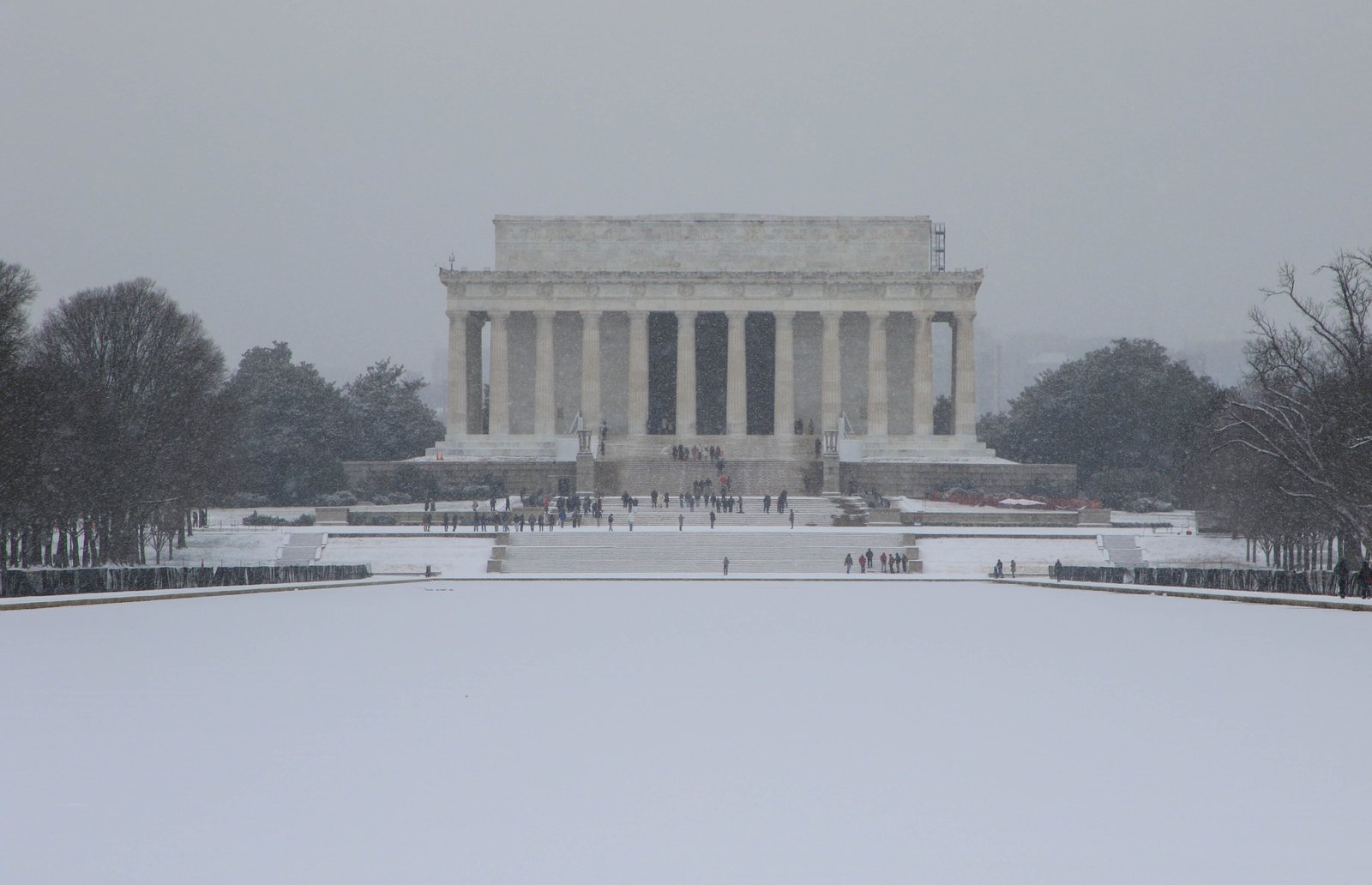
SaveThe signature image — the Washington Monument standing perfectly upright in the pool’s surface — requires still water, and still water requires no wind. The window is narrow: typically 30 to 60 minutes before sunrise, during astronomical or nautical twilight, when the air is coldest, thermals are suppressed, and DC’s notorious afternoon wind has not yet started. This is not a shot you’ll land at noon on a summer Saturday. It’s a shot you’ll land at 5:15 a.m. on a calm, clear Tuesday in October.
Position yourself at the west end of the pool, between the pool’s edge and the Lincoln Memorial steps. The obelisk of the Washington Monument sits directly on the eastern axis at approximately 4,600 feet. A 24–35mm full-frame equivalent focal length captures both the full obelisk reflection and enough pool foreground to make the symmetry land. Set up the tripod low — 8 to 12 inches off the ground — to maximize the reflection’s apparent size relative to the monument. A cable release or 2-second timer eliminates mirror slap vibration. Expose for the sky (typically ISO 200–400, f/8, 2–8 seconds depending on twilight stage) and let the darker water land as the base.
The blue hour sky gradient behind the monument provides the background color that separates this shot from a midday frame. Pink and gold appear in the 10–15 minutes around actual sunrise; blue persists for 20–30 minutes before that. Both are workable. Neither lasts.
Lincoln Memorial from the east end at sunset
 Save
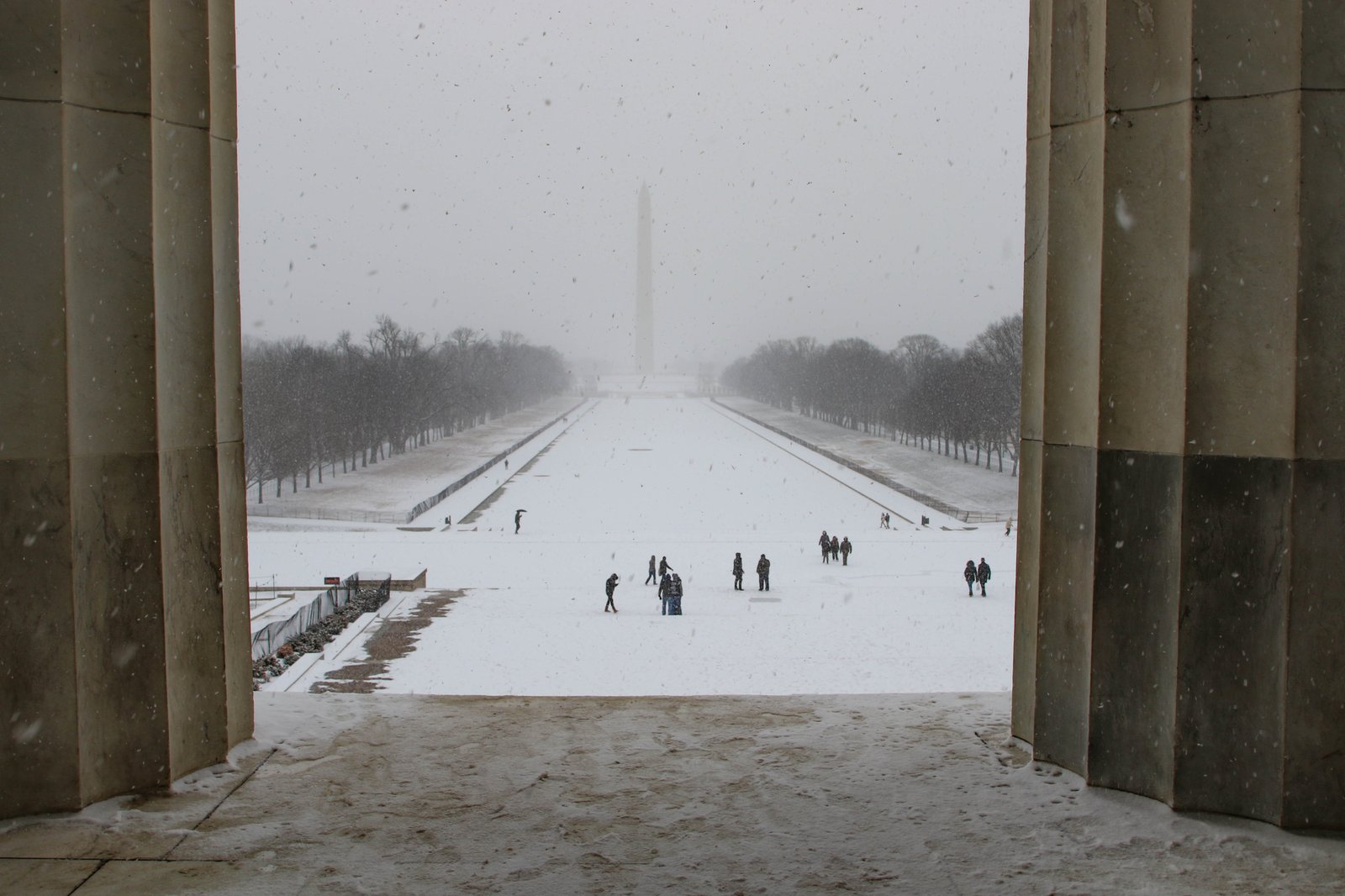
SavePosition yourself at the east end of the pool, near the World War II Memorial, and shoot west toward the Lincoln Memorial as the sun sets to the southwest. The Memorial’s exterior is floodlit at night, but the real window is the 20 minutes before and after sunset when the ambient light and the building’s stone match in temperature — warm gold on white marble, with the columned facade still fully readable. A 35–50mm frame from this end gets the full Memorial across the length of the pool; a 70–85mm compresses the pool’s apparent length and stacks the Memorial larger against the sky.
This composition is more forgiving of ripples because you’re shooting into the light and the reflection is secondary — the drama is in the sky behind the building. Overcast days actually work well here: a flat white sky turns the Memorial into a silhouette study, and an approaching storm to the west can produce cloud gradients that no filter replicates.
Washington Monument from the west end at sunrise
 Save
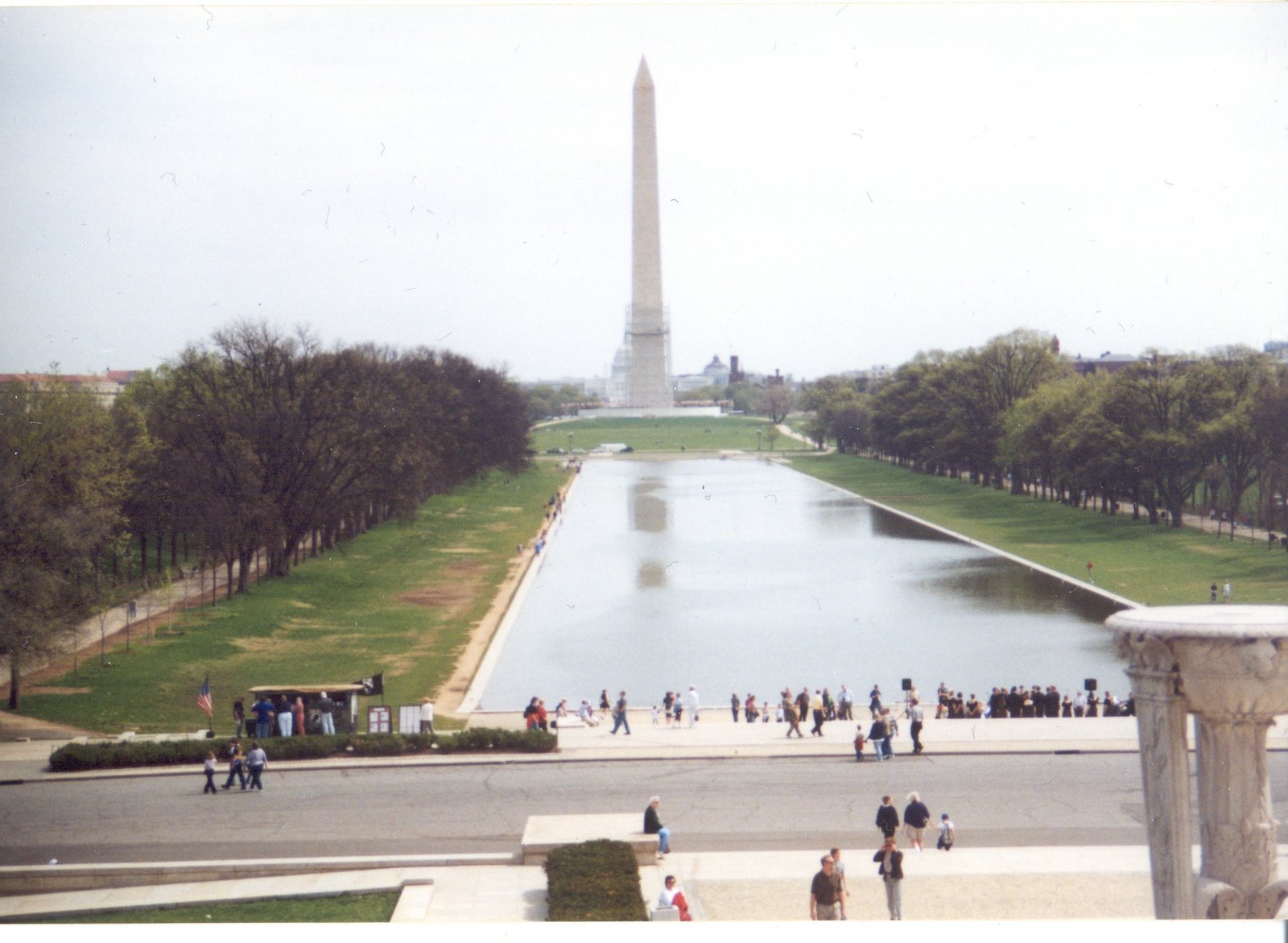
SaveThis is the inverse of the sunset shot: standing at the west end, shooting east toward the Monument as the sun rises behind and to the right of it. The obelisk catches direct light on its eastern face beginning about 20 minutes after sunrise. During spring and fall, the sun rises approximately northeast, which means the pool’s surface is side-lit — producing textured reflections with more dimensionality than the flat pre-dawn mirror shot. Golden-hour frames from this position benefit enormously from an ND grad to pull the sky down and protect pool surface detail. A polarizer at a 30–45° angle to the water surface cuts glare selectively; rotating it toward maximum polarization kills the reflection entirely, which is useful if you’re after pool texture rather than sky mirror.
Understanding landscape photography lighting principles — specifically how the angle of incidence changes with the sun’s azimuth — will help you predict which end of the pool catches the most reflection at any given date. Tools like PhotoPills or The Photographer’s Ephemeris let you model the exact solar azimuth at any DC date and time, so you can pre-visualize which end of the 2,030-foot pool is working before you leave home.
Cherry blossom season amplifier
The Yoshino cherries around the Tidal Basin (a 10-minute walk southwest of the Reflecting Pool’s west end) hit peak bloom — defined as 70% of blossoms open — between the last week of March and the first week of April in most years. NPS bloom data since 2004 shows peak dates ranging from March 17 (2024) to April 10 (2015). The modal window is March 20 to April 1. The Reflecting Pool itself does not have cherry trees on its banks — those are along the Tidal Basin — but the convergence of blossom season, spring light, and mild pre-dawn temperatures makes late March and early April the single most productive two-week window for the entire National Mall as a photography destination. Arrive before the cherry festival crowds (which peak on weekends, 8 a.m. to 6 p.m.) and you’ll have the pool’s walkways largely to yourself.
Tripods, permits, and the rules that actually apply
Per current NPS guidance for National Mall and Memorial Parks: park visitors documenting a visit to the park are not required to obtain a permit for a tripod. This is explicit and unambiguous. A solo photographer with a tripod shooting personal or editorial work at the Reflecting Pool does not need any permit. No paperwork, no fee, no advance notice.
The confusion in prior years stemmed from NPS language that seemed to require permits for any “still photography” that wasn’t “general visitor use.” The current published guidance clarifies the distinction: general visitor use — which includes documenting your visit with any equipment including a tripod — is explicitly exempt. The EXPLORE Act (signed January 4, 2025) further codified this at the federal level, shifting the permit trigger from commercial intent to actual impact — so individual photographers and small groups of up to five people operating normally are clearly exempt under current law.
What does require a permit: commercial photography and filming with a crew; photo workshops and commercial tours (which require a Commercial Use Authorization separate from the filming permit); any setup that uses staging equipment beyond handheld gear (dollies, cranes, external power sources); shoots that require exclusive site access or that interfere with other park visitors. The non-refundable application processing fee is $90, plus location fees starting at $50/day for still photography with 1–10 people. Apply through the NPS Division of Permits Management.
Restricted areas: Tripods are explicitly prohibited within the restricted zones of the memorials. For the Lincoln Memorial, the restriction covers above the white marble steps — meaning the interior chamber where the Lincoln statue sits is off-limits for tripods. The Reflecting Pool’s walkways on either side of the basin are open for tripod use. The World War II Memorial’s field of gold stars is also restricted for photography permits.
Drones: absolute prohibition. The National Mall sits within the FAA’s Flight Restricted Zone (FRZ), a 15-nautical-mile radius inner ring around Ronald Reagan Washington National Airport where drone operations are prohibited without specific FAA and TSA authorization. Per the FAA, the DC area is “more restricted than in any other part of the country,” with rules established after 9/11 creating national defense airspace. Additionally, the prohibited airspace designation P-56A covers the area from approximately Rock Creek Park to east of the Capitol. Violators face criminal penalties. No exceptions for “quick shots,” no exceptions for recreational use within the FRZ, no exceptions for small or toy drones. Do not fly.
Gear for the Reflecting Pool
Tripod: Non-negotiable. The pre-dawn mirror shot requires exposures of 2–15 seconds even at elevated ISO. A carbon-fiber travel tripod saves weight on the walk from the Metro; a heavier aluminum tripod provides better stability if you’re arriving by car and can handle the extra pounds. Either way, extend only the legs you need and keep the center column at or below mid-extension. The pool walkways are paved and level, which makes center-of-gravity management easy — unlike sand or sloped terrain.
Wide-angle lens (16–35mm full-frame equivalent): The symmetry shot demands a focal length that captures the full pool width and enough sky above the Monument. A 24mm or 28mm prime gives a clean, rectilinear result; a 16–35mm zoom gives flexibility to tighten as needed. Watch for barrel distortion at the extreme wide end bowing the horizon.
ND filter (6-stop or 10-stop): Essential for daytime long exposures — specifically for smoothing any wind-caused ripple into a soft surface or for streaking thin clouds above the Monument. A 6-stop ND (64x) brings a 1/500s daytime exposure to 2 seconds; a 10-stop (1000x) to about 2 minutes. For the Reflecting Pool’s calm dawn light, a 6-stop is usually sufficient. Avoid cheap ND glass — color cast on a flat gray water surface is immediately visible. For more on controlling light with filters, see our guide to aperture and exposure control.
Circular polarizer: Useful for mid-morning and afternoon frames when you want to cut surface glare and reveal the pool’s shallow concrete bottom, or conversely, to dial reflection intensity. At dawn, polarizers are largely unnecessary because the light angle is already low.
Weather sealing: Washington DC summers are hot and humid — 80–95°F with 70–80% relative humidity from June through August. Condensation on cold glass surfaces (including the inside of filter rings) is a genuine problem when moving between air conditioning and outdoor heat. Morning dew through May and October can also coat front elements at dawn. A weather-sealed body and lens reduces risk; a lens cloth in every pocket is mandatory regardless.
Remote shutter release / intervalometer: Avoids camera shake at long exposures. Mirror lock-up (or electronic shutter on mirrorless bodies) eliminates the remaining vibration source. With a 10-second self-timer and live view, you can achieve hand-shake-free exposures on a budget.
Hazards, crowds, and what to expect on the ground
US Park Police patrol the National Mall around the clock — they are there for public safety, not to hassle photographers with tripods. Expect occasional walk-pasts and possible friendly questions about what you’re shooting. Park police presence does not authorize entry into restricted areas or into the pool basin itself (which is fenced during maintenance periods and simply off-limits the rest of the time).
Early morning joggers and cyclists use the Mall paths beginning around 5:30–6:00 a.m. on most mornings, which means foot traffic in your frame if you’re shooting the long axis of the pool. At 4:30–5:00 a.m., the paths are close to empty. If a runner cuts through the edge of your 10-second exposure, that’s a ghost — which can be removed in post or simply re-shot.
Tour buses begin staging on Henry Bacon Drive NW (the road north of the Lincoln Memorial) from roughly 7:00 a.m. onward, particularly on spring and fall weekday mornings. Groups of 40–60 people move south toward the Memorial steps and along both pool walkways from that point. If your shot plan requires clear walkways, sunrise is your deadline, not your target.
You cannot stand in the pool. The water is approximately 18–24 inches deep at the center and the concrete basin is federally protected infrastructure — entering the water is prohibited. The perimeter is wide, flat paved walkway (accessible, no barriers) on both the north and south sides of the pool. Low tripod positions on the pavement within 12–18 inches of the water’s edge work well and are the standard setup for the mirror shot.
Lincoln Memorial steps: The iconic steps leading up to the Memorial are typically open to the public and make for a dramatic elevated viewpoint looking east across the full length of the pool toward the Washington Monument. During certain events and security sweeps, the steps are roped off — July 4 is the most reliable date when this happens, with the NPS closing the steps from 6 a.m. until approximately 11 p.m.
Event closures: the dates that will ruin a trip
July 4th: The National Mall between 14th Street and the Lincoln Memorial closes at 6 a.m. for a security sweep, with screened entry beginning after 2 p.m. Road closures begin at 4 a.m. and include 23rd Street SW, Constitution Avenue NW from 23rd to 15th, and Lincoln Memorial Circle — which means driving anywhere near the site is impossible. Per NPS, the Lincoln Memorial itself, including its steps, is closed from 6 a.m. until approximately 11 p.m. Do not schedule a shoot here on the Fourth.
Marine Corps Marathon (late October, annually): The race courses through the National Mall and closes Jefferson Drive SW and Madison Drive NW from approximately 3:45 a.m. to 2:00 p.m. on race day. Parkway Drive from Rock Creek Parkway to Lincoln Circle also closes at 5:30 a.m. Check the MCM road closure page for current-year specifics.
NPS pool maintenance / draining: The pool has historically been drained for annual cleaning in early spring (typically March to April) — this is the window when the NPS scrubs algae, sediment, and addresses any infrastructure needs before refilling for the season. The 2026 renovation is a larger-than-usual maintenance cycle tied to the America 250 anniversary. In typical years, the maintenance window is shorter (2–4 weeks). The pool is refilled by late March or early April in time for cherry blossom season in most years — but this is not guaranteed, and the 2026 cycle demonstrates that extended closures do happen.
Logistics
Restrooms: Portable restrooms are available near the Lincoln Memorial, particularly on the south walkway near the Korean War Veterans Memorial. The World War II Memorial visitor facilities at the east end of the pool are the nearest permanent facilities. Plan accordingly for 4 a.m. arrival.
Food and water: Nothing is open before 7 a.m. near the pool. Bring water — especially in summer. The nearest coffee options open early are on Pennsylvania Avenue NW near the Federal Triangle Metro, roughly a mile east. If you’re driving, a stop on the way in is the practical move.
Cell service: Strong throughout (Verizon, AT&T, T-Mobile all have good DC coverage). This matters for weather app checks — a calm-wind forecast that deteriorates by 10 a.m. means your mirror-shot window is exactly as long as the stillness holds.
Accessibility: The pool walkways on both sides are paved and fully accessible. The Lincoln Memorial steps require climbing; the accessible ramp runs along the south side of the building. The World War II Memorial and its surrounding plaza are accessible at grade.
Coordinates: 38.8893° N, 77.0501° W. The center of the Reflecting Pool — set that as your navigation target and you’ll arrive mid-pool, from which both ends are roughly 1,000 feet in either direction.
More photography spots in this area
Gear Blueprint: What to Pack for This Shoot
The Lincoln Memorial shot is about symmetry: Washington Monument + reflection. You’re shooting from the east end of the pool at blue hour. Crowds, security restrictions on large tripods, and a long focal length flexibility are the main constraints.
- Compact travel tripod (under 60in) — Park Service permits restrict full-size tripods in some seasons. A travel-sized rig keeps you flexible.
- Wide zoom (16-35mm) — You need 24-35mm range to balance the Monument and pool symmetry.
- Standard prime (35mm or 50mm) — Lower-light blue-hour walking shots when you have to break down the tripod.
- Polarizer (CPL) — Cuts reflection glare off the pool — but use it carefully here, you usually WANT the reflection.
- Intervalometer — For 30s+ exposures during full blue hour.
- Lens hood — Streetlights and security floodlights cause heavy flaring.
- Microfiber cloth — DC humidity fogs your front element constantly in summer.
Affiliate disclosure: links above go to Amazon. We may earn a small commission at no extra cost to you. We only recommend gear we’d take ourselves to this specific location.