For the underlying mechanics behind every choice below, our aperture photography guide is the fastest way to get fluent.
Wake up, grab your coffee, and let’s get into it. It’s Tuesday, May 12, 2026, and the world of videography is moving faster than a 120fps slow-motion shot. If you aren't paying attention, you're falling behind. Between new AI-integrated sensors and software updates that make old-school color grading look like a chore, there is a lot to unpack this morning.
In this guide, we’re breaking down the essential news every videographer needs to know to stay competitive. Whether you’re shooting weddings, high-end commercial work, or just trying to figure out how to master manual mode and stop fearing your camera, this is your roadmap for today.
The Big Story: Sony’s New Sensor Tech is Game-Changing
The rumors were true. This morning, Sony officially announced their latest global shutter sensor designed specifically for the mid-range market. This is huge because global shutter technology: which eliminates rolling shutter distortion: has traditionally been reserved for high-end cinema rigs like the Venice or the A9 III.
By bringing this to a more accessible body, Sony is effectively killing the "jello effect" for sports and action videographers on a budget. If you’ve ever had a shot ruined by weird warping during a fast pan, those days are numbered. For those of you wondering how to choose the best mirrorless cameras for your 2026 kit, this release just made your decision a lot harder.
The integration of AI into these sensors is also stepping up. We aren't just talking about autofocus anymore; we're talking about real-time subject isolation and lighting correction before the data even hits the memory card. It’s why everyone is talking about AI-powered mirrorless tech, and quite frankly, if you aren't paying attention to it, you're going to be working twice as hard as everyone else for the same result.

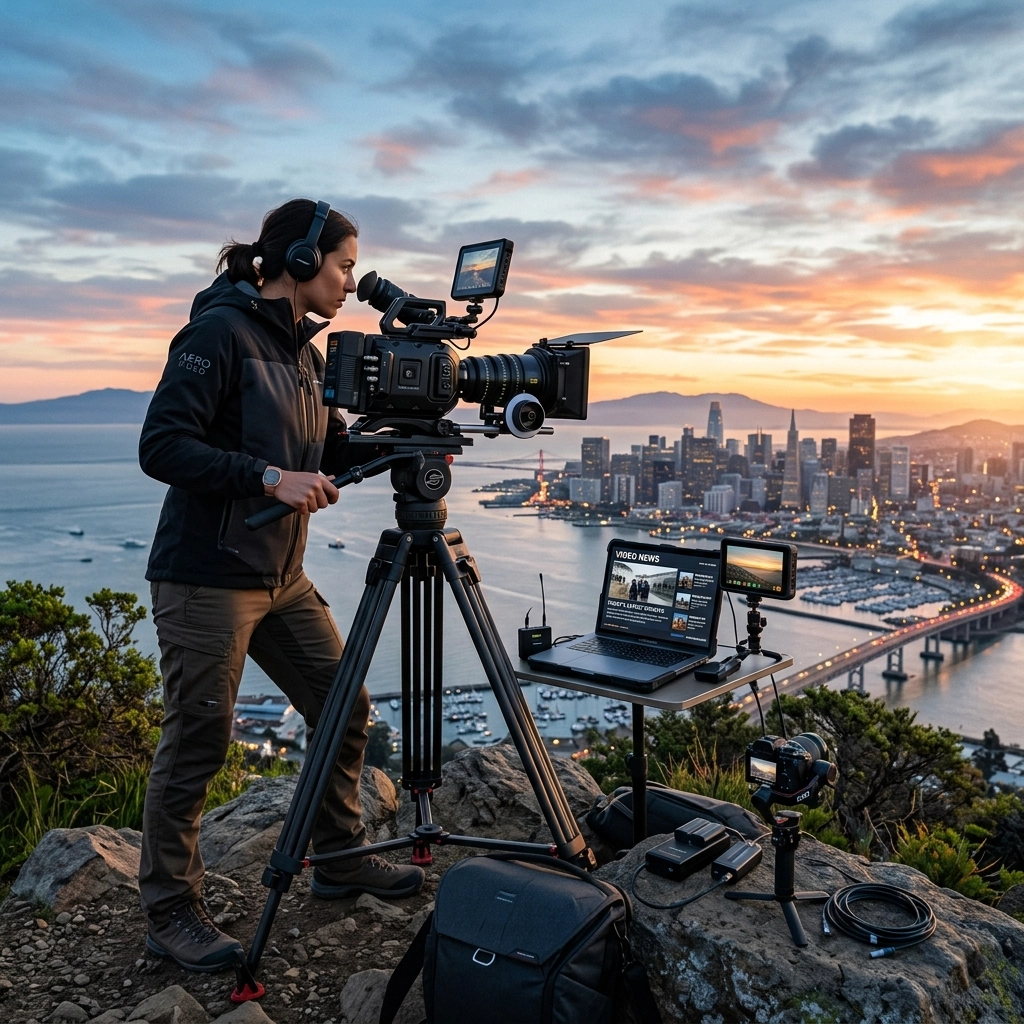
Alt Text: A professional videographer filming an urban sunset using a high-end mirrorless camera with a global shutter sensor on a modern gimbal.
Software Wars: The AI Edit is Here
Post-production is currently undergoing its biggest shift since the move from film to digital. This morning, Adobe and Blackmagic both dropped updates that lean heavily into generative fill for video.
Imagine you’re filming a corporate interview and there’s an ugly fire exit sign in the background. In the past, you’d spend an hour masking and tracking. Now? You just circle it, tell the AI to "remove and replace with wall texture," and it’s done. This level of efficiency is what separates the pros from the hobbyists in 2026.
If you’re still doing things the manual way, you're losing money. Speed is everything. Even if you're primarily a photographer moving into video, tools like Luminar have been leading the charge in AI-based enhancements for years. Seeing these features migrate into the video timeline is a natural evolution. For those who want to master the basics of editing and light before diving into AI, I highly recommend checking out these tips on mastering light.
Canon’s Secret Firmware Update
Canon released a surprise firmware update for the R5 series early this morning. While they didn't shout it from the rooftops, the patch notes reveal a significant increase in thermal management efficiency. For years, the "overheating" ghost has haunted the R5. This 2026 update essentially unlocks higher bitrates for longer durations without the dreaded red thermometer icon appearing on your screen.
If you are a Canon shooter, stop what you’re doing and update your firmware now. It’s a free upgrade that essentially gives you a "new" camera. This kind of tech support is why people stay loyal to brands. If you're new to the Canon ecosystem, make sure you don't make the common mistakes you're making with manual mode while testing out these new features.
Alt Text: Close-up of a modern mirrorless camera screen showing a firmware update progress bar in a professional studio setting.
The State of Mobile Videography in 2026
It’s no longer "just a phone." The latest mobile releases announced this week are featuring 1-inch sensors as a standard. For street videographers and those who prefer a "run and gun" style, the gap between a smartphone and a dedicated mirrorless camera is closing.
I spent some time this morning looking at the new footage coming out of the latest Apple and Samsung flagship devices. The dynamic range is staggering. For anyone doing street photography, incorporating a high-end phone into your workflow for "b-roll" or social media snippets is now a necessity, not an option.
However, don't let the gear fool you. You still need to understand the fundamentals. If you don't know the 7 mistakes you’re making with natural light portraits, a $2,000 phone won't save your footage. The gear gets better, but the eye stays the same.
Why You Should Care About AI Photography News
You might think, "I'm a videographer, why do I care about photography news?" Because the two are merging. The computational photography we see today is the cinematic video of tomorrow. We’ve written before about why everyone is talking about AI photography news, and the logic holds up for video too.
AI isn't here to take your job; it's here to take the boring parts of your job. It’s here to handle the noise reduction, the upscaling, and the color matching. Your job is to tell the story. If you're struggling to keep up with the technical side, take a step back and revisit Photography 101. Mastering the basics of your first camera is the only way to truly understand how to use the high-tech stuff.
Alt Text: An AI-generated visualization of a futuristic video editing suite with holographic displays and AI-assisted color grading tools.
Lighting Trends: Beyond the Softbox
The morning news from the lighting world is all about "smart LED" integration. Companies like Aputure and Nanlite are releasing fixtures that can sync directly with your camera's metadata. This means your lights can automatically adjust their color temperature to match the white balance set on your camera, or even mimic the flickering of a monitor that is being filmed in real-time.
For those of you doing professional corporate headshots or corporate video interviews, this level of automation is a life-saver. No more running back and forth between the talent and the light stand. You can control everything from an iPad, or better yet, let the camera talk to the lights for you.
If you're still struggling with lighting basics, check out these corporate headshot tips. The principles of good lighting never change, even when the tech does.
Landscape Videography: A New Horizon
With the release of the Sony ZV-E10 II, we’re seeing a surge in people taking video more seriously in the great outdoors. This morning, several travel vloggers released footage from the Dolomites that looks like it was shot on a RED camera, but it was actually done on a sub-$1500 setup.
The secret? Using the right settings and understanding the terrain. If you want to dive deeper into this, you can find incredible resources on PhotoGuides.org. They have been documenting the transition from stills to motion in the landscape space better than anyone else.
Alt Text: A travel videographer standing on a mountain ridge at dawn, using a compact mirrorless camera to capture cinematic landscape footage.
How to Succeed in the "New" Videography Economy
To succeed in 2026, you need to be a hybrid creator. You cannot just be "the camera guy." You need to understand editing, AI tools like Luminar, and the business side of things.
The most successful videographers right now are those who treat their craft like a business. They are constantly learning. They are following daily photography tutorials because they know that a tip about lighting a portrait can easily be applied to lighting a film scene.
If you're looking for a structured way to level up, I can't recommend Shut Your Aperture's learning portal enough. It’s where we dump all the knowledge we've gained from years in the field.
Audio is Still 50% of the Video
The news wouldn't be complete without a nod to audio. This morning, Rode announced a new wireless mic system that features 32-bit float recording in a form factor the size of a postage stamp. If you don't know what 32-bit float is, it basically means it's impossible to "clip" your audio. You can record a whisper and a jet engine on the same setting and fix it all in post.
This is a safety net that every videographer should have. Bad video with good audio is a "style." Good video with bad audio is "unwatchable." Keep that in mind next time you're tempted to spend your last $500 on a new lens instead of a decent microphone.
Industry Trends: The Rise of Vertical Cinema
I know, I know. Purists hate it. But the morning data is clear: vertical video consumption is up another 15% this year. Studios are now starting to shoot "vertical first" for major ad campaigns. This requires a different way of thinking about composition and framing.
If you've spent your whole life shooting 16:9, it’s time to start practicing your vertical compositions. Look at portrait photography techniques for inspiration. Many of the same rules for framing a tall subject in a still photo apply to framing a vertical video.
Final Thoughts on Today's News
The takeaway from this morning’s news is simple: adapt or get left behind. The tools are getting smarter, the cameras are getting smaller, and the audience is getting more demanding.
- Update your firmware.
- Embrace the AI tools (don't fear them).
- Focus on the fundamentals of light and sound.
- Keep shooting every single day.
For more deep dives into gear and technique, keep an eye on blog.edinchavez.com and the incredible fine art work over at edinfineart.com. Both are great places to see how these high-end concepts are applied in the real world.
Alt Text: A modern, minimalist workspace of a videographer with two monitors, an editing controller, and a camera body on a wooden desk.
The world of videography is a wild ride, but if you keep your head down and keep learning, there’s no reason you can’t be at the top of your game. Now, quit reading and go shoot something.
Stay creative, stay curious, and keep that aperture open (metaphorically speaking, of course). If you're ever feeling stuck, just remember why you started in the first place: to tell stories that matter. The tech is just a tool. You are the artist.
Don't forget to head over to learn.shutyouraperture.com for our latest deep-dive courses that will help you turn these news updates into actionable skills. See you on the next shoot.